

Marketing for Business Coaches: The Complete Strategy Guide
Why 90% of Business Coaches Are Terrible at Marketing
Getting marketing for business coaches right is one of the highest-leverage moves you can make. I’ve watched it happen over and over again. Brilliant business coaches who can transform companies and careers, sitting in their home office at 2 PM wondering where their next client will come from. They’re incredible at what they do, but their marketing? It’s a mess.
📋 Table of Contents
Here’s the brutal truth: being a great coach doesn’t make you a great marketer. The skills that make you exceptional at strategy, leadership development, and organizational transformation are completely different from the skills that fill your pipeline with qualified leads.
Most coaches make the same mistakes. They post inspirational quotes on LinkedIn hoping someone will book a discovery call. They attend networking events and hand out business cards. They write generic blog posts about “5 Tips for Better Leadership” that nobody reads. Then they wonder why they’re stuck at $8K-15K months instead of the six-figure consistency they deserve.
I’m going to show you exactly how to fix this. Over the last 12 years, we’ve helped 400+ clients build marketing systems that work, including dozens of business coaches who’ve gone from feast-or-famine to predictable six-figure revenue. Here’s the complete playbook.
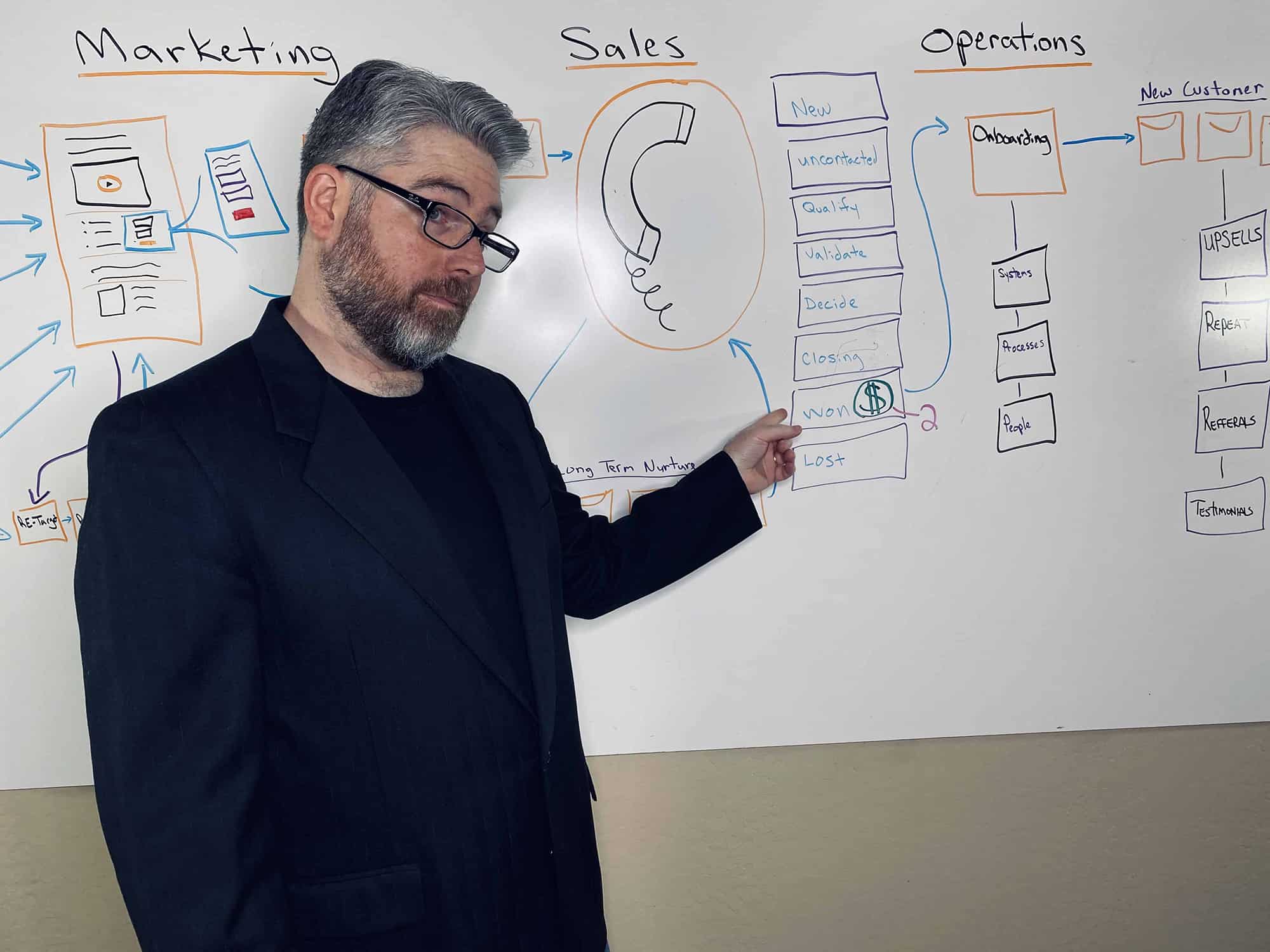
The Three-Layer Marketing System Every Business Coach Needs
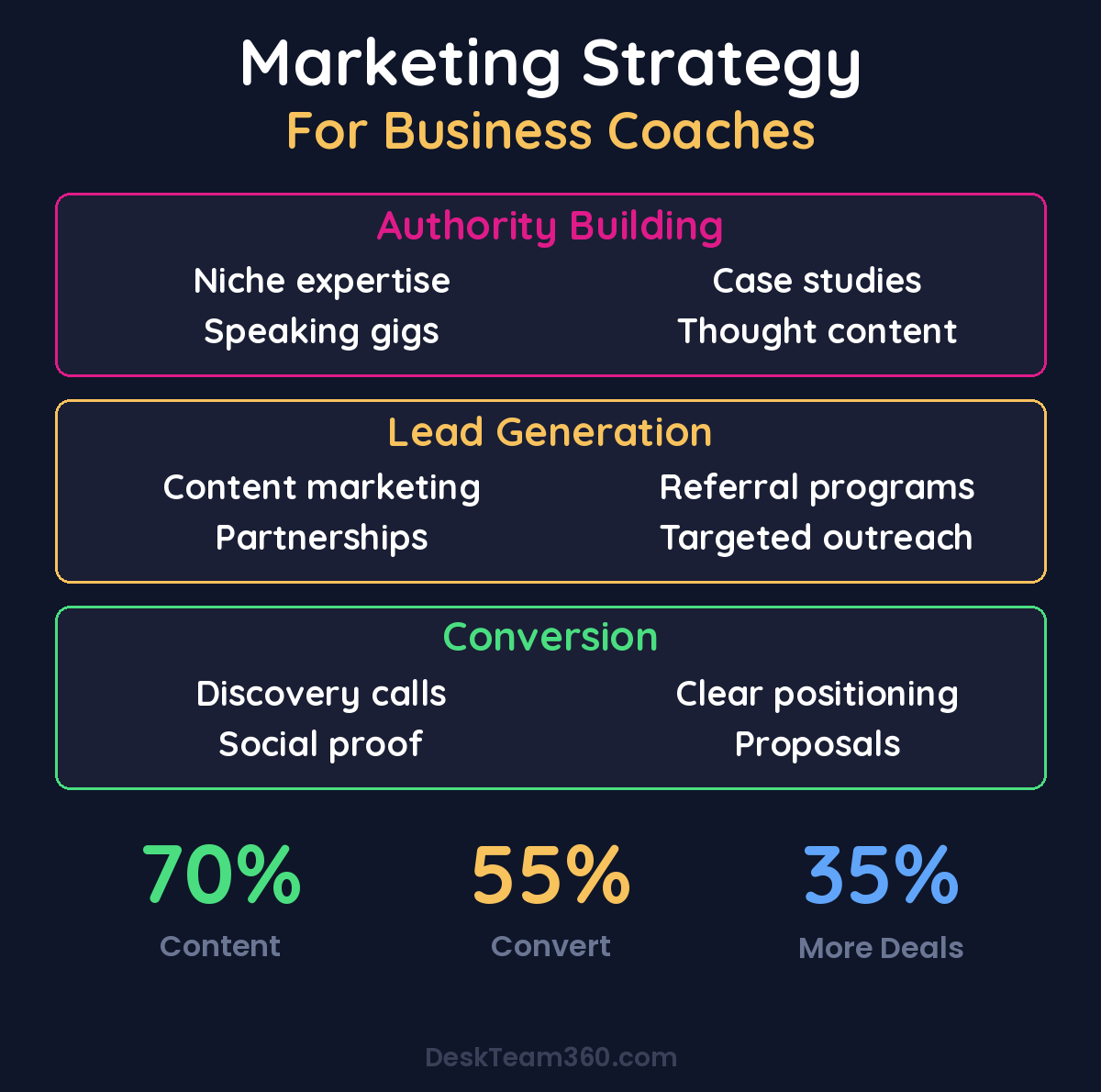
Successful coach marketing isn’t about posting more content or buying more ads. It’s about building a system with three distinct layers that work together to attract, nurture, and convert your ideal clients.
Most coaches try to jump straight to selling without building trust first. That’s why their LinkedIn outreach gets ignored and their webinars convert at 2%. Trust comes before transactions, always.
Layer 1: Authority Building
You can’t sell coaching to people who don’t believe you can solve their problems. Authority building proves you understand their world better than they do. This means creating content that demonstrates deep expertise, sharing specific case studies and results, speaking at industry events or podcasts, and establishing yourself as the go-to expert for your niche.
Here’s what doesn’t work: generic business advice that every other coach is already saying. “Communication is important for leadership” isn’t insight, it’s filler. What works is specific, contrarian perspectives backed by real results. “Why your open-door policy is destroying productivity and the three-question framework that fixes it” gets attention because it’s specific and challenges conventional thinking.
Layer 2: Lead Generation
Once you’ve established authority, you need systematic ways to capture and nurture interested prospects. This includes content marketing that educates your ideal client, speaking engagements at industry conferences, strategic partnerships with complementary service providers, referral programs that incentivize existing clients, and yes, paid advertising when done correctly.
The key word here is “systematic.” Random acts of marketing don’t build businesses. You need predictable ways to generate leads every month, not just when you feel like posting something inspirational.
Layer 3: Conversion
This is where most coaches fail hardest. They get leads but can’t convert them into paying clients. Effective conversion requires a structured sales process, usually starting with a low-stakes assessment or strategy call, clear positioning that differentiates you from every other “business coach,” proof points that demonstrate real results, and a compelling proposal process that makes the next steps obvious.
Pro tip: Track everything. How many discovery calls did you book? How many converted to proposals? How many proposals closed? Most coaches have no idea where their process breaks down, so they can’t fix it. You can’t improve what you don’t measure.
Free 5-Minute Video
See How DeskTeam360 Works in Under 5 Minutes
Watch the short video and see exactly how we handle design, development, and marketing implementation — so you don't have to.
Watch the Video →
Content Marketing That Actually Converts
Let’s get specific about content, because this is where I see the most wasted effort. Coaches spend hours writing blog posts, recording videos, and creating LinkedIn content that generates zero business results.
The 70-20-10 Content Rule
Here’s how to allocate your content creation time for maximum impact. 70% should be educational content that solves specific problems your ideal clients face right now. Not fluffy motivational content, but tactical advice they can implement immediately. 20% should be behind-the-scenes content showing your process, your results, and your expertise in action. Case studies, client wins, methodology breakdowns. 10% should be promotional content about your services, programs, and how to work with you.
Most coaches flip this. They create 70% inspirational quotes and 30% “hire me” posts. Then they wonder why their content gets likes but doesn’t generate business.
Platform Strategy That Makes Sense
You don’t need to be everywhere, you need to be excellent somewhere. For business coaches, LinkedIn is usually the highest-ROI platform because that’s where executives and business owners spend their time. YouTube works if you can consistently create valuable, searchable content. Industry publications and podcasts often convert better than social media.
Pick one primary platform and one secondary platform. Master those before expanding. I’ve seen coaches burn out trying to maintain presence on LinkedIn, Instagram, TikTok, YouTube, and their blog simultaneously. They end up mediocre everywhere instead of excellent somewhere.
The Discovery Call Framework That Closes
Most coaches treat discovery calls like friendly chats. Big mistake. A discovery call is a structured sales conversation with a clear objective: determine if there’s a fit and, if so, move to a proposal.
The Five-Part Structure
Start with context setting. Confirm the agenda, timeline, and what you both hope to accomplish. Then move to situation analysis. What’s working? What’s not? What’s the cost of inaction? This is where you demonstrate expertise by asking better questions than they’ve heard before.
Next, dive into the problem definition. Help them articulate the real challenge, not just the symptoms. This is consultative selling at its best. Follow with impact discussion. What happens if this doesn’t get solved? What’s possible if it does? Paint the picture of both scenarios.
Finally, discuss next steps. If there’s a fit, what would working together look like? If not, what other resources might help them? Always end with a clear next step, never with “I’ll send you some information.”
Watch out: Don’t give away the entire solution on the discovery call. Your job is to diagnose the problem and demonstrate you understand it, not to solve it for free. Save the detailed solutions for paying clients.
Pricing and Packaging That Positions You as Premium
Here’s where most coaches sabotage themselves before they even start. They price their services based on what they think the market can afford, or what other coaches in their Facebook group are charging. Wrong approach entirely.
Value-Based Pricing Fundamentals
Your pricing should reflect the transformation you deliver, not the time you spend delivering it. If your coaching helps a CEO increase revenue by $500K, your fee should be a percentage of that value, not $150 per hour because that’s what you used to charge as a consultant.
Package your services around outcomes, not time. “Six-month executive transformation program” sounds more valuable than “12 one-hour coaching sessions.” The packaging implies a comprehensive system, not just conversation time.
The Three-Tier Strategy
Always present three options: good, better, best. This gives prospects choice while anchoring them to your premium option. Your entry-level package should solve a specific problem. Your mid-tier should include additional support or access. Your premium should be comprehensive transformation with maximum support.
Price them so the middle option is obviously the best value. Most people won’t choose the cheapest or most expensive option, they’ll choose the one that feels like the smart middle ground.
Coaches who offer three-tier pricing see 35% higher average deal size compared to those offering single packages.
Speaking and Networking Strategy
In-person networking events are often low-ROI for coaches, but strategic speaking can be incredibly powerful. Instead of working the room at generic Chamber of Commerce events, focus on speaking at industry conferences where your ideal clients gather.
The Speaking Funnel
Start local. Offer to speak at industry meetups, association chapters, and corporate lunch-and-learns. Build a reputation and collect video testimonials. Use those to book bigger stages at regional conferences. Document those successes to land national speaking opportunities.
Always have a clear call-to-action. “If you’d like the framework I just shared, visit my website to download the implementation guide” works better than “here’s my business card if you want to chat.” Drive people to a specific next step where you can capture their contact information and continue the relationship.
Partnership and Referral Systems
The fastest way to scale your coaching business is through other people’s networks. Strategic partnerships with complementary service providers can generate more qualified leads than months of content marketing.
Identifying Partnership Opportunities
Look for professionals who serve the same clients but don’t compete with your services. Management consultants, executive search firms, business attorneys, and accounting firms all work with the same executives who need leadership coaching. Marketing agencies and IT consultants work with business owners who might need operational coaching.
The key is reciprocity. What can you offer their clients that adds value to their relationship? Maybe you provide a leadership assessment for their consulting engagements, or they refer their clients to your productivity workshop. Make the partnership valuable for everyone involved.
Measuring What Matters
Most coaches track vanity metrics like followers and post engagement. Those don’t pay the bills. Here’s what actually matters for building a sustainable coaching practice.
Lead Generation Metrics
Track how many qualified leads you generate monthly, your cost per lead across different channels, and the conversion rate from lead to discovery call. A qualified lead isn’t everyone who downloads your free guide, it’s someone who matches your ideal client profile and has a real problem you can solve.
Conversion Metrics
Monitor your discovery call to proposal conversion rate (target 50-70%), proposal to closed deal conversion rate (target 30-50%), and average deal size. If your discovery calls aren’t converting, you’re either attracting the wrong prospects or your questioning process needs work. If your proposals aren’t closing, your pricing might be wrong or you’re not clearly articulating value.
Business Health Metrics
Watch your client lifetime value, monthly recurring revenue if you have ongoing coaching arrangements, and referral rate from existing clients. Understanding how to measure marketing ROI will help you make smarter decisions about where to invest your time and money.
Common Mistakes That Kill Results
I’ve seen these patterns destroy promising coaching practices. Here’s how to avoid them.
For industry benchmarks and research, see Shopify Blog.
Trying to serve everyone. “I help businesses grow” isn’t a niche, it’s a platitude. The riches are in the niches. Pick a specific type of business owner or executive, understand their unique challenges deeply, and become known as the expert for that group.
Underestimating the sales cycle. Coaching is a high-consideration purchase. People don’t hire coaches impulsively. The decision process often takes 3-6 months from first contact to signing a contract. Your marketing needs to nurture prospects over that entire timeline, not just capture leads and hope they convert immediately.
Neglecting existing clients. Your best source of new business is your current clients. They refer colleagues, extend engagements, and hire you for new projects. Yet most coaches spend 90% of their marketing effort on new lead generation and 10% on client success and expansion. Flip that ratio.
Pro tip: Create a systematic follow-up process for completed clients. Quarterly check-ins, relevant article shares, and invitations to exclusive events keep you top-of-mind when they or their network need coaching services again.
Technology Stack for Efficiency
You don’t need expensive marketing automation platforms, but you do need systems that prevent leads from falling through the cracks. A CRM to track all interactions and follow-ups, email marketing platform for nurturing sequences, calendar scheduling tool for frictionless booking, and basic analytics to track what’s working.
Keep it simple early on. I’ve seen coaches spend months configuring complex marketing automation systems instead of having conversations with prospects. The best system is the one you’ll actually use consistently.
Building Your Marketing Calendar
Consistency beats perfection in marketing. Better to post valuable content twice a week for a year than to post daily for a month and then disappear. Build a sustainable rhythm that you can maintain long-term.
Plan your content quarterly around industry events, seasonal business cycles, and your own program launches. Create templates for your most effective content types so you’re not starting from scratch every time. Batch similar activities, writing all your LinkedIn posts for the week on Sunday instead of scrambling daily.
The goal is predictable marketing activity that generates predictable results. Random acts of marketing might get you a client here and there, but they won’t build a scalable business.
Your Next Steps
Marketing for business coaches isn’t rocket science, but it is systematic. The coaches who succeed are the ones who treat marketing as seriously as they treat client delivery. They invest time in building authority, create systems for generating leads, and measure everything to optimize for better results.
If you’re ready to stop struggling with feast-or-famine months and start building predictable revenue, it starts with getting clear on your niche, building authority in that space, and systematically nurturing prospects until they’re ready to buy. Our approach to reducing website bounce rates applies to coach websites too, the faster you build trust, the more likely visitors become leads.
At DeskTeam360, we’ve helped dozens of business coaches implement these systems, from content strategy to lead nurturing to conversion optimization. We handle the marketing execution so you can focus on what you do best: transforming businesses and careers.
Free Tool
How Much Is Freelancer Management Really Costing You?
Most agency owners have never done this math. Plug in a few numbers and see your real cost in 2 minutes.
Calculate Your Hidden Costs →