


Marketing Implementation for Online Service Providers: A Practical Guide
You’re Great at Serving Clients — But Terrible at Marketing Yourself
Let’s talk about marketing implementation for online service providers. Let’s be honest. If you’re an online service provider — web developer, copywriter, bookkeeper, virtual assistant, social media manager, SEO specialist, or any other service-based business — you’re probably world-class at what you do for clients and absolutely awful at doing it for yourself.
📋 Table of Contents
The cobbler’s children have no shoes. The web designer’s website hasn’t been updated since 2021. The social media manager’s LinkedIn profile has tumbleweeds blowing through it.
I get it. After 12+ years running agencies and managing 400+ clients, I know this pain intimately. Client work always takes priority over your own marketing. There are always deadlines to meet, projects to deliver, and fires to put out. Marketing yourself gets pushed to “next week” — and next week never comes.
But here’s the thing: inconsistent marketing creates an inconsistent pipeline. And an inconsistent pipeline means feast-or-famine revenue cycles that stress you out and limit your growth. Let’s fix that. Here’s how to systematize your marketing so it actually gets done — even when you’re buried in client work.
Why Service Providers Suck at Their Own Marketing
Before we fix the problem, let’s understand it. There are three core reasons service providers don’t market themselves consistently, and they’re all completely predictable.
Client Work Always Wins the Tug of War
When you have to choose between spending an hour on a client deliverable that you’re getting paid for right now and an hour on a blog post that might bring in a lead in three months, the client work wins every single time. It’s rational — but it’s also how you end up on the revenue roller coaster.
This is the fundamental problem: short-term revenue pressure kills long-term marketing investment. You can’t grow a sustainable business if your marketing starts and stops based on how busy you are with client work.
You Know Too Much About Marketing
Paradoxically, knowing how marketing should be done makes it harder to do your own. A web designer won’t publish a website that’s “good enough” — it has to be perfect. A copywriter agonizes over their own headlines in ways they’d never do for a client. Perfectionism paralysis is real, and it’s killing your momentum.
I’ve watched talented service providers spend six months “perfecting” their LinkedIn strategy while their pipeline slowly emptied. Done is better than perfect, especially when perfect never ships.
Watch out: The perfectionist trap kills more service provider marketing than lack of time. Your audience needs to see your expertise more than they need to see your perfection. Ship it.
You Don’t Have a System
You have systems for client onboarding, project management, and invoicing. But do you have a marketing system? A documented process that spells out what gets published, when, where, and by whom? Most service providers don’t — and that’s why their marketing is reactive instead of proactive.
Without a system, marketing becomes a side project that depends on motivation. With a system, it becomes part of your business operations that happens regardless of how you feel about it.
Free Tool
How Much Is Freelancer Management Really Costing You?
Most agency owners have never done this math. Plug in a few numbers and see your real cost in 2 minutes.
Calculate Your Hidden Costs →
Building a Marketing System That Runs Without You
The goal isn’t to spend more time on marketing. It’s to build a system where marketing happens consistently whether you’re busy with clients or not. Here’s exactly how to do it.
For more on this, check out our guide on ai marketing tools: the complete guide for 2026.
Step 1: Define Your Marketing Minimum Viable Output
What’s the smallest amount of marketing that will keep your pipeline healthy? For most service providers, it’s one blog post per month targeting a keyword your ideal clients search for, three to five social media posts per week on LinkedIn for B2B or Instagram for B2C, one email to your list per week or biweekly at minimum, and one case study per quarter documenting a great client result.
That’s it. Not 20 blog posts, 5 platforms, and a daily podcast. Just the minimum that keeps you visible and your pipeline flowing. Our guide on creating a content calendar covers the fundamentals of mapping this out systematically.
Step 2: Batch Your Content Creation
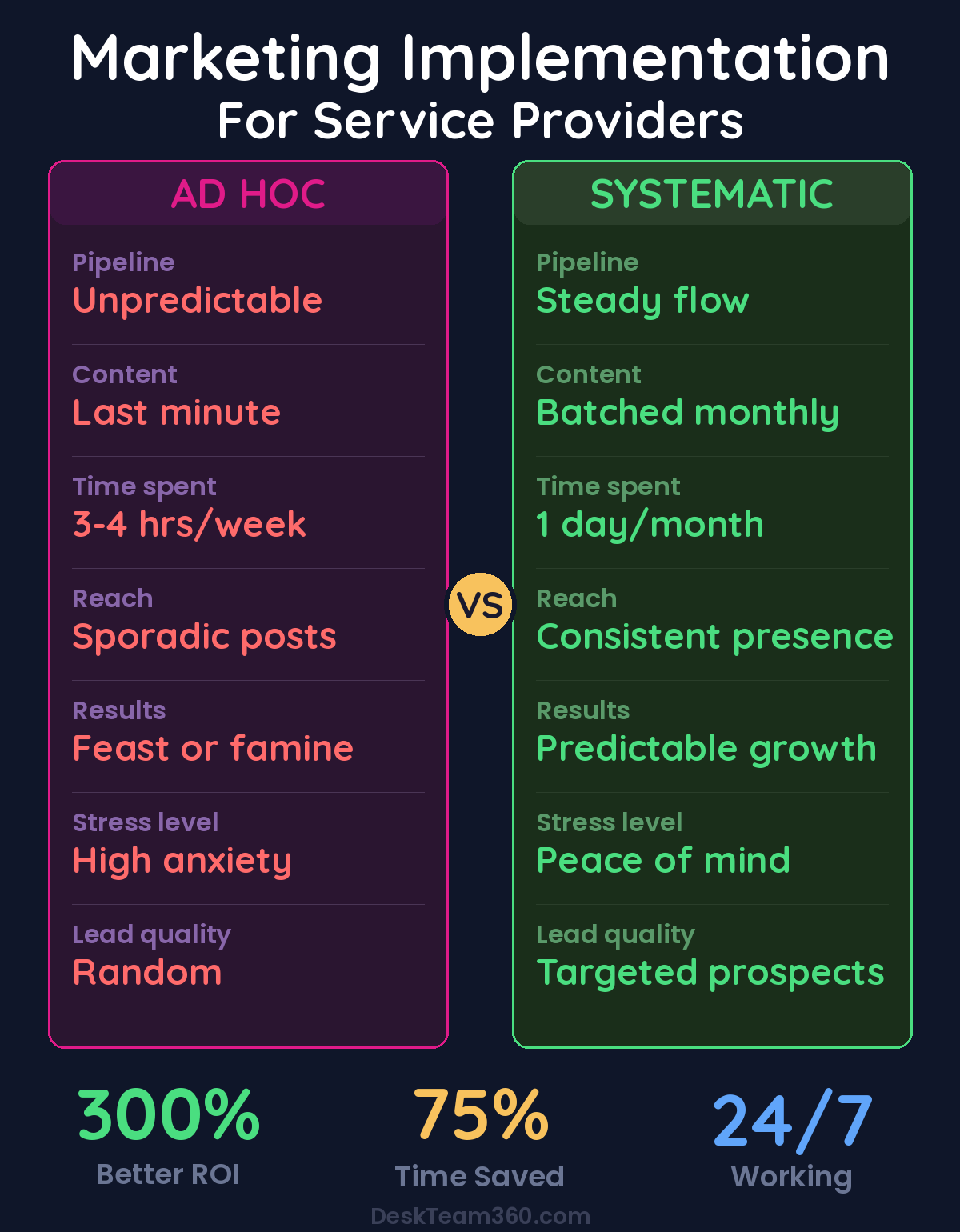
Stop trying to create content in real-time. Instead, dedicate one day per month to batching everything. In the morning, write or outline your monthly blog post. At midday, draft 15 to 20 social media posts for the month. In the afternoon, write four email newsletters.
One day of focused work gives you an entire month of content. Schedule everything using Buffer, Later, or your email platform’s scheduler. Then forget about it and focus on client work. This approach eliminates the daily “what should I post today” decision fatigue that kills consistency.
Pro tip: Block your batching day on your calendar like it’s a client project. Treat it with the same importance as paid work. Your future self will thank you when leads start flowing in consistently.
Step 3: Create Templates and Systems
Document your marketing processes so they can be repeated by you or someone else. Build a blog post template with standard structure, SEO checklist, and publishing process. Create social media templates with branded graphics that you can swap text into. Develop an email template with consistent format that only needs the core content changed. Design a case study template with standard questions and format for documenting wins.
Templates eliminate decision fatigue. You’re not staring at a blank page wondering what to create — you’re filling in a framework. This is also essential for delegating tasks effectively when you’re ready to hand things off.
Step 4: Outsource the Production Work
Here’s the game-changer: you don’t have to do any of the production work yourself. What you keep is strategy, voice, and expertise. You write the first draft of the blog post. You approve the social media captions. You share the client results for case studies. This is the stuff that requires your brain.
What you outsource is everything else: graphic design for social media posts, lead magnets, and presentations; website updates and landing page design; video editing for client testimonials and social content; email template design and formatting; blog post formatting, image sourcing, and publishing.
The production work is what eats your time. It’s also the easiest to outsource because it doesn’t require your expertise — it requires design and technical skills. A marketing team as a service gives you access to designers, developers, and video editors for a flat monthly rate. You submit requests, they produce the assets, you review and publish. Simple.
The Marketing Channels That Actually Work for Service Providers
Not all marketing channels are created equal. I’ve tested everything over 12+ years, and here’s what actually moves the needle for online service providers.
Related: Digital Marketing for Construction Companies: The Complete Guide.
LinkedIn (The #1 Channel for B2B Service Providers)
If your clients are businesses, LinkedIn is your primary marketing channel. Period. Everything else is secondary.
What works on LinkedIn for service providers: process posts that show how you approach problems, your methodology, your thinking; before and after posts with visual transformations of client work with permission; lesson posts structured as “here’s what I learned from this specific situation”; tool and resource posts where you share useful tools with your honest take on them; and client win posts that celebrate results without being salesy.
Post three to five times per week and spend 15 minutes daily engaging with others’ content. The algorithm rewards consistency and engagement, but more importantly, your prospects see you as an active expert in your field.
SEO and Blog Content
Blog content is the most underrated channel for service providers because it compounds. Write articles targeting the questions your ideal clients ask before they hire you: “How much does your service cost?”, “How to choose a service provider like you”, “Your service versus DIY — what’s better?”, and “Signs you need to outsource your service.”
Every article that ranks is a 24/7 lead generation machine. And unlike social media, SEO compounds — a blog post written today can generate leads for years. Start with solid keyword research to target the right topics instead of writing about what you think is interesting.
Email Marketing
Build an email list and nurture it weekly. Your email list is the one marketing asset that no algorithm can take away from you. When Facebook changes their rules or LinkedIn throttles your reach, your email list still belongs to you.
For service providers, the best email format is a simple value-first newsletter: one useful tip or insight that takes two minutes to read, one example from your work anonymized if needed, and one soft call to action like “reply if you need help with this.” Keep it short. Keep it useful. Keep it consistent. That’s the formula.
Referral Systems
Referrals are already your number one source of clients — so systematize them. Don’t leave them to chance. Ask for referrals at project completion, the moment of peak satisfaction. Create a referral incentive like a discount, bonus service, or gift card. Build a referral partner network with complementary service providers. Make it easy by giving referring clients a link, email template, or introduction script.
Our full guide on creating a customer referral program covers the specific tactics that actually drive growth instead of just hoping referrals happen naturally.
The Portfolio and Case Study Strategy
Your portfolio is your proof, but most service providers treat it as an afterthought — a random collection of screenshots with no context. That’s a missed opportunity.
Building Case Studies That Actually Sell
For every significant project, document the client’s situation before they hired you, the challenge that made this project interesting or difficult, your approach and what you actually did to show your process, the specific and measurable results, and a client testimonial in their own words.
For more on this, check out our guide on what is white label marketing? the complete guide for agencies.
We break this down further in marketing for consultants: how to get clients without cold calling.
Organize case studies by industry, service type, or problem solved. When a prospect visits your site, they should quickly find a case study that mirrors their exact situation. This isn’t about showing off your best work — it’s about proving you can solve their specific problem.
Case studies sell more than portfolios. A prospect doesn’t just want to see what you’ve built — they want to know how you think, how you solve problems, and what results they can expect. That’s what case studies deliver.
Pricing Your Services for Marketing Growth
Marketing and pricing are inseparable for service providers. If your pricing model makes it hard to take time off for marketing, you’ll never market consistently. Consider retainer models that provide predictable monthly revenue and give you breathing room to invest in marketing. Look at productized services with fixed scope and fixed price that are easier to sell and scale. Think about value-based pricing where you charge based on the outcome, not hours, giving you more margin for marketing investment.
The more predictable your revenue, the easier it is to invest time and money in marketing. Feast-or-famine pricing creates feast-or-famine marketing, and that’s a cycle you need to break to scale.
Marketing Automation That Actually Works
The right automation tools let you maintain a consistent marketing presence with minimal daily effort. Set up social media scheduling with Buffer, Later, or Hootsuite for scheduling a month of posts. Build email automation with welcome sequences, nurture sequences, and follow-up sequences that run automatically. Create proposal and follow-up automation with automated reminders for unsigned proposals. Implement review and testimonial collection with automated requests triggered by project completion.
Set these up once and they work indefinitely. Learn more about marketing automation for small businesses that actually saves time instead of creating more work.
Service providers who use marketing automation see 300% better lead follow-up rates and 40% faster sales cycles.
The Reality Check: You Can’t Scale Without Marketing Systems
If you want to grow beyond trading hours for dollars, you need marketing systems that consistently generate leads without your daily involvement. The math is simple: inconsistent marketing equals inconsistent leads equals inconsistent revenue. Systematic marketing equals steady leads equals predictable growth.
The service providers who break through the revenue ceiling are the ones who stop treating marketing as “something I’ll do when I have time” and start treating it as a core business function — just like project delivery and invoicing. Marketing isn’t optional for growth, it’s required.
I’ve seen too many talented service providers stay stuck at the same revenue level year after year because they never built a marketing system. Don’t be one of them. The techniques in this guide work, but only if you implement them consistently.
Ready to Stop Being the Cobbler With No Shoes?
Stop being the cobbler whose children have no shoes. Build a marketing system that works whether you’re busy with clients or not. The production side — website design, social media graphics, case study layouts, email templates, landing pages — that’s exactly what we handle at DeskTeam360.
We give you access to a flat-rate creative team that handles all your marketing assets so you can focus on serving clients and growing your business. You submit requests, we produce the assets, you review and publish. It’s that simple.
Free 5-Minute Video
See How DeskTeam360 Works in Under 5 Minutes
Watch the short video and see exactly how we handle design, development, and marketing implementation — so you don't have to.
Watch the Video →