
AI Content Creation: What Works and What Doesn't in 2026
The Brutal Truth About AI Content in 2026
The rise of ai content creation is changing the game for businesses of all sizes. I’m going to tell you something that’ll probably piss off the AI evangelists: Most AI-generated content is still garbage. But the content that’s good? It’s really, really good.
📋 Table of Contents
Here’s what I’ve learned after spending the last two years knee-deep in AI content workflows, testing every tool from ChatGPT to Claude to the latest marketing automation platforms, and integrating AI into our content operations at DeskTeam360. The difference between AI content that converts and AI content that gets ignored isn’t the tool you use. It’s how you use it.
I’ve seen companies blow $50K on AI writing platforms only to produce content that reads like it was written by a committee of robots. I’ve also seen smart operators use basic AI tools to create content that outperforms anything their competitors are publishing. The gap is strategy, not technology.
Let me show you exactly what works, what doesn’t, and how to build a content operation that actually moves the needle on your business.
Where AI Content Actually Dominates
Research and First Drafts
This is where AI absolutely crushes it. The hardest part of any content project isn’t writing, it’s staring at a blank page trying to figure out where to start. AI eliminates that problem completely.
I can give Claude or ChatGPT a topic, target audience, and key points to cover, and get a well-structured 2,000-word first draft in under 10 minutes. Not a final draft, obviously. But a solid foundation with research citations, logical flow, and comprehensive coverage of the topic. That same research and outlining process used to take our writers 3-4 hours.
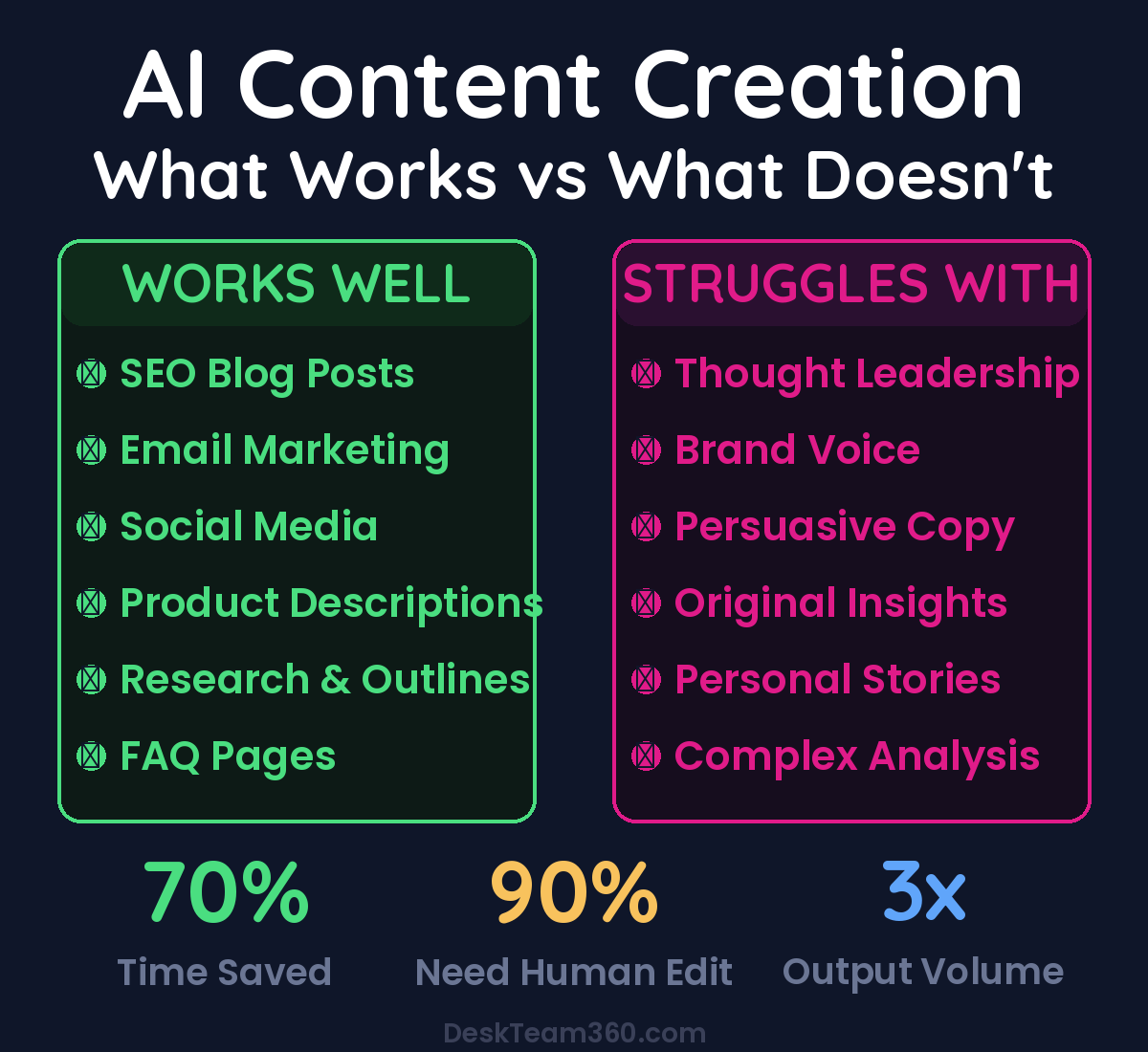
AI reduces research and first-draft time by 70-80% for most content types.
The secret is in the prompting. Don’t just say “write about email marketing.” Give it context, angle, audience, examples, and specific outcomes you want. Feed it good input, get good output. Feed it lazy prompts, get lazy content.
SEO-Optimized Content at Scale
AI was basically built for SEO content. Here’s why it works so well: it naturally integrates target keywords without the awkward stuffing that plagued early SEO writing. It covers topics comprehensively, which Google rewards. It generates clean structure and formatting automatically. And most importantly, it can produce 10 solid SEO articles in the time it takes a human to write two.
But here’s the thing most people miss about AI and SEO. The content still needs to be good. Google’s algorithms are smart enough to detect thin, auto-generated content that adds no value. If you’re using AI to pump out 50 mediocre blog posts hoping something sticks, you’re doing it wrong.
The companies winning with AI SEO are the ones using it to create genuinely helpful content faster, not more bad content at scale. Our keyword research guide still applies, AI just makes the execution faster.
Email Marketing and Social Media
Email and social are perfect AI use cases because they require massive volume and constant iteration. You need 20 subject line variations for split testing. You need to adapt one piece of content for LinkedIn, Twitter, Instagram, and Facebook. You need to respond to trending topics while they’re still relevant.
AI handles all of this effortlessly. I can take one blog post and have AI generate email versions, social posts for four platforms, subject line variations, and even response templates for common comments. The human work becomes curation and optimization, not content creation.
Pro tip: Use AI to generate 15-20 email subject line variations, then A/B test the top 3-4 that sound most human. The data will tell you which AI suggestions actually work with your audience.
Product Descriptions and Technical Documentation
For straightforward, factual content, AI often outperforms human writers. Product descriptions, feature documentation, FAQ pages, help center articles. These content types prioritize accuracy and consistency over creativity. AI delivers both at scale.
If you’re running an e-commerce business, AI can write 200 product descriptions in the time it takes to write five manually. For SaaS companies, AI can turn feature specs into user-friendly documentation faster than any technical writer. The key is feeding it accurate source information and having a human review for technical accuracy.
Free Template
The Ultimate Task Delegation Template
Stop guessing what to hand off. This template shows you exactly what to delegate, how to brief it, and how to QA the results.
Get the Free Template →
Where AI Content Falls Apart
Thought Leadership and Original Insights
This is AI’s biggest weakness and it’s not even close. Thought leadership requires original perspectives shaped by years of experience. It requires the kind of specific, detailed “I was there when this happened” storytelling that only comes from actually having done the thing.
AI can write thought leadership format. It knows the structure, the rhetorical patterns, the industry buzzwords. But the content is fundamentally hollow because it doesn’t have original experiences to synthesize. It regurgitates existing ideas from its training data. It doesn’t generate new ones.
The result is content that reads like a well-organized Wikipedia article. Informative but forgettable. No edge, no personality, no authentic perspective that makes people think “this person gets it.”
Watch out: If your thought leadership content sounds like it could have been written by anyone in your industry, it probably was written by AI. The test is simple: remove your name and company from the article. Could it be published by a competitor with minimal changes? If yes, it’s not thought leadership.
Brand Voice and Personality
AI defaults to a specific voice: slightly formal, relentlessly positive, and packed with hedge words like “it’s important to note” and “in today’s fast-paced business environment.” You know the voice I’m talking about. It’s the same voice every AI tool uses unless you specifically train it otherwise.
You can train AI on your brand voice with examples and detailed guidelines, and it gets better. But it still drifts over time. Without constant human oversight, your content gradually becomes more generic, more formulaic, and less distinctively you.
Strong brand voices are built on specific word choices, sentence rhythms, cultural references, and personality quirks that AI struggles to maintain consistently. It can approximate your voice, but it can’t embody it.
Emotional and Persuasive Copy
AI understands copywriting formulas. It can apply AIDA, PAS, and other frameworks competently. But the copy that stops a scroll, the headline that makes someone lean in, the story that creates genuine emotional connection, that’s still human territory.
AI copy converts adequately. Human copy converts exceptionally. For routine marketing assets, AI is fine. For the pages and campaigns that define your business, you want a skilled human copywriter working with AI as a research and ideation tool.
The Human-AI Workflow That Actually Works
After two years of testing every combination, here’s the workflow that consistently produces our best content. It’s not about replacing humans with AI or using AI as just a grammar checker. It’s about each doing what they do best.
Human Strategy and Planning
Humans define the content strategy monthly. What topics align with business goals? What keywords are we targeting? What’s the competitive landscape? What angles haven’t been covered? This requires business context and strategic thinking that AI can’t provide.
We also define brand voice guidelines and content standards here. AI needs specific guardrails about what to write and how to write it. The clearer your guidelines, the better your AI output. Having a solid content calendar foundation makes everything downstream smoother.
For a deeper dive, see our guide on how to create an ai-powered customer support system.
AI Research and Outline Generation
AI handles the heavy lifting of research and organization. It analyzes top-ranking content for target keywords, identifies gaps in existing coverage, generates comprehensive outlines with heading structures, and suggests internal linking opportunities. This used to take 2-3 hours per piece. Now it takes 15 minutes.
AI First Draft Creation
AI produces complete first drafts following the research and outline. The key is detailed prompting that includes brand voice examples, specific points to cover, word count requirements, formatting guidelines, and internal links to include. The better your prompt, the better your output.
Human Editing and Enhancement
This is where the magic happens. Humans add original insights, specific examples, and personality that AI can’t provide. We remove generic AI language, strengthen the introduction and conclusion, fact-check all claims, and ensure brand voice consistency. This step typically takes 45-60 minutes per piece but it’s what transforms good content into great content.
AI Optimization and Distribution
AI handles the final optimization: SEO titles and meta descriptions, social media variations for each platform, email newsletter versions, and image alt text. Basically all the tedious but important stuff that takes time but doesn’t require creativity.
Total Time Investment
For a 2,000-word blog post, our total time investment is about 90 minutes: 30 minutes of AI work, 60 minutes of human work. Compare that to 5-6 hours for human-only content creation. We’re getting better results faster at about one-third the time investment.
The Tools Actually Worth Using
I’ve tested dozens of AI writing tools. Most are overhyped and overpriced. Here are the ones actually worth paying for.
General Writing and Research
Claude and ChatGPT Plus remain the best general-purpose AI writing tools. Claude is better for long-form content and research. ChatGPT is faster for quick iterations and social media content. Both cost $20/month. Everything else is just a wrapper around these models with markup.
SEO-Specific Tools
Surfer SEO integrated with AI is genuinely useful for SEO content. It analyzes top-ranking pages, suggests topics to cover, and scores your content for search optimization. Worth the money if you’re serious about SEO. Clearscope does similar analysis with better user experience but higher cost.
Team Collaboration
Jasper is overpriced for individual use but actually good for teams. It maintains brand voice settings across multiple users and integrates with content calendars. Writer.com is the enterprise option with advanced style guide enforcement.
For most small businesses, ChatGPT Plus or Claude Pro plus a human editor beats any specialized AI writing platform.
The Google Penalty Myth
Let me clear this up once and for all: Google does not penalize AI-generated content. Google penalizes bad content, regardless of how it was created.
Google’s official position is clear. They evaluate content based on helpfulness, experience, expertise, authoritativeness, and trustworthiness. Not on whether a human or AI wrote it. Content that demonstrates value to readers ranks well whether it was written by Shakespeare or ChatGPT.
What Google does penalize is thin, auto-generated content published at scale without human review. Content that doesn’t add value beyond what’s already ranking. Factually inaccurate content. Content farms pumping out hundreds of low-quality articles hoping something sticks.
The rule is simple: use AI to create better content faster, not to create more bad content at scale. Quality always wins, regardless of production method.
What’s Actually Coming in 2026
The AI content landscape is evolving fast, but not in the way most people think. Here’s what’s actually happening.
AI agents that can research, write, edit, and publish complete content workflows are already here. The technology works. The challenge is maintaining quality and brand voice at scale. Most companies aren’t ready for fully autonomous content creation, but the ones that figure it out will have massive competitive advantages.
Voice AI that can conduct interviews and turn conversations into written content is improving rapidly. I’m already using tools that transcribe strategy calls and turn them into blog outlines. Within 12 months, you’ll be able to have a 20-minute conversation with an AI agent and get a complete, publication-ready article.
Personalized content at scale is the next frontier. AI that can create unique versions of the same core content for different audience segments, industries, and use cases. Not just mail merge personalization, but fundamentally different articles targeting different reader needs.
The Content Strategy That Wins
The businesses dominating content in 2026 aren’t the ones using AI the most. They’re the ones using AI the smartest. Human strategy and creativity, amplified by AI production and optimization.
Start with clear business objectives. What do you want your content to achieve? Who are you trying to reach? What actions do you want them to take? AI amplifies good strategy and terrible strategy equally. Make sure your strategy is good first.
Invest in human talent that understands both content strategy and AI tools. The writers and editors who can work effectively with AI are worth 3x what pure human writers cost. The time savings alone justifies the premium.
Build systems and workflows that scale. Document your brand voice. Create content templates. Establish quality standards. Train your team on AI tools. The companies that systematize AI content creation will dominate those that wing it.
At DeskTeam360, we’ve built our entire content operation around this philosophy. Our outsourced marketing teams combine experienced content strategists with AI-powered production workflows. The result is more content, higher quality, faster turnaround, and significantly lower costs than traditional agency models.
Ready to Scale Your Content Operation?
AI content creation isn’t about replacing human creativity. It’s about amplifying it. The right combination of human strategy, AI production, and systematic optimization creates content that ranks, engages, and converts.
We help businesses build these integrated workflows from scratch. Content strategy, AI implementation, team training, and ongoing optimization. You focus on running your business. We handle scaling your content.
Free 5-Minute Video
See How DeskTeam360 Works in Under 5 Minutes
Watch the short video and see exactly how we handle design, development, and marketing implementation — so you don't have to.
Watch the Video →