
AI for Marketing Agencies: How to 10x Output Without Hiring
The Agency Math Problem That AI Finally Solves
Getting ai for marketing agencies right is one of the highest-leverage moves you can make. Every marketing agency hits the same wall. You win new clients, but you can’t deliver fast enough without hiring more people. You hire more people, but margins disappear. You raise prices, but you lose competitive deals to agencies using offshore teams. The fundamental math of trading time for money eventually breaks, no matter how smart you are.
📋 Table of Contents
I’ve watched this cycle destroy agencies for over 12 years. Talented founders grinding themselves into the ground because the unit economics don’t work. Amazing creative teams burned out because the workload never stops growing. Good agencies going out of business not because they lacked talent, but because they couldn’t crack the scalability code.
AI doesn’t just make agencies slightly faster. It fundamentally changes the equation. Instead of “more clients = more headcount,” it becomes “more clients = more AI capacity.” Your fixed costs stay flat while your output scales dramatically. I’m not talking about replacing your team with robots. I’m talking about turning each team member into a production powerhouse.
Here’s exactly how agencies are doing this today, not in theory, but with real workflows that are working right now.
Content Production That Defies Physics
Let’s start with content, because this is where most agencies bleed time and money. A good content writer produces 2-3 quality blog posts per week. For a 10-client agency, you need 4-5 writers just for blog content. That’s $15,000-$25,000 per month in writing costs alone, before you factor in editing, SEO optimization, and project management overhead.
Here’s what changes with AI: one content strategist paired with AI can produce 15-20 quality posts per week. Not garbage content. Not content that needs to be completely rewritten. Content that’s 80% there and needs human polish to make it great.
Pro tip: The magic happens when AI handles the research and first draft, then humans add the insights and personality. AI researches your client’s industry and competitors, generates topic ideas with search volume data, creates structured first drafts with proper keywords, and even suggests internal links. Your human strategist reviews everything, adds unique insights, refines the voice, and ensures accuracy. Total time per post: 75 minutes instead of 4-6 hours.
One person doing the work of five. That’s not incremental improvement, that’s a complete paradigm shift. The agencies that master this workflow can take on 3x more content clients without hiring anyone. For agencies looking to scale their content operation, our guide on outsourcing content creation shows you exactly how to structure these workflows.
Free Tool
How Much Is Freelancer Management Really Costing You?
Most agency owners have never done this math. Plug in a few numbers and see your real cost in 2 minutes.
Calculate Your Hidden Costs →
Design Iteration Without Designer Breakdown
Design used to be the ultimate bottleneck. Client wants 5 social media ad variations? Your designer spends 3-4 hours creating them from scratch. Client picks one direction and wants revisions? Another 2 hours. Multiply this across 10 clients and your designers are burned out, your project pipeline is backed up by weeks, and you’re turning down new business because you can’t deliver fast enough.
AI flips this completely. Now your workflow looks like this: AI generates 20+ visual concepts in minutes using Midjourney or DALL-E. Your designer selects the strongest 5 concepts and refines them in Figma or Photoshop. AI creates size variations, color alternatives, and copy swaps automatically. Instead of presenting 3 options to the client, you present 10 polished options.
The result is more options, faster turnaround, happier clients, and designers who actually get to do creative work instead of grinding through variations. You’re not replacing design talent, you’re multiplying it. One designer can now handle the creative volume that used to require 3 designers. This is exactly the model that makes subscription design services so effective at scale.
Client Reporting in Minutes, Not Misery
Friday afternoon reporting hell. You know the drill. Your account manager spends the entire afternoon pulling data from Google Analytics, Google Ads, Meta Ads Manager, Search Console, and social platforms. Then they paste everything into a template, write commentary that nobody reads, and send it Monday morning. Per client: 2-3 hours of soul-crushing data entry. For 10 clients: an entire week wasted on reports that could be automated.
Here’s what that looks like with AI: automated data pulls from all platforms using tools like Supermetrics or Make.com. AI analyzes the data and generates insights like “Organic traffic increased 18% this month, driven primarily by the new blog content strategy. Top-performing page was the competitor comparison guide with 2,400 views.” Dashboard generation happens automatically in Looker Studio or Databox. Your account manager reviews everything, adds strategic recommendations, and sends it to the client.
Time per client: 20 minutes instead of 2.5 hours. For 10 clients: 3.5 hours instead of 25 hours. That’s 21.5 hours per week your team gets back. That’s real capacity for strategic work, client relationships, and business development. Understanding how to measure marketing ROI effectively makes these automated reports even more valuable to clients.
Agencies using automated reporting workflows recover an average of 20+ hours per week that they can reinvest into high-value strategic work.
SEO Audits That Scale
SEO audits are the worst kind of time sink. An SEO specialist takes 6-10 hours to manually audit a client’s website. They check technical issues, content gaps, keyword opportunities, backlink profiles, competitor positioning, and local SEO factors. For 10 clients doing quarterly audits, that’s 60-100 hours per quarter tied up in documentation that could be largely automated.
With AI, that same audit takes 2 hours. Screaming Frog or Sitebulb crawls the site and identifies technical issues automatically. AI analyzes the crawl data, categorizes issues by priority, identifies patterns, and generates recommendations. AI compares the client’s content and keyword coverage against their top 3 competitors. AI produces a structured audit report with prioritized action items. Your SEO specialist validates recommendations and adds strategic context.
Your SEO team goes from being report generators to strategic advisors. They spend their time on implementation and strategy instead of documentation. Time per audit: 2 hours instead of 8. Quarterly time for 10 clients: 20 hours instead of 80. That’s 60 hours per quarter you get back to actually improve your clients’ SEO instead of documenting what’s wrong. For the audit methodology, our guide on keyword research covers the foundation.
Proposal Writing That Wins More Deals
Proposal writing is where most agencies waste enormous amounts of time for uncertain returns. You get RFP documents or discovery call notes. Someone spends 4-8 hours writing a custom proposal from scratch. You submit it and wait. Win rate: maybe 20-30% if you’re good. The time investment on lost proposals kills your margins before you even win the business.
AI changes this game completely. You feed AI your discovery call notes, the prospect’s website, and their competitive landscape. AI generates a complete proposal using your templates, with customized sections for the prospect’s specific needs, relevant case studies, and tailored pricing recommendations. Your senior strategist reviews everything, adjusts strategy, and personalizes the narrative. AI handles formatting, grammar, and consistency checks.
Time per proposal: 1.5 hours instead of 6. And because you can respond faster and with higher quality, win rates go up. You can now respond to more opportunities, which means more wins, even if your conversion rate stays the same.
Social Media That Actually Scales
Social media is supposed to be the “easy” service to scale, but most agencies get trapped by the production volume. Your social media manager creates 3-5 posts per platform per week for each client. For a 10-client agency managing 3 platforms each, that’s 90-150 posts per week. One person can maybe handle 3 clients before quality drops and they start recycling the same content concepts.
Here’s how AI breaks through that limitation: human defines content themes, topics, and pillars for each client once per month. AI creates platform-specific posts from those briefs, including captions, hashtags, and calls to action. AI generates on-brand visuals using tools like Canva AI or Midjourney. Your social media manager reviews everything, selects the best options, and schedules through Buffer or Hootsuite. AI tracks engagement, identifies trending content opportunities, and flags negative sentiment.
One social media manager can now handle 8-10 clients instead of 3. The quality stays high because the human is focused on curation and strategy, not production. For agencies outsourcing social media management, AI makes this model even more cost-effective at scale.
The New Agency Economics
Let’s do the math, because this is where the business case gets really compelling. Here’s what a typical 10-client agency looks like before and after AI implementation.
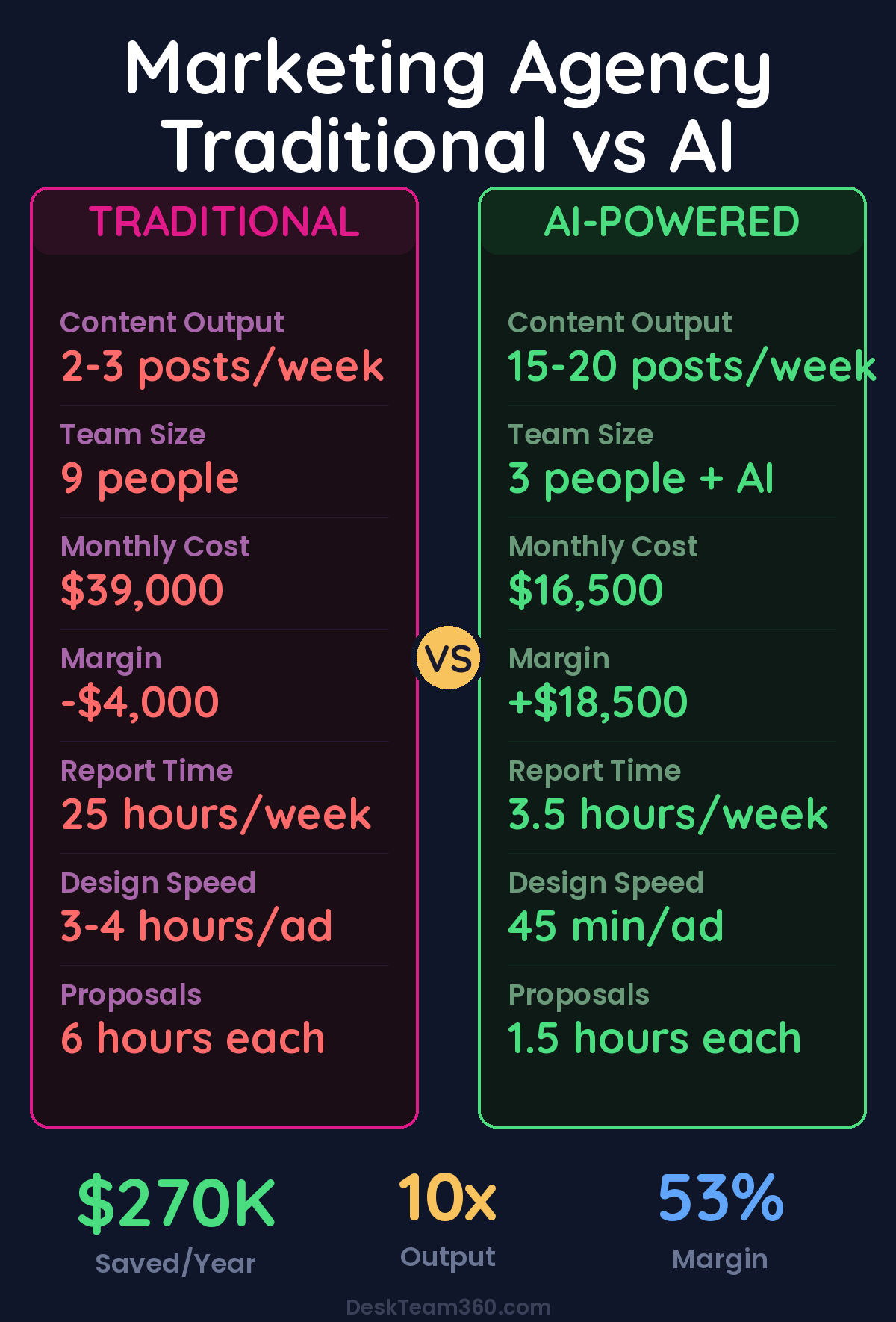
Traditional agency setup: 3 content writers at $4,000 each ($12,000 monthly), 2 designers at $5,000 each ($10,000), 2 account managers at $4,000 each ($8,000), 1 SEO specialist ($5,000), 1 social media manager ($4,000). Total staff cost: $39,000 per month. Revenue from 10 clients at $3,500 average: $35,000 per month. You’re losing $4,000 before overhead even kicks in.
AI-powered agency setup: 1 content strategist/editor ($5,000), 1 designer ($5,000), 1 account manager/strategist ($5,000), AI tools and APIs ($1,500). Total cost: $16,500 per month. Same $35,000 revenue from 10 clients. Margin: $18,500 per month, which is a 53% margin.
The margin swing is $22,500 per month. That’s $270,000 annually. Same client base, same output quality, but 3 people plus AI instead of 9 people.
Here’s the real kicker: with that same 3-person team plus AI, you could comfortably serve 20+ clients. Scale without proportional headcount growth. That’s how you actually scale a digital marketing agency in 2026 without burning out your team or destroying your margins.
Implementation That Actually Works
Most agencies try to implement AI everywhere at once and fail. Here’s the roadmap that actually works, based on watching dozens of agencies make this transition successfully.
Month 1 focus on content and reporting. Set up AI content workflows for topic research, draft creation, and optimization. Automate client reporting with data connectors plus AI analysis. Expected time savings: 20-30 hours per week. This alone pays for all your AI tools and gives you breathing room for the next phases.
Month 2 add design and social media. Integrate AI image generation into design workflows. Build AI-powered social media content production pipeline. Expected additional time savings: 15-20 hours per week. Now you’re operating with the capacity of a much larger team.
Month 3 tackle sales and operations. Automate proposal generation using your templates and client data. Build AI-powered SEO audit workflows. Set up AI-assisted project management for task routing and deadline tracking. Expected additional time savings: 10-15 hours per week.
Month 4 and beyond is optimization and scaling. Refine all workflows based on 3 months of real data. Start onboarding new clients with your new capacity. Identify additional automation opportunities specific to your niche and client types.
For industry research and benchmarks, check out McKinsey’s State of AI report.
Watch out: Don’t try to implement everything at once. Agencies that rush this process end up with half-built workflows that don’t work properly. Build one solid workflow before moving to the next. Quality over speed in implementation.
What Clients Need to Know (And What They Don’t)
Here’s a nuanced point that most agencies get wrong: how you communicate AI usage to clients matters, but probably not the way you think it does.
What clients should know: you use cutting-edge technology to deliver faster, higher-quality work at competitive prices. You’ve invested in AI tools and workflows that give them an unfair advantage over their competitors. You’re using the best available tools to get better results.
What they don’t need to know: the specific details of which AI tools generate which outputs. They hired you for results, not a technology tutorial. How you achieve those results, as long as quality is high and deadlines are met, is your operational decision. They don’t need to know that their blog post started as an AI draft any more than they need to know what brand of computer you used to write it.
What you should never do: deliver raw AI output without human review. Every piece of client-facing work should be reviewed, refined, and approved by a human expert. AI is your production tool, not your quality standard. The moment you start sending unreviewed AI output to clients is the moment you destroy your reputation.
The Competitive Reality Check
Here’s the truth that nobody wants to talk about: if your agency isn’t using AI today, you’re already falling behind. Your competitors are either using AI to deliver the same quality at lower cost, using AI to deliver higher quality at the same price, or using AI to handle more clients with the same team size.
The agencies that thrive in the next 2-3 years won’t be the ones with the biggest teams. They’ll be the ones with the smartest workflows. The agencies that figure out human-AI collaboration first will have an insurmountable advantage over the ones still trying to scale through pure headcount. The outsourced marketing model is evolving rapidly, and AI is the primary catalyst driving that evolution.
This isn’t coming someday. It’s happening right now. The question isn’t whether AI will change agency operations, it’s whether you’ll be leading that change or scrambling to catch up when your competitors start winning deals you used to win.
Scale Your Agency Without Scaling Your Payroll
The math is simple. The technology is proven. The workflows are tested. What’s stopping most agencies isn’t the complexity of implementation, it’s the complexity of change management and the fear of betting on the wrong approach.
At DeskTeam360, we work with agencies as a white-label partner, providing the human plus AI production capacity you need without the overhead of building these workflows internally. Content creation, design production, development work, and implementation support, all powered by AI-enhanced workflows that we’ve already built and optimized.
You focus on strategy, client relationships, and business development. We handle the production at scale.
Free 5-Minute Video
See How DeskTeam360 Works in Under 5 Minutes
Watch the short video and see exactly how we handle design, development, and marketing implementation — so you don't have to.
Watch the Video →