


Digital Marketing for Luxury Brands: The Complete Strategy Guide
Why Luxury Brand Marketing Is Completely Different
Let’s talk about digital marketing for luxury brands. I watched a luxury watch company run Google Ads the same way a pizza place would. Same keywords stuffing, same aggressive CTAs, same discount-heavy messaging. They burned through $50K in three months and got exactly zero sales.
📋 Table of Contents
That’s not incompetence, that’s category confusion. Luxury marketing isn’t normal marketing with a higher price tag. It’s a completely different discipline with its own rules, psychology, and execution framework.
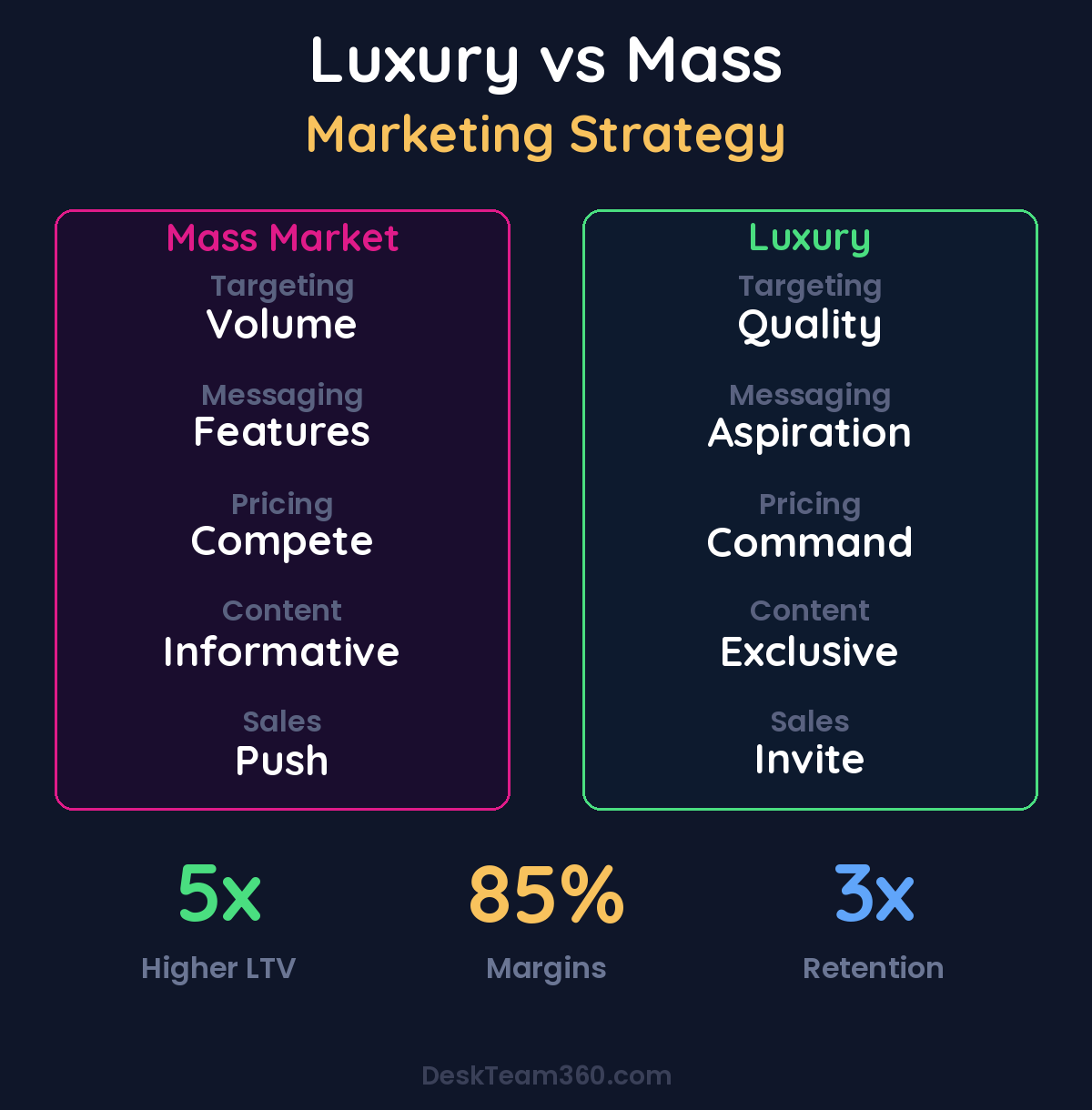
Here’s what 12+ years of working with premium brands has taught me. Luxury consumers don’t shop, they acquire. They don’t compare prices, they evaluate prestige. They don’t want to be sold to, they want to be invited in. Get this wrong and you’re just an expensive commodity competing on features and financing options.
Let me walk you through the playbook that actually works for luxury brands, from positioning to digital channels to measuring success in ways that matter.
The Four Pillars of Luxury Digital Marketing
Every luxury brand that succeeds in digital follows the same four-pillar framework. Miss any of them and your marketing feels like a department store trying to be Hermès. It doesn’t work.
Pillar 1: Scarcity and Exclusivity Positioning
Luxury thrives on limitation. Limited editions, invitation-only events, private collections, member-exclusive access. Your digital marketing should reinforce scarcity at every touchpoint, not fight against it.
This means no countdown timers screaming “SALE ENDS TONIGHT!” No desperate email sequences offering progressively bigger discounts. No social proof that focuses on how many thousands of people bought something. Those tactics work for volume businesses, they kill luxury brands.
Instead, you’re showcasing craftsmanship stories, heritage narratives, and the select few who understand true quality. Your Instagram stories feature the artisan who hand-stitches each piece, not the warehouse where you fulfill orders. Your email marketing talks about the waiting list, not the clearance section.
Pillar 2: Aspiration Before Information
Luxury buyers already know they want the category. A Rolex buyer isn’t comparing watch functions, they’re choosing which status symbol fits their identity. Your marketing should fuel aspiration first, provide information second.
This flips normal digital marketing on its head. Instead of leading with features and benefits, you lead with lifestyle and identity. Instead of answering “what does it do,” you’re answering “who am I when I own this.” Instead of logical persuasion, you’re creating emotional connection.
Pro tip: Audit your current website copy. Count how many sentences focus on product features versus lifestyle aspirations. If features dominate, you’re marketing like a commodity brand. Flip the ratio.
Pillar 3: Experience-Driven Touchpoints
Every digital interaction should feel like walking into a high-end boutique. Thoughtful, personalized, unhurried. Your website loads instantly, your forms are elegant and minimal, your email responses come from real people with expertise, not automated systems.
This extends to everything. Your social media customer service feels like a personal concierge, not a call center. Your product photography looks like it belongs in a museum, not an Amazon listing. Your checkout process removes friction without feeling cheap or rushed.
Pillar 4: Community Over Audience
Luxury brands don’t build audiences, they cultivate communities. The difference matters. An audience watches content and might buy something. A community shares values, advocates for the brand, and creates its own social proof among exactly the right people.
Your digital marketing should identify, attract, and nurture the people who already align with your brand values. Not everyone who could afford your product, but everyone who should own it. Quality over quantity isn’t just a product philosophy, it’s a marketing strategy.
Free 5-Minute Video
See How DeskTeam360 Works in Under 5 Minutes
Watch the short video and see exactly how we handle design, development, and marketing implementation — so you don't have to.
Watch the Video →
Platform Strategy: Where Luxury Brands Actually Win
Not every digital channel works for luxury marketing. Some platforms dilute prestige just by showing up. Others are essential but require completely different approaches than traditional marketing would suggest.
Instagram: Visual Storytelling, Not Product Catalog
Instagram is where luxury brands live online, but most of them use it like a product brochure. Wrong approach entirely.
Your Instagram should tell stories about craftsmanship, heritage, and lifestyle. Behind-the-scenes content showing artisans at work. Customer lifestyle shots that don’t feel like ads. Partnership content with cultural institutions, artists, or other luxury brands. Event coverage that makes non-attendees wish they’d been invited.
Skip the obviously promotional posts. Your audience knows you’re selling something, they don’t need constant reminders. Focus on content that makes owning your product feel like joining a culture, not making a purchase.
Email Marketing: Personal, Not Promotional
Luxury email marketing looks nothing like standard ecommerce email marketing. No aggressive subject lines, no discount codes, no urgency manipulation. Instead, you’re sending content that feels like it comes from a knowledgeable friend who happens to work in the industry.
The best luxury email campaigns feel more like magazine subscriptions than marketing sequences. Educational content about the category, insider stories about the brand, early access to experiences or collections.
Segment ruthlessly based on engagement and purchase history. New prospects get different content than VIP customers. Geographic location matters too, cultural context affects messaging and timing. If you’re treating all subscribers the same, you’re missing the personalization that luxury buyers expect.
LinkedIn: B2B Luxury Strategy
For luxury B2B brands or high-end services, LinkedIn becomes critical. But it’s not about thought leadership content or lead generation campaigns. It’s about demonstrating expertise and connecting with decision-makers who value premium solutions.
Share insights about industry trends, not company updates. Publish content about quality, craftsmanship, and long-term value. Connect with prospects through introductions and referrals, not cold outreach. The platform works, but only if you approach it like networking at an exclusive industry event.
Google Ads: Defensive, Not Aggressive
Most luxury brands should run Google Ads defensively. Protect your brand terms, capture high-intent searchers, and retarget website visitors. Don’t try to cast wide nets or compete for generic keywords against volume players.
Your ads should feel editorial, not promotional. Professional photography, minimal copy, clear value proposition focused on quality or exclusivity. Landing pages that continue the brand experience, not conversion-optimized squeeze pages designed for volume.
Watch out: Google’s automated bidding and campaign optimization tools are designed for volume businesses. They’ll push you toward broader keywords, higher competition, and tactics that work for mass market brands but destroy luxury positioning.
We covered this in detail in our post about how to build trust on your website: the complete trust stack guide.
Content Marketing That Builds Prestige
Luxury content marketing isn’t about driving traffic or generating leads directly. It’s about establishing authority, sharing expertise, and creating content so valuable that owning it becomes a status symbol itself.
Think about brands like Patek Philippe’s magazine or Hermès’ cultural publications. They’re creating content that luxury consumers want to own, display, and share. Your digital content should follow the same principle.
Write guides about appreciating quality in your category. Create video series featuring craftspeople, designers, or category experts. Develop downloadable resources that are genuinely useful reference materials. Partner with museums, cultural institutions, or academic experts to create authoritative content.
This connects directly to how you structure your knowledge base for customer support, which our guide on creating FAQ pages covers in detail. Luxury customers expect expert-level responses to sophisticated questions.
Measuring Success: Metrics That Actually Matter for Luxury
Standard marketing metrics don’t translate to luxury brands. Conversion rates, cost per acquisition, and click-through rates miss the point entirely. You’re optimizing for different outcomes.
Track brand mention sentiment, not just volume. Monitor customer lifetime value and repeat purchase rates. Measure engagement quality, not quantity. Look at average order value trends and customer retention by segment. Survey buyers about purchase motivations and post-purchase satisfaction with the experience, not just the product.
Luxury brands see 3-5x higher customer lifetime values compared to mass market competitors, but acquisition costs that justify the investment.
Most importantly, track business metrics that matter to luxury positioning. Are you maintaining pricing power? Is your brand mentioned alongside aspirational competitors? Are customers choosing you over lower-priced alternatives? Those indicators predict long-term success better than any digital marketing metric.
Common Luxury Marketing Mistakes That Kill Brands
I’ve seen luxury brands make the same five mistakes repeatedly. Each one individually can undermine years of brand building. Together, they’re fatal.
Competing on price or discounting publicly. The moment you start competing on price, you’re not a luxury brand anymore. You’re a premium-priced commodity waiting for someone to undercut you. If you need to move inventory, do it through private sales, VIP early access, or trade-in programs that maintain pricing integrity.
Optimizing for volume metrics. Maximizing traffic, leads, or social media followers dilutes your brand by attracting people who can’t or won’t buy luxury products. Focus on attracting qualified prospects who align with your brand values and can afford your pricing.
Using high-pressure sales tactics. Countdown timers, limited-time offers, aggressive follow-up sequences, and urgency-based messaging work for impulse purchases. Luxury purchases are considered decisions made by people who don’t respond to pressure tactics.
Ignoring the post-purchase experience. Luxury marketing doesn’t end at purchase, it starts there. Unboxing experiences, follow-up communications, service experiences, and ownership support all contribute to the brand perception that drives future purchases and referrals.
We break this down further in website design for coaches and consultants: the complete guide.
For more on this, check out our guide on marketing implementation for online service providers: a practical guide.
Building Your Luxury Marketing Technology Stack
The platforms and tools that work for mass market businesses often fail luxury brands. You need technology that enables personalization, maintains brand control, and creates premium experiences.
For email marketing, platforms like Klaviyo or Mailchimp work technically but don’t offer the design flexibility or personalization depth that luxury brands need. Consider more sophisticated solutions like Braze or custom email systems that give you complete control over design and data.
Your website platform matters enormously. Shopify works for basic ecommerce but lacks the customization and performance capabilities that luxury experiences require. Magento Commerce, WooCommerce with custom development, or completely custom solutions provide the control you need. The principles in our guide on reducing website bounce rates apply even more critically to luxury brands where first impressions are everything.
Customer relationship management becomes critical when individual customer lifetime values are high. Standard CRM systems focus on lead volume and sales velocity. Luxury brands need systems that track relationship depth, purchase motivations, and lifestyle preferences. This connects to broader principles about measuring marketing ROI in ways that matter for your business model.
Global Considerations for Luxury Digital Marketing
Luxury brands often sell globally, but luxury positioning varies dramatically across cultures. What signals prestige in New York might seem ostentatious in Tokyo. What works in London might be completely wrong for Dubai.
Your digital marketing needs geographic customization that goes deeper than language translation. Product photography, model selection, cultural references, and even color choices affect luxury perception. Partner with local experts or agencies that understand luxury positioning in each major market.
Payment options, shipping methods, and customer service availability all impact luxury perception. Offering installment payments might increase conversions but could undermine luxury positioning. Slow shipping feels inconsistent with premium pricing. Limited customer service hours suggest you don’t value customer relationships appropriately.
The Future of Luxury Digital Marketing
Luxury digital marketing is evolving toward even more personalization and exclusive experiences. Virtual reality showrooms let customers experience products remotely while maintaining the intimacy of private shopping. AI-powered personal shopping assistants provide customized recommendations based on individual style preferences and purchase history.
Blockchain technology enables verifiable authenticity and ownership history, critical for luxury resale markets. NFTs and digital collectibles create new categories of luxury goods that exist entirely online. Augmented reality lets customers visualize products in their personal environment before purchase.
The brands that succeed will be those that adopt new technologies to enhance luxury experiences, not replace them with more efficient alternatives. Technology should make luxury more accessible to qualified customers while maintaining the exclusivity that justifies premium pricing.
Implement Your Luxury Marketing Strategy
Luxury digital marketing requires different thinking, different execution, and different measurement than traditional marketing. But get it right and you build a brand that commands premium pricing, generates customer loyalty that lasts decades, and grows sustainably without competing on price.
Understanding how AI can enhance rather than replace the luxury experience is crucial for modern luxury brands. Our AI-powered customer support guide shows how technology can maintain the white-glove service that luxury customers expect.
At DeskTeam360, we help luxury brands develop digital marketing strategies that maintain exclusivity while scaling effectively. From content creation to customer experience design to technology implementation, we handle the execution so you can focus on what makes your brand exceptional.
Free Tool
How Much Is Freelancer Management Really Costing You?
Most agency owners have never done this math. Plug in a few numbers and see your real cost in 2 minutes.
Calculate Your Hidden Costs →