
Digital Marketing for Coaches and Consultants: Build Authority and Generate Leads
Digital marketing for coaches and consultants requires a focused strategy that actually drives results.
📋 Table of Contents
Why Most Coaches and Consultants Fail at Marketing
Here’s what I see constantly: coaches marketing to other coaches, consultants posting generic “thought leadership” that says nothing, and everyone copying the same tired playbook of “free webinar → high-ticket offer → discovery call close.” Then they wonder why their calendars are empty.
The playbook isn’t the problem. Parts of it work incredibly well. The problem is execution. Most coaches and consultants skip the foundational work and jump straight to tactics. They buy a course on Instagram marketing, start posting motivational quotes, and expect qualified leads to magically appear.
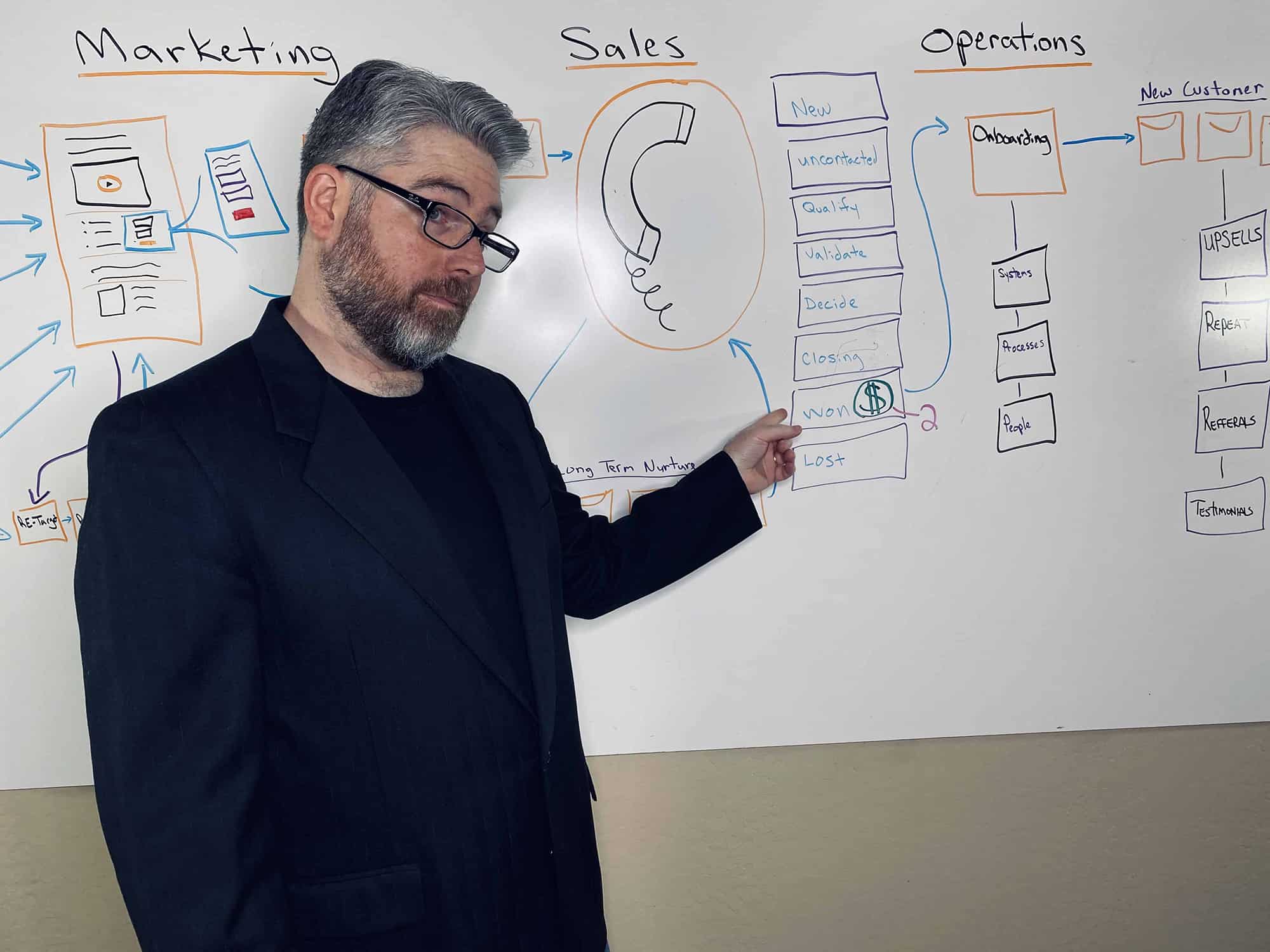
I’ve been running agencies and managing marketing for 400+ clients over the past 12 years. The coaches and consultants who actually build sustainable, six-figure practices do things completely differently. They understand that marketing for expertise-based businesses isn’t about volume, it’s about positioning and trust.
This isn’t another recycled list of social media tactics. This is the strategic foundation that makes those tactics actually work.
Build Authority First, Sell Second
Here’s where most coaches screw up immediately: they start selling before anyone knows who they are. You can’t skip the authority-building phase. People hire coaches and consultants because they trust your expertise, not because you have the slickest sales funnel.
If prospects don’t know you, trust you, or believe you can deliver results, no amount of marketing spend will fix that fundamental problem.
Pick One Platform and Dominate It
You don’t need to be everywhere. You need to be exceptional somewhere. Pick one primary channel and commit to it for at least 6 months before even thinking about adding another.
**LinkedIn** works best for B2B consultants, executive coaches, and business coaches. LinkedIn’s organic reach is still incredible compared to other platforms. A well-written post can reach thousands without spending a dollar on ads. The algorithm actually rewards good content here.
**YouTube** is perfect for coaches who can teach through video. YouTube content has the longest shelf life of any platform. Videos you post today will generate leads for years. The trade-off is higher production effort and slower initial traction.
**Podcasting** works for consultants who love conversation and want to build relationships with other experts. Guest appearances on established podcasts fast-track your authority. Hosting your own builds a dedicated audience over time.
**Instagram** fits life coaches, wellness coaches, and anyone whose audience skews younger or more visual. Reels are the growth lever right now, but the platform changes constantly.
**Blogging and SEO** capture search intent. When someone Googles “how to improve team communication” and your comprehensive guide shows up, that’s a warm lead who already has the problem you solve.
If digital marketing for coaches and consultants is on your radar, this guide is for you. Let’s talk about digital marketing for coaches and consultants. Pro tip: Test your channel choice by looking at where your ideal clients actually spend time. B2B decision-makers scroll LinkedIn during lunch. Life coaching prospects watch Instagram Stories at night. Don’t guess, observe.
The Four Types of Content That Build Authority
Everything you publish should fit into one of these categories, and you need all four working together.
**Problem-awareness content** helps your audience understand their problem better. “5 signs your leadership team has a communication breakdown” attracts people in the early stages of recognizing they need help. This content casts the widest net.
**Solution-education content** teaches your framework or methodology. “How to run a quarterly planning session that actually produces results” positions you as the expert with a proven approach. This is where you start differentiating from competitors.
**Proof content** includes case studies, client results, and testimonials. “How we helped a SaaS company reduce team turnover by 40% in 6 months” builds confidence that you deliver results, not just theory. This moves people from interested to ready to buy.
**Point-of-view content** takes a stance on industry topics. “Why most executive coaching is a waste of money (and what works instead)” differentiates you from every other coach saying the same things. This attracts people who think like you do.
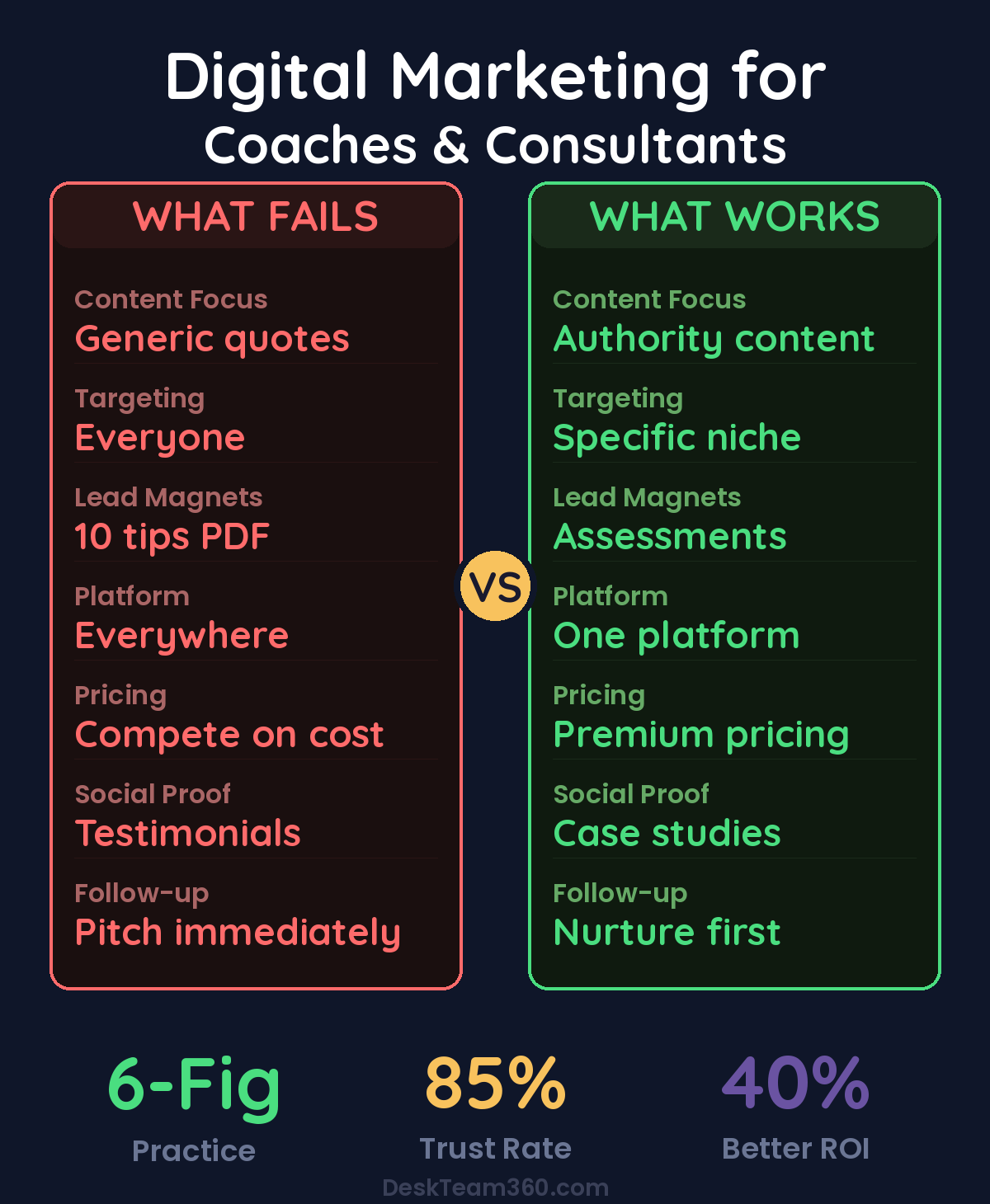 Digital Marketing Strategies for Coaches and Consultants: What Fails vs What Works” style=”max-width:100%;height:auto;border-radius:12px;box-shadow:0 4px 20px rgba(0,0,0,0.08);” width=”1200″ height=”1460″>
Free Template
The Ultimate Task Delegation Template
Stop guessing what to hand off. This template shows you exactly what to delegate, how to brief it, and how to QA the results.
Get the Free Template →
Your Website: The Hub That Converts
Social media builds awareness. Your website closes the deal. Most coaching and consulting websites fail because they’re either too vague (“I help people reach their potential”) or too salesy (three pop-ups before the page loads).
What Visitors Must Understand in 5 Seconds
When someone lands on your homepage, they should immediately understand who you help, what outcome you deliver, why you’re credible, and what to do next. That’s it. If you’re trying to communicate more than that above the fold, you’re communicating nothing.
“I help Series A SaaS founders build leadership teams that don’t fall apart at scale” is 10 times better than “I help businesses grow.” Specificity builds trust. Vagueness kills it.
The Pages That Actually Matter
**Homepage** needs a clear value proposition, key social proof, and one primary call-to-action. Don’t offer six different ways to work with you. Pick one and optimize for that.
**About page** tells your story, credentials, and philosophy. This is often the most-visited page on coaching websites because people want to know who they’ll be working with. Include a professional photo and video introduction if possible.
**Services page** details your offerings with pricing or at least price ranges. Coaches who hide pricing lose prospects to coaches who don’t. Price transparency filters out tire-kickers and attracts serious buyers.
**Results page** documents specific client outcomes with numbers, testimonials, and before-and-after narratives. This is your proof page. It answers the “can you actually deliver” question.
**Content hub** serves as your SEO engine and authority builder. Publish regular, in-depth content that addresses your ideal client’s specific questions and problems. For guidance on creating pages that convert visitors, our conversion rate optimization guide covers the fundamentals.
Lead Generation That Actually Works
The classic coaching funnel works when executed properly: lead magnet → email nurture → discovery call → enrollment. The key word is “properly.” Here’s how each piece should actually function.
Lead Magnets That Qualify, Not Just Attract
Your lead magnet should do two things: provide genuine value and qualify the prospect. If your lead magnet attracts everyone, it attracts no one worth selling to.
**Assessments and scorecards** work incredibly well because they’re interactive and personalized. “Rate your leadership team’s communication: take the 5-minute assessment” beats “10 tips for better leadership” every time. People want to know where they stand, not generic advice.
**Frameworks and templates** give prospects a tool they can actually use. A decision-making framework for executives has more value than a PDF they’ll never read. Make it practical and specific to your methodology.
**Mini-courses or video series** let prospects experience your teaching style before committing to work with you. Three to five short videos teaching one concept often converts better than a single long webinar.
**Detailed case studies** walk through exactly how you helped a specific client get results. These work especially well for high-ticket consulting because they demonstrate your process and outcomes.
Avoid generic lead magnets like “10 Tips for Better Leadership.” These attract tire-kickers, not buyers. You want fewer leads, but better ones.
Email Sequences That Build Trust Over Time
Once someone downloads your lead magnet, resist the urge to immediately pitch your services. Build trust over 5-7 emails first.
Day 0: Deliver the lead magnet plus a quick personal introduction. Day 2: Share a relevant insight or teaching moment that reinforces your expertise. Day 4: Tell a client success story with specific, measurable results. Day 7: Address a common objection or misconception in your industry. Day 10: Share your philosophy or unique approach to solving their problem. Day 14: Soft call-to-action to a free workshop, webinar, or podcast episode. Day 18: Direct invitation to book a discovery call.
This sequence builds familiarity and trust over 2-3 weeks instead of asking for a sales call immediately. The prospects who book calls after this sequence are much more likely to buy.
The nurture sequence is where relationships form. People don’t hire strangers, even credible ones. Use this time to let your personality show through your writing. Prospects hire coaches they like and trust, not just ones they respect.
Webinar Funnels for High-Ticket Programs
Webinars remain one of the highest-converting tactics for coaches and consultants selling programs over $2,000. The key is following a proven structure that delivers value first, then makes the offer.
Hook (first 5 minutes): Make a bold promise and establish your credibility immediately. “By the end of this webinar, you’ll have a framework for reducing team turnover by 50% in the next 90 days. I’ve used this exact approach with 47 companies.”
Teaching (20-30 minutes): Deliver genuine value by teaching a concept or framework they can use immediately. This isn’t a teaser, it’s real education. The goal is for attendees to think, “If this is what he gives away for free, imagine what the paid program contains.”
Bridge (5 minutes): Transition from teaching to offering by explaining why the concept alone isn’t enough and what the full transformation looks like. “This framework is powerful, but implementing it across your entire organization requires additional steps most companies miss.”
Offer (10-15 minutes): Present your program, pricing, bonuses, and guarantee. Be clear about what’s included, what results they can expect, and what happens if they’re not satisfied.
Q&A (10-15 minutes): Address objections in real-time and provide additional clarity about the program.
The webinar should be valuable even for people who don’t buy. That builds long-term trust and generates referrals.
LinkedIn Strategy for B2B Coaches
LinkedIn deserves its own section because it’s by far the most effective organic platform for B2B coaches and consultants. The reach is better, the audience is more professional, and the competition is lower than other platforms.
Optimize Your Profile Like a Landing Page
Your LinkedIn profile isn’t a resume, it’s a landing page. Optimize it accordingly.
**Headline** should be your value proposition, not your job title. “I help SaaS founders build teams that don’t fall apart at scale” beats “Executive Coach | Leadership Expert | Speaker” because it tells prospects exactly what you do for people like them.
**Banner image** is prime real estate. Use it for your website URL, a key statistic, or your positioning statement. Don’t leave it blank.
**About section** should read like a sales page: problem → solution → proof → call-to-action. Write in first person with a conversational tone. This isn’t a corporate bio.
**Featured section** should highlight your lead magnet, best case study, and top-performing post. Pin the content you want prospects to see first.
Content That Actually Gets Engagement
Post 3-5 times per week with a mix of these formats. Don’t just post randomly, have a plan.
**Personal stories with business lessons** get the highest engagement because people connect with stories. “The day I got fired taught me everything I needed to know about leadership” will outperform generic advice every time.
**Contrarian takes** challenge industry assumptions and start conversations. “Why I stopped doing discovery calls” generates more comments and shares than “5 tips for better discovery calls.”
**Client results** share what happened, what you did, and the measurable outcome. Anonymize if needed, but include specific numbers and timeframes.
**Framework posts** teach a concept using a simple visual framework. These position you as someone with proprietary methodologies, not just general advice.
**Engagement posts** ask questions, run polls, or start discussions. These boost your visibility in the algorithm and help you understand your audience better.
Watch out: Don’t turn your LinkedIn into a motivational quote factory. Business professionals want insights and frameworks, not generic inspiration. Save the motivational content for platforms where it actually works.
For industry benchmarks and research, see Thinkific Blog.
For industry research and benchmarks, check out Shopify Blog.
DM Strategy That Doesn’t Feel Slimy
The “Hey [Name], I noticed your profile and wanted to connect” DM template died years ago. Don’t resurrect it.
Instead, engage meaningfully on prospects’ content for 2-3 weeks before sending any direct messages. Comment thoughtful insights on their posts. Share their content with your network. When you finally DM, reference specific content they’ve shared and offer genuine value, not a pitch.
“I saw your post about the challenges with remote team communication. I’ve helped several companies in similar situations and have a framework that might be useful. Happy to share it with no strings attached if you think it would help.” This approach works because it’s helpful, not salesy.
Paid Advertising That Actually Pays Off
Paid ads can accelerate growth dramatically, but only after your funnel converts organically first. Don’t throw money at ads until you’ve validated your message, offer, and conversion process with free traffic.
Facebook and Instagram Ads for Coaches
These platforms work best for driving traffic to lead magnet opt-in pages, webinar registrations, or free challenges. Don’t try to sell high-ticket coaching directly from Facebook ads. The platform isn’t built for that.
Start with $30-50 per day minimum. Anything less won’t generate enough data to optimize. Target based on interests (entrepreneurship, specific industries, business books), job titles, and behaviors. Create separate campaigns for cold audiences and warm retargeting.
Retarget website visitors and email subscribers with testimonial videos and case study ads. These prospects already know you exist, so social proof moves them closer to booking a call.
LinkedIn Ads for High-Value Consulting
LinkedIn ads cost more per click but offer laser-targeted reach for B2B prospects. Use LinkedIn’s job title and company size targeting to reach decision-makers directly. This works best for high-ticket consulting where client lifetime value justifies the higher cost per lead.
Sponsored content performs better than direct message ads for building awareness. Save the direct outreach for prospects who’ve already engaged with your content.
YouTube Ads for Authority Building
YouTube pre-roll ads work exceptionally well for coaches because you can demonstrate expertise directly in the ad. A 2-3 minute video that teaches something valuable, then invites viewers to a webinar or lead magnet, often outperforms traditional short-form ads.
The key is leading with value, not promotion. Teach first, sell second.
Scaling Beyond One-on-One: Group Programs and Courses
If you’re ready to scale beyond individual coaching into group programs or courses, the marketing approach shifts from relationship-based to systems-based.
Launch Model vs Evergreen Model
**Launch model** opens enrollment 2-4 times per year with a structured launch sequence: waitlist → cart open → bonuses → urgency → close. This creates natural urgency and event energy around your program. Best for programs over $1,000 where personal involvement is high.
**Evergreen model** offers always-open enrollment with automated webinar funnels and email sequences. This provides consistent, predictable revenue without the feast-or-famine cycle of launches. Best for courses under $1,000 with minimal personal interaction.
Many successful coaches use a hybrid approach: launch their flagship group program quarterly while selling lower-ticket courses on evergreen autopilot.
Pricing Strategy That Positions You as Premium
Don’t compete on price. Coaches and consultants who position as premium and charge accordingly attract better clients, get better results, and build more sustainable businesses.
One-on-one coaching typically ranges from $200-1,000 per session or $2,000-25,000 per engagement, depending on your expertise level and client type. Group coaching programs range from $1,000-10,000 per participant. Online courses range from $200-2,000. Consulting engagements range from $5,000-50,000+ per project.
These ranges vary widely by niche, but the principle remains: charge what your expertise is worth, not what you think people can afford. You’ll be surprised how much qualified prospects are willing to invest in solving their problems.
Coaches who charge premium rates report 85% higher client satisfaction compared to those competing on price. Higher prices attract more serious, committed clients.
Measuring What Actually Matters
Track these numbers monthly to understand what’s working and what needs improvement.
**Lead magnet conversion rate** measures what percentage of website visitors opt in. Target 20-40% for a focused landing page. If you’re below 20%, your lead magnet isn’t compelling enough or your traffic isn’t targeted.
**Email engagement rates** show whether your nurture sequences are working. Target 30%+ open rates and 3%+ click rates. Low engagement indicates poor subject lines, irrelevant content, or the wrong audience.
**Discovery call booking rate** tracks what percentage of leads actually book calls with you. This number reveals the quality of your leads and the effectiveness of your nurture sequence.
**Discovery call close rate** measures what percentage of calls become paying clients. Target 20-40% depending on your price point and lead quality. Higher-priced offerings typically have lower close rates but higher revenue per client.
**Cost per lead and cost per client** determine whether your marketing investments are profitable. Know these numbers cold so you can scale what works and eliminate what doesn’t.
**Client lifetime value** shows how much revenue an average client generates over their entire relationship with you. This determines how much you can afford to spend acquiring new clients.
For help tracking these metrics effectively, our marketing ROI measurement guide covers the tools and systems.
Five Mistakes That Kill Coach Marketing
**Being too broad.** “I help anyone who wants to improve their life” serves no one effectively. Niche down until it feels uncomfortable. You can always expand later, but you can’t build authority by trying to help everyone.
**Marketing to other coaches.** If your entire network consists of other coaches and consultants, you’re in an echo chamber. Your marketing should reach the people you actually want to serve, not your professional peers.
**All content, no conversion mechanism.** Posting valuable content without a clear path to working with you is just free education with no business impact. Every piece of content should connect to your lead generation system.
**Skipping the proof stage.** If you can’t point to specific client results, focus on getting them before scaling your marketing efforts. Case studies and testimonials are your most powerful marketing assets. Without them, you’re just another person with an opinion.
**Inconsistency.** Marketing works through consistency and compounding effects. Posting twice a day for a week then disappearing for a month is worse than posting three times a week consistently for a year.
Building Systems That Work Long-Term
The coaches and consultants who build thriving practices don’t rely on any single marketing tactic. They build integrated systems where authority content attracts prospects, lead magnets qualify them, nurture sequences build trust, and sales conversations convert them into clients.
Start with one platform, one lead magnet, and one core offer. Perfect that system before trying to scale or add complexity. Most marketing failures happen because people try to do too much too quickly instead of executing one thing exceptionally well.
Your website serves as the hub that makes everything else work. Social media drives traffic, but your website converts that traffic into leads and clients. Invest in making it professional, clear, and conversion-focused.
If you need help building a website that converts, creating content at scale, or developing marketing materials for your coaching business, our lead magnet creation guide and case study writing guide provide step-by-step frameworks. For ongoing support with web design, graphic design, and marketing materials, DeskTeam360’s plans handle the technical execution so you can focus on what you do best: serving clients.
Stop copying what everyone else does. Build a marketing system that works specifically for your expertise, your audience, and your business goals.
Free 5-Minute Video
See How DeskTeam360 Works in Under 5 Minutes
Watch the short video and see exactly how we handle design, development, and marketing implementation — so you don't have to.
Watch the Video →