


How to Measure Marketing ROI: Attribution Models, Metrics, and Tracking Setup
Knowing how to measure marketing roi can be the difference between growth and spinning your wheels.
📋 Table of Contents
The Marketing ROI Problem That’s Costing You Money
I had this exact conversation with a client last week: “Jeremy, we’re spending $15,000 a month on marketing, and I honestly have no clue if it’s working.” This isn’t a small business problem. This is a fundamental challenge that 90% of companies face, regardless of size.
You’ve got customers discovering you through Google searches, clicking Facebook ads, reading your emails, getting referrals from friends, and bouncing between all of these touchpoints multiple times before they buy. When someone finally becomes a customer, which marketing dollar deserves credit? It’s like trying to figure out which raindrop caused the flood.
Most businesses either give up on attribution entirely (and make budget decisions based on gut feel) or they obsess over perfect attribution (which doesn’t exist) and analyze themselves into paralysis. Neither approach works.
The solution isn’t perfect measurement. It’s directionally accurate measurement that’s good enough to make smart budget decisions. I’ve been implementing marketing ROI systems for 12+ years across 400+ clients, and I’m going to show you exactly how to measure what matters without drowning in data that doesn’t move the needle.
Why Most ROI Calculations Are Garbage
The basic ROI formula looks simple: Revenue from Marketing minus Marketing Cost, divided by Marketing Cost, times 100. Spend $10,000 on marketing, generate $50,000 in revenue, you’ve got a 400% ROI. Congratulations, you’re a marketing genius.
Except you’re not, because that calculation is probably wrong in two critical ways.
First, you’re undercounting your marketing costs. Most businesses include ad spend and maybe some agency fees, then pat themselves on the back for hitting a 500% ROI. They forget to include the email marketing platform, the CRM subscription, the designer they hired for landing pages, the copywriter for ad copy, and the 20 hours a week their marketing manager spends managing campaigns. Add all that up, and your 500% ROI suddenly becomes 150% ROI.
If how to measure marketing roi is on your radar, this guide is for you. Figuring out how to measure marketing roi doesn’t have to be complicated. Watch out: The businesses with the most inflated ROI calculations are the ones making the worst budget decisions. If you’re not counting all your costs, you’re optimizing for a fantasy number that has no relationship to reality.
Second, you’re overcounting revenue attribution. Not every dollar of revenue came from marketing. You’ve got repeat customers, referrals, brand recognition, and people who would have bought anyway. If your business has been around for more than six months, some percentage of your revenue would exist even if you turned off all marketing tomorrow.
Here’s what should actually be included in your marketing cost calculation: advertising spend across all platforms, agency and freelancer fees, marketing tool subscriptions (email, CRM, analytics, design), content creation costs, and the fully loaded cost of employee time spent on marketing. Yes, that includes benefits and overhead, not just salary.
Free 5-Minute Video
See How DeskTeam360 Works in Under 5 Minutes
Watch the short video and see exactly how we handle design, development, and marketing implementation — so you don't have to.
Watch the Video →
Attribution Models That Don’t Make You Crazy
Perfect attribution is a myth. Customer journeys are messy, non-linear, and happen across devices, platforms, and time periods you can’t always track. The goal isn’t perfection, it’s picking an attribution model that’s consistently wrong in the same direction so you can make relative comparisons.
Let me break down the options without the academic nonsense.
**First-touch attribution** gives all credit to the first interaction. Simple to implement, shows you which channels generate awareness, but completely ignores everything that happens between discovery and purchase. Use this if you care more about top-of-funnel optimization than understanding the full journey.
**Last-touch attribution** gives all credit to the final interaction before purchase. Also simple, shows you which channels close deals, but ignores all the nurturing that led to that final click. This is what most small businesses default to because it’s what Google Analytics shows by default.
**Position-based attribution** gives 40% credit to first touch, 40% to last touch, and splits the remaining 20% among middle interactions. This is my recommendation for most businesses because it acknowledges both ends of the funnel without getting overly complicated.
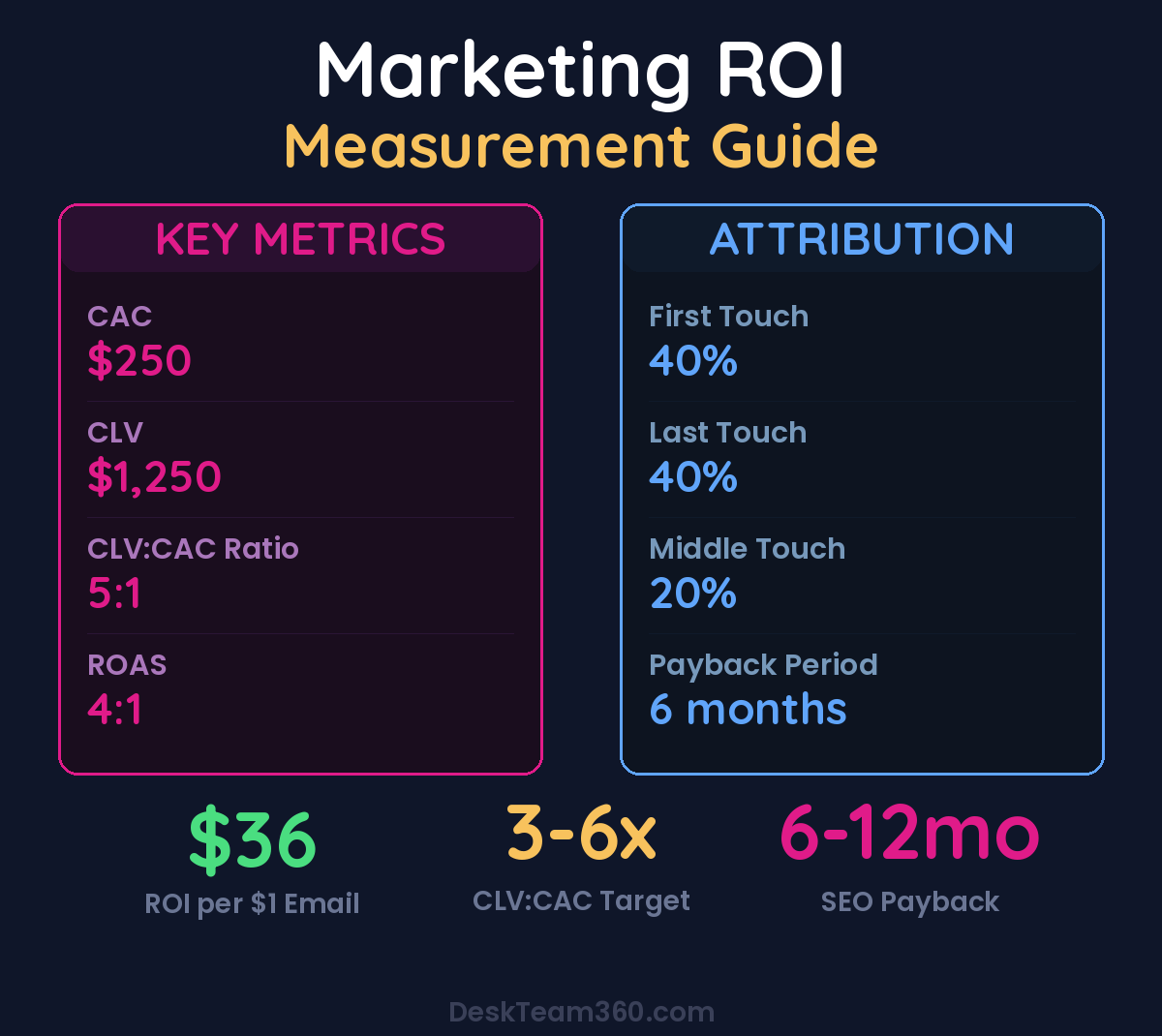
The 40/20/40 rule works because it mirrors reality. First touch matters (somebody has to discover you). Last touch matters (something has to trigger the final decision). And everything in between contributes, just not as much as the bookends.
For more on this, check out our guide on digital marketing for home services: the complete playbook.
If you’re using Google Analytics 4 and have sufficient conversion volume (50+ conversions per month), their data-driven attribution model is actually pretty good. It uses machine learning to analyze your specific customer behavior patterns and assigns credit accordingly. But if you don’t have enough data, it defaults to last-touch, which puts you back where you started.
For service businesses and anything with a sales cycle longer than a few days, our guide on setting up Google Analytics walks through the configuration that actually captures meaningful attribution data.
The Three Metrics That Actually Predict Success
ROI is the scoreboard, but it’s a lagging indicator. By the time you calculate it, you’ve already spent the money. The metrics that matter for day-to-day optimization are the ones that predict ROI before it happens.
**Customer Acquisition Cost (CAC)** is your cost to acquire one new customer, including all marketing and sales expenses divided by new customers acquired in that period. This is your efficiency metric. Track it by channel to see which sources deliver customers most cost-effectively.
The critical insight most businesses miss is that CAC varies dramatically by channel and campaign type. Your Google Ads might have a $200 CAC while your email nurture campaigns have a $50 CAC. Both can be profitable, but that information changes how you allocate budget.
**Customer Lifetime Value (CLV)** is what each customer is worth over the entire relationship, not just the first purchase. Average purchase value times purchase frequency times average customer lifespan. This determines how much you can afford to spend on acquisition.
Here’s the rule that matters: your CLV should be at least 3x your CAC. Below that ratio, you’re either spending too much to acquire customers or not retaining them long enough to justify the acquisition cost. Above 5x and you’re probably underinvesting in growth.
Businesses that nail the CLV:CAC ratio see 40% faster growth than those that optimize for individual campaign performance.
For more on this, check out our guide on marketing implementation for online service providers: a practical guide.
For industry research and benchmarks, check out Google Search Central.
**Return on Ad Spend (ROAS)** measures revenue generated per dollar of ad spend, specific to paid advertising. A 4:1 ROAS means every ad dollar generates four dollars in revenue. But ROAS doesn’t include your total marketing costs, just the ad spend itself. A campaign with 4:1 ROAS might actually lose money after you factor in agency fees, creative costs, and landing page development.
Tracking Setup That Actually Works
You can’t manage what you don’t measure, but you also can’t measure what you don’t track correctly. Most businesses have tracking setups that generate more confusion than clarity.
**Google Analytics 4** is non-negotiable. It needs to be installed on every page of your website with proper conversion tracking configured. Not just “contact form submissions” as a conversion, but qualified leads, phone calls, downloads, email signups, and any other action that indicates genuine buying interest.
The setup that most businesses get wrong is conversion value assignment. A newsletter signup isn’t worth the same as a demo request, but if you assign them both a conversion value of $1 in GA4, your data will tell you they’re equally valuable. Assign realistic values based on your actual conversion rates from each action to sale.
**UTM parameters** are mandatory for every external link you share. This means every social media post, every email link, every ad, every piece of content you distribute. The UTM structure tells GA4 exactly where traffic came from so you can attribute results correctly.
Be obsessively consistent with UTM naming. “Facebook” and “facebook” and “FB” are three different traffic sources in your analytics. Create a naming convention and stick to it religiously. I recommend: utm_source=facebook, utm_medium=social, utm_campaign=product_launch_q1. No spaces, lowercase, underscores for separation.
Pro tip: Create a simple spreadsheet with your UTM naming conventions and share it with anyone who creates marketing links. Inconsistent UTM parameters will destroy your attribution data faster than any other single mistake.
**CRM integration** is where marketing data connects to revenue data. Your CRM needs to track the original lead source for every contact, all marketing touchpoints throughout the customer journey, and revenue attributed to each customer. Without this connection, you’re making assumptions about ROI instead of calculating it.
If phone calls represent a significant portion of your conversions (and for most local businesses they do), call tracking is essential. Tools like CallRail assign unique phone numbers to different marketing channels so you know which campaigns are driving calls, not just website conversions.
Channel-Specific Measurement Reality Check
Different marketing channels require different measurement approaches because they serve different purposes in the customer journey.
**SEO and content marketing** have the longest payback period and the most indirect attribution. You’re investing in assets that generate traffic and leads for months or years after creation. Measuring SEO ROI requires patience and a longer time horizon than most businesses are comfortable with.
Track organic traffic growth, keyword ranking improvements, and conversions from organic traffic separately from other channels. Calculate the equivalent cost of your organic traffic if you had to buy it through paid ads. That’s your “SEO savings” metric and often represents significant value even before direct ROI calculations.
Realistic timeline for SEO results: 6-12 months minimum. Anyone promising meaningful SEO results in 30-60 days is either planning to cut corners or hasn’t done this before.
**Paid advertising** offers the most direct attribution because you can connect spend to results with minimal guesswork. Cost per click, cost per lead, cost per acquisition, and return on ad spend are all measurable in real-time.
The mistake most businesses make with paid ads is optimizing for cheap clicks instead of profitable customers. A $50 click that converts to a $5,000 customer beats a $2 click that never converts. Focus on cost per qualified customer, not cost per click.
**Email marketing** consistently delivers the highest ROI of any marketing channel, typically $36-42 for every $1 spent according to industry data. But email attribution gets complex because email often influences purchases that happen through other channels.
Track both direct email-attributed revenue (customer clicked email link and bought) and email-assisted revenue (customer received emails during the purchase window). The assisted metric captures email’s nurturing impact even when the final conversion happens through a different channel.
Our guide on improving website conversion rates includes email integration strategies that improve attribution accuracy across channels.
Building Your Marketing Dashboard
Don’t build a dashboard that requires a data science degree to interpret. Focus on answering three questions every month: How much are we spending? What are we getting? Is it working?
**Spending:** Total marketing cost by channel, including all the hidden costs most businesses ignore. Ad spend plus agency fees plus tool costs plus employee time. Update this monthly and be ruthlessly honest about the true cost.
**Results:** Leads, customers, and revenue by channel. Not just first-touch attribution, but the attribution model you’ve chosen to use consistently. Track leading indicators (traffic, leads, conversion rates) and lagging indicators (revenue, ROI, CLV).
**Performance:** ROI trends, CAC by channel, CLV:CAC ratios, and ROAS for paid channels. Look for trends over three-month periods, not individual monthly fluctuations. One bad month doesn’t indicate a broken channel. Three consecutive months of decline might.
For dashboard tools, Google Looker Studio is free and connects directly to GA4, Google Ads, and most other platforms. If you want something more polished, Databox aggregates multiple data sources cleanly. For smaller businesses, a well-organized monthly spreadsheet works perfectly well.
The key is reviewing your dashboard monthly and actually making decisions based on what it shows you. A perfect dashboard that nobody looks at is worthless. A simple dashboard that drives budget reallocation decisions is invaluable.
Common Measurement Mistakes That Cost Money
**Measuring too early.** Some marketing activities need 6-12 months to show real ROI. Content marketing, SEO, and brand building campaigns have long payback periods. Measuring ROI after 30 days and killing effective programs prematurely is how you end up stuck in short-term thinking.
**Ignoring lifetime value.** A $500 customer acquisition cost looks terrible if you’re measuring first-purchase revenue of $200. But if that customer spends $5,000 over three years, the $500 CAC is profitable. Always evaluate acquisition costs against lifetime value, not just initial purchase value.
**Chasing vanity metrics.** Likes, followers, impressions, and website traffic aren’t ROI. They’re activity metrics, not outcome metrics. Always connect your measurements back to revenue or at least to the specific actions that lead to revenue.
**Perfect attribution obsession.** Spending weeks building complex attribution models that change your budget decisions by 5% is a waste of time. Spend that effort on creating better marketing content or optimizing conversion rates. Directionally accurate attribution that you check monthly beats perfectly accurate attribution that you calculate quarterly.
Start Measuring Marketing ROI Properly
Marketing ROI measurement isn’t about perfect attribution, it’s about consistent attribution that enables better budget decisions. Start with honest cost accounting, implement position-based attribution, track leading indicators that predict ROI, and build a simple dashboard that answers the three critical questions.
The businesses that get this right don’t measure everything perfectly, they measure the important things consistently. Set up the foundation properly, review the data monthly, and make budget adjustments based on what the data shows you.
Getting your tracking and attribution setup right is fundamental to scaling any business profitably. It’s also technical work that most business owners don’t enjoy and don’t have time for. At DeskTeam360, we handle the implementation of marketing systems, analytics setup, and tracking configuration so you can focus on strategy instead of technical details.
Understanding how to measure marketing ROI is the first step. Building the marketing assets that generate measurable ROI is where the real work happens.
Free Tool
How Much Is Freelancer Management Really Costing You?
Most agency owners have never done this math. Plug in a few numbers and see your real cost in 2 minutes.
Calculate Your Hidden Costs →