


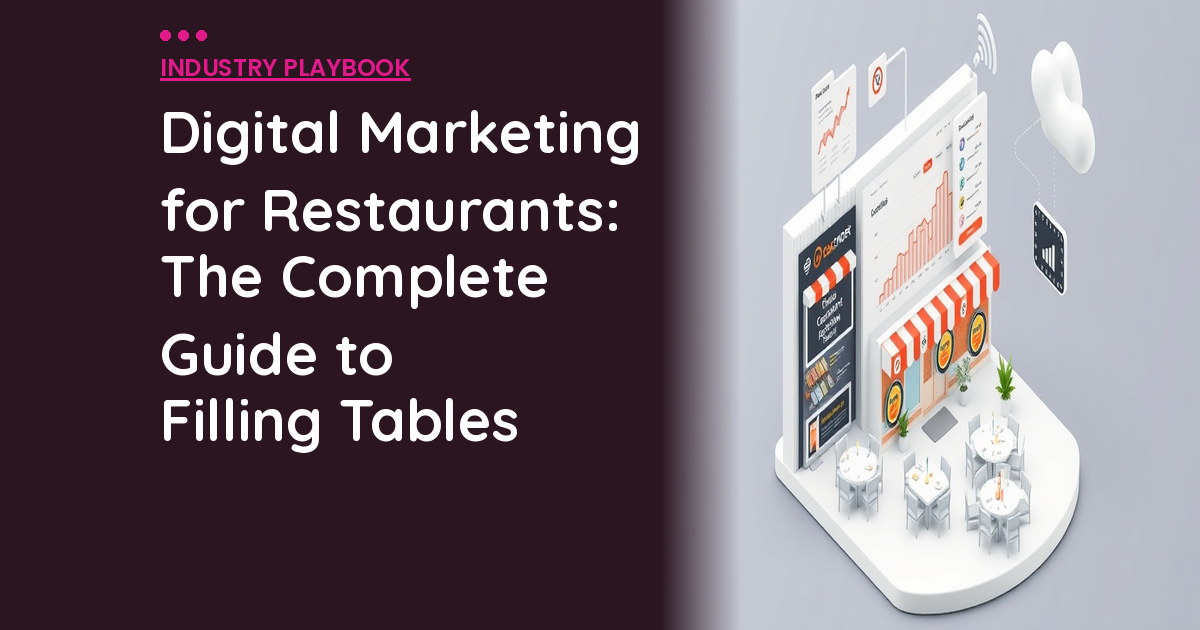
Digital Marketing for Restaurants: The Complete Guide to Filling Tables
Digital marketing for restaurants requires a focused strategy that actually drives results.
📋 Table of Contents
Why Most Restaurant Marketing Falls Flat
Let me be blunt: most restaurants are terrible at digital marketing. And I get it completely. You got into this business because you love food and hospitality, not because you wanted to become a social media manager who obsesses over Instagram engagement rates at 2am.
But here’s the reality after working with 400+ clients across every industry: the restaurants that figure out digital marketing are the ones that survive and thrive. The ones that don’t? They’re part of that brutal statistic where 80% close within five years.
Here’s what kills me about restaurant failures. It’s not always bad food or poor service. I’ve eaten at incredible restaurants that closed because no one knew they existed. Amazing chefs pouring their hearts into dishes that only twelve people per night get to experience because their marketing is nonexistent.
Digital marketing fixes that. Not with viral TikTok dances or desperate social media gimmicks (though those don’t hurt when done right), but with consistent, strategic execution across the channels that actually put butts in seats and orders in the system.
Google Business Profile: Your Digital Front Door
If you do absolutely nothing else from this article, fix this one thing: claim, optimize, and actively manage your Google Business Profile. This isn’t optional marketing fluff. It’s the single most important piece of digital real estate for any restaurant, and most of you are completely botching it.
When someone searches “restaurants near me” or “best Italian food in downtown,” Google serves up the local pack. Those three listings with the map. That’s where 90% of clicks go. If you’re not in that pack, you’re invisible. Might as well not exist.
I’ve audited hundreds of restaurant Google profiles, and the pattern is always the same. Incomplete information, outdated hours, three grainy photos from 2019, and review responses that sound like they were written by a teenager who just got fired.
Here’s what actually works. Complete every single field in your profile. Business name, address, phone number, hours including holiday hours, website link, menu link, reservation link, and all those attributes like outdoor seating and wheelchair accessibility. Google rewards completeness with better rankings.
If digital marketing for restaurants is on your radar, this guide is for you. Let’s talk about digital marketing for restaurants. Pro tip: Upload new photos every single week. Not stock photos from a marketing agency, real photos of your actual food, your actual dining room, your actual staff serving actual customers. Restaurants with 100+ photos get 520% more calls than the average listing. That’s not marketing fluff, that’s Google’s own data.
Choose the right categories carefully. Your primary category should match your main cuisine type. Italian Restaurant, Mexican Restaurant, whatever you actually serve. Then add secondary categories like Delivery Restaurant, Catering Service, or Bar if they apply to your operation.
And for the love of everything sacred in hospitality, respond to every review. Every single one. Good reviews get a genuine thank you. Bad reviews get a professional, empathetic response that shows future customers you actually care. Never argue with reviewers. Never get defensive. Future customers are reading your responses more carefully than the original reviews.
Free Template
The Ultimate Task Delegation Template
Stop guessing what to hand off. This template shows you exactly what to delegate, how to brief it, and how to QA the results.
Get the Free Template →
Local SEO: Dominating Your Neighborhood
Beyond your Google Business Profile, local SEO is how you own the search results within a 10-mile radius of your front door. You’re not trying to rank nationally for “best restaurant.” You want to dominate searches that happen in your immediate area.
Local citations are your foundation. Get your restaurant listed with consistent NAP (Name, Address, Phone) on every relevant directory. Yelp, TripAdvisor, OpenTable, Zomato, DoorDash, Uber Eats, Grubhub, your Chamber of Commerce, local food blogs, city directories. Consistency matters more than you think. If your address shows up as “123 Main St” on Google but “123 Main Street, Suite A” on Yelp, that discrepancy confuses search engines and hurts your ranking.
Your website needs location-specific content that explicitly connects your restaurant to your area. Blog posts like “Best Date Night Spots in [Your Neighborhood]” or “Where to Find Authentic [Your Cuisine] in [Your City]” help capture local search traffic from people planning their evening out.
Social Media That Actually Drives Diners

Here’s where most restaurants either go completely overboard or do nothing at all. Let me save you some time and money: you don’t need to be on every platform. You need to be genuinely great on two or three.
Instagram is non-negotiable for restaurants. Food is visual, Instagram is visual, and this is the most obvious marketing match in human history. But posting a blurry photo of today’s special with the caption “Yummy!” isn’t going to move the needle.
Invest in decent food photography. You don’t need a professional photographer every day, but you need someone who understands lighting, composition, and how to make food look irresistible on a small screen. Natural light, clean backgrounds, strategic angles, and props that tell a story about your restaurant’s personality.
Use Reels and Stories consistently. Short-form video content gets 2-3x the engagement of static posts, and the algorithm heavily favors it. Show your chef plating a complex dish in real time. Show your bartender crafting your signature cocktail. Show your team prepping for a busy Friday night. People eat with their eyes first, and they want to see the care that goes into their experience.
Facebook still matters enormously for restaurants, especially if your target demographic includes the 35-65 age range who tend to have more disposable income for dining out. Use Facebook for community engagement, event promotion, and most importantly, Facebook Ads targeting people within a specific radius of your location.
Online Ordering: Own Your Revenue Stream
Post-2020, online ordering isn’t a nice-to-have feature. It’s a revenue stream you can’t afford to ignore. But how you handle it determines whether it boosts your profits or slowly kills your margins.
Third-party platforms like DoorDash, Uber Eats, and Grubhub charge 15-30% commission on every order. That’s insane. That’s your entire profit margin on most dishes. Use these platforms for visibility and customer acquisition, but push everyone toward your own online ordering system wherever possible.
Platforms like ChowNow, Toast, or Square Online let you set up direct ordering with zero or minimal commission fees. Promote your direct ordering link everywhere. Your website, social media profiles, Google Business Profile, table tents in your dining room, even printed on your takeout bags.
Create a delivery-specific menu that highlights items that travel well. Not every dish arrives looking and tasting great after a 20-minute car ride. Nothing kills repeat delivery orders faster than soggy, lukewarm food that looks nothing like your beautiful dine-in presentation.
We break this down further in marketing implementation for online service providers: a practical guide.
Include high-quality photos for every delivery menu item. This is critical. Listings with photos get 30-40% more orders than those without. When someone’s scrolling through delivery options on their phone, you’re competing for attention with a dozen other restaurants. The visual matters enormously.
Email Marketing for Repeat Business
The money in the restaurant business isn’t in acquiring new customers. The money is in getting existing customers to come back more often, spend more per visit, and bring their friends. Email marketing is how you systematically make that happen.
Build your email list aggressively at every touchpoint. Online ordering checkout, reservation confirmations, WiFi login pages, comment cards, loyalty program signups, and your website. That WiFi trick alone can build your list faster than anything else. Offer free WiFi in exchange for an email address. People will gladly trade their email for internet access.
Send the right kinds of emails. Weekly specials and events with great photos and clear calls-to-action. Birthday and anniversary emails with special offers. Win-back campaigns for customers who haven’t visited in 60-90 days. These “we miss you” emails with special offers work incredibly well because it costs 5-7x more to acquire a new customer than to retain an existing one.
Paid Advertising That Fills Tables Tonight
Organic marketing builds your foundation over months and years. Paid advertising fills tables this week. Here’s where to spend your ad dollars for maximum ROI.
Google Ads for high-intent searches are pure gold. When someone searches “Thai restaurant open now near me” at 7pm on a Tuesday, they’re ready to eat right now. Google Ads lets you show up at the very top of those results with your menu, hours, and phone number prominently displayed.
Keep your budget modest to start. Even $500 per month can drive significant results for a local restaurant when targeted properly to high-intent keywords with location modifiers. Use call extensions and location extensions to make it easy for hungry searchers to contact you directly.
Facebook and Instagram ads work differently. They’re about putting your restaurant in front of people who aren’t actively searching but match your ideal customer profile. Target by location radius, age demographics, interests like dining out and specific cuisines, and behavioral patterns.
Video ads showing your food being prepared outperform static images by 340% for restaurant advertising.
For industry research and benchmarks, check out Think with Google.
Digital Loyalty Programs That Actually Work
The punch card is dead. Digital loyalty programs give you customer data, drive repeat visits, and let you personalize the experience in ways that create customers for life.
Modern platforms like Square Loyalty, Toast, or Thanx integrate directly with your POS system and track purchases automatically. The best programs offer tiered rewards where the more a customer spends, the better the perks they unlock. This creates genuine VIP experiences for your highest-value guests.
Use your loyalty program data to personalize marketing. If you know a customer orders the same dish every Wednesday, surprise them with a complimentary appetizer on their fifth visit. That kind of personalized experience creates word-of-mouth marketing you can’t buy.
Your Website: Mobile-First Essentials
Your restaurant website doesn’t need to win design awards, but it absolutely needs to do a few things perfectly on mobile devices. Over 75% of restaurant searches happen on phones. If your website isn’t fast and intuitive on a small screen, you’re hemorrhaging potential customers.
Put your menu front and center. Don’t make people hunt through multiple clicks to find what you serve. And please, for everyone’s sanity, don’t upload a PDF menu. Use an HTML menu that’s easy to read on any device and that search engines can actually crawl and index.
One-click access to online ordering and reservations. Every extra click between “I want to eat here” and “My order is placed” is a lost customer who went to your competitor instead. Our guide on website navigation best practices covers exactly how to structure this for maximum conversions.
Content Marketing Without Becoming a Media Company
I know what you’re thinking. “I run a restaurant, not a content studio.” But content marketing helps you rank in search results, build authority in your community, and connect with customers on a deeper level than “today’s special is salmon.”
You don’t need to blog daily or become a food influencer. A few high-quality posts per month can make a meaningful impact on your search rankings and community presence.
Share simplified versions of popular dishes as recipes. It builds goodwill and positions your chef as an authority worth seeking out. Write behind-the-scenes stories about where you source ingredients, how you develop new menu items, or profiles of team members who’ve been with you for years.
Create local guides that position your restaurant as a community hub. “Best Things to Do in [Your Neighborhood] This Weekend” attracts local search traffic and shows prospective customers that your restaurant sits at the center of an interesting area worth exploring.
If you host events, write about them afterwards with photos and customer testimonials. This creates a content library that shows prospective diners your restaurant is vibrant, active, and consistently full of happy people. Having a strategic content calendar keeps your marketing consistent without overwhelming your already busy schedule.
Reputation Management Is Everything
In the restaurant industry, your online reputation literally is your marketing. A single negative review on Google or Yelp can cost you thousands in lost revenue as people scroll past your listing to try somewhere else.
Monitor reviews across all platforms religiously. Set up Google Alerts for your restaurant name. Check Yelp, TripAdvisor, Facebook, and every delivery platform weekly. Tools like ReviewTrackers can aggregate all your reviews in one dashboard so you’re not logging into twelve different platforms.
Generate more positive reviews by asking at exactly the right moment. When a customer compliments the food, when they’re paying the bill and clearly satisfied, or in a follow-up email after a great online ordering experience. Make it easy with direct links to your Google review page.
Watch out: Never offer incentives for reviews. That violates most platforms’ terms of service and can get your entire listing penalized. You can absolutely ask happy customers to share their experience, but don’t offer discounts or freebies in exchange.
Measuring What Actually Matters
Digital marketing without measurement is just expensive guessing. Track metrics that connect directly to revenue, not vanity numbers that make you feel good but don’t pay the bills.
Google Business Profile insights show you views, searches, direction requests, phone calls, and website clicks. These numbers tell you whether your local SEO efforts are actually driving foot traffic.
Website analytics reveal traffic sources, top-performing pages, bounce rates, and conversion rates on online orders and reservations. Social media metrics that matter are engagement rate (not follower count), reach, saves, shares, and click-throughs to your website or ordering system.
Email marketing success is measured by open rates, click rates, and most importantly, redemption rates on special offers. Can you trace specific campaigns to actual revenue? UTM tracking codes and unique promo codes help connect marketing activities to real sales data.
For businesses serious about scaling their marketing efforts efficiently, understanding how to properly measure marketing ROI becomes essential for making smart budget decisions.
Stop Trying to Do Everything Yourself
Here’s my honest advice after working with hundreds of restaurant owners: the ones who try to handle all their own marketing burn out. You should be in your restaurant, managing your team, ensuring food quality, and creating amazing experiences for guests. That’s where your expertise creates the most value.
The smart restaurant groups I work with outsource the marketing execution while maintaining control over strategy and brand voice. Whether it’s social media management, email design, website updates, or ad creative, having a dedicated team handle the technical execution lets you focus on what you do best.
This isn’t about being lazy or giving up control. It’s about recognizing that marketing requires consistent daily attention, and your attention is better spent on the hundred other decisions that only you can make. The right outsourcing strategy actually gives you more control over results because things get done consistently instead of when you finally have time between inventory counts and staff meetings.
Build Your Restaurant’s Digital Presence
Digital marketing for restaurants isn’t complicated, but it does require consistency, strategy, and execution. The restaurants that commit to showing up digitally with great photos, responsive engagement, smart advertising, and genuine community connections are the ones building loyal customer bases and sustainable revenue streams.
The choice is simple. You can keep winging it with occasional social media posts and hope people stumble across your restaurant. Or you can build a systematic approach that consistently drives new customers through your door while bringing existing customers back more often.
At DeskTeam360, we work with restaurant owners who are tired of inconsistent marketing results and ready to build systems that actually work. We handle the design, development, and daily execution while you focus on creating incredible dining experiences that keep customers coming back.
Free 5-Minute Video
See How DeskTeam360 Works in Under 5 Minutes
Watch the short video and see exactly how we handle design, development, and marketing implementation — so you don't have to.
Watch the Video →