

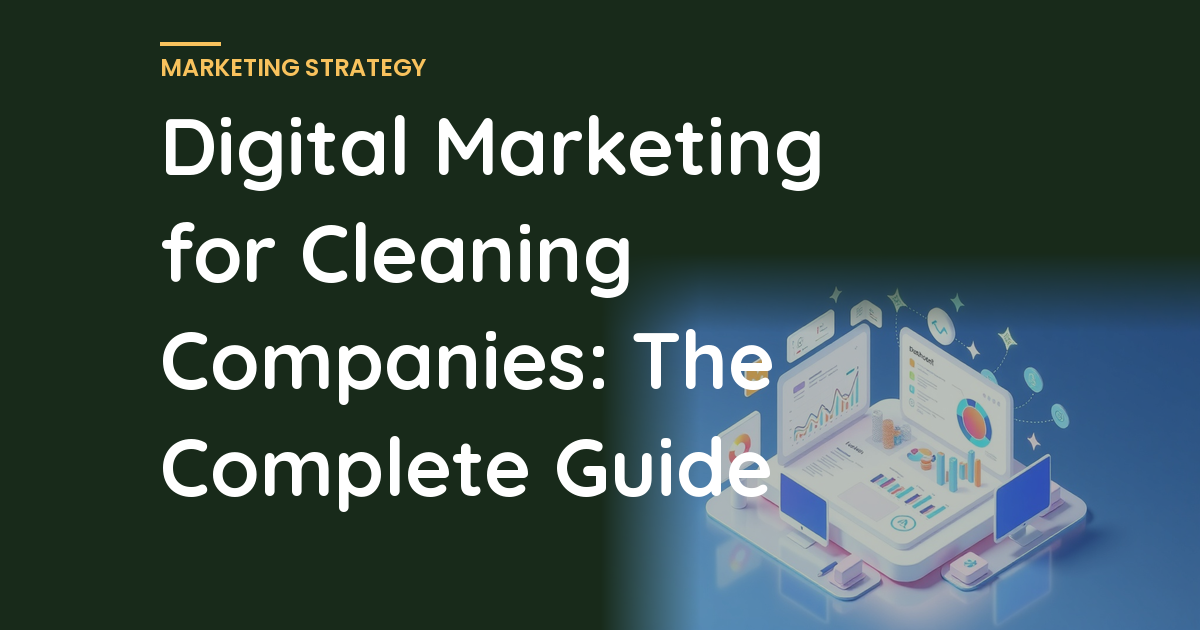
Digital Marketing for Cleaning Companies: The Complete Guide
Why Most Cleaning Companies Are Invisible Online
Let’s talk about digital marketing for cleaning companies. Your cleaning service does incredible work. You transform cluttered offices into productivity powerhouses and turn chaotic homes into peaceful sanctuaries. Your customers love you. But here’s the problem: the people who desperately need your services can’t find you.
📋 Table of Contents
I see this constantly. Cleaning companies with stellar reputations, decades of experience, and waiting lists for existing customers, but their phone isn’t ringing with new leads. Meanwhile, their competitors with basic websites are booked solid because they figured out digital marketing first.
The frustrating part? Digital marketing for cleaning companies isn’t rocket science. It’s just different from other industries, and most marketing advice misses the mark completely. Here’s exactly what works, no fluff, just the proven playbook we’ve used to help 400+ clients get found online.
The Five-Channel Marketing Framework
Successful cleaning company marketing isn’t about doing everything. It’s about doing the right five channels consistently. Skip any of them and you’re leaving money on the table. Try to do ten channels at once and you’ll do all of them poorly.
Pro tip: Start with Google My Business and paid search first. These two channels alone can double your lead volume in 60 days. Once those are dialed in, layer on the other three. This sequence matters because it builds momentum and cashflow to fund the rest.
Channel 1: Google My Business Optimization
This is your biggest opportunity and the one most cleaning companies completely botch. When someone searches “office cleaning near me” or “house cleaning services,” Google My Business listings dominate the top of search results. Not traditional website listings, not ads, the map pack.
Here’s what your Google My Business listing actually needs: professional photos of your team in action (not stock photos), recent customer reviews with detailed responses from you, accurate business hours and service areas clearly marked, and a complete service list with specific keywords like “post-construction cleanup” and “weekly office maintenance.”
The biggest mistake I see? Cleaning companies that list “cleaning services” as their description and wonder why they don’t rank. Google needs specifics. “Commercial janitorial services for medical offices” beats “professional cleaning” every time.
Channel 2: Paid Search Advertising
Google Ads for cleaning services is pure gold when done right, and complete waste when done wrong. The difference comes down to understanding search intent and bid strategy.
People searching for cleaning services fall into three categories. Immediate need searchers use terms like “house cleaning today,” “emergency office cleaning,” and “move-out cleaning service.” These convert at 15-25% and justify higher bids. Research phase searchers look up “cleaning service prices,” “commercial cleaning companies,” and “best house cleaners.” They convert at 3-8% but cost less. And comparison shoppers search “cleaning services near me,” “office cleaning quotes,” and specific competitor names.
Instead of “Professional Office Cleaning Services,” try “Get Your Weekends Back with Weekly House Cleaning” or “Impress Clients with Spotless Office Spaces.” The difference in click-through rates is dramatic.
Channel 3: Local SEO Content Marketing
This is where most cleaning companies either overthink it or skip it entirely. You don’t need to become a content factory. You need 20-30 pieces of locally-focused, service-specific content that answer your prospects’ actual questions.
The content that works for cleaning companies: “Office Cleaning Checklist for [Your City]” posts, before-and-after case studies with specific client challenges, seasonal cleaning guides (“Spring Office Deep Clean”), pricing transparency pages, and employee spotlights that build trust.
For more on this, check out our guide on ai marketing tools: the complete guide for 2026.
The content that doesn’t work: generic cleaning tips everyone already knows, overly promotional “hire us” posts, and blog content that could apply to any city or any cleaning company. Local specificity and practical value beat generic advice every time.
Channel 4: Review and Reputation Management
Social proof drives cleaning service purchases more than almost any other factor. People are letting you into their most private spaces, trust is everything. But most cleaning companies treat reviews as a “nice to have” instead of the marketing engine they actually are.
Here’s what systematic review generation looks like: ask for reviews immediately after exceptional service, not weeks later when the experience fades. Make it stupidly easy with direct links in follow-up texts. Respond to every review, positive and negative, within 24 hours. Display reviews prominently on your website homepage.
The review velocity rule: you need 3-5 new reviews per month minimum. Below that threshold, potential customers assume you’re either new, struggling, or not actively serving clients. Above it, you signal momentum and current activity.
Channel 5: Strategic Social Media
Most cleaning companies approach social media all wrong. They post generic cleaning tips and motivational quotes thinking that builds a following. It doesn’t. What works is documentation of your actual work and the people behind the business.
Content that converts: time-lapse videos of office transformations, team members explaining specialized techniques, client testimonials recorded on-site, before-and-after photos with specific challenges called out, and behind-the-scenes content that humanizes your business.
The platforms that matter for cleaning services: Facebook for residential clients (they’re researching and sharing recommendations in local groups), LinkedIn for commercial prospects (facility managers and office administrators hang out here), and Instagram for showcasing visual transformations.
Free 5-Minute Video
See How DeskTeam360 Works in Under 5 Minutes
Watch the short video and see exactly how we handle design, development, and marketing implementation — so you don't have to.
Watch the Video →
The Marketing Calendar That Actually Works
Random, sporadic marketing efforts don’t work for cleaning companies. You need consistent touchpoints because people don’t decide to hire cleaners on a schedule. They decide when their current situation becomes unbearable or when their circumstances change.
Weekly non-negotiables: Post 2-3 pieces of social content showing actual work, send review requests to last week’s satisfied customers, update Google My Business with fresh photos or posts, and check and respond to all online reviews and messages.
Monthly deep work: Analyze which lead sources are converting to paying customers, update service pages with new keywords you’re tracking, create one substantial piece of content (case study, local guide, or process explanation), and review and adjust paid search campaigns based on performance data.
Quarterly strategy sessions: Survey current customers about their experience and referral opportunities, analyze competitor activity and adjust positioning, review pricing and service packages based on market feedback, and plan seasonal campaigns for high-demand periods.
Watch out: Don’t chase every new platform or trend. I’ve seen cleaning companies waste months trying to crack TikTok while ignoring Google My Business optimization. Stick to the five channels, do them well, then expand if you have capacity.
Pricing Your Digital Marketing Investment
Here’s what most cleaning companies get wrong about marketing budgets: they think of marketing as an expense instead of an investment in a predictable lead generation system. That mindset shift changes everything.
For residential cleaning services: budget 5-8% of monthly revenue for marketing, with 60% going to paid search and Google My Business, 25% to review management and social media content creation, and 15% to website optimization and content marketing.
We covered this in detail in our post about marketing implementation for online service providers: a practical guide.
For commercial cleaning services: budget 8-12% of monthly revenue, with 70% going to paid search and LinkedIn advertising, 20% to content marketing and case study creation, and 10% to networking events and referral programs.
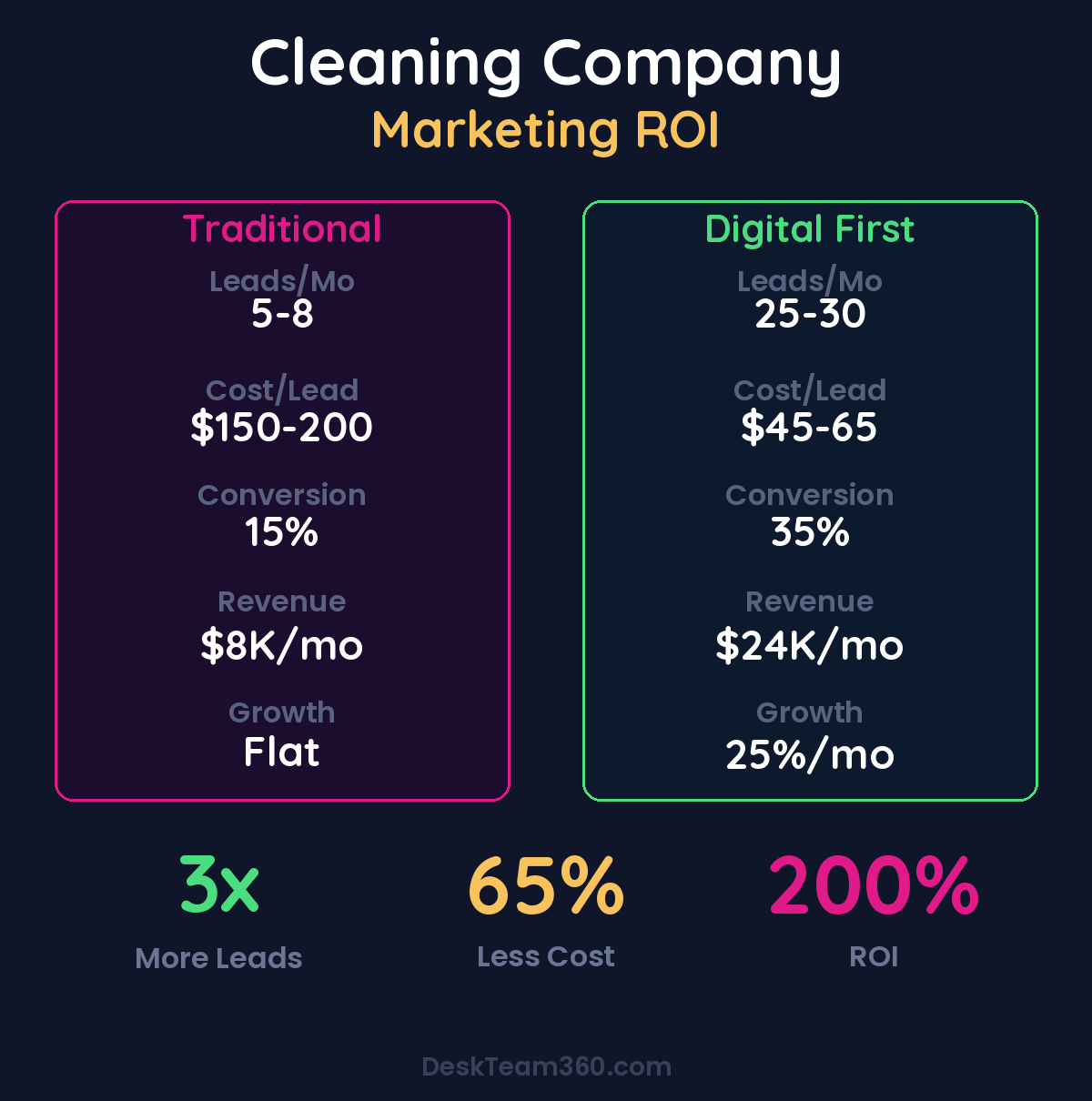
The math works like this: a $1,000 monthly marketing investment should generate 15-20 qualified leads. Of those, 3-5 convert to paying customers. For residential services averaging $150/month, that’s $450-750 in new monthly recurring revenue. For commercial contracts averaging $800/month, that’s $2,400-4,000 in new MRR.
The lifetime value makes it even more compelling. Residential customers typically stay 18-24 months, commercial customers 3-5 years. Your $1,000 marketing investment can generate $15,000-60,000 in total customer value. Those are the economics that let you scale systematically.
Common Digital Marketing Mistakes That Kill ROI
I’ve seen cleaning companies make the same five mistakes repeatedly. Here’s how to avoid each one.
Mistake #1: Competing on price in your marketing. The moment you lead with “Lowest Prices Guaranteed” or “Beat Any Quote,” you’re attracting price shoppers who will leave you for the next company that undercuts by $5. Instead, compete on reliability, thoroughness, and peace of mind.
Mistake #2: Ignoring local search optimization. If someone in your service area can’t find you when they search for cleaning services, your marketing budget is wasted. Local SEO isn’t optional for cleaning companies, it’s the foundation everything else builds on.
Mistake #3: Treating all leads equally. A commercial facility manager researching janitorial services has completely different needs than a busy parent looking for weekly house cleaning. Your marketing messages, landing pages, and follow-up sequences should reflect those differences.
Companies that segment their marketing by customer type see 60% higher conversion rates and 40% lower customer acquisition costs compared to those using one-size-fits-all messaging.
Mistake #4: No follow-up system for leads. Cleaning services are considered purchases, people research multiple options before deciding. If you quote a job and disappear, you’re leaving money on the table. A systematic follow-up sequence doubles your conversion rate.
Mistake #5: Neglecting your existing customers in favor of new lead generation. Your current customers are your best source of referrals and additional services. Marketing to retain and expand existing relationships often delivers better ROI than constantly chasing new prospects.
Measuring Success: The Metrics That Matter
Most cleaning companies track the wrong metrics or don’t track anything at all. Here’s what actually matters for growing your business.
Lead generation metrics: Total qualified leads per month (people actually ready to hire), cost per lead by source (helps you double down on what works), and lead-to-customer conversion rate (reveals where your sales process needs work).
Customer value metrics: Average contract value for new customers, customer lifetime value by acquisition source, and monthly recurring revenue growth rate. Understanding how to measure marketing ROI properly is crucial for scaling what works.
We break this down further in how to create email marketing templates that actually convert.
Operational metrics: Time from lead to quote, quote-to-close rate, and referral rate from existing customers. These reveal operational bottlenecks that no amount of marketing can fix.
Building Your Marketing Team vs. Outsourcing
Every growing cleaning company faces this question: should we hire marketing staff or work with an agency? The answer depends on your current revenue, growth goals, and management bandwidth.
Build in-house if you’re doing $75K+ monthly revenue, have someone internally who can manage marketing people, and want complete control over strategy and execution. The typical in-house marketing hire for cleaning companies costs $4,500-6,500/month in salary and benefits, plus tools and advertising spend.
Outsource if you’re under $75K monthly revenue, don’t have management bandwidth for another department, or want proven systems without the trial-and-error phase. A specialized marketing partner typically costs $3,000-8,000/month but comes with established processes and immediate expertise.
The hybrid approach is hiring for operations and customer service while outsourcing marketing strategy and execution. This lets you focus on service delivery while professionals handle lead generation. Our guide on reducing website bounce rates covers the technical optimization side most cleaning companies struggle with internally.
Seasonal Marketing Strategies
Cleaning services experience predictable seasonal patterns, and smart marketing adjusts for them.
Spring surge (March-May): Spring cleaning mentality drives residential demand up 35%. Focus on deep cleaning services, move-out cleaning for relocations, and office refreshes after long winters. Your content should emphasize renewal and fresh starts.
Summer sustain (June-August): Vacation schedules disrupt commercial cleaning but residential stays strong. Market vacation cleaning services (prep homes before trips, maintain while away), and focus on acquiring commercial accounts for fall starts.
Fall ramp-up (September-November): Back-to-school and back-to-office drives commercial cleaning demand. Target new businesses opening, expanding companies, and facilities preparing for year-end. This is prime time for commercial prospecting.
Holiday preparation (December-February): Holiday parties create commercial cleaning opportunities while residential customers want homes ready for entertaining. Market pre-party preparation and post-party cleanup packages.
Start Your Digital Marketing System Today
Digital marketing for cleaning companies isn’t about having the fanciest website or the most creative social media posts. It’s about consistently showing up where your ideal customers are looking, with messaging that speaks to their real needs, and systems that turn those interactions into profitable relationships.
The five-channel framework works because it covers the entire customer journey, from initial awareness through decision and retention. Most of your competitors are doing one or two channels inconsistently. Do all five systematically and you’ll dominate your local market.
At DeskTeam360, we’ve built these exact systems for cleaning companies ranging from solo operations to multi-location enterprises. We handle the marketing complexity so you can focus on delivering exceptional cleaning services and growing your business.
Free Tool
How Much Is Freelancer Management Really Costing You?
Most agency owners have never done this math. Plug in a few numbers and see your real cost in 2 minutes.
Calculate Your Hidden Costs →