


Digital Marketing for Construction Companies: The Complete Guide
The Cold Truth About Digital Marketing for Construction Companies
It’s 2 PM on a Tuesday. A commercial property manager needs a tenant improvement done ASAP. They Google “commercial construction companies near me” and start calling. Your competitor shows up first in the search results with 47 five-star reviews and a portfolio full of similar projects. You don’t show up until page three.
Guess who gets the call?
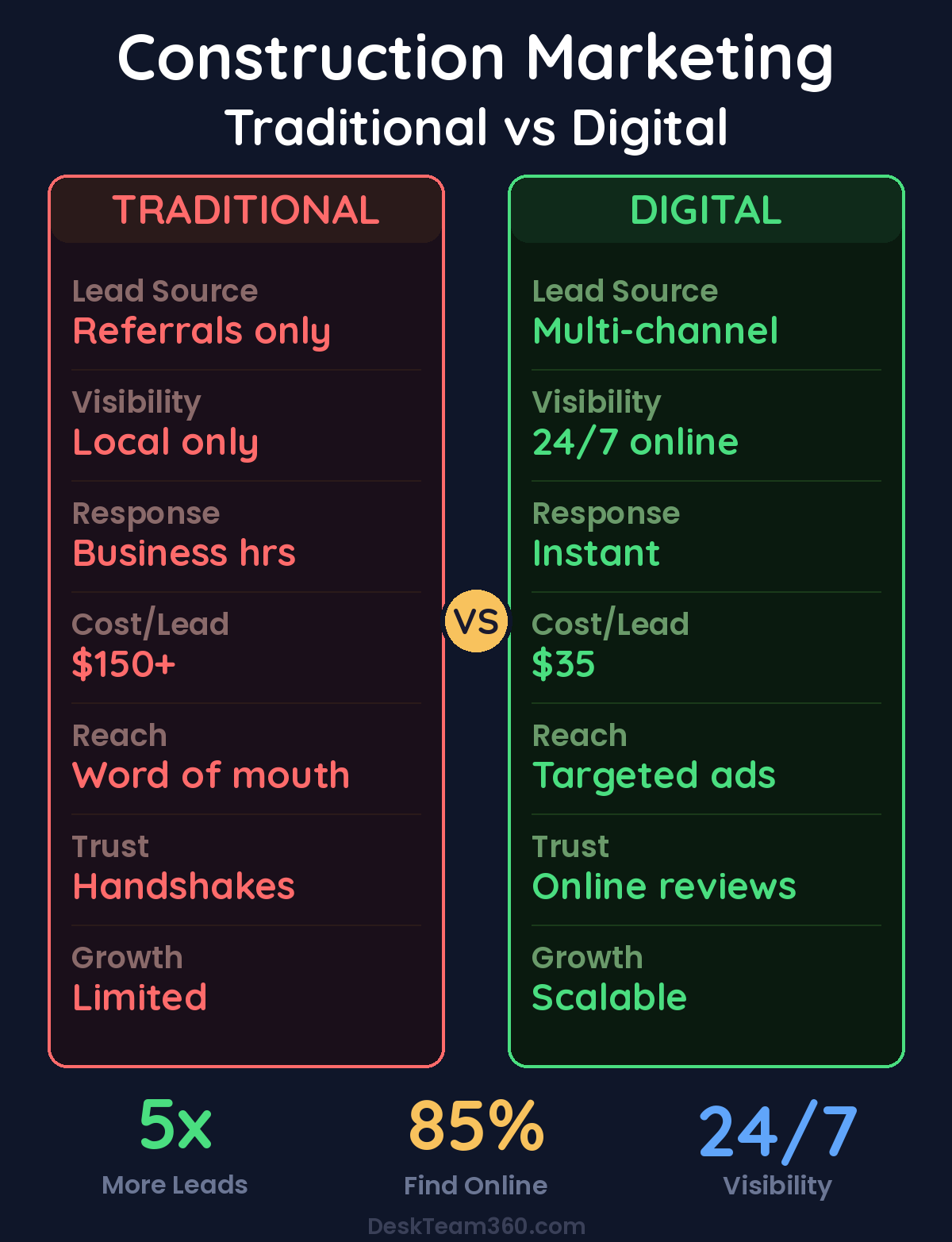
I’ve been running agencies for 12+ years across dozens of industries, and construction is the most underserved when it comes to digital marketing. Most construction companies are still operating like it’s 1995, relying entirely on handshakes and referrals while their potential clients are researching contractors online at 11 PM on their phones.
Here’s the brutal reality: 85% of people search online before hiring a contractor. They’re not finding you at the chamber meeting. They’re finding your competitor who invested in their online presence while you were ignoring yours.
The good news? This creates a massive opportunity. While your competition is still printing business cards and hoping for referrals, you can build a lead generation engine that works 24/7. Here’s exactly how to do it.
Your Website: More Important Than Your Business Cards
Think of your website as your digital storefront. If someone drove past your office and it looked like it hadn’t been updated since 2008, would they trust you with a $500K renovation? That’s exactly what a terrible website communicates.
Most construction company websites are disasters. Blurry photos, no clear service descriptions, contact forms that don’t work on mobile, and zero evidence of actual completed projects. If that’s your website, you’re hemorrhaging leads to competitors who figured this out.
What Your Website Actually Needs
A professional project portfolio is your most powerful sales tool. Before-and-after photos, detailed project descriptions, timelines, and client testimonials for each job. Potential clients want to see work that’s similar to what they need, not generic “we do construction” messaging.
Photography matters more than you think. Invest in professional photography for your best 10-15 projects. Capture before, during, and after shots. Include drone photography for large commercial projects because it instantly elevates your credibility. Show your team in action with proper safety gear and equipment. This isn’t Instagram, but it needs to look professional.
Create individual service pages for each service line. Don’t dump everything into one “services” page. Commercial construction, residential remodeling, design-build, tenant improvements, and pre-construction services each need their own detailed page. Each page should target specific search terms and address the unique concerns buyers have for that service.
Your About page needs to build trust, not stroke your ego. People are handing you hundreds of thousands of dollars. They need to see your team with names, roles, photos, and experience. List your licenses and certifications prominently. Include your safety record and OSHA certifications. Show your insurance and bonding information. Years in business matters. Industry associations matter. All of it builds trust.
Make your geographic service areas crystal clear. Construction is inherently local. Don’t make people guess whether you serve their area. List cities, counties, and regions explicitly. If you serve multiple areas, create location-specific pages with real content, not copy-paste jobs with the city name swapped.
Mobile optimization isn’t optional. Property managers, developers, and homeowners are searching on their phones. Your photos need to load fast and look great on mobile. Your phone number needs to be click-to-call. Your contact form needs to work perfectly on a 6-inch screen. A broken mobile experience tells potential clients that if this is how you handle your website, imagine how you’ll handle their project.
Free 5-Minute Video
See How DeskTeam360 Works in Under 5 Minutes
Watch the short video and see exactly how we handle design, development, and marketing implementation — so you don't have to.
Watch the Video →
Google Business Profile: Your Digital Yellow Pages Entry
For construction companies, your Google Business Profile might be more important than your website. When someone searches “construction company near me,” Google shows the Map Pack with three local businesses before any other results. If you’re not in that Map Pack, you’re losing leads every day.
How to Actually Optimize Your Google Business Profile
Complete every single field. Business name, address, phone, website, hours, service areas, business description, and all applicable categories. Google rewards complete profiles with better visibility.
Choose your primary category carefully. “General Contractor” or your most relevant specialty. Then add every secondary category that applies: commercial construction, home builder, remodeler, design-build contractor. More relevant categories mean more ways to be found.
Upload 20+ high-quality photos and add new ones monthly. Project photos, team photos, office photos, equipment photos. Google tracks photo engagement and uses it for ranking. Fresh photos signal an active business.
Publish Google Business posts weekly. Project completions, awards, team news, community involvement. These posts show up in your search results and prove you’re actively operating.
Pro tip: Add a service list with descriptions for every service you offer. Most contractors skip this, but it’s free keyword real estate that improves your visibility for specific searches like “tenant improvement contractor” or “commercial renovation.”
Reviews: The Currency of Trust
Reviews aren’t just nice to have. They’re the deciding factor between getting the call and losing to a competitor. A company with 47 five-star reviews will get hired over a company with 3 reviews every single time, even if the second company is better.
Ask for reviews systematically, not randomly. When a project wraps up and the client is happy, ask for a Google review immediately. Make it easy with a direct link. Follow up by email one week later with another request. Most people intend to leave a review but forget, so the follow-up actually helps.
Respond to every review, positive and negative. Potential clients read your responses as much as the reviews themselves. Thank people for positive reviews specifically. Address negative reviews professionally, acknowledge the issue where appropriate, and offer to resolve it offline. How you handle criticism tells potential clients everything about your character.
Target five new reviews per month minimum. Consistent review velocity signals to Google and to potential clients that you’re actively operating and delivering good work. Our guide on getting Google reviews covers the complete strategy.
Content Marketing That Actually Works for Construction
“But we’re a construction company, who’s going to read our blog?” More people than you think, if you write about the right topics. Your content should target the people who hire construction companies: property developers, facility managers, business owners planning expansions, and homeowners planning major renovations.
Content Ideas That Generate Leads
Cost guides perform exceptionally well. “How Much Does Commercial Tenant Improvement Cost in Phoenix?” People search for cost information before anything else. Give them real numbers, ranges, and factors that affect pricing. Be specific about your market.
Process explainers demystify construction for clients who’ve never done this before. “What to Expect During a Commercial Build-Out: A Step-by-Step Guide” addresses the anxiety most clients feel about the construction process. Walk them through permitting, planning, construction phases, and handover.
Project showcases work better than generic portfolio pages. Write detailed case studies of completed projects with timelines, challenges you encountered, and how you solved them. Include the client’s goals, budget considerations, and results. These pieces rank well for project-specific searches and build trust.
Local market content captures hyper-local search intent. “Commercial Construction Trends in Austin for 2025” or “New Building Codes Affecting Dallas Renovations” shows you understand your specific market and serves people searching for local expertise.
Video content is uniquely powerful for construction. Drone footage of project progress, walkthrough tours of completed projects, and behind-the-scenes content showing your team working builds trust in ways photos can’t match.
Video That Converts Browsers Into Clients
Video shows what photos can’t: scale, progress, and craftsmanship in motion. Monthly drone flyovers of active projects create compelling time-lapse content. Project walkthrough tours with your project manager explaining key features work exceptionally well for attracting similar projects.
Behind-the-scenes content humanizes your company. Show your team working, safety meetings, and quality checks. Client testimonial videos filmed on-site with the completed project in the background are infinitely more credible than written testimonials.
Educational content attracts future clients through value. “How Concrete Foundations Are Built” or “What Goes Into a Commercial HVAC Installation” positions you as an expert while building trust with people planning similar projects.
SEO: Being Found When It Matters
Search engine optimization for construction is primarily local SEO. You need to show up when someone in your service area searches for your services. The keyword patterns that matter are service plus location, service plus cost, and “near me” searches.
“Commercial construction Atlanta,” “kitchen remodel Denver,” “general contractor near me,” and “office build-out cost per square foot” are the types of searches driving qualified traffic. Target these systematically with dedicated pages and location-specific content.
Local SEO Tactics That Work
Your business name, address, and phone number must be identical across your website, Google Business Profile, and every directory listing. Inconsistent information confuses Google and hurts your local rankings.
List your business on industry directories like Houzz, HomeAdvisor, BuildZoom, and Angi. Also claim your listings on local business directories and chamber of commerce websites. Each citation helps reinforce your local presence.
If you serve multiple cities, create unique pages for each with location-specific content. Don’t just copy-paste the same text with different city names. Include local landmarks, building codes, permit requirements, or market conditions specific to each area.
Implement local business schema markup on your website. This helps Google understand your business details and can improve your appearance in local search results. For technical SEO guidance, our technical SEO checklist covers the essentials.
Safety as a Marketing Advantage
Most construction companies completely miss this, but your safety record and certifications are powerful marketing differentiators. Smart clients, especially commercial ones, care deeply about safety. A construction company with OSHA 30-hour certifications, an EMR (Experience Modification Rate) below 1.0, and zero lost-time incidents has a massive competitive advantage.
Create a dedicated safety page on your website listing certifications, training programs, EMR rating, and incident statistics. Include safety in every proposal and bid. Share safety meeting photos and certification completions on social media. Write blog content like “How We Maintain Our Zero Lost-Time Incident Record” to differentiate from competitors who don’t prioritize safety.
Watch out: Don’t market safety credentials you don’t have. Exaggerating or lying about safety records will backfire spectacularly when clients verify your claims during the bidding process.
For more on this, check out our guide on marketing implementation for online service providers: a practical guide.
Social Media Strategy for Construction
Social media for construction isn’t about going viral. It’s about staying visible and building trust with your community over time. The goal is consistent presence, not massive follower counts.
Facebook remains the most effective platform for local construction companies. Share project updates, team highlights, community involvement, and behind-the-scenes content. Facebook Groups for local business and real estate communities provide networking opportunities.
Instagram works well for showcasing beautiful project photography. Before-and-after posts, drone footage, and team content perform well. Instagram Reels showing quick transformation clips get excellent engagement from both potential clients and industry peers.
LinkedIn is essential for commercial construction companies. Connect with property managers, developers, architects, and facility directors. Share thought leadership content, project completions, and industry insights. LinkedIn is where commercial clients research contractors.
YouTube has exceptional longevity. Project walkthroughs, drone footage compilations, educational content, and time-lapse videos can generate leads for years. The platform’s search function makes it a valuable long-term investment.
Content Calendar for Construction Social Media
Post weekly project progress updates. “Transformation Tuesday” before-and-after reveals work well across all platforms. Introduce crew members with team spotlights. People love seeing heavy machinery in action, so equipment spotlights perform well.
Safety moment posts highlight your safety culture. Community involvement including charity builds, sponsorships, and volunteering shows you’re invested in your area. Client testimonials and project handover celebrations demonstrate success and satisfaction.
Paid Advertising That Generates Quality Leads
Google Ads delivers the most direct lead generation for construction companies. When someone searches “commercial general contractor [city],” they’re actively looking to hire. That’s high-intent traffic worth paying for, even at $15-50 per click.
Target service plus location keywords like “commercial construction Miami” or “office renovation San Francisco.” Use call extensions because many construction leads prefer calling to filling out forms. Create specific landing pages for each service you’re advertising rather than sending traffic to your homepage.
Construction companies using service-specific landing pages see 40% higher conversion rates than those sending ad traffic to generic pages.
For industry benchmarks and research, see WordStream.
For industry research and benchmarks, check out HubSpot Marketing Blog.
We break this down further in how to create email marketing templates that actually convert.
Budget $50-100 per day to start and optimize based on lead quality. Use negative keywords like “jobs,” “salary,” and “DIY” to exclude non-buyer searches. Track cost per lead and lead-to-contract conversion rates to optimize your spend.
Facebook and Instagram ads work better for awareness and retargeting than direct lead generation. Stunning before-and-after carousels targeted to property owners and business owners in your service area build brand recognition. Retargeting ads shown to people who visited your website but didn’t contact you can capture leads who weren’t ready the first time.
For landing page optimization guidance, our landing page creation guide covers conversion best practices.
Email Marketing: The Neglected Goldmine
Construction companies rarely use email marketing, which means there’s almost no competition in your prospects’ inboxes. This creates a massive opportunity for companies willing to do it consistently.
Build your email list by adding capture forms to your website offering project guides, cost calculators, or planning checklists. Collect emails at trade shows, community events, and networking functions. Ask satisfied clients if they’d like to receive project updates and industry news.
Send a monthly newsletter featuring a completed project, team spotlight, construction tip, and call-to-action. Seasonal preparation guides like “Getting Your Property Ready for Winter Construction” provide value while keeping you top of mind. Share project completion announcements with your network to showcase recent work.
Market update emails covering construction cost trends, material pricing changes, and local development news position you as a knowledgeable industry resource. Keep it simple and consistent. One email per month is enough to stay visible without being annoying.
Measuring What Matters
Construction projects have long sales cycles, sometimes months from first contact to signed contract. Track these metrics to measure your digital marketing effectiveness: website traffic by source, lead volume and source, cost per lead by channel, lead-to-proposal rate, proposal-to-contract rate, average project value, and customer acquisition cost.
Even basic lead source tracking provides valuable optimization data. Ask every caller “how did you find us?” and track the responses. This simple question reveals which marketing channels deserve more investment and which ones to eliminate.
Track Google Business Profile views, calls, and direction requests monthly. Monitor review velocity and average rating. Watch your local search rankings for key service terms. These metrics indicate local visibility improvement over time.
For comprehensive measurement strategies, our marketing ROI measurement guide covers tracking methodologies.
The Reputation Management Reality
In construction, your reputation precedes every bid and proposal. Digital reputation management lets you control that narrative online instead of hoping for the best.
Set up Google Alerts for your company name and monitor Google reviews, Yelp, Houzz, and BBB weekly. Respond to every review, positive and negative, within 48 hours. Track mentions on social media and industry forums.
Build trust through radical transparency. Publish your license and insurance details on your website. Share your safety record openly. Provide detailed, written estimates instead of vague ballpark numbers. Document your process so clients know what to expect at every stage. Show real project timelines, including challenges and how you solved them.
Building Your Digital Marketing Foundation
Start with the basics: a professional website with a strong project portfolio, an optimized Google Business Profile, and a systematic review collection process. These three elements form the foundation everything else builds on.
Layer on content marketing, local SEO, and targeted advertising as your digital presence matures. Don’t try to do everything at once. Pick two or three channels, execute them well, then expand.
The construction companies that dominate the next decade won’t just be the ones doing the best work. They’ll be the ones the most people know about. While your competitors wait for referrals and handshakes, you can build a lead generation engine that never sleeps.
Your choice is simple: adapt to how clients find contractors today, or watch them find your competitors instead. The technology exists. The proven strategies are available. The only question is whether you’ll use them before your competition does.
Free Template
The Ultimate Task Delegation Template
Stop guessing what to hand off. This template shows you exactly what to delegate, how to brief it, and how to QA the results.
Get the Free Template →