
SEO vs PPC: Which Is Better for Your Business in 2025?
Why This Question Keeps Coming Up Wrong
The seo vs ppc debate comes up a lot, and for good reason. Here’s the conversation I have with clients at least three times a week: “Should we do SEO or PPC?” And every time, I want to shake them. It’s like asking if you should eat vegetables or drink water. You need both.
📋 Table of Contents
But I get it. You’ve got limited budget and time. Some marketing consultant told you to “pick a lane.” Or maybe you tried PPC and burned through $3,000 with nothing to show for it. Now you’re thinking SEO is the “free” alternative.
None of that changes the fact that this is the wrong question. After implementing marketing strategies for 400+ clients over 12+ years, I can tell you exactly when to use each one, how they work together, and why treating them as competitors instead of teammates is costing you customers.
The Real Difference Between SEO and PPC
Let me cut through the marketing fluff and explain what these actually are. SEO is about building authority and visibility over time. You create content, optimize pages, earn links, and gradually climb search rankings. It’s compound growth, results take 6-12 months to really show up, but once they do, the traffic is essentially free forever.
PPC is about buying instant visibility. You write ads, set budgets, and show up in search results immediately. It’s linear growth, you get results in 1-7 days, but the minute you stop paying, the traffic disappears completely.
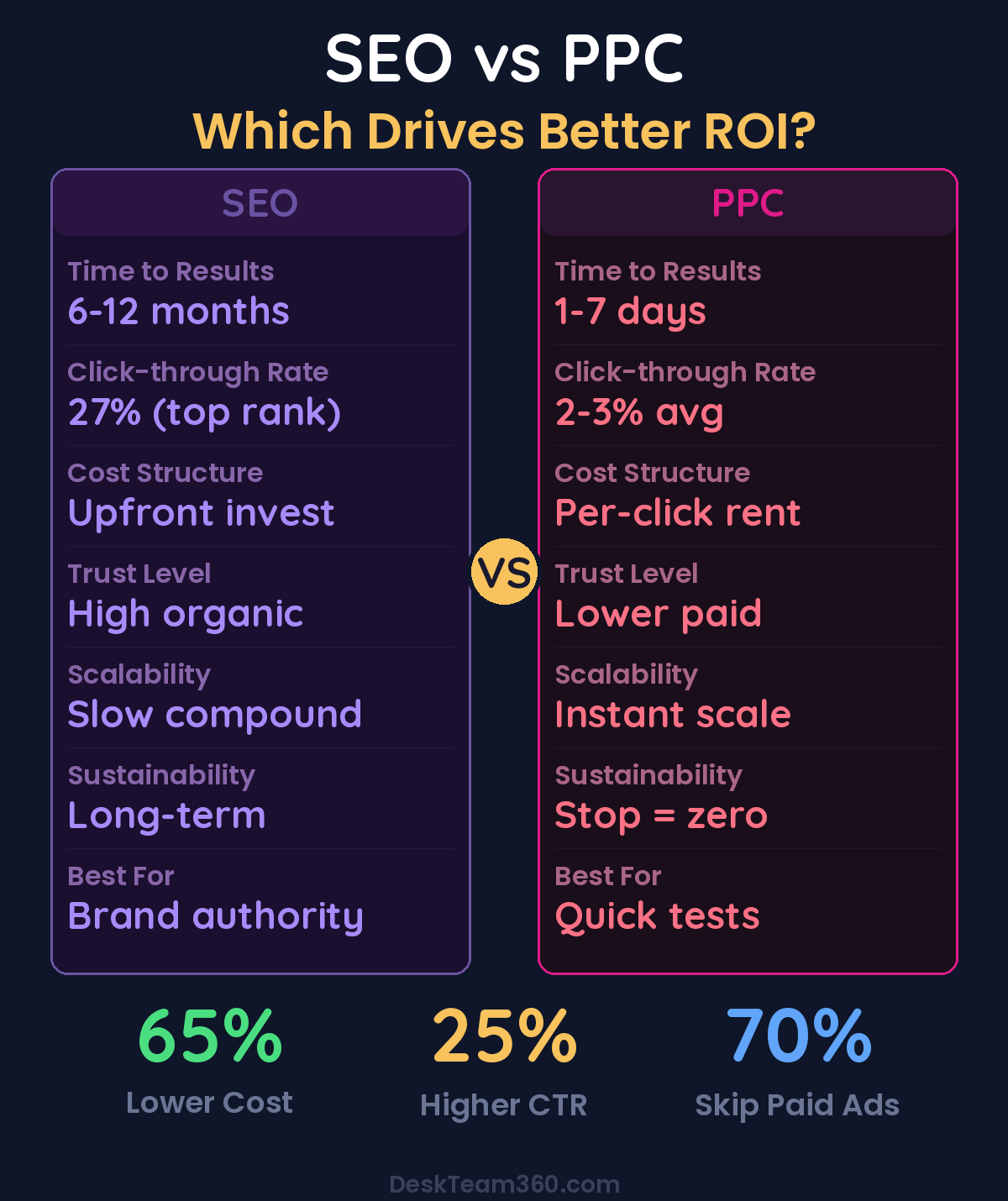
Every business I work with eventually uses both, but the timing and emphasis depends entirely on where they are in their growth journey.
Free Template
The Ultimate Task Delegation Template
Stop guessing what to hand off. This template shows you exactly what to delegate, how to brief it, and how to QA the results.
Get the Free Template →
When SEO Makes Sense (And When It Doesn’t)
SEO is a long-term investment that pays compound returns. It makes sense when you’ve got at least six months runway, content resources (either in-house or outsourced), and patience to let the strategy build momentum.
The best SEO situations I see are established businesses with expertise to share, companies in competitive markets where PPC costs are insane ($50+ per click), service businesses that benefit from local authority, and SaaS companies building educational content around their solution.
Here’s what good SEO actually looks like in practice. You’re consistently publishing 2-4 valuable articles per month that answer real customer questions. You’re optimizing for keywords your customers actually search for, not just high-volume vanity terms. You’re earning links by creating genuinely useful resources other sites want to reference. And you’re measuring progress in organic sessions, keyword rankings, and most importantly, conversions from organic traffic.
Pro tip: Don’t start SEO until you can commit to 12+ months of consistent content creation. Half-hearted SEO is worse than no SEO because you waste time and budget without building any real momentum.
SEO doesn’t make sense if you need results in the next 90 days, have no content strategy or resources, are in a brand new market where no one’s searching yet, or you’re testing a new business model and don’t know if it’ll work.
I’ve seen companies spend 18 months “doing SEO” with blog posts that nobody reads, targeting keywords nobody searches, with no link-building strategy. That’s not SEO, it’s content theater. Real SEO requires research, strategy, and sustained execution.
When PPC Makes Sense (And When It’s a Waste)
PPC is immediate gratification with ongoing cost. It makes sense when you need to test messaging and positioning fast, have a proven offer that converts well, need to scale revenue quickly, or want to dominate competitive keywords where SEO would take years.
We break this down further in digital marketing for home services: the complete playbook.
The strongest PPC situations are proven businesses that know their unit economics, companies with high lifetime customer value, time-sensitive offers or launches, and competitive markets where you need instant visibility to compete.
Good PPC strategy isn’t about spending money on ads. It’s about systematic testing to find what converts, then scaling the winners aggressively. You start with small budgets across different audiences and keywords. You track everything, cost per click, conversion rate, cost per acquisition, lifetime value. You kill what doesn’t work within two weeks and double down on what does.
Watch out: PPC without conversion tracking is just expensive brand awareness. If you can’t measure exactly which ads drive sales and at what cost, you’re gambling with your marketing budget.
PPC doesn’t make sense if your offer doesn’t convert well yet, you have no budget for testing ($1,000+ per month minimum for meaningful data), your lifetime customer value is too low to support ad costs, or you’re in a market with no search volume.
The biggest PPC mistake I see is companies that treat it like a vending machine. They think you put money in and customers come out. Real PPC is about rapid experimentation to find profitable customer acquisition channels, then optimizing them relentlessly.
The Smart Strategy: Use Both, But Sequence Them Right
Here’s the playbook that works for most businesses. If you’re just starting or testing a new market, begin with PPC. It gives you immediate feedback on messaging, helps you understand your actual cost per acquisition, and validates demand before you invest months in content.
Once PPC is profitable, use those insights to inform your SEO strategy. The keywords that convert in PPC become your target keywords for organic content. The ad copy that performs becomes your headline and meta description templates. The landing pages that work become your content structure.
This is how successful businesses actually grow. PPC funds the business and validates the market. SEO builds the long-term moat that makes the business defensible and profitable at scale.
For established businesses, the sequence might be different. If you’re already getting organic traffic but want to accelerate growth, layer PPC on top to capture more of the demand you’re already ranking for. If you’ve been running PPC for years but costs are climbing, invest in SEO to reduce your dependence on paid channels.
The key insight most businesses miss is that SEO and PPC share data that makes both channels stronger. Your SEO keyword research tells you what to bid on in PPC. Your PPC conversion data tells you what content to create for SEO. Your organic rankings tell you where PPC can fill gaps. They’re not competing strategies, they’re complementary intelligence systems.
The Budget Reality Check
Let’s talk actual numbers because everyone wants to know what this costs. For effective SEO, budget $3,000-8,000 per month for content creation, optimization, and link building. If you’re doing it in-house, that’s roughly 20-40 hours per week of skilled work. Results start showing up in months 3-6, meaningful growth happens in months 6-12.
For effective PPC, budget $5,000-15,000 per month total, with $3,000-10,000 going to ad spend and the rest covering management and optimization. Results show up in weeks 1-2, profitability typically kicks in by month 2-3 if the fundamentals are right.
The math is simple but the psychology is hard. SEO feels cheaper because the monthly costs are lower, but it takes longer to generate returns. PPC feels more expensive because you see the ad spend every day, but it can be profitable from week one.
We covered this in detail in our post about web design retainer vs project-based: which pricing model saves you more?.
Companies using both channels see 35% higher ROI than those using either channel alone, but only when both strategies are properly integrated and measured.
If you can only afford one channel right now, choose based on urgency, not preference. Need revenue in the next 90 days? Start with PPC. Building for long-term growth with time to invest? Start with SEO. But plan to add the other channel as soon as financially possible.
Platform-Specific Realities for 2025
Google remains the dominant platform for both SEO and PPC, but the landscape is shifting fast. For SEO, Google’s AI updates mean content quality and user experience matter more than ever. Thin, keyword-stuffed content gets buried. Comprehensive, helpful content gets rewarded. The bar for ranking is higher, but the traffic is more qualified.
For Google PPC, costs continue climbing in competitive markets, but targeting and attribution keep improving. Smart bidding strategies work better than manual management for most businesses. The key is understanding your actual customer lifetime value so you can bid appropriately.
Beyond Google, LinkedIn and Facebook offer different opportunities. LinkedIn PPC works incredibly well for B2B services with high contract values. Facebook PPC still delivers strong ROI for consumer products and local businesses. Both platforms require different creative approaches than Google search ads.
For alternative search engines, Bing captures 6-8% of search volume but often converts better than Google traffic. Amazon SEO and PPC are critical if you sell products. YouTube SEO is severely underrated for service businesses that can create helpful video content.
Measuring What Actually Matters
Most businesses track the wrong metrics and make bad decisions because of it. Here’s what actually matters for each channel and how they connect to revenue.
For SEO: organic traffic is a vanity metric, focus on organic conversions. Keyword rankings matter, but only for keywords that drive customers. Domain authority scores are mostly meaningless, track share of voice in your actual market instead. The real SEO metric is organic revenue per month and how it trends over time.
For PPC: clicks and impressions don’t pay the bills, conversions do. Cost per click matters less than cost per acquisition. Ad position matters less than actual conversion rate. The real PPC metrics are return on ad spend (ROAS) and customer acquisition cost (CAC) relative to customer lifetime value (LTV).
Pro tip: Set up proper attribution tracking that connects both channels to actual revenue, not just leads or sign-ups. Most businesses have no idea which channels actually drive paying customers versus tire-kickers.
Cross-channel metrics matter more than individual channel performance. Track assisted conversions, where customers find you through one channel but convert through another. Measure brand search volume growth, which indicates how well your combined efforts build recognition. Monitor customer acquisition cost across all channels to optimize your overall marketing mix.
The Biggest Mistakes That Kill Both Strategies
I’ve seen companies waste millions on both SEO and PPC by making the same predictable mistakes. Here’s how to avoid them.
The first mistake is treating them as separate strategies instead of integrated systems. Your SEO and PPC teams should share data, insights, and goals. When they operate in silos, you miss opportunities and duplicate efforts.
For industry benchmarks and research, see Ahrefs Blog.
For industry research and benchmarks, check out Moz SEO Learning Center.
The second mistake is optimizing for metrics that don’t matter. High CTR in PPC means nothing if the traffic doesn’t convert. High organic traffic means nothing if visitors bounce immediately. Always connect activities to revenue outcomes.
The third mistake is insufficient budget commitment. Half-hearted SEO generates half-hearted results. Under-funded PPC campaigns never get enough data to optimize properly. Either commit the budget to do it right or spend the money elsewhere.
Watch out: Don’t hire agencies that promise guaranteed rankings or impossible PPC returns. Real marketing is about systematic testing and optimization, not magic tricks or silver bullets.
The fourth mistake is neglecting the fundamentals. The best SEO content in the world won’t help if your website loads slowly or breaks on mobile. The most targeted PPC ads won’t convert if your landing pages are confusing or your checkout process is broken.
Your Next Action Depends on Where You Are
If you’re just starting out, begin with PPC to validate demand and messaging. Set aside $3,000-5,000 for 60 days of testing. Track everything. Once you find profitable campaigns, use that data to inform your SEO strategy.
If you’ve been doing PPC for 6+ months and it’s working, start layering in SEO. Target the same keywords that convert in PPC. Create content around the problems your best customers are solving. Build for the long-term while PPC funds immediate growth.
If you’ve been doing SEO for 6+ months but growth has plateaued, add PPC to accelerate results. Use paid ads to capture more traffic for keywords you’re ranking on page 2-3. Test new markets and keywords before investing months in organic content.
If you’re doing both but they’re not connected, audit your tracking and strategy alignment. Make sure your teams share data and insights. Look for opportunities where one channel can amplify the other.
The reality is that most businesses eventually need both channels to maximize growth and reduce risk. The question isn’t SEO vs PPC, it’s how to sequence and integrate them for your specific situation.
At DeskTeam360, we’ve seen hundreds of businesses scale by getting this integration right. Our team handles the strategy, execution, and optimization for both channels so you can focus on running your business. We start with an audit of your current marketing, identify the biggest opportunities, and build a integrated plan that maximizes your growth potential.
Whether you need help with content strategy, PPC campaign management, or conversion optimization, we’ll help you build a marketing system that drives predictable, scalable growth.
The debate about SEO vs PPC misses the point entirely. The right question is how to use both channels to build a business that grows predictably and profitably. That’s what actually matters in 2025.
Free 5-Minute Video
See How DeskTeam360 Works in Under 5 Minutes
Watch the short video and see exactly how we handle design, development, and marketing implementation — so you don't have to.
Watch the Video →