
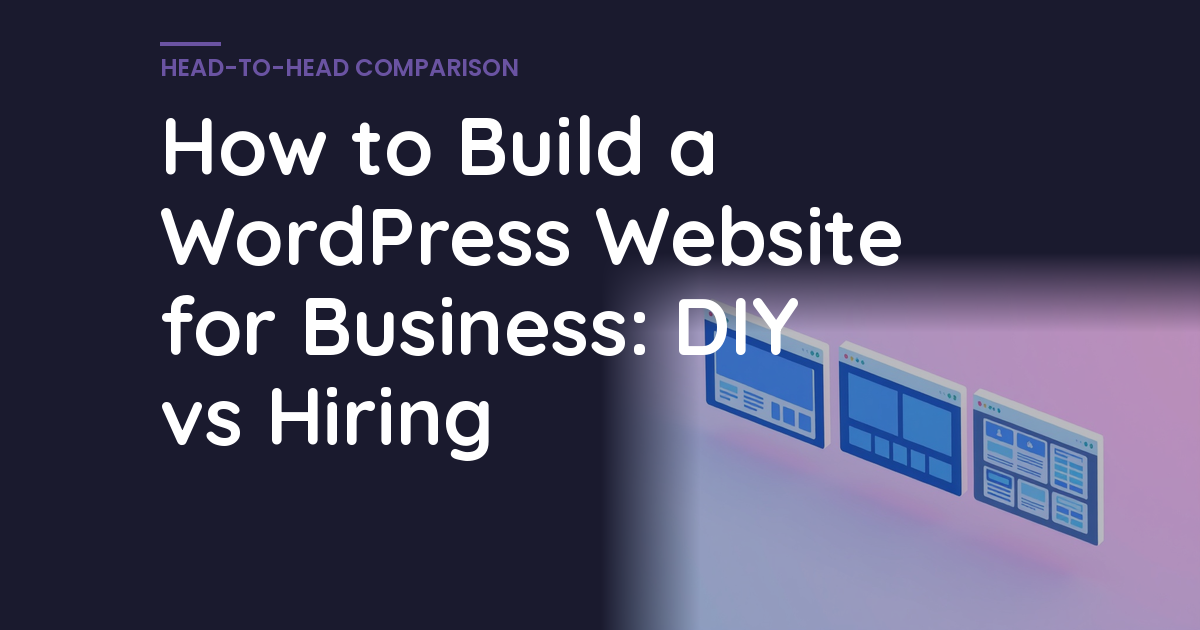
How to Build a WordPress Website for Business: DIY vs Hiring
Let’s talk about build wordpress website for business and why it matters for your business.
📋 Table of Contents
The WordPress Question Every Business Owner Asks Wrong
WordPress powers 43% of the internet. It’s flexible, scalable, and there’s a plugin for everything. But here’s the question nobody answers honestly: should you actually build your business website yourself, or is that a $10,000 mistake waiting to happen?
After 12+ years of building websites for 400+ clients, I’ve seen the full spectrum. Entrepreneurs who crushed their DIY builds and those who spent four months wrestling with WordPress before scrapping everything and hiring help. The difference wasn’t technical skill, it was knowing what they were really signing up for.
This guide gives you the real picture. If you decide to DIY, you’ll know exactly what’s involved. If you decide to hire, you’ll understand what to look for and what to pay. No fluff, just the playbook.
WordPress: Why Everyone Uses It and Why It Drives People Crazy
WordPress dominates for good reasons. You can build virtually any type of website with it: business sites, e-commerce stores, membership platforms, online courses. The ecosystem is massive with 60,000+ plugins and thousands of themes. When properly optimized, WordPress sites rank extremely well in search engines. Content management is straightforward once you learn the interface. And it scales from a simple blog to handling millions of monthly visitors.
But here’s what the WordPress evangelists don’t tell you. The learning curve is real, especially if you want something that doesn’t look like every other WordPress site. WordPress needs constant maintenance, regular updates for core software, themes, and plugins. Skip updates and you become a hacker’s favorite target. Plugin conflicts are inevitable. More plugins means more potential breaking points, and one bad update can crash your entire site.
If build wordpress website for business is on your radar, this guide is for you. Let’s talk about build wordpress website for business. Watch out: WordPress is the most targeted CMS by hackers precisely because it’s the most popular. Security isn’t optional, it’s a full-time job. Our guide on website security best practices covers the fundamentals, but understand that choosing WordPress means accepting security responsibility.
Free Template
The Ultimate Task Delegation Template
Stop guessing what to hand off. This template shows you exactly what to delegate, how to brief it, and how to QA the results.
Get the Free Template →
The DIY Route: What It Actually Takes
If you’re thinking about building your own WordPress site, let’s talk real numbers and real timelines.
The Financial Investment
Domain registration runs $10-$20 per year. Don’t overthink it, use Namecheap or Cloudflare Registrar. Keep it short, memorable, and relevant to your business.
Hosting is where most people make their first mistake. Those $3 per month shared hosting plans are garbage. Your business website deserves better. Managed WordPress hosting from SiteGround, WP Engine, or Kinsta costs $25-$100 per month, but it’s worth every dollar for the performance and peace of mind.
You’ll need a theme. Free themes exist but good business themes cost $60-$200 one-time. I recommend GeneratePress for speed, Astra for flexibility, or Kadence for the best balance of features and performance.
Unless you’re comfortable with code, you’ll need a page builder. Elementor is most popular at $59 per year for the Pro version. Beaver Builder is more developer-friendly at $99 per year. The WordPress Block Editor is free and improving rapidly, but it’s still limited for complex designs.
Essential plugins will cost $200-$500 per year total. You need SEO (Yoast or Rank Math), security (Wordfence), caching (WP Rocket at $59/year), backups (UpdraftPlus), forms (WPForms or Gravity Forms), and analytics (Site Kit by Google is free).
All in, you’re looking at $675-$1,800 in the first year. That’s before your time investment.

The Time Reality Check
Here’s what nobody tells you about WordPress timelines. For someone who’s never built a website before, learning WordPress basics takes 10-20 hours. Just getting comfortable with the dashboard, understanding posts versus pages, and figuring out how themes work.
Setup, hosting, domain configuration, and WordPress installation takes 2-4 hours for beginners. Theme and plugin configuration adds another 5-10 hours. Designing and building your pages is the big time sink: 20-40 hours for a non-technical person. Content creation and entry takes 15-30 hours. Testing and troubleshooting adds 5-15 more hours.
Total for a non-technical business owner: 57-119 hours. Working on it 10 hours per week, that’s 6-12 weeks to launch. For someone technically savvy, it’s still 3-6 weeks.
If your time is worth $100 per hour (conservative for a business owner), those 57-119 hours cost $5,700-$11,900 in opportunity cost. Suddenly DIY isn’t so cheap.
But here’s the real kicker: that timeline assumes everything goes smoothly. It doesn’t account for plugin conflicts, theme limitations you discover halfway through, or the inevitable “why doesn’t this work like I expected” moments that can derail you for days.
The Professional Route: Your Three Options
Option 1: Hire a Freelancer
Cost runs $2,000-$10,000 depending on complexity. Timeline is 3-8 weeks. This works best for simple to medium-complexity sites when you have a clear vision of what you want.
Freelancers give you specialized WordPress expertise without agency overhead. The risk? Reliability varies wildly. Find a good one and it’s great. Find a bad one and you’re starting over with someone new while your launch date slips by months.
The key is vetting them properly. Look for specific WordPress experience, not general web development. Ask to see recent projects similar to yours. Get references and actually call them. Understanding how to find reliable web developers makes the difference between a smooth project and a disaster.
Option 2: Hire an Agency
Agencies cost $10,000-$50,000+ and take 6-16 weeks. This makes sense for complex sites needing strategy, design, and development expertise working together.
You get a full team and structured process. Project management, design, development, and quality assurance. But you pay a premium for all that overhead. Many agencies also treat WordPress as just another tool rather than specializing in it specifically.
Option 3: Design and Development Subscription
This is the sweet spot for most businesses. Monthly cost runs $399-$999. Timeline is 3-6 weeks for a business site. You get professional design and development at a predictable monthly cost, and the same team handles updates, new pages, and ongoing improvements after launch.
Step-by-Step: How Professional WordPress Development Actually Works
Whether you DIY or hire, understanding the process helps you make better decisions and communicate effectively with your team.
Phase 1: Strategy and Planning
Before anyone touches WordPress, the strategy needs to be locked down. What pages do you need? How should navigation be structured? What are your conversion goals? What action do you want visitors to take?
This phase also includes competitor analysis and user experience planning. Most DIY builders skip this entirely and wonder why their site doesn’t convert visitors into customers. Strategy isn’t optional if you want results.
Phase 2: Foundation Setup
Domain registration, hosting setup with managed WordPress, SSL certificate installation, and base WordPress configuration. This includes installing the chosen theme and essential plugins for SEO, security, caching, and backups.
Professional developers also configure staging environments during this phase so all development work happens away from your live site. DIY builders often work directly on the live site, which is asking for trouble.
Phase 3: Design and Development
Homepage design sets the direction for everything else. Interior page templates get built next: services pages, about page, contact page. Blog layout design follows. Mobile optimization isn’t an afterthought, it’s designed specifically for mobile screens.
This is where page builders shine for DIY projects, but they also introduce complexity and potential performance issues if not used carefully.
Phase 4: Content Integration
Compelling copy for each page gets added. High-quality images are sourced or created. Brand elements like logos, colors, and fonts are implemented throughout. Initial blog posts are published, at least 3-5 at launch. All contact information, maps, and business details are added.
Content creation is often the bottleneck in WordPress projects. Writing good copy takes time, and most business owners underestimate how much content a proper business website actually needs.
Phase 5: Optimization and Testing
SEO configuration includes page titles, meta descriptions, and XML sitemaps. Image optimization with alt tags and proper compression. Google Analytics and Search Console setup. Caching configuration for performance. Speed optimization to ensure fast loading times.
Testing covers multiple devices and browsers, all forms and contact methods, internal and external links, and overall user experience. Most importantly, someone unfamiliar with the site tries to navigate it to identify confusing elements.
Pro tip: The testing phase reveals more issues than any other phase. Budget extra time for it. A site that works perfectly on your development computer might have issues in the real world on different devices and internet connections.
Phase 6: Launch and Monitoring
Going live includes sitemap submission to Google, uptime and performance monitoring setup, and content strategy planning for ongoing blog posts. Security monitoring and regular maintenance scheduling happen during this phase too.
Launch isn’t the finish line, it’s the starting line for ongoing optimization based on real user behavior and performance data.
WordPress Plugin Strategy: What You Actually Need
Plugin selection is where most business WordPress sites go wrong. Either they install too many, creating conflicts and performance issues, or they miss critical ones that leave them vulnerable.
Security Stack (Non-Negotiable)
Wordfence provides firewall protection, malware scanning, login protection, and real-time threat intelligence. The free version handles most business needs. WordPress is the most targeted CMS on the internet, making security plugins mandatory.
Two-factor authentication for every admin account isn’t optional. Limit Login Attempts Reloaded blocks brute force attacks by limiting failed login attempts. Simple but effective protection that takes five minutes to set up.
Performance Stack
WP Rocket costs $59 per year and it’s the best money you’ll spend on your WordPress site. It handles page caching, browser caching, minification, and lazy loading automatically. If you install one paid plugin, make it this one.
ShortPixel automatically compresses images and converts them to WebP format. It works on upload so you never have to think about image optimization again. Most sites have bloated images killing their loading speed.
SEO and Analytics Stack
Choose either Yoast SEO or Rank Math for meta titles, descriptions, XML sitemaps, and schema markup. Never install both. The free versions of either plugin handle most business needs perfectly.
Site Kit by Google connects Analytics, Search Console, PageSpeed Insights, and AdSense right in your WordPress dashboard. Free and incredibly useful for monitoring your site’s performance in search results.
Functionality Stack
WPForms or Gravity Forms handle contact forms, lead generation forms, and payment processing. WPForms Lite is free and sufficient for basic contact forms. Gravity Forms is more powerful but costs extra.
UpdraftPlus provides automated backups to cloud storage like Google Drive or Dropbox. Schedule daily backups and sleep better at night knowing your site can be restored quickly if something goes wrong.
Plugin bloat kills WordPress performance. Every plugin adds code and potential security vulnerabilities. If you have more than 20 active plugins, you probably have redundancies. Audit regularly and consolidate where possible.
For industry research and benchmarks, check out WordPress Developer Resources.
Hosting Deep Dive: Why It’s Your Most Important Decision
I mentioned hosting earlier, but let me explain why it’s the single most impactful choice you’ll make for your site’s performance and reliability.
SiteGround starts at $15 per month and excels at support quality with free SSL and staging environments. Perfect for small business sites that need reliability without complexity.
WP Engine costs $25 per month and provides automatic backups, staging environments, and includes Genesis themes. Best for growing businesses that need performance and support.
Kinsta starts at $35 per month with Google Cloud infrastructure delivering the fastest loading speeds available. Use this for performance-critical sites where every millisecond matters.
Cloudways runs $14 per month and offers choice of cloud providers with scalable resources. Great for technically savvy users who want control over their infrastructure.
What separates managed WordPress hosting from regular hosting is WordPress-specific optimization, automatic security updates, staging environments for testing changes, and support teams that actually understand WordPress. Regular shared hosting treats WordPress like any other website software, which is a mistake.
Never judge hosting by the lowest price. Performance, security, and support quality matter more than saving $10 per month. Our comprehensive guide on choosing website hosting covers the technical details if you want to dive deeper.
Common WordPress Mistakes That Cost Businesses Money
Using Bloated Themes
Multipurpose themes advertising “500+ demos included” load massive amounts of unused CSS and JavaScript. Your site becomes a tank. Use lightweight themes and build only what you actually need. Performance beats features every time.
Installing Too Many Plugins
Every plugin adds code, potential security vulnerabilities, and maintenance overhead. More than 20 active plugins usually indicates redundancies. Audit your plugin list quarterly and remove anything that isn’t essential.
Skipping Mobile Optimization
Over 60% of web traffic comes from mobile devices. If your site doesn’t work beautifully on smartphones, you’re losing the majority of your potential customers. Test on actual mobile devices, not just browser development tools.
Ignoring Security
WordPress sites get attacked constantly. Use strong passwords, install security plugins, keep everything updated, and enable two-factor authentication. Security breaches cost far more than prevention measures.
Watch out: No backup strategy means starting from scratch when something goes wrong. And something will go wrong eventually. Set up automated daily backups stored off-site. This isn’t optional for business websites.
The First 30 Days After Launch: Critical Success Actions
Your website isn’t finished when it launches. The first month determines whether your site succeeds or joins the millions of WordPress sites that get abandoned.
Week one is bug hunting time. Browse every page on multiple devices, click every link, submit every form. You’ll find issues: broken links, formatting problems, slow loading pages, mobile layout quirks. Fix them immediately. Ask people who weren’t involved in the build to navigate your site and report anything confusing.
Week two focuses on analytics verification. Confirm Google Analytics tracks correctly and all conversion events fire properly. Establish baseline metrics for traffic, bounce rate, and conversion rate. These numbers become your benchmark for future improvements.
Week three covers SEO verification through Google Search Console. Check for crawl errors or indexing issues, verify sitemap submission and page indexing, and confirm meta titles and descriptions render correctly in search results.
Week four starts your first optimization round. Based on two weeks of data, identify weak pages with high bounce rates or low engagement. Start improving them systematically. This iterative optimization separates good websites from great ones.
Understanding how to measure marketing ROI helps you track whether your website investment delivers business results beyond just looking professional.
Make the Right Choice for Your Situation
DIY works if you have time, enjoy learning technology, and your needs are straightforward. Hiring works if you value your time, need professional results, and want ongoing support rather than one-time delivery.
For most businesses, the smartest move is a subscription service that handles both the build and ongoing maintenance. You get professional design and development without the massive upfront cost, and the same team keeps your site running, updated, and improved month after month.
At DeskTeam360, our flat-rate plans give you a full design and development team for one monthly price. Your WordPress site gets built by professionals who understand both the technical side and business strategy. More importantly, we don’t disappear after launch. The same team handles updates, improvements, and ongoing website maintenance so you can focus on running your business instead of managing WordPress.
Free 5-Minute Video
See How DeskTeam360 Works in Under 5 Minutes
Watch the short video and see exactly how we handle design, development, and marketing implementation — so you don't have to.
Watch the Video →