
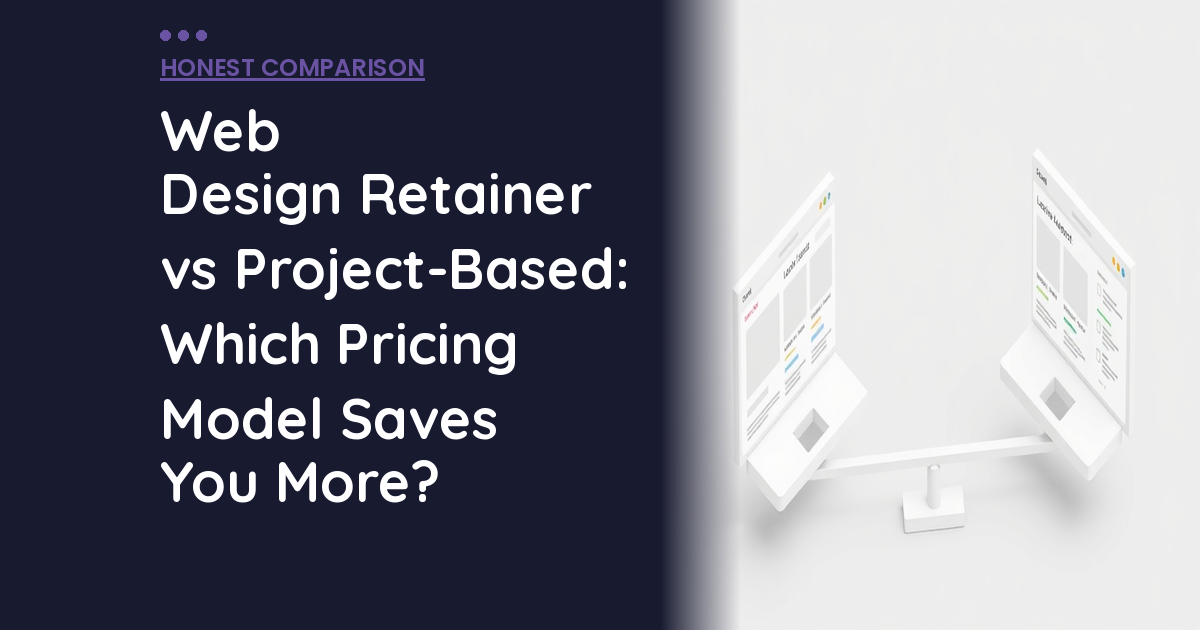
Web Design Retainer vs Project-Based: Which Pricing Model Saves You More?
The $68,000 Mistake I Made (So You Don’t Have To)
Let’s talk about web design retainer and why it matters for your business. Two years ago, I was paying a web design agency $15,000 per project for client websites. Good work. Fair price. But every single project followed the same soul-crushing pattern.
📋 Table of Contents
Month one was always exciting. Creative briefs flying back and forth, wireframes that looked perfect, first comps that made everyone happy. We’re on track, on budget, and I’m already mentally spending the profit margin.
Month two was where things started falling apart. The client would see the design and want “just a few small tweaks.” Nothing major, they’d say. Maybe move this section up here, add a contact form to every page, oh and can we integrate with their CRM that they forgot to mention? That “few small tweaks” somehow required 20 hours of development work and triggered a change order for $3,500.
Month three was me having the awkward conversation with my client about why their website isn’t done yet, why we’re $5,000 over budget, and why the launch date just got pushed to next month. Again.
This happened on roughly 60% of our projects. Not because the agency was bad, they weren’t. It’s because the project-based pricing model creates misaligned incentives that doom most web design projects from day one.
After 12 years running agencies and spending over $1 million on web design through both project-based and retainer models, I’ve learned which one actually works. More importantly, I’ve discovered a third option that beats them both.
How Project-Based Pricing Actually Works (Hint: It Doesn’t)
The promise of project-based pricing is simple and seductive. You define a scope. The designer quotes a price. You shake hands. They build it. You pay once. Done.
A typical 5-10 page WordPress website runs $5,000 to $25,000 project-based. Larger sites with e-commerce, custom functionality, or complex integrations can hit $50,000 to $150,000. The pricing seems straightforward until you realize what’s not included in that original quote.
Here’s what nobody tells you about project-based pricing. Scope creep isn’t an occasional problem, it’s a mathematical certainty. According to Project Management Institute data, 52% of all projects experience scope creep. In web design, that number is probably closer to 80% because clients literally don’t know what they want until they see what they don’t want.
Watch out: Those “two rounds of revisions included” clauses in web design contracts are designed to fail. Real websites need 6-12 rounds of meaningful changes. Every revision beyond round two costs $150-200 per hour, and those charges add up fast.
Change orders are where project budgets go to die. That “simple” revision your client requested? It triggers a change order process that takes 2-3 days to estimate, requires approval from three different people, and costs $150 per hour once you’ve burned through your included revision rounds. I’ve watched projects go 40% to 60% over budget purely from change order fees.
The relationship ending when the project ends creates its own set of problems. Need a bug fix two months after launch? That’s a new mini-project with a new quote and a new wait time. Want to add a simple contact form? New project. Need to update some copy? New project. There’s no continuity, no institutional knowledge, and no one who feels responsible for the site’s ongoing performance.
The incentives are fundamentally backwards. Your designer makes more money when projects take longer and require more change orders. You want projects done fast and on budget. These incentives are pulling in opposite directions, and that tension creates friction throughout every project interaction.
For a deeper dive, see our guide on what does a web developer do? front-end vs back-end explained for business owners.
Free 5-Minute Video
See How DeskTeam360 Works in Under 5 Minutes
Watch the short video and see exactly how we handle design, development, and marketing implementation — so you don't have to.
Watch the Video →
Retainer Pricing: Better But Still Broken
Retainer pricing feels like a smarter approach. You pay a fixed monthly fee for ongoing access to design and development services. Instead of negotiating each project separately, you get priority access to a team that knows your business.
Typical web design retainers range from $2,000 to $10,000 per month depending on the hours or capacity included. Some agencies sell retainers by hours (40 hours per month), others by deliverables (two website updates per month), and a few sell pure capacity (we handle your design work, period).
Retainers solve several project-based problems immediately. Your costs become predictable with the same invoice every month. You get priority access to the team since retainer clients almost always jump ahead of project clients in the queue. The ongoing relationship means your team actually learns your brand, your preferences, and your systems over time instead of starting from scratch every project.
Scope creep becomes manageable because changes and updates are just part of the monthly work rather than expensive change orders that require approval and delay everything.
Hourly retainers create the same fundamental problem as hourly billing. You’re still counting minutes, tracking time, and having conversations about whether updating a paragraph counts as content strategy (billable) or content entry (not billable). The hourly model makes everyone think about time instead of outcomes.
Most retainers I’ve worked with still have overage clauses that kick in when you exceed the monthly hour allocation. So you get predictable costs until you don’t, and you’re back to variable pricing exactly when you need the most help.
The Real Math From Someone Who’s Paid Both
Let me show you what a typical year actually looks like under each model, using real numbers from my business.
In 2020, we operated entirely on project-based pricing. Here’s what we actually spent. Four client websites at $15,000 each totaled $60,000. Change orders and scope creep added approximately $18,000. Post-launch bug fixes that became new mini-projects cost another $8,000. Ongoing updates and maintenance handled by freelancers ran about $12,000. The total damage was roughly $98,000 for what should have been $60,000 worth of work.
In 2024, we operate on a subscription model through DeskTeam360’s approach. Here’s what we spend now. A flat monthly subscription covering unlimited design and development costs $2,500 per month or $30,000 annually. That same price covers those four websites plus all updates, all maintenance, all graphics, video editing, and any other design work we need throughout the year.
The subscription model saved us roughly $68,000 per year for the same output. Actually better output since we’re not rationing requests or avoiding small updates because they’ll trigger expensive change orders.
Companies switching from project-based to subscription pricing typically see 40-60% cost savings in their first year while getting faster turnaround times.
The key difference isn’t just price, it’s psychology. No per-project negotiations. No change order invoices. No “that’ll be extra” conversations. Just a team that does the work without nickeling and diming every request.
Which Model Fits Your Business?
Despite everything I just said about project-based pricing, it still makes sense in specific situations. Choose project-based if you genuinely have one specific project with a clear, unchanging scope. If you won’t need any ongoing work after the project is complete. If you’re comfortable managing scope creep and change order processes. Or if your budget is absolutely fixed and you need a hard cap, though change orders often blow past this anyway.
Choose a retainer if you need ongoing design and development work month over month. If you want priority access and faster turnaround times. If you value a team that knows your brand and doesn’t need to ramp up on every new request. If you want predictable monthly costs without surprise invoices.
For most businesses I work with, agencies, growing companies, anyone doing regular marketing, a retainer or subscription model wins every time. The consistency, the relationship building, and the cost savings compound over months and years. Understanding how to measure ROI becomes much easier when your costs are predictable.
The Third Option That Beats Them Both
There’s a model that takes the best parts of retainers and removes the worst parts. Instead of buying hours, which creates the same counting-minutes anxiety as hourly billing, you buy capacity. A team that handles your design and development work for a flat monthly rate with no hour tracking.
This is what we do at DeskTeam360. You pay a flat rate. You submit work requests. The team handles them. Need a website redesign this month and social media graphics next month? Same rate. Need a video edited and a CRM automation built? Same rate. No hours to track, no overage conversations, no “you’ve used 38 of your 40 included hours” emails.

The bandwidth model works because it aligns incentives correctly. We want to do great work efficiently, not slowly like hourly billing incentivizes. You want to get maximum value from your subscription, not hoard hours like retainers incentivize. When everyone wins by moving fast and producing quality work, that’s what happens.
Agencies that switch from project-based to subscription pricing typically see their capacity scale 2-3x without adding headcount. The operational simplicity alone is worth the switch. No more project management overhead, no more change order paperwork, no more scope negotiations on every request.
Pro tip: When evaluating subscription or bandwidth models, ask how they handle rush requests and what happens during slow months. The best providers give you the same level of service regardless of your monthly workload fluctuations.
According to Deloitte’s outsourcing research, 70% of companies cite cost reduction as the primary driver for outsourcing. But the businesses that get the most value don’t just save money, they save time, reduce management overhead, and increase output quality through consistent team relationships.
The Hidden Costs Nobody Talks About
Project-based pricing looks cheaper on paper until you account for the hidden costs that nobody mentions in the initial proposals. Project management overhead alone consumes 15-20% of most project budgets. Someone needs to manage timelines, coordinate feedback, track changes, and handle approvals. That’s expensive whether you do it internally or pay the agency to do it.
Context switching costs money too. Every new project requires a learning curve where the agency figures out your brand, your preferences, your existing systems, and your goals. With project-based work, you pay this learning curve cost on every single project. With ongoing relationships, you pay it once.
Quality control becomes your responsibility with project-based work. The agency delivers the website, collects their payment, and moves on to the next client. If something breaks three weeks later, that’s your problem to solve. With subscription or retainer models, ongoing quality is part of the service.
For industry research and benchmarks, check out Nielsen Norman Group.
The switching costs are brutal too. When a project-based agency relationship ends badly, which happens more often than anyone admits, you’re back to square one. New agency, new learning curve, new processes, new disappointments. With ongoing relationships, the switching cost incentivizes both parties to work through problems instead of walking away.
What Works in 2024 and Beyond
The businesses that are scaling fast in 2024 have moved away from per-project thinking entirely. They’ve realized that marketing, design, and development aren’t discrete projects with clear beginning and end points. They’re ongoing capabilities that need to adapt and evolve continuously.
Your website needs regular updates. Your marketing materials need constant refreshing. Your sales pages need optimization based on performance data. Your email designs need seasonal updates. These aren’t projects, they’re operational requirements that subscription models handle much better than project-based pricing.
The companies still stuck in project-based thinking are the ones asking “how much will this cost?” instead of “how can we make this work better?” The mindset shift from cost-per-project to capability-per-month changes everything about how you approach growth and marketing.
This shift isn’t just about web design. Smart businesses are moving to subscription models for content creation, social media management, email marketing, and even business development. The operational simplicity and cost predictability make growth planning much easier.
If you’re currently locked into project-based pricing and it’s working perfectly for you, don’t change anything. But if you’re tired of scope creep conversations, change order invoices, and starting from scratch with every new project, subscription models exist for a reason. They exist because people like me got tired of the alternative.
For agencies specifically, scaling without hiring more employees becomes much easier when you can predict capacity needs and costs month to month. The financial planning alone makes subscription models worth considering.
Understanding how to reduce website bounce rates and implementing those changes becomes an ongoing optimization process rather than a discrete project when you have a team that can make updates immediately.
Making the Switch Without Disrupting Operations
If you’re currently using project-based pricing and want to test a subscription approach, start with a pilot program. Pick one type of recurring work, maybe social media graphics or website updates, and handle that through a subscription while keeping larger projects on the old model.
The transition costs are minimal. Most subscription providers can start immediately without long contract commitments. Test it for 90 days and measure the difference in cost, turnaround time, and your own stress levels managing the work.
Compare what you spent last year on web design projects to what 12 months of a subscription would cost. Include the hidden costs like change orders, project management time, and the opportunity cost of projects that ran long. The math usually speaks for itself.
Want to understand more about the real costs of outsourced marketing across different models? The comparison will probably surprise you.
Free Template
The Ultimate Task Delegation Template
Stop guessing what to hand off. This template shows you exactly what to delegate, how to brief it, and how to QA the results.
Get the Free Template →