


Website Design for Coaches and Consultants: The Complete Guide
Why Most Coach and Consultant Websites Convert Like Garbage
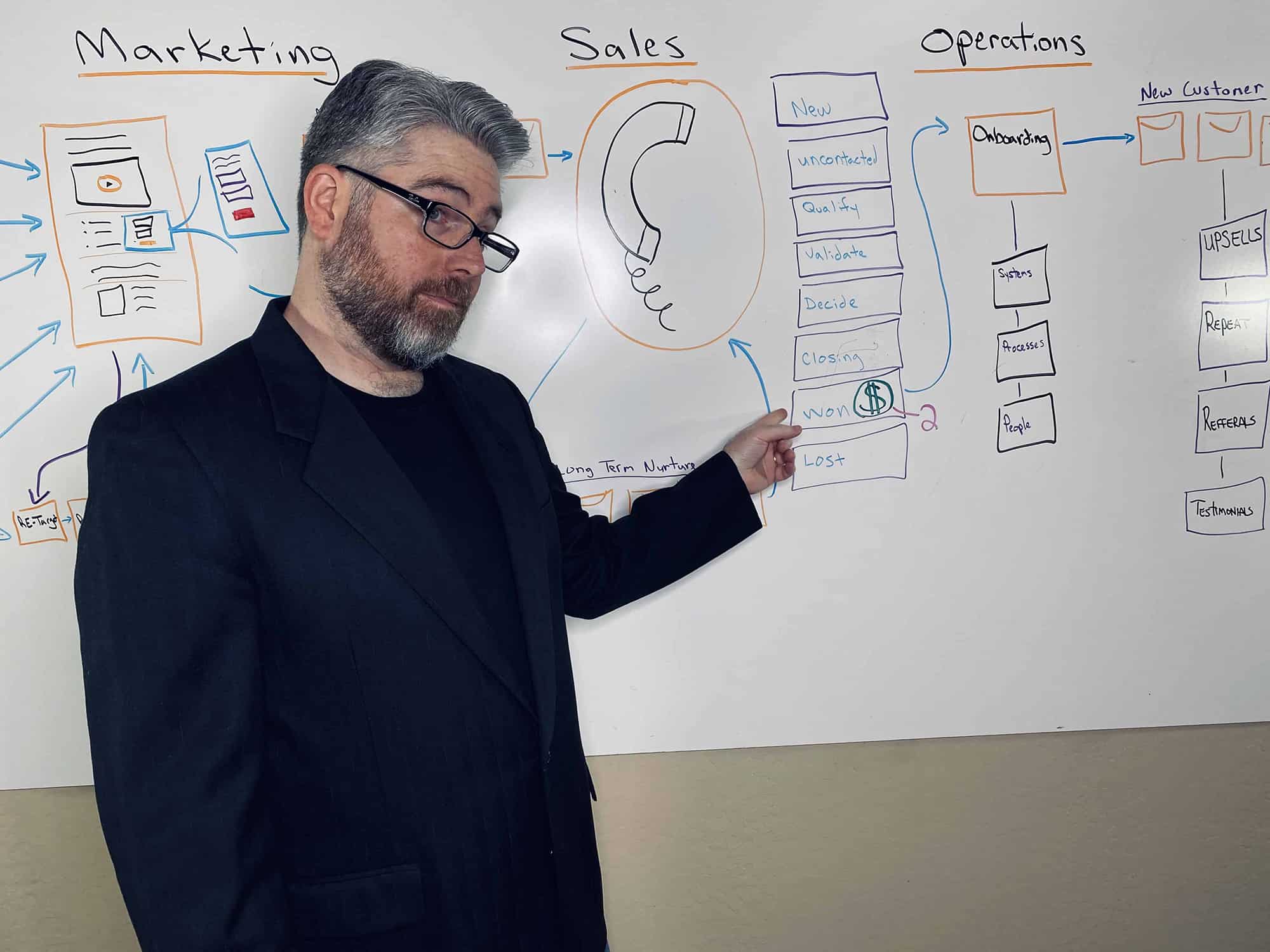
Let’s talk about website design for coaches and consultants. I’ve seen hundreds of coaching and consulting websites over the past 12 years. And 90% of them make the same fatal mistakes. They look pretty, they cost a fortune, and they convert about as well as a broken vending machine.
📋 Table of Contents
A coach comes to me with a $15K website built by a “brand specialist” who made everything look gorgeous. Zero conversions. Zero leads. Zero ROI. Meanwhile, I’ve seen consultants using basic WordPress themes who generate six figures annually because they understand something critical: your website isn’t a piece of art, it’s a lead generation machine.
The coaches and consultants who get this right don’t just build websites, they build trust systems. They understand that every pixel, every word, every button serves one purpose: turning visitors into paying clients. Here’s the exact playbook for building a website that actually works.
The Trust-to-Sale Conversion Framework
Your website needs to answer three questions in order: Do you understand my problem? Can you actually solve it? Why should I trust you over everyone else? Get this sequence wrong and your bounce rate stays north of 80%. Get it right and you’re looking at conversion rates that make other coaches weep.
I’m not talking about clever taglines or brand storytelling. I’m talking about laser-focused messaging that hits prospects between the eyes with clarity. “I help marketing executives who feel overwhelmed by managing remote teams” beats “Empowering leaders to unlock their potential” every single time.
Free Template
The Ultimate Task Delegation Template
Stop guessing what to hand off. This template shows you exactly what to delegate, how to brief it, and how to QA the results.
Get the Free Template →
The Five Essential Pages That Convert
Forget the 15-page website architecture that development agencies love to sell. You need five pages that work harder than a tax attorney in March. Each one has a specific job in your conversion funnel.
Page 1: Homepage (The Filter)
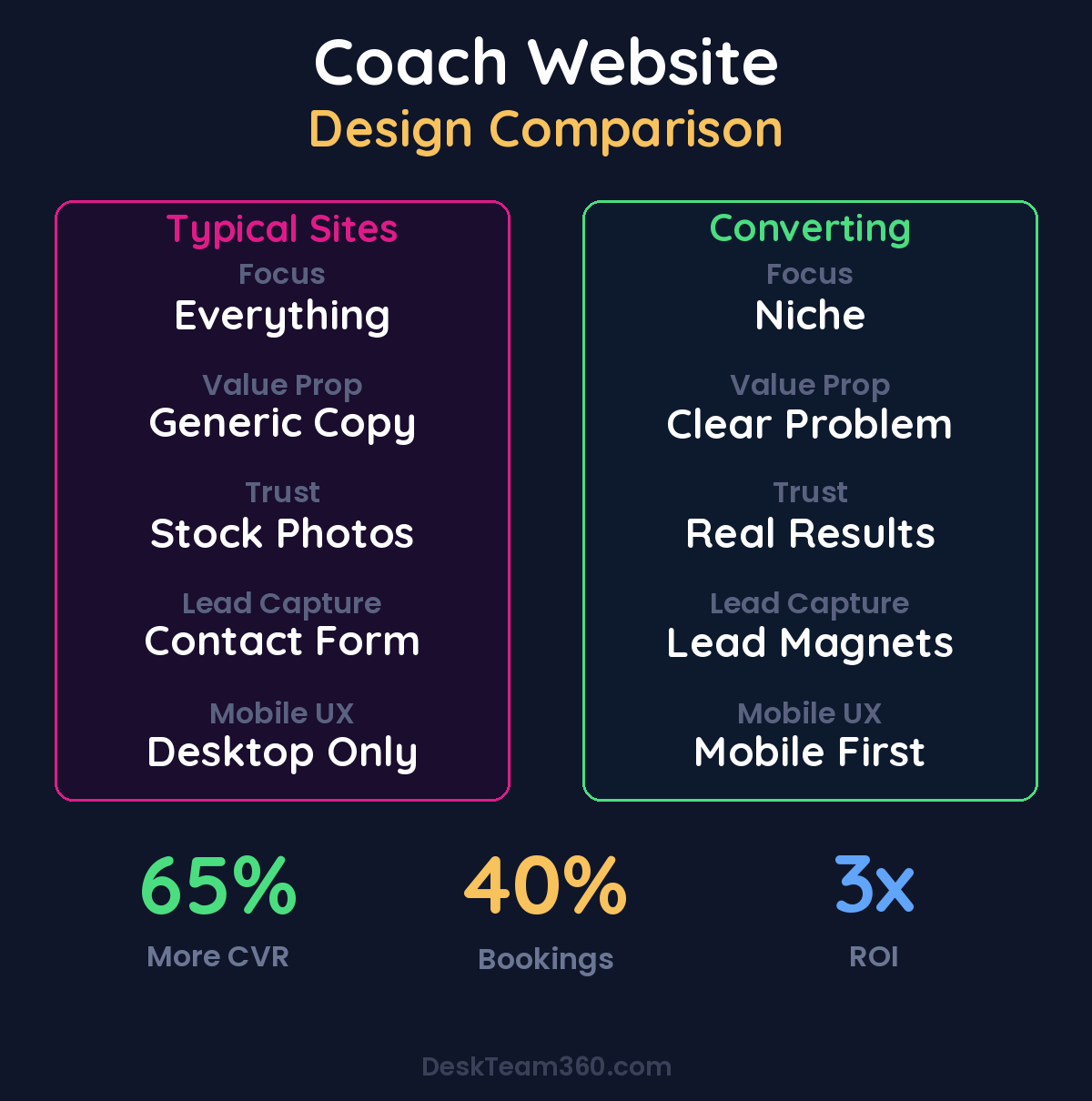
Your homepage isn’t for everyone. It’s for your ideal client only. If you’re a business coach who specializes in helping struggling SaaS founders scale to their first $1M ARR, say exactly that. Don’t water it down to appeal to “all entrepreneurs” because you’ll appeal to none.
Start with a headline that identifies the specific person and problem you solve. Follow with three bullet points showing the transformation you deliver. Include one clear call-to-action above the fold. Then prove you can deliver with social proof, specific results, and authority indicators.
Pro tip: Your headline formula should be “I help [specific audience] who [specific problem] achieve [specific outcome] in [specific timeframe].” Specificity builds trust faster than generic promises.
Page 2: About Page (The Trust Builder)
Nobody cares about your credentials unless they prove you can solve their problem. Your about page isn’t your resume, it’s your origin story. Start with the moment you realized you could solve the exact problem your ideal client faces. Share your method, your philosophy, your approach. End with proof that it works.
Include a professional photo that looks like you but slightly better. Share specific client results with names and numbers when possible. Address the obvious objections: Why should they trust you? What makes your approach different? Why do you only work with this specific type of client?
Page 3: Services Page (The Value Demonstrator)
Most coaches bury their services behind vague program names and flowery descriptions. “The Breakthrough Method” tells me nothing. “90-Day Revenue Recovery Program for Struggling Consultants” tells me exactly what I’m buying and who it’s for.
Structure each service with the problem it solves, the specific outcomes clients get, the process you use, and the investment required. Be transparent about pricing. The coaches who hide their rates aren’t protecting themselves from bargain hunters, they’re creating friction for serious prospects.
Page 4: Results/Case Studies Page (The Proof Factory)
This is where you prove everything you’ve claimed on the other pages. Specific client names, specific challenges, specific results, specific timelines. “Increased revenue” means nothing. “Helped Sarah’s consulting firm go from $8K to $35K monthly recurring revenue in 6 months” creates belief.
Websites with detailed case studies see 65% higher conversion rates than those with generic testimonials.
Include at least three case studies that mirror your ideal client’s situation. Show the before, the process, and the after. Include direct quotes from clients about their experience working with you. The more specific and detailed, the more persuasive.
Page 5: Contact/Booking Page (The Conversion Closer)
This page should make scheduling a call as friction-free as possible. Use a calendar booking system like Calendly or Acuity. Clearly state what happens on the call, how long it takes, and what they should prepare. Remove every excuse for not booking.
Address last-minute objections: “What if I’m not ready?” “What if my situation is different?” “What if I can’t afford your services?” Answer these before they ask. The easier you make it to say yes, the more yeses you’ll get.
Design Elements That Convert (And Ones That Kill Sales)
Design matters, but not the way most coaches think it does. Your website doesn’t need to win design awards. It needs to guide visitors toward booking a call. Every design choice should either build trust or reduce friction. Everything else is visual masturbation.
Trust Signals That Actually Work
Professional photography where you look confident and approachable. Client logos from recognizable companies (if you have them). Media mentions, podcast appearances, speaking engagements. Specific credentials that relate to your niche. Industry association memberships. Security badges and privacy certifications.
Don’t fake it. If you don’t have Fortune 500 clients yet, showcase the impressive transformations you’ve delivered for smaller businesses. Authenticity beats artifice every time.
Conversion Killers to Avoid
Stock photos of people in suits pointing at charts. Generic testimonials without names or specifics. Complicated navigation menus with eight dropdown categories. Auto-playing videos with sound. Pop-ups that appear before someone has been on your site for at least 30 seconds. Contact forms with more than four fields. Multiple calls-to-action competing for attention on the same page.
Watch out: Your website loading speed directly impacts conversions. If your site takes more than 3 seconds to load, you’re losing 40% of potential clients before they even see your content. Use tools like GTmetrix to audit performance regularly.
Content Strategy: What to Write and Where
Content marketing for coaches isn’t about posting motivational quotes on LinkedIn. It’s about demonstrating expertise while attracting your ideal clients. Your content should answer the questions your prospects are asking before they’re ready to hire you.
Blog Content That Converts
Write about specific challenges your ideal clients face. If you help marketing consultants struggling with client retention, write “How to Reduce Client Churn When Retainer Fees Are Rising” not “Five Keys to Client Satisfaction.” Specific problems attract specific people with specific budgets.
Share frameworks and methodologies without giving away the full implementation. Your content should make prospects think “This person clearly knows what they’re talking about, I wonder what they could accomplish if I hired them.” Balance being helpful with maintaining mystique around your process.
Content Calendar for Coaches
Two blog posts per month focused on client problems and solutions. One case study per quarter showing specific client transformations. Monthly industry insights that position you as a thought leader. Weekly social media posts that drive traffic back to your website. Quarterly webinars or workshops that capture leads and demonstrate expertise.
Quality beats quantity every time. One deeply helpful blog post that ranks on Google and attracts qualified prospects is worth more than 20 motivational posts that get ignored.
Lead Generation: Turning Visitors Into Prospects
Your website should capture contact information from visitors who aren’t ready to book a call yet. Most coaching websites have one lead magnet: “Schedule a free consultation.” That’s not enough. People need time to develop trust and evaluate their options.
Lead Magnets That Actually Work
Diagnostic assessments that identify specific problems in their business. Strategic templates they can implement immediately. Detailed case studies showing step-by-step transformations. Industry-specific guides that address common challenges. Toolkits with resources organized by problem type.
The best lead magnets solve a small version of the big problem you solve through coaching. If you help consultants scale their teams, offer a “Remote Hiring Checklist for Consultants” that showcases your methodology without replacing your service.
Position these throughout your website, not just on the homepage. Your about page can offer a case study download. Your services page can include relevant templates. Your blog posts can promote related resources. Multiple touchpoints create multiple conversion opportunities.
Email Follow-Up Sequences
When someone downloads your lead magnet, they should receive a strategic email sequence over the next 2-3 weeks. Day 1: deliver the promised resource plus a quick introduction. Day 3: share a relevant case study. Day 7: provide additional value related to their downloaded resource. Day 14: soft pitch your services with social proof. Day 21: direct call-to-action to schedule a consultation.
The goal isn’t to sell immediately. It’s to demonstrate consistent value while staying top-of-mind during their decision-making process. Most prospects need 5-7 touchpoints before they’re ready to purchase high-ticket services.
Technical Essentials: Platform, Hosting, and Tools
I get asked constantly about the “best” website platform for coaches. The answer depends on your technical comfort level and growth plans. But here’s what I’ve seen work across hundreds of implementations.
Related reading: How to Create a High-Converting Course Sales Page.
We cover this in more detail in how to launch an online course: the complete checklist.
Platform Recommendations
WordPress gives you the most flexibility and control, requires some technical knowledge, costs $200-500 annually for hosting and premium themes, and offers unlimited customization options. Squarespace provides beautiful templates with drag-and-drop editing, limited customization compared to WordPress, costs $144-408 annually, and works best for design-focused coaches. ConvertKit Landing Pages are perfect for simple lead generation sites, integrate seamlessly with email marketing, cost $29+ monthly, and offer excellent conversion optimization tools.
For most coaches starting out, I recommend Squarespace for simplicity or WordPress if you have technical support available. Avoid Wix, GoDaddy Website Builder, and other consumer-focused platforms. They look amateur and perform poorly.
Essential Tools and Integrations
Calendar booking systems like Calendly, Acuity, or Dubsado for scheduling consultations. Email marketing platforms such as ConvertKit, Mailchimp, or ActiveCampaign for lead nurturing. Analytics tools including Google Analytics 4 and Google Search Console for performance tracking. Live chat software like Intercom or Drift for immediate prospect engagement. Payment processors such as Stripe or PayPal for accepting coaching fees.
Pro tip: Set up goal tracking in Google Analytics for key actions: contact form submissions, calendar bookings, lead magnet downloads, and service page views. What gets measured gets optimized.
Consider implementing AI-powered support systems to handle frequently asked questions about your coaching programs. This allows you to provide instant responses while focusing your time on qualified prospects.
Pricing Strategy: What to Display and What to Hide
Pricing transparency for high-ticket coaching is controversial. Some coaches swear by posting rates publicly. Others insist on discovery calls first. Here’s what actually works based on conversion data from 400+ coaching businesses.
When to Show Pricing
Display prices when you offer standardized programs under $5,000, when you want to pre-qualify prospects and eliminate bargain hunters, when your competitors are transparent about pricing, and when your target market expects upfront costs (like small business owners who comparison shop).
When to Hide Pricing
Keep pricing private for custom coaching engagements over $10,000, when you offer multiple service tiers that require explanation, when your pricing depends on company size or complexity, and when your ideal clients are enterprises that expect custom proposals.
The middle ground? Show starting ranges: “Executive coaching programs begin at $3,500 monthly” or “Consulting engagements typically range from $15,000 to $50,000.” This sets expectations without boxing you into specific numbers.
Mobile Optimization: Where Most Coaches Fail
Sixty-eight percent of your website traffic comes from mobile devices. Yet most coaching websites are designed on desktop and barely function on phones. This isn’t just bad user experience, it’s lost revenue.
Your mobile site should load in under 3 seconds on 4G networks. Contact information and booking buttons should be thumb-friendly and prominently placed. Text should be readable without zooming. Forms should minimize typing required. Navigation should be simple and obvious.
Mobile-optimized coaching websites see 40% higher booking rates than desktop-only designs.
Test your site monthly on actual mobile devices, not just browser tools. iPhone Safari behaves differently than desktop Chrome. Android phones have different screen sizes and resolutions. Your highest-value prospects might be viewing your site while commuting or traveling. Make it easy for them to hire you.
SEO for Coaches: Getting Found by Ideal Clients
Search engine optimization for coaches isn’t about ranking for “life coach” or “business consultant.” Those keywords are too competitive and too generic. You want to rank for specific problems your ideal clients search for when they’re ready to hire help.
Keyword Strategy That Works
Target long-tail keywords that indicate buying intent: “marketing consultant for SaaS startups,” “executive coach for tech leaders,” “business coach for struggling restaurants.” These searches have less competition and higher conversion rates than generic coaching terms.
Create content around specific client questions: “How much should a marketing consultant charge per hour?” or “What to expect from executive coaching sessions.” People search for these exact phrases when evaluating whether to hire a coach.
For industry benchmarks and research, see HubSpot Blog.
For industry research and benchmarks, check out Shopify Blog.
Related: Digital Marketing for Construction Companies: The Complete Guide.
Understanding how to create comprehensive content that ranks requires the same strategic thinking as building effective FAQ pages that address real customer concerns.
Local SEO for Location-Based Coaches
If you work with local clients, optimize for geographic keywords: “business coach in Denver” or “leadership consultant Seattle.” Create location-specific content about local business challenges. Get listed in local business directories. Encourage clients to leave Google My Business reviews mentioning your location and service area.
Tracking Performance: Metrics That Matter
Most coaches track vanity metrics like website visitors and social media followers. These numbers feel good but don’t pay your bills. Focus on metrics that directly correlate with revenue.
Conversion metrics to track weekly: What percentage of visitors book consultations (target 2-5%)? How many consultation calls convert to paying clients (target 30-50%)? What’s the average value per client engagement? How many qualified leads does your website generate monthly?
Content performance indicators: Which blog posts generate the most consultation bookings? What lead magnets have the highest download-to-client conversion rates? Which pages have the highest bounce rates and need improvement? What traffic sources bring the highest-value prospects?
The 90-day optimization cycle is critical. Review performance monthly, identify the biggest conversion leaks, implement fixes, and measure results. Small improvements compound into dramatic revenue increases over time.
Common Mistakes That Cost Coaches Six Figures
I’ve diagnosed hundreds of coaching websites that should be profitable but aren’t. The same issues come up repeatedly, and they’re all preventable with proper strategy.
Trying to appeal to everyone. “I help anyone who wants to improve their life” attracts no one. Narrow your focus until you feel uncomfortable, then narrow it more. Specialists charge premium rates. Generalists compete on price.
Hiding behind your methodology. Prospects don’t care about your proprietary process until they understand the results it delivers. Lead with outcomes, support with methodology, close with social proof.
Underestimating the sales cycle. High-ticket coaching sales take 30-90 days from initial contact to signed contract. Your website needs to nurture prospects through this entire journey, not just capture initial interest.
Ignoring mobile users. If your site doesn’t work perfectly on phones, you’re losing 40%+ of potential clients. No exceptions.
Not testing conversion elements. Your headline, call-to-action buttons, contact forms, and pricing presentation should be continuously optimized based on real performance data. What you think will work and what actually works are often completely different.
The $100K Website: Putting It All Together
A coaching website that generates $100K+ annually isn’t magic. It’s strategic. It attracts the right visitors, builds trust quickly, demonstrates value clearly, captures leads effectively, and converts prospects systematically.
Every successful coaching website I’ve analyzed follows the same pattern: crystal-clear messaging for a specific audience, compelling proof that the coach delivers results, multiple lead capture opportunities throughout the user journey, systematic follow-up that nurtures prospects over time, and continuous optimization based on conversion data.
Your website should work as hard as you do. It should answer prospects’ questions, address their objections, and make hiring you the obvious next step. When it does all that, consistent five and six-figure revenue becomes inevitable, not accidental.
At DeskTeam360, we’ve built conversion-focused websites for coaches across every niche, from executive leadership to health and wellness to business consulting. We handle the strategy, design, and ongoing optimization so you can focus on delivering results for your clients.
Free 5-Minute Video
See How DeskTeam360 Works in Under 5 Minutes
Watch the short video and see exactly how we handle design, development, and marketing implementation — so you don't have to.
Watch the Video →