


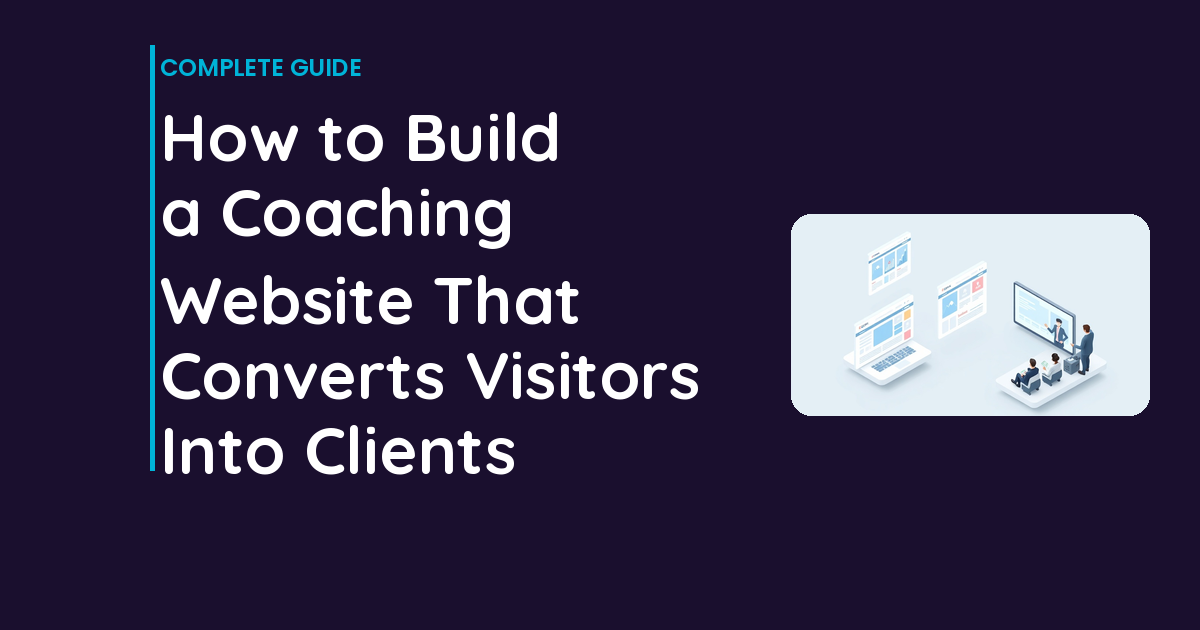
How to Build a Coaching Website That Converts Visitors Into Clients
Let’s talk about coaching website that converts and why it matters for your business.
📋 Table of Contents
Your Coaching Website Is Probably Costing You Clients
I’ll say it bluntly: if you’re a coach charging $5,000+ per client and your website looks like a DIY template from 2019, you’re bleeding money. Not dripping. Bleeding.
After 12 years of building websites at DeskTeam360, I’ve seen exactly what separates a coaching website that books discovery calls from one that just collects digital dust. It’s not about having the prettiest colors or the trendiest animations. It’s about being strategically ruthless with every element on your page.
Most coaches think their website is about them. Wrong. Your website exists for one reason: to convert visitors into paying clients. Every word, every image, every button should push toward that goal. If it doesn’t, it’s dead weight.
Here’s exactly how to build a coaching website that actually books clients instead of just looking nice in your portfolio.
What Makes Coaching Websites Different From Everything Else
A coaching website isn’t an e-commerce store where people buy on impulse. It’s not a corporate site designed by committee. And it’s definitely not a personal blog with a “hire me” button thrown on as an afterthought.
Coaching is a trust-based, high-ticket purchase. People are investing thousands of dollars based on their confidence in you as a person. Your website needs to accomplish three critical things in the first 10 seconds: establish authority fast, create emotional connection, and drive one clear action.
That’s it. Everything else is noise.
Most coaches try to say everything on their home page. They want to explain their entire methodology, share their complete life story, and list every possible outcome someone might achieve. This is exactly backward. Your home page is a trailer, not the entire movie. Its job is to make people want to watch the full feature.
Free Tool
How Much Is Freelancer Management Really Costing You?
Most agency owners have never done this math. Plug in a few numbers and see your real cost in 2 minutes.
Calculate Your Hidden Costs →
The Foundation: Pages That Actually Convert
Home Page: Your Digital Handshake
Your home page has exactly one job: make visitors want to learn more. Everything else is secondary.
Above the fold, you need four elements and nothing more. A headline that speaks directly to your ideal client’s biggest problem or most desired outcome. A subheadline that explains how you help, with specifics, not vague promises. A professional photo of you, because people buy from people, not logos. And one primary CTA button that’s impossible to miss.
Below the fold is where you build credibility. A social proof strip showing where you’ve been featured or how many clients you’ve helped. Three to four key benefits of working with you, focused on outcomes, not features. Two to three video testimonials from real clients with real results. A brief overview of your programs with clear next steps.
The mistake I see constantly? Coaches trying to cram their entire value proposition above the fold. Your visitors’ screens aren’t billboards. Guide them through a logical flow instead of hitting them with everything at once.
About Page: Authority, Not Autobiography
Your about page isn’t about you. It’s about your ideal client and why you’re uniquely qualified to solve their specific problems.
Start with empathy. Show you understand their struggle before you talk about your solution. Share your origin story, but only the parts that build credibility and connection with your target audience. Highlight relevant credentials, years of experience, certifications that matter, and specific results you’ve achieved for clients.
Pro tip: Nobody cares that you love hiking, have two dogs, and drink kombucha. They care that you’ve helped 200 business owners double their revenue in 18 months. Lead with results, not personal trivia.
Include a professional bio photo that matches the energy you bring to your coaching. This isn’t LinkedIn. Show personality while maintaining credibility. End with a clear CTA that moves people toward working with you.
Programs and Services: Make Your Offer Crystal Clear
This is where most coaching websites completely implode. You need a dedicated page for each program or service, and each page needs to answer the five questions every prospect has.
Who is this for? Be ruthlessly specific about your ideal participant. Don’t say “anyone who wants to grow their business.” Say “established consultants earning $200K annually who want to break through the $1M barrier without burning out.”
What’s included? Number of sessions, group versus one-on-one format, program duration, specific deliverables they’ll receive. Vague promises like “transformation” mean nothing. Give them the concrete details.
What results can they expect? Paint a picture of what their life looks like after working with you, with realistic timelines and specific outcomes.
What does it cost? You don’t need exact pricing, but give a range or “starting at” figure. This qualifies leads and reduces wasted discovery calls with people who can’t afford your services.
Price transparency is your friend, not your enemy. Coaches who hide their pricing get more calls from tire-kickers. Coaches who show pricing ranges get fewer calls from higher-quality prospects ready to buy.
Include testimonials from past participants with specific results, an FAQ section that addresses common objections before they become deal-breakers, and a clear CTA that moves them to the next step.
Results and Testimonials: Your Proof Factory
Dedicate an entire page to social proof. This isn’t optional for high-ticket coaching. It’s essential.
Video testimonials are gold, even 60-second phone recordings outperform polished text reviews. Written case studies with before and after details show the depth of your work. Screenshots of client wins like revenue reports, messages, or social media posts make results tangible. And specific metrics like “average client sees 40% revenue increase within 6 months” give prospects concrete expectations.
Organize testimonials by client type or problem solved so visitors can find stories that mirror their exact situation. If you coach both executives and entrepreneurs, separate the proof so each audience sees relevant results.
Content That Builds Trust
A blog isn’t just for SEO, though it’s incredible for that. For coaches, it’s a trust-building machine that works around the clock. Every blog post demonstrates your expertise, shares your methodology, and shows potential clients how you think and solve problems.
Post consistently, at least twice a month. Focus on topics your ideal clients are actively searching for. Make every post genuinely useful, not promotional fluff disguised as education. You want readers thinking “if this is what they give away for free, imagine what the paid content is like.”
Booking and Contact: Remove All Friction
Make it dead simple to get in touch. Use an embedded calendar tool like Calendly or Acuity so visitors can book immediately without leaving your site. Include a brief qualification form with budget range, biggest challenge, and timeline to help you prepare.
Set clear expectations about what happens on the discovery call. Is it a sales conversation? A strategy session? A mutual fit assessment? Managing expectations up front leads to better calls and higher close rates.
Design Elements That Convert Visitors Into Clients
Professional Photography: Your Secret Weapon
Coaching is personal. People need to see your face, your energy, your vibe before they’ll trust you with their biggest challenges and significant investment.
Invest $500 to $2,000 in a professional brand photoshoot. You need a primary headshot for your home page and about page, action shots of you coaching or speaking, lifestyle shots that reflect your brand personality, and multiple outfits and backgrounds for variety across your site and marketing materials.
Those images will be used for one to two years across your website, social media, email signatures, and marketing materials. It’s one of the highest ROI investments you can make as a coach.
Color Psychology That Supports Your Message
Your color palette communicates before a single word is read. Navy and dark blue signal trust, authority, and professionalism, perfect for executive coaches. Gold and amber convey premium positioning and transformation, great for high-ticket programs. Green represents growth, health, and balance, ideal for wellness and life coaches. Purple suggests creativity, wisdom, and spirituality, perfect for creative and spiritual coaches.
Pick two to three colors and use them religiously. Your website, social media, lead magnets, and program materials should look like they belong to the same brand. Consistency builds trust, and trust converts to sales.
Mobile-First Design Is Non-Negotiable
Over 65% of your traffic comes from mobile devices. If your site doesn’t look amazing and function flawlessly on a phone, you’re losing the majority of your visitors before they ever see your offer.
Buttons need to be large enough to tap easily, text readable without zooming, forms that work on small screens, load times under three seconds, and calendar booking that functions perfectly on mobile. Test every page on your phone after any update. What looks good on your desktop might be unusable on mobile.
Watch out: Many coaches design their sites on desktop and never check mobile. Then they wonder why their conversion rates are terrible. Mobile isn’t secondary anymore, it’s primary.
For a deeper dive, check out our guide on marketing for business coaches: the complete strategy guide.
Related reading: How to Launch an Online Course: The Complete Checklist.
For industry benchmarks and research, see Thinkific Blog.
For industry research and benchmarks, check out HubSpot Blog.
The Technical Foundation That Supports Conversions
Speed Kills Conversions
A slow website bleeds money. For every second of load time, you lose approximately 7% of conversions. This adds up fast when you’re selling high-ticket coaching programs.
Compress images before uploading and use WebP format when possible. Choose quality hosting like SiteGround, WP Engine, or Kinsta that can handle traffic spikes. Use a caching plugin if you’re on WordPress. Minimize unnecessary plugins and scripts that slow down your site.
Test your site speed regularly at PageSpeed Insights and aim for scores above 80 on both mobile and desktop. Speed isn’t just about user experience, it directly impacts your bottom line.
Booking Systems That Actually Work
Your booking system is the most critical piece of technology on your website. Everything else can be average, but this has to be perfect.
Calendly is simple, reliable, and integrates with everything. Best choice for most coaches. Acuity Scheduling offers more customization and better intake forms for coaches who need detailed pre-call information. GoHighLevel is an all-in-one CRM plus booking system, ideal for coaches who want to consolidate tools. TidyCal offers lifetime pricing and works well for coaches just starting out.
Whatever you choose, embed the calendar directly on your website. Every external redirect loses prospects. Make booking as friction-free as possible.
Pre-Call Qualification Forms
Before someone books a call, ask three to five qualifying questions. What’s your biggest challenge right now? What have you already tried to solve this? What would success look like for you in six months? What’s your approximate budget for coaching? How did you find me?
This serves two purposes: it weeds out people who aren’t a good fit for your programs, and it gives you valuable information to personalize the sales conversation and increase your close rate.
Video: The Conversion Multiplier
Video is the closest thing to meeting you in person. For coaching, where the purchase decision is deeply personal, video can be the difference between a prospect who books and one who bounces.
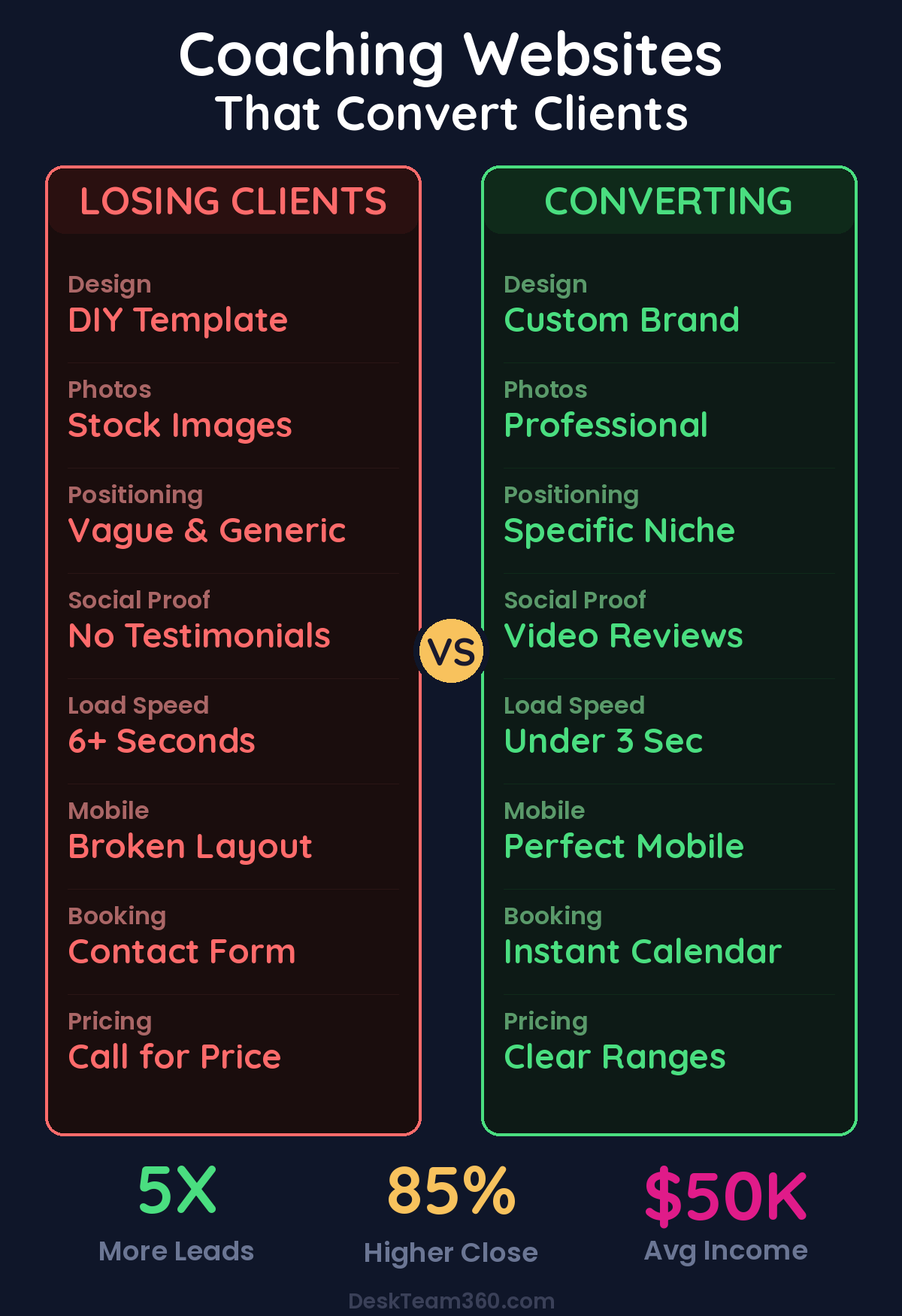
Coaching websites with video convert 85% higher than those without. Video builds trust faster than any other medium.
Use a 60 to 90 second intro video on your home page where you speak directly to your ideal client. Include a 2 to 3 minute “my story” video on your about page. Create program walkthrough videos that show what clients experience. Collect video testimonials from past clients, the more the better. Consider a video sales letter for your primary coaching offer.
You don’t need Hollywood production quality. A well-lit room, decent audio, and genuine energy will outperform a slick but soulless corporate video every time. Authenticity trumps perfection in the coaching space.
What Separates $5K Coaches From $50K Coaches Online
I’ve built websites for coaches at every income level. The difference between those earning $5,000 annually and those earning $50,000+ isn’t talent or credentials. It’s infrastructure and positioning.
Struggling coaches use DIY website templates with stock photos everywhere. They have vague positioning like “I help people live their best life.” They have no testimonials or generic ones that could apply to anyone. Multiple CTAs compete for attention on every page. They have no lead magnet or email nurture sequence.
Successful coaches invest in professionally designed, brand-consistent websites with custom photography throughout. They have razor-sharp positioning with specific outcomes for specific people. They showcase multiple video testimonials with measurable results. Every page has one clear primary CTA. They have automated funnels with email nurture sequences that work while they sleep.
The difference isn’t talent. It’s systems. $50K coaches have built marketing infrastructure that generates leads and books calls automatically. Your website should be your hardest-working team member.
Common Mistakes That Kill Coaching Website Conversions
Using too many fonts and colors makes your site look amateur. Stick to two fonts and three colors maximum. Autoplay videos annoy visitors, let them choose to press play. Hiding pricing completely attracts tire-kickers, give at least a starting range.
Having no social proof above the fold wastes your most valuable real estate. Put credibility indicators near the top where everyone sees them. Ignoring mobile design loses 65% of your traffic. Test every page on your phone after updates.
Generic headlines like “Welcome to my website” say nothing about the value you provide. Lead with specific benefits for specific people. Having no clear next step on pages leaves visitors confused about what to do next.
Build Your Client-Converting Website
Your coaching website should be your most reliable lead generation system, working 24/7 to build trust, demonstrate expertise, and book discovery calls. If your current site isn’t doing that consistently, it’s costing you clients every single day.
The coaches who invest in proper website infrastructure see the difference immediately. More qualified leads, higher-quality discovery calls, and significantly better close rates. This isn’t about vanity metrics or pretty designs. It’s about building a system that grows your coaching business.
At DeskTeam360, we build coaching websites that actually convert, with proper strategy, professional design, and all the technical details handled by our team of 400+ specialists. We handle the implementation so you can focus on what you do best: transforming your clients’ lives.
Free 5-Minute Video
See How DeskTeam360 Works in Under 5 Minutes
Watch the short video and see exactly how we handle design, development, and marketing implementation — so you don't have to.
Watch the Video →