


How to Create a Lead Magnet That Actually Converts in 2025
Why 90% of Lead Magnets Are Just Pretty Trash
Knowing how to create a lead magnet can be the difference between growth and spinning your wheels. Here’s what happens in most businesses: someone decides they need a lead magnet, throws together a “free guide” in Canva over a weekend, slaps it behind an opt-in form, and then wonders why their email list is full of tire kickers who never buy anything.
📋 Table of Contents
I’ve watched this same mistake play out hundreds of times over 12+ years of running agencies. The problem isn’t that lead magnets don’t work. The problem is that most businesses treat them like digital afterthoughts instead of what they actually are: your first sales pitch.
Think about it. Someone just handed you their email address. That’s currency in 2025. They’re essentially saying “I trust you enough to let you into my inbox.” And your response is… a poorly designed PDF full of generic advice they could find on page one of Google?
A real lead magnet isn’t just a freebie. It’s a sample of what working with you feels like. It’s proof that you know what you’re talking about. It’s the difference between someone thinking “this person might be able to help me” and “I need to hire this person immediately.”
Let me show you exactly how to build lead magnets that don’t just collect emails, they create customers.
The Five Elements Every Converting Lead Magnet Must Have
I’ve analyzed hundreds of lead magnets across dozens of industries. The ones that actually generate revenue all share five specific characteristics. Miss any of them and you’re basically running an expensive email collection service.
Solves One Specific Problem
“The Ultimate Marketing Guide” is not a lead magnet. It’s a research project nobody asked for. The best lead magnets solve one painfully specific problem your target audience is dealing with right this second.
Here’s the test: can you describe the problem your lead magnet solves in one sentence? If not, you’re too broad. “How to get more website traffic” is too broad. “The 15-minute SEO audit that found $50K in missed revenue” is specific.
Delivers a Quick Win
Your lead magnet should give someone a tangible result within 10 minutes of consuming it. Not next week, not after they implement your 47-step process. Right now, immediately, while they’re still engaged.
The best lead magnets I’ve seen give people what I call the “holy crap” moment. That moment when someone thinks “this actually worked” or “I never knew that.” That’s the feeling that turns a skeptical email subscriber into someone who opens every message you send.
Pro tip: Test your lead magnet with someone who’s never seen your business before. Give them 10 minutes to consume it. If they can’t immediately tell you one specific thing they learned or one action they can take, your lead magnet needs work.
Demonstrates Your Expertise Without Giving Everything Away
This is where most people get confused. They think a lead magnet has to contain everything they know about a topic. Wrong. A lead magnet should prove you know what you’re talking about while making it clear there’s much more where that came from.
Think of it like a restaurant giving out free samples. The goal isn’t to give you a full meal, it’s to give you a taste that makes you want to order the entrée. Your lead magnet is the sample. Your paid service is the entrée.
Looks Like It Came From a Real Business
Design quality is a trust signal. When someone downloads your lead magnet and it looks like it was designed by a middle schooler with a free trial of Canva, what does that say about your ability to solve their business problems?
I’m not talking about spending $5,000 on custom illustrations. I’m talking about clean layouts, readable fonts, consistent branding, and professional polish. If design isn’t your strength, outsource your graphic design to someone who can make your materials look like they belong to a company ten times your size.
Has a Clear Next Step
Most lead magnets end with “thanks for downloading.” That’s a wasted opportunity. The best lead magnets end with a clear, logical next step. “Want us to run this audit for your business? Book a call here.” “Ready to implement this strategy at scale? Here’s how we can help.”
Free Template
The Ultimate Task Delegation Template
Stop guessing what to hand off. This template shows you exactly what to delegate, how to brief it, and how to QA the results.
Get the Free Template →
The Lead Magnet Formats That Actually Convert
Not every format works for every business. Here’s what I’ve seen perform consistently well, and when to use each one.
Checklists and Quick Reference Guides
These convert higher than any other format because they’re immediately useful and require zero time investment. Someone can print it out, stick it on their wall, and reference it repeatedly.
The secret is making them visually scannable. Use checkboxes, icons, color coding, and plenty of white space. One page is ideal, two pages maximum. Any longer and it stops being a quick reference and becomes homework.
Example: “The 23-Point Website Launch Checklist” or “Social Media Image Sizes for Every Platform in 2025”
Templates and Swipe Files
Give people something they can literally copy, paste, and customize. Templates eliminate the blank page problem that keeps people stuck in planning mode forever.
The key is making the template itself look professional. If you’re offering email templates, design them with your branding and make them feel polished. A plain text document isn’t a template, it’s lazy.
For detailed guidance on creating templates that work, check out our guide on writing creative briefs that actually get results.
Mini-Courses and Video Training
Video builds trust faster than any other medium. A 15-20 minute training video positions you as the expert and creates a pseudo-relationship before they ever talk to you.
The mistake most people make is trying to teach everything in one video. Pick one specific outcome and focus entirely on that. “How to audit your website for conversion issues in 20 minutes” is better than “Everything you need to know about conversion optimization.”
Interactive Tools and Calculators
These are lead magnet gold for any business that involves pricing, budgeting, or ROI calculations. They provide immediate, personalized value and naturally lead into a sales conversation.
The best calculators solve a real problem your prospects are trying to figure out anyway. “How much should I budget for a website redesign?” “What’s my customer acquisition cost?” “How much time could I save by outsourcing?”
Resource Bundles
Bundle multiple related resources into a single download. This works because it has high perceived value, even if each individual piece is simple.
Example: “The Complete Brand Launch Kit” including a logo checklist, brand style guide template, social media templates, and voice worksheet. Each piece might be simple, but together they feel substantial.
How to Design Lead Magnets That Don’t Look Amateur
Content is only half the equation. How your lead magnet looks determines whether people actually consume it and whether they take you seriously afterward.
Brand Consistency Isn’t Optional
Your lead magnet should look like it belongs to your brand. Same colors, same fonts, same visual style as your website. If someone downloads your ebook and it looks nothing like your website, you’ve created a disconnect that kills trust.
If you don’t have established brand guidelines, create them before you design anything. Consistency across every touchpoint is what builds recognition and credibility.
Layout Principles That Actually Matter
White space is not wasted space. Don’t cram every pixel with content. Give your text room to breathe. Use visual hierarchy with clear headings, subheadings, and body text in readable sizes. Break up long blocks of text with callout boxes, quotes, and images.
Related reading: In-House Designer vs Agency vs Subscription: Which One Actually Works? [2026].
For a deeper dive, check out our guide on one simple trick to minimize overwhelm.
Most importantly, design for mobile first. The majority of people will consume your lead magnet on their phone. If it’s not readable at mobile sizes, you’ve lost them before they start.
Professional design is a competitive advantage. Two lead magnets with identical content, one professionally designed and one DIY, will convert at dramatically different rates. Design quality signals competence before people even read your content.
Building Landing Pages That Convert Visitors to Subscribers
Your lead magnet is only as good as the landing page promoting it. Here’s what high-converting lead magnet pages include.
Headlines That Promise Specific Outcomes
The best lead magnet headlines follow this pattern: Get [specific result] without [thing they want to avoid]. Examples: “Get 50+ Content Ideas Without Spending Hours Brainstorming” or “Launch Your Website Without Forgetting Critical Steps.”
Avoid vague promises like “Grow Your Business” or “Improve Your Marketing.” Those mean nothing to someone with a specific problem they need solved right now.
Keep Form Fields to the Absolute Minimum
Every form field you add reduces conversions. For most lead magnets, you need exactly two things: first name and email address. That’s it. Don’t ask for their phone number, company size, annual revenue, and shoe size. You can collect additional information later.
Social Proof Builds Credibility Fast
If you have download numbers, testimonials, or logos of companies that have used your resources, include them prominently. “Downloaded by 8,000+ marketers” carries more weight than any benefit statement you’ll write.
For comprehensive guidance on building pages that actually convert, our guide on creating effective landing pages covers the fundamentals.
The Follow-Up Sequence That Turns Subscribers Into Customers
This is where the real magic happens. Your lead magnet gets attention, but your follow-up sequence builds the relationship and moves people toward buying.
The Five-Email Welcome Series That Works
Email 1 (immediate): Deliver the lead magnet. Keep it short and friendly. “Here’s what you requested. Hope it helps!”
Email 2 (day 2): Ask how they found the resource. Share one additional tip related to the topic. Build engagement.
Email 3 (day 4): Tell a story about a client or customer who had the same problem your lead magnet addresses. Show the transformation.
Email 4 (day 7): Introduce your paid solution as the logical next step. Don’t be salesy, be helpful.
Email 5 (day 10): Direct offer with urgency or scarcity. This is your clear call-to-action.
Segmentation Makes Everything Better
Not everyone who downloads your lead magnet is ready to buy immediately. Segment your list based on engagement and send different messages to different groups. People who click multiple links get more aggressive sales messages. People who only open emails get more educational content.
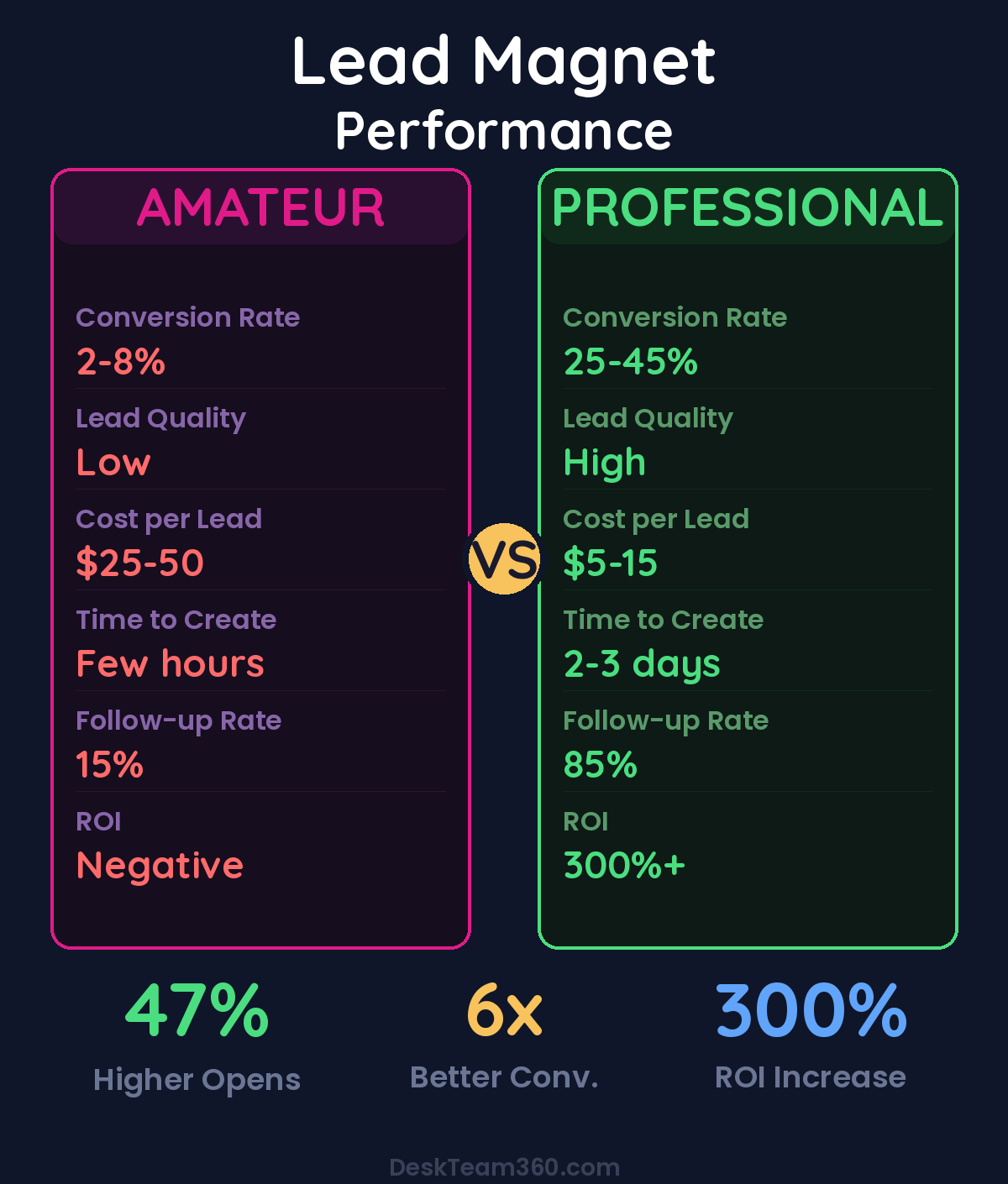
Properly segmented email sequences see 47% higher open rates and convert 6x better than broadcast emails sent to your entire list.
Where to Promote Your Lead Magnet for Maximum Exposure
Building a great lead magnet means nothing if nobody sees it. Here’s where to put it.
On Your Website
Your homepage should promote your best lead magnet prominently. Use exit-intent popups to catch people before they leave. Embed content-specific lead magnets within related blog posts. Add persistent sidebar and footer promotions across all pages.
Through Content Marketing
Every blog post you write is an opportunity to promote a related lead magnet. If you write about social media strategy, promote your social media template bundle. If you write about website optimization, promote your conversion checklist.
Paid Advertising
Lead magnet ads typically have the lowest cost per lead of any ad type because you’re not asking people to buy anything immediately. Facebook, Google, and LinkedIn all work well for lead magnet promotion.
Understanding how to measure marketing ROI becomes critical when you’re spending money to acquire email subscribers.
Measuring Performance and Optimizing for Better Results
Don’t set it and forget it. Track these metrics religiously:
Landing page conversion rate should be 25-45%. Below 25% means your page needs work. Above 45% means you’re crushing it. Email deliverability matters more than you think. Are your delivery emails actually reaching inboxes or getting stuck in spam?
The consumption rate tells you if people are actually reading your content. Use tools like PDF analytics to see how much of your lead magnet people actually consume. Lead-to-customer rate is the only metric that ultimately matters. These leads need to eventually buy something.
Five Mistakes That Kill Lead Magnet Performance
Making It Too Long
A 50-page ebook sounds impressive but nobody reads it. Better to create a focused 8-page guide that gets consumed and acted on than a comprehensive tome that sits in downloads folders forever.
Generic Topics That Appeal to Everyone
“10 Marketing Tips” attracts everyone and converts no one. “The 3 Facebook Ad Mistakes Killing Your Real Estate Lead Generation” attracts exactly the right people and converts them into customers.
Skipping the Professional Design
A beautifully designed lead magnet signals competence. An ugly one kills credibility before your content gets a fair chance. This isn’t negotiable in 2025.
Watch out: Most businesses underestimate how much design quality affects conversion rates. A professionally designed lead magnet will outperform a DIY version by 300-400%, even with identical content.
No Follow-Up Strategy
Collecting emails without nurturing them is like filling a bucket with holes. Build your email sequence before you launch your lead magnet, not after.
Turn Your Lead Magnets Into Revenue Generators
Lead magnets are one of the highest-ROI marketing investments you can make, but only if they solve real problems, look professional, and connect to a solid sales process.
Most businesses treat lead magnets as one-off projects instead of the systematic lead generation engines they should be. They create one lead magnet, promote it halfheartedly, and wonder why it doesn’t generate meaningful revenue.
At DeskTeam360, we build complete lead generation systems for our clients. Professional design, high-converting landing pages, email automation, and ongoing optimization. Everything you need to turn website visitors into paying customers at a predictable flat monthly rate.
If you’re tired of lead magnets that collect dust instead of generating dollars, we can help you build something that actually works.
Free 5-Minute Video
See How DeskTeam360 Works in Under 5 Minutes
Watch the short video and see exactly how we handle design, development, and marketing implementation — so you don't have to.
Watch the Video →