

Digital Marketing for Beauty Salons and Spas: Complete Strategy
Digital marketing for beauty salons requires a focused strategy that actually drives results.
📋 Table of Contents
Why Most Beauty Salons Are Failing at Marketing (And How to Fix It)
You could be the best colorist in your city. Doesn’t matter. If nobody can find you online when they search “hair salon near me,” you’re invisible. And invisible means empty chairs.
I’ve worked with service businesses for 12+ years now, and beauty salons are hands down the worst at marketing themselves. Which is insane, because you have everything you need to dominate digital marketing: visual results, repeat customers, and transformation stories that make people stop scrolling.
Instead, most salon owners throw up an Instagram page, post sporadically when they remember, and wonder why their appointment book has gaps. Then they blame the economy or say “people don’t value quality anymore.” Wrong. They just can’t find you.
Let me show you exactly how to market a beauty salon or spa online. No fluff, no theory, just what actually works to fill chairs and build a waiting list.
Local SEO: Your Biggest Opportunity (That Everyone Screws Up)
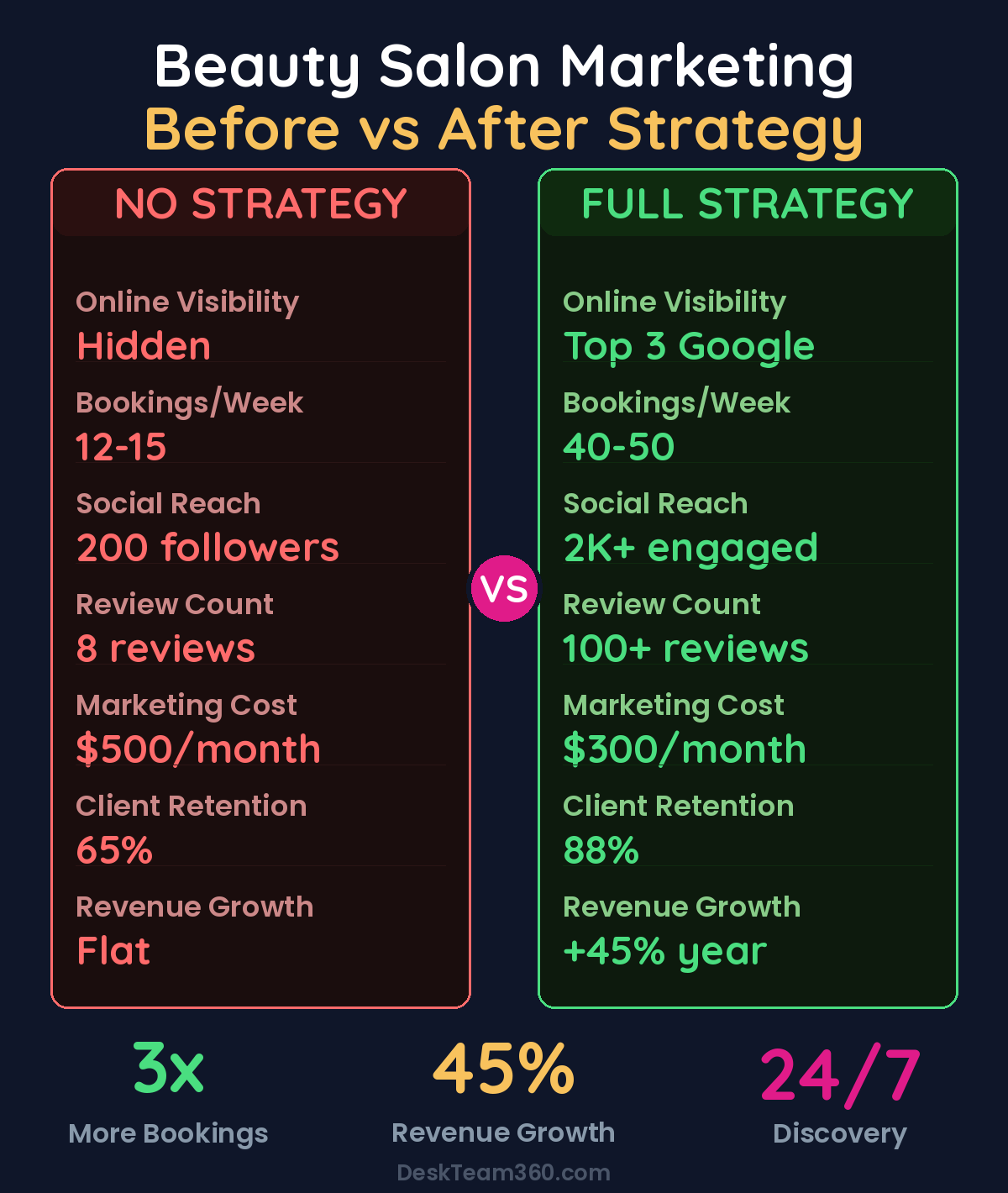
Here’s the brutal truth: if you’re not showing up in the top three results when someone searches “beauty salon [your city],” you don’t exist. Period. Local SEO is everything for brick-and-mortar beauty businesses, and it’s where I see the most wasted potential.
Your Google Business Profile is more important than your website. More important than your Instagram. More important than every other marketing channel combined. When someone searches for a service you offer, your Google profile is what shows up in the map pack. Get this wrong and nothing else matters.
If digital marketing for beauty salons is on your radar, this guide is for you. Let’s talk about digital marketing for beauty salons. Watch out: I see salon owners claim their Google profile and then never touch it again. That’s like buying a Ferrari and leaving it in the garage. Your Google Business Profile needs weekly attention, not monthly, definitely not yearly.
Most salons completely whiff on their Google profile setup. They pick the wrong primary category (hint: “Beauty Salon” beats “Hair Salon” for most search volume), leave the description blank, upload three blurry photos from 2019, and call it done. Then they wonder why the salon down the street with worse reviews gets more calls.
Here’s what a properly optimized profile looks like: every single section completed, primary category that matches your main service, secondary categories for every service you offer (hair, nails, facials, lashes, whatever), detailed service listings with actual prices (yes, include prices, hiding them makes people think you’re overpriced), professional photos uploaded every week, and Google Posts promoting your latest work or special offers.
Location Pages That Actually Convert
If you serve multiple areas, create dedicated pages for each neighborhood. Not generic “services” pages that mention the location once. Real pages with local content, local testimonials, local photos. A page targeting “balayage specialist in [specific neighborhood]” will demolish a generic services page every time.
Most salons have one contact page with their address. Meanwhile, smart salons have individual pages for every neighborhood they serve: “Hair Salon in Downtown [City],” “Best Colorist in [Specific Area],” “Bridal Hair Specialist [Neighborhood].” Each page loaded with area-specific content and testimonials from clients in that location.
Free Template
The Ultimate Task Delegation Template
Stop guessing what to hand off. This template shows you exactly what to delegate, how to brief it, and how to QA the results.
Get the Free Template →
Before-and-After Content: Your Unfair Advantage
Beauty businesses have a massive marketing advantage that most other industries would kill for: your results are visual. A single before-and-after photo is worth more than any sales copy you could write. Yet most salons post maybe one transformation a week on Instagram and call it content marketing.
Here’s what I’ve learned from salons that actually get booked solid: consistency beats perfection, but documentation beats everything. You should be capturing before-and-after photos for every single client who gets a transformation service. Not just the ones that turn out Instagram-perfect. Every. Single. One.
Pro tip: Set up a dedicated photo station with ring lighting and a clean backdrop. Same angle, same distance for every before-and-after set. The consistency makes transformations look more dramatic, and clients will actually ask you to take their photo because they know it’ll look good.
For more on this, check out our guide on ai marketing tools: the complete guide for 2026.
For a deeper dive, see our guide on how to create email marketing templates that actually convert.
The salons that kill it with content have a simple system: quick before photo when the client sits down, after photo when the service is complete, upload to a shared folder sorted by service type, and their social media person (or virtual assistant) handles the posting schedule. They’re generating 20-30 pieces of transformation content per week without thinking about it.
Most salon owners tell me they don’t want to bother clients for photos. That’s backwards thinking. Clients love seeing their transformation. They want to share it. They’ll post it on their own social media and tag you. You’re not imposing, you’re giving them content for their own feeds while building your portfolio.
Instagram Strategy That Fills Chairs
Instagram is where beauty businesses either dominate or disappear. The algorithm rewards the exact type of content you naturally create: visual transformations, behind-the-scenes moments, educational tips. Yet most salons treat Instagram like a chore instead of their most powerful marketing tool.
Here’s what works: Reels get the highest reach, carousel posts drive the most engagement, and Stories build relationships. But posting random content whenever you feel like it gets you nowhere. The salons with waiting lists post 4-5 times per week with a planned content mix.
Your Reels should focus on before-and-after reveals with trending audio, time-lapse videos of your process (color application, curl setting, facial treatments), and quick educational content (how to maintain your color, what to expect during a facial, styling tips for different face shapes). These are the Reels that actually get shared and bring in new clients.
Carousel posts work best for education: explaining different hair techniques, showing multiple angles of a finished look, or walking through a skincare routine. People save educational carousels, and saved content tells Instagram your posts have value. More saves means more reach.
Stories are for relationship building. Behind-the-scenes content, polls asking what color to do next, client testimonial reposts, last-minute availability announcements. Stories don’t need to be polished. They need to be frequent and authentic.
Stop Making These Instagram Mistakes
I see the same Instagram mistakes from salons everywhere. Posting only finished results without showing the process. Using the same three hashtags on every post. Never responding to comments or DMs. Treating Instagram like a portfolio instead of a social platform.
Instagram is social media, not a photo gallery. Respond to every comment. Reply to every story mention. Share content from clients who tag you. The salons with the most engaged followings aren’t just posting great content, they’re actively building relationships with their audience.
Online Booking: Make It Effortless or Lose the Client
Someone discovers your salon at 11pm on a Saturday. They love what they see. They want to book. If they can’t do it instantly, they’re gone by Sunday morning. Every single touchpoint needs to link directly to online booking.
I’ve watched salons spend thousands on marketing to drive traffic to their website, then lose half their potential clients because booking requires a phone call during business hours. That’s insane. If someone wants to give you money, make it as easy as possible.
The booking process should be: service, time, confirm. Done. Every extra step you add cuts your conversion rate. Don’t ask for their life story upfront. Get them booked, collect details later.
Your booking platform choice matters more than you think. Vagaro works great for multi-stylist salons with complex scheduling. Booksy is perfect for individual stylists or barbers. Square Appointments makes sense if you already use Square for payments. Fresha is gaining ground with their commission-free model.
But platform choice isn’t what kills booking conversions. It’s making the process too complicated. Show real-time availability so people see open slots immediately. Send automated confirmations and reminders. Enable deposits for high-value services to reduce no-shows. And put the booking link everywhere: Instagram bio, every social post, your Google Business Profile, your website header.
Email Marketing: The Retention Secret Most Salons Ignore
Here’s a number that’ll change how you think about marketing: acquiring a new client costs 5-7x more than keeping an existing one. Yet most salons spend all their marketing effort chasing new clients while their existing ones drift away to competitors.
Email marketing is the best retention tool for beauty businesses, and it’s criminally underused. Your clients already trust you with their appearance. They’ll definitely trust you with their email address if you ask for it and actually provide value.
Start collecting emails from day one. During booking, at checkout, through your website, via social media lead magnets. Every client interaction is an opportunity to build your email list. Offer something valuable in exchange: styling tips, skincare guides, maintenance checklists, whatever matches your services.
Salons with active email lists see 40% higher client retention compared to those relying only on social media and word-of-mouth.
For industry research and benchmarks, check out HubSpot Marketing Blog.
Your email campaigns should be practical, not promotional. Appointment reminders 48 hours and 2 hours before reduce no-shows by 30-40%. Re-booking prompts sent 6-8 weeks after a color service catch clients before they start shopping around. Birthday emails with special offers get opened at twice the normal rate and drive immediate bookings.
Seasonal promotions work incredibly well for beauty businesses because your services align with life events: wedding season, prom, holiday parties, summer beach prep, back-to-school refreshes. Plan these campaigns around your calendar, not random discount ideas.
Loyalty Programs That Actually Work
Beauty services are perfect for loyalty programs because clients need recurring appointments. Haircuts every 6-8 weeks, color touch-ups every 8-12 weeks, facials monthly, nails every 2-3 weeks. The repeat nature makes loyalty programs a natural fit.
The best performing program I’ve seen is simple: every 10th service gets a free add-on. Not a discount, not a percentage off, a free upgrade. Free deep conditioning treatment, free hand massage, free eyebrow shaping. Something that feels valuable but doesn’t cost you much to provide.
Points-based systems work too, but they’re more complicated to track and explain. Visit-based programs are dead simple: punch card mentality that everyone understands immediately. Monthly membership models create predictable revenue: $89/month includes one blowout per week plus 15% off other services. Some salons are building entire business models around memberships.
Referral Programs Done Right
Referral programs for beauty businesses should benefit both people. Existing client gets a discount or free service for referring someone. New client gets a welcome discount on their first visit. Both people win, and you get a qualified lead from someone who already loves your work.
Track referrals properly. Don’t rely on “just mention Sarah sent you.” Use referral codes, special links, or formal referral cards. Give credit where it’s due and make the reward meaningful enough to motivate action.
Paid Advertising: When and Where to Spend Your Money
Organic marketing builds your brand, but paid advertising fills chairs this month. Most salons are scared of paid ads because they’ve heard horror stories about wasted budgets. The truth is simpler: most people just target the wrong audiences with the wrong creative.
Facebook and Instagram ads work incredibly well for beauty businesses when done correctly. The targeting options let you reach women (or men) in your service area who are actively interested in beauty, hair care, skincare, and related topics. Plus the creative formats (video, carousel, collection ads) are perfect for showcasing transformations.
Pro tip: Start with a $300-500 monthly budget and target a 5-10 mile radius around your salon. Test before-and-after carousel ads against video reveals. Scale what works, kill what doesn’t. Most salons give up after two weeks. Give it 2-3 months to optimize.
Your ad creative should be transformation-focused. Before-and-after carousels showing multiple client results. Short video reveals with trending audio. Seasonal offers tied to events (prom, weddings, holidays). Educational content that builds trust (hair care tips, skincare routines, color maintenance).
Google Ads work for high-intent searches: “hair salon near me,” “best facial [city],” “microblading [area].” These people are ready to book now. Your landing pages need booking links, result photos, and testimonials. Don’t send Google Ad traffic to your homepage. Send them to service-specific pages with clear calls to action.
Reputation Management: Reviews Rule Everything
In the beauty industry, online reviews directly impact bookings more than any other factor. A salon with 200 five-star Google reviews will stay busy while a salon with 15 reviews sits empty, regardless of who’s actually more talented.
Most salons handle reviews passively. They hope happy clients will leave reviews and pray unhappy clients won’t. That’s backwards. You need to systematically generate reviews from satisfied clients and professionally handle the negative ones.
Send automated review requests after every appointment. Not sales pitches, simple requests with direct links to your Google or Yelp pages. Train your team to mention reviews: “If you loved your experience today, we’d really appreciate a Google review.” Display QR codes at checkout that link directly to your review page.
Watch out: Never ask for positive reviews specifically or try to filter who gets review requests. That’s against platform policies and looks fake to potential clients. Ask everyone for honest feedback and handle whatever comes back professionally.
Negative reviews happen. How you respond matters more than the review itself. Acknowledge the concern, apologize for the experience they had, offer to make it right, and take detailed conversations offline. Future clients judge your response more than the original complaint. A thoughtful response to criticism can actually build trust.
Stop Hoping and Start Marketing
The beauty industry is crowded. The salons and spas that thrive aren’t necessarily the most talented, they’re the ones that consistently market themselves professionally. Word-of-mouth isn’t enough anymore. Social media posts when you remember isn’t enough. Hoping clients find you isn’t a strategy.
Master your Google Business Profile. Document every transformation. Stay consistent on Instagram. Make booking effortless. Keep clients engaged with email marketing. Build loyalty programs that create recurring revenue. And invest in paid advertising to fill the gaps between organic growth.
The salon owners who implement these strategies systematically are the ones with waiting lists and growing revenue. The ones who pick and choose or give up after a few weeks stay stuck wondering why nothing works. Marketing isn’t optional anymore. It’s the difference between thriving and just surviving.
If you need help with website design, social media graphics, email templates, or ad creative, our team at DeskTeam360 handles the production work so you can focus on what you do best: making your clients look and feel amazing.
Free 5-Minute Video
See How DeskTeam360 Works in Under 5 Minutes
Watch the short video and see exactly how we handle design, development, and marketing implementation — so you don't have to.
Watch the Video →