

Digital Marketing for Home Services: The Complete Playbook
Why Most Home Service Companies Throw Money Away on Digital Marketing
Let’s talk about digital marketing for home services. Here’s what I see every time a home service business calls me: they’ve burned through $15K on some marketing “system” that was supposed to flood them with leads, and they’ve got nothing to show for it except a lighter bank account and a serious case of marketing skepticism.
📋 Table of Contents
It’s not their fault. The home services marketing world is packed with slick sales reps promising the moon and delivering dirt. I’ve worked with HVAC companies, plumbers, roofers, landscapers, and electricians over the past 12+ years, and the pattern is always the same: they get sold whatever’s trendy instead of what actually works.
But here’s the thing about marketing for home service businesses. It’s actually one of the most straightforward industries to market digitally because the demand is already there. People don’t browse for a plumber for entertainment. When they search, they need help right now. Your job is to show up when they’re looking and give them a reason to pick you over the guy down the street.
This is the complete playbook for what actually works. No theory, no fluff, just the tactics that drive phone calls and booked jobs from companies serving 400+ clients.
Google Local Service Ads: The Only Channel You Need to Start
If you’re a home service company and you’re not running Google Local Service Ads (LSAs), you’re leaving money on the table every single day. I’m not being dramatic here. LSAs are the closest thing to a guaranteed lead generator that exists in digital marketing.
What Makes LSAs Different From Every Other Ad Platform
Local Service Ads show up at the very top of Google search results, above regular paid ads, above the map pack, above everything else people might click on. They include your business name, rating, and a “Google Guaranteed” or “Google Screened” badge that tells customers Google has vetted you.
The game changer? You only pay per qualified lead, not per click. Someone who calls you through an LSA is actively looking for your service, in your specific area, right now. That’s as qualified as leads get in any industry.
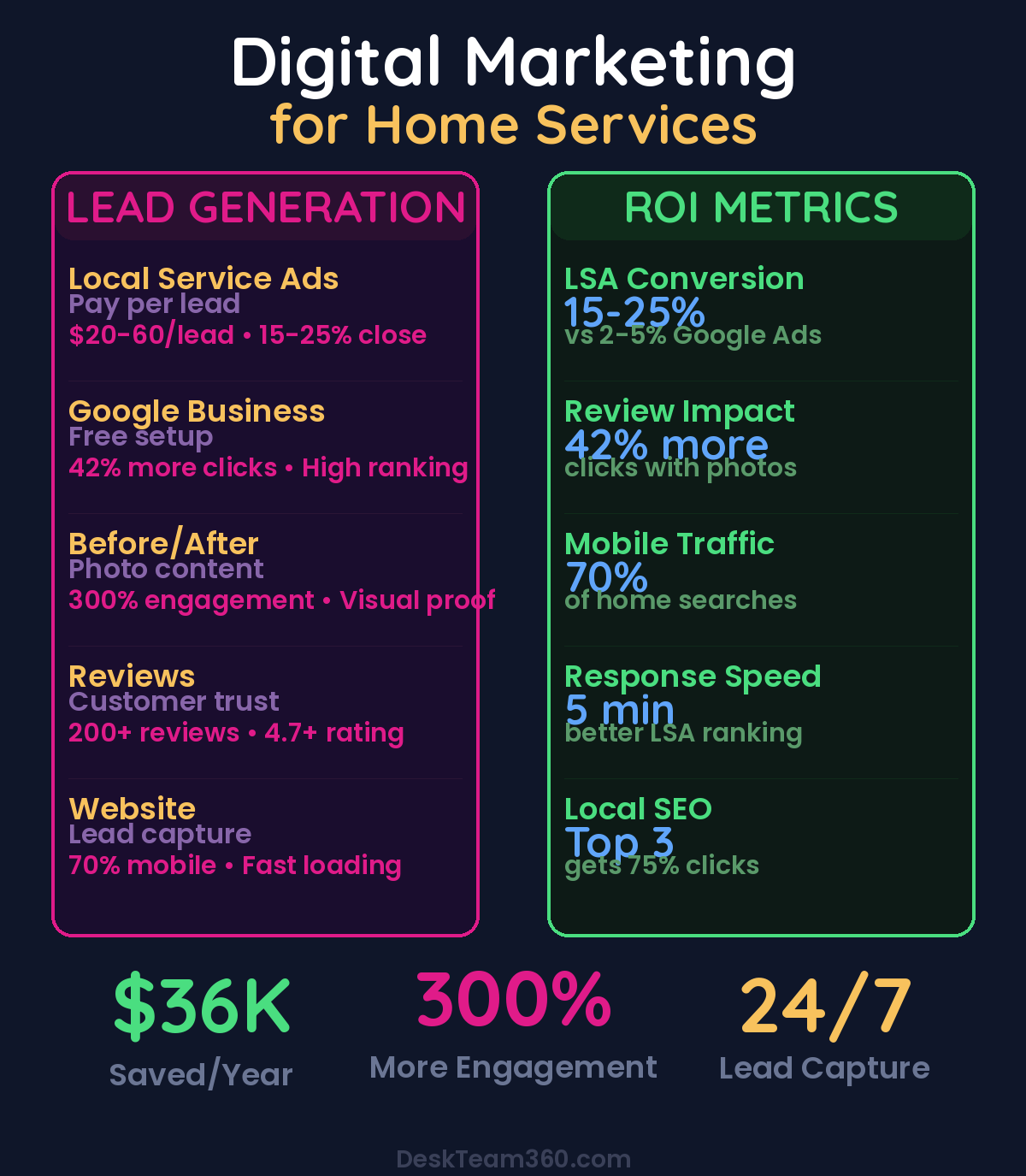 Digital Marketing for Home Services – Lead Generation vs ROI Metrics” style=”max-width:100%;height:auto;border-radius:12px;box-shadow:0 4px 20px rgba(0,0,0,0.08);” width=”1200″ height=”1200″>
How to Get Started With LSAs
The setup process takes 2-4 weeks because Google actually verifies you’re legitimate. Background checks for key employees, license verification, insurance verification, and a review of your business operations. It’s a pain initially, but that screening process is exactly why LSA leads convert so much better than random clicks.
Once you’re approved, set your service areas carefully. Don’t try to cover a 100-mile radius if you primarily serve a 30-mile area. Google rewards businesses that stick to their actual service zones with better placement and more relevant leads.
Start your budget at $100-200 per week. You can always scale up based on lead quality and your capacity to handle more work. I’ve seen companies go from $500/month to $5,000/month on LSAs because the ROI was so clear.
Pro tip: Response speed directly affects your ad placement. Google tracks how fast you respond to LSA leads and prioritizes faster responders. Set up text alerts for new leads and aim to respond within 5 minutes, even if it’s just to schedule a callback.
What LSAs Actually Cost by Trade
HVAC typically runs $25-60 per lead. Plumbing is usually $20-50 per lead. Roofing (because of higher project values) costs $30-80 per lead. Landscaping is the cheapest at $15-40 per lead. Electrical falls in the $20-50 range.
Compare that to any other lead source. Door-to-door sales teams, Yellow Pages ads, Home Advisor leads, or hiring a full-time marketing person. The ROI on LSAs is almost always the best in your entire marketing mix.
Free 5-Minute Video
See How DeskTeam360 Works in Under 5 Minutes
Watch the short video and see exactly how we handle design, development, and marketing implementation — so you don't have to.
Watch the Video →
Your Google Business Profile: More Important Than Your Website
I’ll say this straight: your Google Business Profile is more important than your website for driving local leads. When someone searches “plumber near me” or “HVAC repair [city name],” the map pack results come directly from Google Business Profiles. Nail this, and you’ll show up. Ignore it, and you won’t exist in local search.
The Optimization Basics That 90% of Companies Skip
Complete every single field Google gives you. Business hours, service areas, services offered, business description, attributes, website link, phone number. All of it. Google rewards completeness with better visibility, and incomplete profiles get buried.
Choose your primary category carefully. “Plumber” performs differently than “Plumbing Service.” “HVAC Contractor” gets different visibility than “Air Conditioning Repair Service.” Research which category gets the most visibility for your target searches in your area before you commit.
Add photos constantly. Not stock photos you downloaded from some template site, but real photos of your team, trucks, completed jobs, and your office or warehouse. Google says businesses with photos get 42% more direction requests and 35% more website clicks. Those aren’t small numbers.
Post weekly Google Business updates. These are like mini social media posts that show up on your profile. Share completed jobs, seasonal maintenance tips, team updates, or current promotions. It signals to Google that your business is active and engaged.
The Review Strategy That Wins Local Search
Reviews are the single biggest ranking factor in local search after proximity to the searcher. More reviews, higher average rating, more recent reviews all push you up in the map pack. Here’s the system that works:
Ask every satisfied customer for a review. Every single one. Not just the ones who seem really happy, not just the big jobs, everyone. Make it stupid simple by sending a direct link to your Google review page via text message immediately after you finish the work.
Respond to every review, positive and negative. Be professional and solution focused with negative reviews. Be genuinely grateful with positive ones. Don’t copy and paste the same response, people notice.
Watch out: Never buy fake reviews. Google’s detection is getting scary good, and one penalty can destroy your entire local search presence. The short-term boost isn’t worth the long-term risk of disappearing from search results completely.
Aim for five or more new reviews every month. Consistency matters more than big batches. A company with 200+ reviews and a 4.7 rating will almost always outrank a competitor with 15 reviews and a perfect 5.0 rating. Volume and recency both matter to Google’s algorithm.
Your Website Strategy: Convert Visitors, Don’t Just Impress Them
I see home service websites all the time that look like they were built in 2012 and never updated. Or worse, they hired someone’s nephew to build a “modern” site that looks gorgeous but converts terribly because it’s missing every element that actually drives phone calls.
Your website has exactly one job: turn visitors into phone calls or form submissions. Everything else is nice to have but not essential.
The Pages That Actually Generate Leads
Your homepage needs a crystal clear headline about what you do and where you serve. Your phone number should be visible without scrolling. Include trust signals like “licensed,” “insured,” and “X years in business.” The call to action should be obvious and compelling.
Create individual pages for each service you offer. “HVAC Repair in Phoenix” as a standalone page will rank better for local searches than a single page listing all your services. This is huge for SEO and lead quality.
Build service area pages if you serve multiple cities or neighborhoods. “Plumbing Services in [City Name]” pages rank for hyperlocal searches and show customers you actually serve their area.
Your About page needs to answer the question every homeowner has: who’s coming to my house? Include photos of your actual team, your company story, years of experience, and any relevant credentials or certifications.
Aggregate your best reviews onto a dedicated testimonials page. Don’t just link to Google, actually display the reviews on your site. Social proof builds trust faster than any sales copy you could write.
Speed and Mobile: The Non-Negotiables
Over 70% of home service searches happen on mobile phones. If your site takes more than three seconds to load or is hard to navigate on a phone, you’re losing leads to competitors who invested in proper mobile optimization.
Make sure your phone number is click-to-call on mobile devices. That sounds obvious, but you’d be amazed how many sites make people manually dial numbers. Every extra step between a visitor and a phone call costs you conversions.
If you need help with website performance, our guide on common website mistakes covers the technical issues that kill lead generation for small businesses.
Before-and-After Content: The Secret Weapon No One Uses
This is the most underutilized marketing tactic in home services, and it costs basically nothing to implement. Before-and-after photos are visual proof that you do excellent work, they build trust instantly, and they perform incredibly well across every marketing channel.
Why Before-and-After Content Works So Well
They’re immediate credibility. No words needed, no explanations required. Someone sees a dramatic transformation and thinks “I want my house to look like that.” They perform incredibly well on social media, especially Facebook and Instagram. They give you content for your Google Business Profile, website, email campaigns, and paid ads.
They also help customers visualize what’s possible with their own property. A lot of home service customers don’t call because they can’t picture what the end result would look like.
Before-and-after posts get 300% more engagement on social media compared to text-only posts or stock photos. They’re the highest-performing content type in the home services industry.
How to Capture Content That Actually Sells
Train your entire crew to take “before” photos at every single job. Same angle, good lighting, clean frame showing the problem clearly. After the work is done, take the “after” shot from the exact same position. That consistency is what makes the comparison powerful.
For landscaping companies, capture overgrown yards before and manicured lawns after. For roofers, show damaged or aging roofs next to brand new installations. HVAC companies should photograph old rusted units next to clean new systems, and include the thermostat showing a comfortable temperature.
Plumbers have amazing opportunities here. Corroded pipes before, clean new plumbing after. Flooded basements before, dry and restored spaces after. Water heaters that look like they belong in a museum next to efficient modern units.
Social Media That Actually Drives Business
Let me be direct about social media for home services. You don’t need to be on every platform, you don’t need to post every day, and you definitely don’t need to become an influencer. Focus on Facebook and Instagram because that’s where your customers actually are.
The Content Mix That Works
Post three to four times per week with this mix: before-and-after photos as your primary content, team spotlights that introduce your technicians and show the humans behind the company, seasonal tips like “5 things to check before winter” or “spring lawn prep checklist,” and screenshots of great Google reviews posted as images.
Behind-the-scenes content performs well too. Day in the life of a technician, how you prep trucks for service calls, team training sessions, or equipment demonstrations. People want to see what goes into professional work.
If creating consistent social media content feels overwhelming, consider working with a team that specializes in social media graphics for small businesses. Consistency beats perfection every time.
Facebook Ads for Home Services
Facebook ads work differently for home services than for ecommerce. You’re not selling products, you’re generating leads for services people need when they need them.
Retargeting website visitors is incredibly effective. Someone visited your “AC Repair” page but didn’t call? Show them an ad reminding them you exist when their AC breaks down next week.
Seasonal promotions drive urgency and bookings. “AC tune-up special: $79 if you book before June 1” gets people to act instead of procrastinate.
Neighborhood targeting is a Facebook advertising goldmine. Target specific zip codes or neighborhoods with ads like “Hey [Neighborhood Name], your neighbors trust us for plumbing repairs. Here’s why you should too.” Hyperlocal messaging converts much better than generic ads.
Start with a $500-1,000 monthly budget. Test different ad formats and audiences for 30 days before making major changes. Facebook’s algorithm needs time to optimize, and knee-jerk adjustments usually make performance worse.
Email Marketing: The Channel Everyone Ignores
Most home service companies don’t do any email marketing. That’s leaving money on the table. Your past customers are your warmest leads because they already know and trust you, and they’ll need your services again.
Simple Campaigns That Generate Revenue
Seasonal maintenance reminders work incredibly well. “It’s been six months since your last HVAC service. Schedule your tune-up before the summer heat hits.” Most homeowners want to maintain their systems, they just forget.
Annual check-ins show you care about long-term relationships. “A year ago we installed your new water heater. Here are the warning signs to watch for and when to call us for maintenance.”
Referral campaigns turn happy customers into lead generators. “Know someone who needs [service]? Refer a friend and get $25 off your next service call.” People are more likely to refer when there’s a clear incentive.
Holiday promotions work if you keep them simple and seasonal. “Get your heating system checked before winter weather hits” performs better than generic discount offers.
You don’t need fancy templates, though professional ones definitely help with credibility and open rates. If email marketing feels like too much to handle internally, our guide on outsourcing email marketing covers how to get it done without burning your time.
SEO for Home Services: Play the Long Game
SEO takes time, but for home services, the payoff is massive because the searches are so high-intent. Someone searching “emergency plumber near me” is ready to hire someone right now, not browse around for six months.
The SEO Priorities That Actually Move the Needle
Create individual pages for each service and location combination. “Emergency Plumber in Scottsdale AZ” as a dedicated page will rank better than trying to cover all your services and locations on one page.
Write blog content that answers common questions your customers ask. “How much does it cost to replace an AC unit in Arizona?” captures people at the top of the research funnel and positions you as the expert when they’re ready to buy.
Get your technical SEO basics right. Fast loading site, mobile-friendly design, proper title tags and meta descriptions on every page, clean URL structure. These fundamentals matter more than any advanced tactics.
Keep your NAP citations consistent everywhere. Your business Name, Address, and Phone number should be identical on Google, Yelp, Facebook, BBB, Angi, HomeAdvisor, and any industry-specific directories you’re listed on. Inconsistent information confuses Google and hurts your local search rankings.
For industry research and benchmarks, check out HubSpot Marketing Blog.
Related reading: Marketing Implementation for Online Service Providers: A Practical Guide.
Pro tip: Local SEO for home services is about dominating your service area, not competing nationally. Focus on ranking for “[service] + [city]” searches rather than trying to rank for generic industry terms. “Plumber Phoenix” is worth more than “plumbing services.”
Tracking What Actually Matters
You don’t need a PhD in analytics to know what’s working. Track these numbers every month and ignore everything else: phone calls from Google (LSAs plus organic search), form submissions from your website, cost per lead by marketing channel, conversion rate from lead to booked job, and total customer acquisition cost.
If a channel isn’t producing profitable leads after 60-90 days of consistent effort, cut it and reallocate that budget to what’s working. Don’t get emotional about marketing tactics. Follow the numbers, not your gut feelings about what should work.
Use call tracking to understand which marketing channels drive phone calls. Most call tracking software can separate LSA calls from organic Google calls from Facebook ad calls. That data tells you exactly where to invest more budget.
The Mistakes That Kill Home Service Marketing
Trying to do everything at once is the fastest way to do everything poorly. Pick two or three channels, execute them well for three months, then expand. Don’t spread yourself across eight platforms and half-ass all of them.
Having no follow-up system for leads costs you more conversions than any other single mistake. If a lead calls and you don’t answer, you need an automated text response system or a voicemail system that gets back to them within minutes. Speed-to-lead wins in home services more than any other industry.
Ignoring reviews and reputation management will sink any other marketing effort. You can have the best ads in the world, but if your Google rating is 3.2 stars, people will call the competitor with 4.7 stars.
Using a DIY website that looks unprofessional destroys credibility before you get a chance to build it. Your website is customers’ first impression of your business. If it looks cheap or outdated, people assume your work is cheap or outdated too.
Inconsistent branding across all touchpoints confuses potential customers. Your truck wrap, website, social media profiles, and business cards should all look like they’re from the same professional company. Consistency builds trust and recognition.
Your Six-Month Launch Plan
If I had to build a home service marketing plan from scratch with a limited budget, here’s exactly what I’d do in order.
Month one: optimize your Google Business Profile completely and start aggressively collecting reviews from every satisfied customer. Set up your LSA application and begin the screening process.
Month two: launch Google Local Service Ads and make sure your website loads fast and works perfectly on mobile devices. Fix any obvious conversion problems.
Month three: start posting before-and-after content on Facebook three times per week. Build your content library and engagement.
Month four: launch SEO with individual service pages and location pages. Start building your organic search presence.
Month five: add email marketing for past customers with seasonal maintenance reminders and referral campaigns.
Month six: evaluate all channels based on actual ROI data. Double down on what’s working, cut what’s not. Plan your expansion for the next six months.
That’s it. No magic tricks, no secret strategies. Just consistent execution of proven fundamentals that work for home service businesses.
Stop Guessing, Start Growing
Digital marketing for home services isn’t complicated, but it does require consistent execution and attention to detail. The demand for your services already exists. Your job is to be visible when people need help and trustworthy enough that they choose you over the competition.
The companies that win in home services marketing are the ones that focus on fundamentals, track their results, and adjust based on data instead of hunches. Start with the basics, execute them well, and expand from there.
Free Tool
How Much Is Freelancer Management Really Costing You?
Most agency owners have never done this math. Plug in a few numbers and see your real cost in 2 minutes.
Calculate Your Hidden Costs →