



What Is a Marketing Tech Stack? Essential Tools and How to Audit Yours
Let’s talk about what is a marketing tech stack and why it matters for your business.
📋 Table of Contents
Your Marketing Tools Are Fighting Each Other (And It’s Costing You Money)
Your marketing automation tool doesn’t talk to your CRM. Your CRM fights with your email platform. Your analytics tell you completely different conversion numbers than your ad accounts. And you’re spending $2,000 a month on tools that create more chaos than clarity.
I’ve seen this exact scenario play out with 400+ clients over 12+ years. The problem isn’t that you’re using the wrong tools. It’s that you never built a proper marketing tech stack from the ground up.
A marketing tech stack isn’t just a collection of software you happen to use. It’s an integrated system where data flows seamlessly between platforms, automation actually works, and you can track a lead from their first click to their final purchase. Most businesses have the first part but completely miss the second.
Here’s how to audit what you’ve got, fix what’s broken, and build a stack that actually makes your marketing easier instead of harder.
The Five Layers Every Marketing Tech Stack Needs
Think of your marketing tech stack like a building. You need a solid foundation before you start adding floors. Skip a layer and the whole thing becomes unstable.
Layer 1: Your Website and Data Foundation
Everything starts with your website. This is where every marketing channel drives traffic, where conversions happen, and where you collect the data that feeds everything else in your stack.
Your website platform affects every other tool you’ll use. WordPress gives you the most integration options but requires more maintenance. Webflow looks great but can be limiting for complex functionality. Shopify dominates for e-commerce but struggles with content-heavy sites. Squarespace is simple but harder to connect with other tools.
The platform matters less than having proper tracking set up. Google Analytics 4, Google Tag Manager, and conversion tracking need to be configured correctly before you buy anything else. I’ve worked with companies spending $50K a month on ads who couldn’t tell which campaigns were actually driving sales because their tracking was broken.
If what is a marketing tech stack is on your radar, this guide is for you. Let’s talk about what is a marketing tech stack. Pro tip: Before choosing any marketing tool, check if it has native integrations with your website platform. Native integrations are always more reliable than third-party connectors like Zapier.
Layer 2: Customer Data and CRM
Your CRM is the single source of truth for every prospect and customer interaction. Without it, you’re running marketing campaigns blind.
The CRM you choose shapes everything else. HubSpot plays nice with most marketing tools but gets expensive at scale. Salesforce is powerful but complex and requires dedicated admin time. ActiveCampaign combines CRM and email well for small businesses. GoHighLevel works great for agencies and service businesses with its all-in-one approach.
Here’s what most people get wrong about CRMs: they focus on features instead of data flow. The best CRM is the one that captures lead information from all your marketing channels automatically, scores and routes leads properly, and feeds data back to your marketing tools for better targeting.
Layer 3: Email Marketing and Automation
Email marketing still delivers the highest ROI of any marketing channel, but only if you’re doing it right. Your email platform needs to handle both broadcast campaigns and sophisticated automation sequences.
The key is integration with your CRM and website. When someone downloads a lead magnet, requests a demo, or abandons a cart, your email system should respond automatically with the right message at the right time. Manual email lists that you update by hand are a recipe for missed opportunities and frustrated customers.
Layer 4: Analytics and Attribution
You need to know which marketing channels are working and which ones are burning money. But here’s the problem: every platform reports different conversion numbers because they all use different attribution models.
Google Ads says it generated 50 leads. Facebook says 30. Your CRM shows 25 actually converted. Your analytics say something completely different. This isn’t a bug, it’s the reality of multi-touch attribution, and it’s why you need a unified reporting system.
Start with Google Analytics 4 and Google Search Console as your foundation. Then add UTM parameters to every campaign link so you can track traffic sources accurately. For advanced attribution, tools like HubSpot’s attribution reports or Triple Whale for e-commerce help connect the dots between touchpoints and revenue.
Layer 5: Advertising and Social Platforms
Most businesses should be advertising on at least one platform, but managing ads across Google, Meta, LinkedIn, and others without proper tracking and automation is a nightmare.
The secret is unified campaign management and reporting. Tools like Madgicx or Triple Whale let you manage multiple ad platforms from one dashboard and see which campaigns are actually driving revenue. Without this level of integration, you’re optimizing for clicks and impressions instead of sales.
Free 5-Minute Video
See How DeskTeam360 Works in Under 5 Minutes
Watch the short video and see exactly how we handle design, development, and marketing implementation — so you don't have to.
Watch the Video →
How to Audit Your Current Marketing Tech Stack
Before you fix anything, you need to understand what you’re working with. Most businesses discover they’re paying for tools they forgot about or using three different platforms that do the same thing.
Step 1: Map Your Customer Journey
Start with how customers actually find and buy from you. Draw a simple flowchart: website visit leads to form fill leads to email nurture leads to sales call leads to purchase. Then identify which tools handle each step.
The gaps in your flowchart are where leads fall through the cracks. The overlaps are where you’re paying for redundant functionality. Both problems cost you money.
Step 2: Track Your Data Flow
Follow a lead through your entire system. Someone fills out a contact form on your website. Does that information automatically go to your CRM? Does it trigger an email sequence? Does it update your advertising pixels for retargeting? Does it appear in your analytics with proper attribution?
Every manual step in this process is a point of failure. Every integration that requires exporting and importing data is costing you time and accuracy.
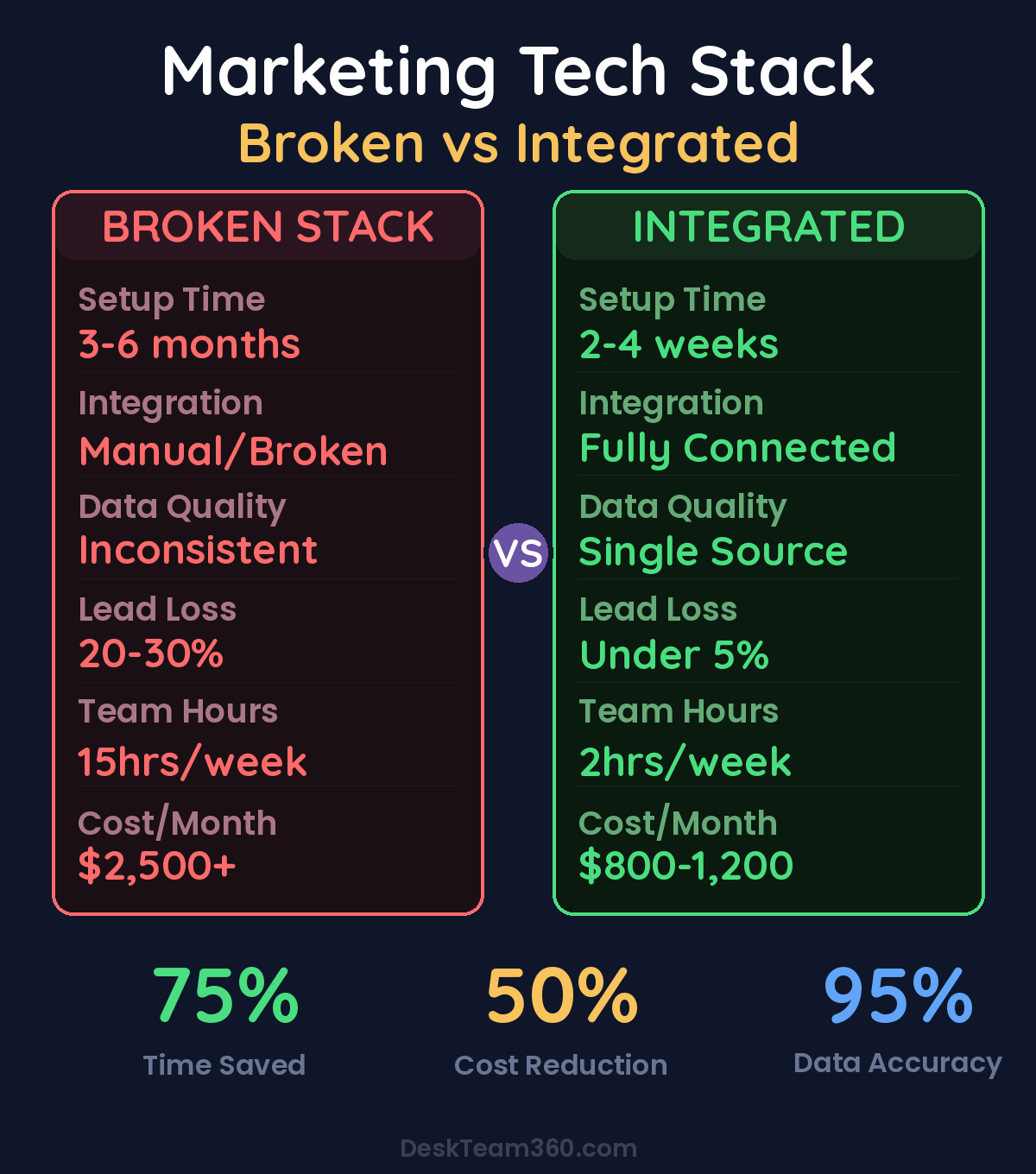
Watch out: If you’re manually moving data between tools more than once a week, your stack needs work. Those manual processes will break down as you scale, guaranteed.
Step 3: Calculate Your Total Cost
Add up everything you’re paying for, including tools that team members signed up for on their own. Include monthly subscriptions, annual fees (divide by 12), per-user costs, and overage charges.
I regularly find businesses spending $3,000+ per month on marketing tools when they could get the same functionality for under $1,000 with better integration. The savings add up to enough money to hire another team member or invest in growth.
Step 4: Measure Integration Health
Rate each tool connection on a scale of 1-5: 1 is completely manual, 5 is fully automated with real-time data sync. If most of your ratings are 3 or below, that’s where to focus your improvement efforts.
The Most Expensive Marketing Tech Stack Mistakes
After helping hundreds of businesses optimize their marketing infrastructure, I see the same mistakes over and over again.
Buying Tools Before Defining Processes
People hear about a cool new tool, sign up for the free trial, and then try to figure out how it fits into their marketing. This is backwards. Define your marketing process first, then find tools that support it.
The companies that do this right start with a documented customer journey, identify what needs to be automated at each stage, then choose tools based on those specific requirements. They end up with fewer tools that work better together.
Choosing Integration-Unfriendly Platforms
Some tools are built to play nice with others. Some aren’t. Before committing to any platform, check its integration directory and API documentation. Can it connect to your website platform? Your CRM? Your email system?
Zapier and Make.com can bridge some gaps, but they add complexity and another monthly cost. Native integrations are always more reliable.
Over-Engineering Early-Stage Marketing
I see startups building 15-step email automation sequences before they have a reliable way to generate leads. Or setting up complex attribution models when they’re getting 10 website visitors per day.
Build your foundation first. Get basic tracking, lead capture, and follow-up working reliably. Then add complexity as you scale. The businesses that try to build everything at once usually end up with nothing working properly.
Companies that start simple and scale systematically are 3x more likely to have profitable marketing automation within their first year.
For industry research and benchmarks, check out HubSpot Marketing.
Marketing Tech Stack Recommendations by Business Stage
Your tech stack should match your business size and complexity. Here’s what actually works at each stage.
Startup or Solopreneur (Under $10K/month revenue)
Keep it simple and cheap while you figure out what works. WordPress for your website with basic hosting, HubSpot’s free CRM, Mailerlite for email marketing, and Google Analytics 4 for tracking. Add Canva for graphics and Buffer’s free plan for social media.
Total cost: under $100/month. Focus on getting the basics working before adding complexity.
Growing Business ($10K-100K/month revenue)
Now you can invest in better integration and automation. Upgrade to paid CRM plans, add marketing automation, and implement proper attribution tracking.
Consider ActiveCampaign for combined CRM and email, or HubSpot if you need more sophisticated lead scoring. Add Hotjar for heatmaps, Ahrefs for SEO, and Facebook/Google Ads for paid acquisition. Total cost: $500-2,000/month depending on your contact count and feature needs.
Established Business (Over $100K/month revenue)
At this stage, sophisticated automation and attribution become profit centers. Invest in enterprise-level CRM and marketing automation, advanced analytics, and dedicated tools for each marketing channel.
HubSpot Professional or Salesforce for CRM, integrated email marketing, comprehensive advertising management tools, and custom attribution reporting. Total cost: $2,000-10,000/month, but the ROI justifies the investment when implemented properly.
When to Get Professional Help With Your Tech Stack
There’s a point where trying to figure this out yourself costs more in lost opportunities than hiring experts to do it right. Here are the warning signs.
You’ve been “about to fix” your tracking for months. You’re manually moving data between platforms daily. Your team avoids certain tools because they’re too confusing. You suspect you’re overpaying but don’t know what to cut. You need to migrate between platforms without losing data.
CRM migration and marketing automation setup are worth outsourcing. The cost of getting it wrong, either through lost data or months of downtime, usually exceeds the cost of professional implementation.
We help businesses audit their current stacks, eliminate redundancies, and build integrated systems that actually work together. Our CRM setup and migration guide covers when and how to get expert help with the technical implementation.
Building Integration That Actually Works
The goal isn’t to have the most tools. It’s to have the right tools working together seamlessly.
Start with your core customer journey and build outward. Website leads should flow automatically into your CRM, trigger appropriate email sequences, update your advertising pixels, and appear in your analytics with proper attribution. Every step should happen without manual intervention.
Test your integrations monthly. Send test leads through your system to make sure data flows correctly and automations trigger properly. The best-designed stack in the world doesn’t help if the integrations break and nobody notices.
Document everything. When team members change or new tools get added, having clear documentation of how everything connects saves enormous time and prevents configuration errors.
For businesses handling complex customer journeys across multiple touchpoints, understanding how to measure marketing ROI becomes critical for optimizing your tech stack investments.
The Hidden Costs of Bad Marketing Tech Stacks
Poor marketing technology integration costs more than monthly subscription fees. Leads get lost between platforms. Customer data becomes inconsistent. Marketing campaigns can’t be properly attributed to revenue. Team members waste hours on manual tasks that should be automated.
I’ve worked with businesses that discovered 30% of their leads were disappearing between their website and CRM due to broken integrations. Others found they were spending money on Google Ads keywords that never converted because their tracking was misconfigured.
The companies that fix these integration problems typically see 20-40% improvement in lead conversion rates and marketing ROI within 90 days. That improvement pays for better tools and professional implementation many times over.
Your Marketing Tech Stack Success Plan
Here’s the step-by-step approach that works: audit everything you currently have, document your ideal customer journey, identify integration gaps and redundancies, prioritize fixes based on revenue impact, implement changes systematically, and test everything monthly.
Don’t try to fix everything at once. Pick the biggest gap in your customer journey and solve it completely before moving to the next issue. Small improvements that compound are more valuable than massive overhauls that never get finished.
The goal is a marketing system that runs itself, captures every lead, nurtures prospects automatically, and gives you clear data on what’s working. When your tools work together properly, marketing becomes predictable and scalable instead of chaotic and manual.
Ready to Build a Marketing Tech Stack That Actually Works?
At DeskTeam360, we specialize in auditing, building, and maintaining integrated marketing technology systems for growing businesses. From CRM setup and migration to marketing automation and analytics implementation, we handle the technical complexity so you can focus on growing your business.
We’ve helped hundreds of companies streamline their marketing stacks, eliminate redundancies, and build systems that actually work together. All for a predictable monthly rate with no long-term contracts.
Free Template
The Ultimate Task Delegation Template
Stop guessing what to hand off. This template shows you exactly what to delegate, how to brief it, and how to QA the results.
Get the Free Template →