



What Is a Marketing Implementation Team? Bridging Strategy and Execution
The Biggest Problem in Marketing Nobody Talks About
Let’s talk about marketing implementation team. Here’s a scenario I see at least twice a week. A business hires a marketing consultant or agency to build a strategy. Three weeks later they get this beautiful 40-page deck with personas, channel recommendations, content calendars, campaign ideas, and KPI targets. It’s comprehensive. It’s smart. And 90% of it never gets executed.
📋 Table of Contents
Why? Because strategy is only half the equation. The other half is where most marketing efforts go to die: implementation.
Somebody has to actually build those landing pages. Design the graphics. Write the emails. Set up the automations. Create the videos. Update the website. Launch the campaigns. That’s what a marketing implementation team does. And after 12+ years of running outsourced teams for 400+ clients, I can tell you this gap between strategy and execution is where businesses burn the most money.
What Is a Marketing Implementation Team?
A marketing implementation team takes your marketing strategies, plans, and ideas and turns them into reality. They don’t create the strategy. They execute it. Think architect versus construction crew. You need both, but they’re completely different skill sets.
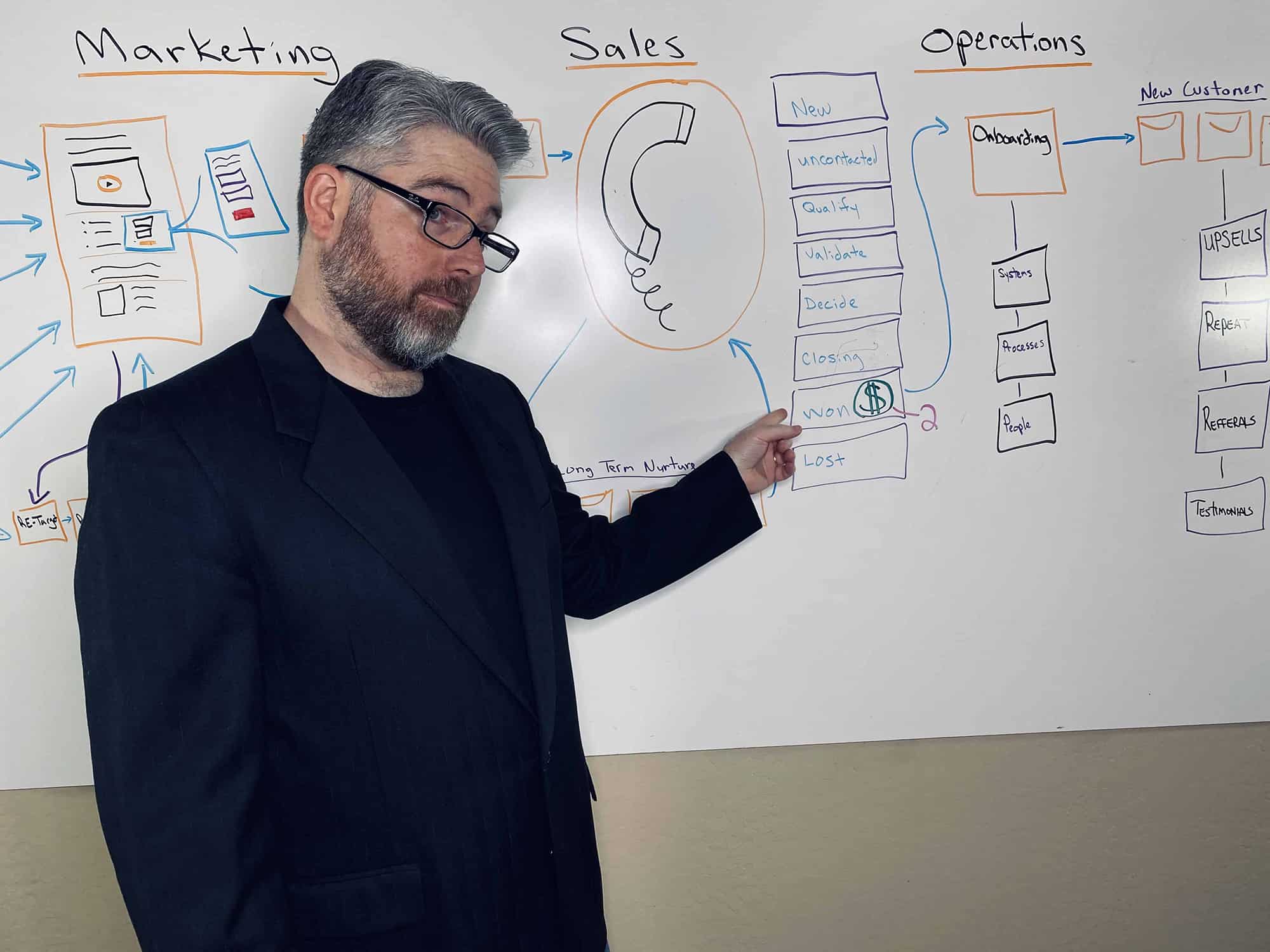
Here’s how it works in practice: your marketing strategist says “We need a 5-page landing page funnel with email nurture sequence targeting enterprise B2B buyers.” Your implementation team designs the pages, writes the copy, builds them in WordPress, sets up the email automation, creates all the graphics, tests everything, and launches it. The strategist is the brain. The implementation team is the hands.
A typical implementation team handles web design and development including landing pages and sales pages. They do graphic design for ad creatives, social media graphics, presentations, and brand materials. They build and deploy email marketing campaigns with templates and automations. They construct sales funnels, lead capture funnels, and webinar funnels. They configure CRM and marketing automation platforms like HubSpot, GoHighLevel, and ActiveCampaign. They edit videos for social media, YouTube, and promotional content. And they format and publish content with proper SEO optimization and images.
Free Template
The Ultimate Task Delegation Template
Stop guessing what to hand off. This template shows you exactly what to delegate, how to brief it, and how to QA the results.
Get the Free Template →
Why the Strategy-Execution Gap Keeps Getting Worse
This gap isn’t new, but it’s expanding fast. Marketing has become execution-heavy in ways that would have been unthinkable ten years ago.
A decade ago, a “basic” marketing operation might have meant a static website, some email blasts, and maybe Google Ads. Today, that same “basic” marketing operation involves a website with regular content updates, a blog with SEO-optimized articles, email marketing with segmented automations, social media content across 3-5 platforms, paid advertising on multiple channels, custom landing pages for every campaign, video content for social and YouTube, multi-step sales funnels, CRM management with lead scoring, and analytics tracking across all of it.
Each piece requires different skills. Design, development, copywriting, video editing, platform expertise. The complexity has multiplied while budgets haven’t kept pace.
For a deeper dive, see our guide on what is an outsourced marketing team? (from someone who’s tried everything).
Pro tip: Audit how many different marketing tools and platforms you’re currently using. Count them. Most businesses I work with are surprised to discover they’re managing 8-15 different systems, each requiring specialized knowledge to use effectively.
The bigger problem? Strategists aren’t implementers, and vice versa. The person who’s brilliant at analyzing your market and identifying opportunities is rarely the same person who’s great at building landing pages or designing Instagram carousels. Strategy requires analytical thinking, market research, data interpretation, and big-picture planning. Implementation requires technical proficiency, design skills, platform knowledge, and speed of execution. These are fundamentally different brains.
Who Actually Needs a Marketing Implementation Team?
Based on working with hundreds of clients, there are four types of businesses that benefit most from having a dedicated implementation team.
Marketing Consultants and Fractional CMOs
If you sell strategy, your clients expect results. Results require execution. Having an implementation team means you can deliver end-to-end value: strategy AND the work that makes it happen. This is a complete game-changer for consultants because instead of handing over a strategy document and crossing your fingers that the client’s internal team executes it properly, you oversee implementation yourself through a dedicated team. Your clients get better results, you can command higher fees, and you’re not constantly explaining why the strategy “didn’t work” when the real problem was poor execution.
We cover this extensively in our guide on building a fractional marketing team that actually delivers results.
Small Businesses Without Marketing Staff
Most small businesses can’t afford a full marketing department. A marketing manager costs $70,000-90,000 annually. A designer is another $50,000-65,000. A developer runs $70,000-100,000. Add a video editor and marketing coordinator, and you’re looking at $300,000+ in salary and benefits before you account for equipment, software, and management overhead.
An implementation team gives you access to all these skills for a fraction of that cost. The economics make sense because you’re sharing the team’s capacity with other clients instead of paying for full-time employees you might not fully utilize. Understanding the math is critical, which is why we wrote a detailed breakdown of the cost to outsource marketing versus hiring internally.
Agencies That Want to Scale Without the Headaches
Agencies face constant tension: more clients means more execution capacity, which means hiring more people, which means more overhead and management complexity. I’ve watched agencies get trapped in this cycle where growth creates operational drag instead of profit improvement.
An implementation team lets you scale client work without scaling headcount. You can take on 3x the clients without tripling your team, and you avoid the hiring, training, and retention challenges that kill agency margins. Our guide on how to scale your agency without hiring walks through this model in detail.
In-House Marketing Teams That Are Stretched Thin
Even companies with marketing staff usually have more work than their team can handle. An implementation team acts as an extension, handling overflow, tackling specialized projects, and freeing up your in-house team to focus on strategy and relationship management instead of getting buried in execution tasks.
We break this down further in digital marketing for beauty salons and spas: complete strategy.
The pattern is always the same. Smart marketers who understand strategy get bogged down in implementation work that doesn’t leverage their skills. They spend time building landing pages instead of analyzing performance data, or designing graphics instead of planning campaigns. The implementation team fixes this misalignment.
Building Internal vs. Outsourcing: The Real Math
You have two paths: build an in-house implementation team or outsource it. Let me give you the honest analysis of both.

Building in-house gives you full control, deep brand knowledge over time, availability for impromptu meetings, and easier integration into company culture. But it’s expensive. Beyond salaries and benefits, you’re paying for equipment, office space, and management time. It’s slow to scale because hiring takes weeks or months. Each person covers one or two specialties, so you need multiple hires to get full coverage. And if you don’t have enough work to keep everyone busy full-time, you’re paying for idle capacity.
Outsourcing costs 60-80% less than in-house. It’s instantly scalable because the capacity already exists. You get access to diverse skills without multiple hires. There’s no HR overhead, no benefits administration, no vacation coverage headaches. And you get predictable monthly costs instead of variable expenses.
The downsides? Less direct control than an in-house team, communication that requires clear processes, a learning curve as the team understands your brand, and potential time zone differences depending on the provider.
For businesses under $10M in revenue, outsourcing implementation typically saves $150,000-250,000 annually compared to hiring equivalent in-house capacity.
For most businesses, especially those under $10 million in revenue, outsourcing is the smarter financial move. The cost savings are enormous, and modern project management tools make communication nearly seamless.
How to Work Effectively with an Implementation Team
Whether you build or outsource your implementation team, success depends on how well you communicate. I’ve learned this from managing implementation work for hundreds of clients over more than a decade.
Give clear, complete briefs for every task. Include the specific deliverable you need, brand guidelines and assets, reference examples of what you like, copy and content or clear direction on what to write, dimensions and format requirements, and deadline with priority level. Vague briefs produce vague results, every time.
For industry research and benchmarks, check out Think with Google.
Establish a clear workflow with a single channel for task submission, a priority system so the team knows what to work on first, a defined review process with standard revision rounds, and clarity on who has final approval to prevent bottlenecks. If you struggle with briefing creative work effectively, our guide on how to write a creative brief covers the fundamentals.
Invest in proper onboarding during the first 2-4 weeks. Front-load the relationship with your brand style guide and assets, templates and examples of past work you liked, access to all necessary platforms and tools, and a kick-off call to walk through expectations and workflow. The time you spend upfront pays dividends in reduced revisions and faster turnaround.
Watch out: The biggest mistake I see is treating an implementation team like a mind-reading service. They’re skilled professionals, but they’re not psychic. The quality of their output is directly proportional to the quality of your input. Garbage brief equals garbage result.
The Implementation-as-a-Service Model
This is exactly what we built DeskTeam360 to be: a marketing implementation team that operates as an extension of your business, not a vendor you have to manage.
Our clients range from solo consultants who need someone to execute their strategies, to agencies juggling 20+ client accounts, to in-house marketing directors who need overflow support. The common thread is they all need skilled people to turn plans into reality without the overhead of hiring.
You get a full team of designers, developers, and video editors with a dedicated project manager who learns your brand and preferences. Flat-rate pricing with unlimited requests and revisions. 24-48 hour turnaround on standard tasks. And month-to-month flexibility without long-term contracts.
We’ve refined this model over 12+ years and thousands of client projects. It works because we’ve solved the hardest part: building systems that let a remote team produce consistent, high-quality work at scale. The team becomes familiar with your brand, your standards, and your workflow. Over time, they anticipate needs and deliver work that requires minimal revisions.
Understanding how to measure marketing ROI becomes much easier when you have a dedicated team executing campaigns consistently instead of hoping different freelancers or agencies understand your business well enough to deliver quality work.
Stop Letting Great Strategy Go to Waste
If you have marketing plans collecting dust because nobody has time to execute them, an implementation team is the missing piece. Stop paying for strategy you can’t implement. Stop watching competitors move faster because they’ve figured out the execution puzzle. And stop burning budget on half-finished campaigns that never reach their potential.
The strategy-execution gap isn’t a technology problem or a budget problem. It’s an organizational problem, and it has a clear solution: dedicated implementation capacity that operates as an extension of your team.
Free 5-Minute Video
See How DeskTeam360 Works in Under 5 Minutes
Watch the short video and see exactly how we handle design, development, and marketing implementation — so you don't have to.
Watch the Video →