


How to Create a Website RFP: Template, Tips, and Common Mistakes
Knowing how to create a website rfp can be the difference between growth and spinning your wheels.
📋 Table of Contents
Why Most Website RFPs Are Total Time Wasters
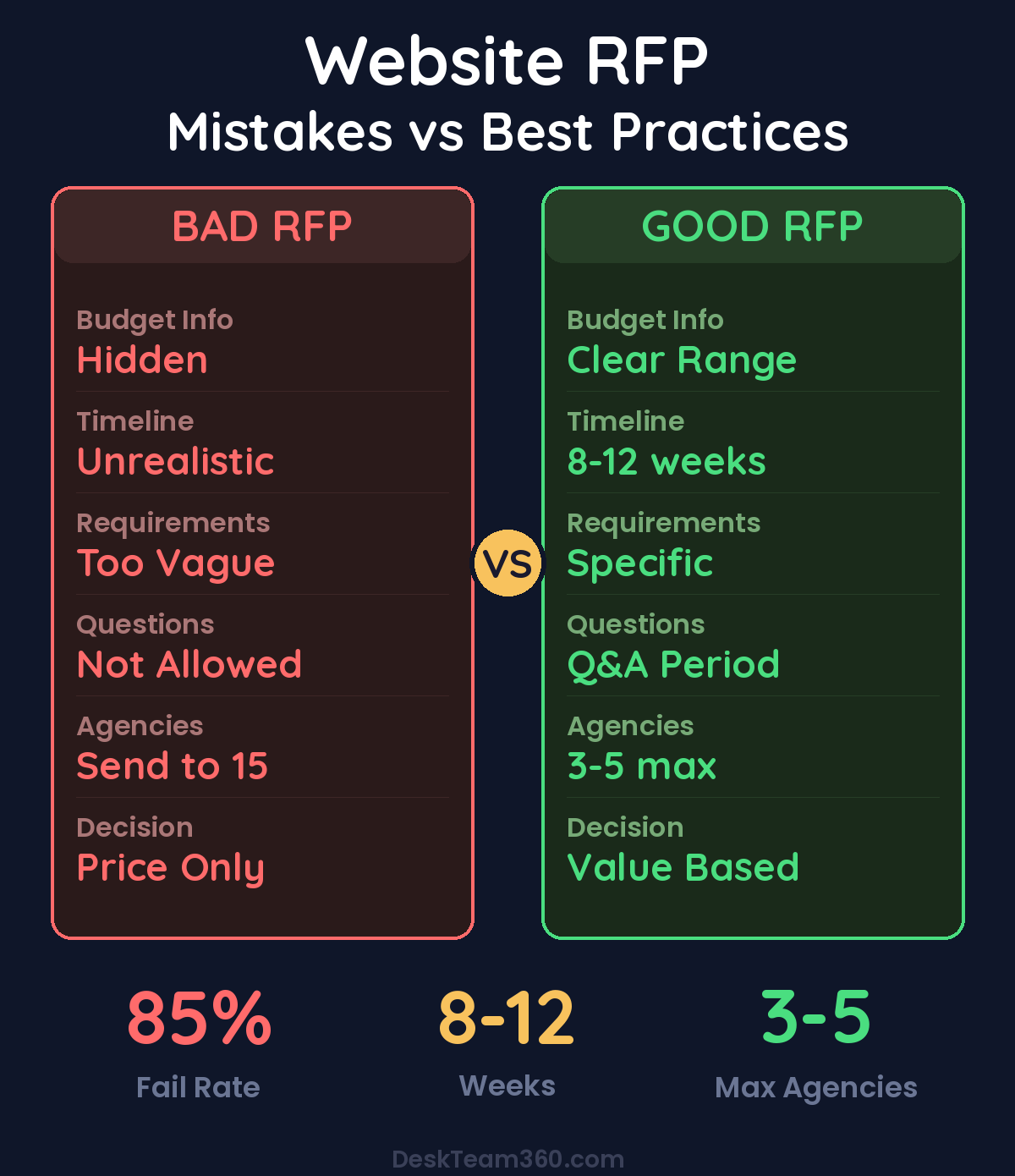
I’ve been on both sides of the website RFP game for over 12 years, and I’m going to tell you something that’ll save you months of frustration. About 85% of the RFPs I see are either so vague that nobody can give you a real price, or so ridiculously detailed that they squeeze out all the creativity you’re supposedly paying for.
Bad RFPs don’t just waste time, they actively attract the wrong agencies. You’ll get wildly different quotes because nobody understood what you actually wanted, or worse, you’ll get cookie-cutter responses from agencies who treat every project like a Mad Libs exercise.
Here’s what happens when you get the RFP right. Agencies understand your problem, they can give you accurate pricing, and they bring ideas to the table you never considered. The whole process becomes collaborative instead of combative.
I’m going to walk you through exactly how to write an RFP that gets you proposals worth reading, complete with a section-by-section template that’s worked for hundreds of our clients.
When You Actually Need an RFP (Spoiler: Less Than You Think)
Let’s start with the basics. An RFP is a formal document that outlines your project requirements and invites agencies to submit detailed proposals. But here’s the thing nobody tells you, most small businesses don’t actually need the full RFP process.
RFP Makes Sense When
Your budget is above $15,000. Anything under that and you’re adding weeks of overhead for a project that could be scoped in a conversation. You have multiple stakeholders who need to sign off. An RFP forces internal alignment before you start getting quotes, which prevents the painful “we changed our minds” conversations later.
You’re legally required to get competitive bids. Government, education, and large enterprises often have procurement rules that mandate the RFP process. You can’t skip it even if you want to.
You’re comparing 3-5 agencies and need apples-to-apples proposals. Without a standardized RFP, Agency A might quote you a 5-page brochure site while Agency B quotes a 50-page custom platform. Good luck comparing those.
The project is genuinely complex. Custom functionality, third-party integrations, data migrations, or multi-phase rollouts benefit from detailed planning upfront.
If how to create a website rfp is on your radar, this guide is for you. Figuring out how to create a website rfp doesn’t have to be complicated. Pro tip: If you already know which agency you want to work with, skip the RFP. Go straight to a discovery call and project scoping. You’ll save 6-8 weeks and get started on actual work instead of paperwork.
Skip the RFP When
You need something simple. A basic business website with 8-12 pages doesn’t require a 20-page RFP. A conversation and a quote will get you there faster.
You’re on a tight timeline. The RFP process adds 6-10 weeks minimum. If you need a website live in a month, this isn’t your path.
You’re looking at ongoing work rather than a one-time project. For regular updates and maintenance, our guide on outsourcing website updates explains better approaches than individual RFPs.
Free 5-Minute Video
See How DeskTeam360 Works in Under 5 Minutes
Watch the short video and see exactly how we handle design, development, and marketing implementation — so you don't have to.
Watch the Video →
The Pre-RFP Work Nobody Talks About
The most important part of the RFP process happens before you write anything. You need internal consensus on the basics, or your RFP will get rewritten three times and delay everything by a month.
Sit down with your team and nail down these answers. What’s the primary goal? Lead generation, e-commerce, brand awareness, customer portal, information hub? Pick one. You can have secondary goals, but if everything is equally important, nothing is important.
Who makes the final decision? If the answer is “the leadership team” or “the board,” prepare for a long process. Decision by committee takes longer and usually produces worse results. Designate one person with veto power.
What’s the actual budget? Not what you hope it might cost, not a range you pulled from a competitor’s website. What has been approved and allocated? I can’t stress this enough, agencies need real numbers to scope projects properly.
What’s driving your timeline? Is there a trade show, product launch, or seasonal deadline? Or is this just “sooner would be better”? Hard deadlines change how agencies approach the project.
The RFP Template That Actually Works
Here’s the structure I’ve seen work across hundreds of projects. Every section matters, even if some are brief.
Company Overview
Keep this to one page. Agencies will research you deeper on their own, but they need context about who you are, what industry you’re in, who your target audience is, and roughly how big you are. Include your main competitors so agencies can research your space and understand the landscape.
Project Background and Goals
This is where most RFPs go wrong. Be brutally honest about what’s driving this project. Your current website sucks? Say so. Your conversion rates are terrible? Include the numbers. You can’t update anything without calling a developer? That’s valuable information.
State 2-3 specific, measurable goals. “Increase leads by 40%” is good. “Improve user experience” is useless. Include your current website URL and share Google Analytics access if possible. Traffic numbers, bounce rates, and conversion data help agencies understand what they’re working with.
Scope of Work
Define what you need without over-specifying how it should be built. That’s the agency’s expertise.
For pages and structure, estimate the number of pages or page types. Homepage, service pages, about, blog, contact, whatever you need. If you’re migrating content from an existing site, be clear about what’s coming over and what’s getting rewritten.
Functionality requirements should cover everything beyond basic pages. Contact forms, quote calculators, e-commerce, user accounts, third-party integrations with your CRM or email marketing platform, search functionality, multi-language support if needed.
Be explicit about content. Who’s writing it? Your team, the agency, or a freelancer? Do you need copywriting services? Photography? Video production? How will content be managed after launch?
For design, include existing brand guidelines if you have them. If you need branding work as part of the project, say so. Share examples of websites you like, but don’t say “make it look exactly like this.” You’re hiring expertise, not a copy machine.
Technical Requirements
If you have technical preferences or constraints, include them. Preferred CMS, hosting requirements, security standards, performance expectations, accessibility compliance, SEO needs, analytics setup.
If you don’t know what you need here, that’s fine too. Say so. A good agency will guide you through the technical decisions and explain the tradeoffs.
Don’t fake technical knowledge you don’t have. Agencies can tell when you’ve Googled “website technical requirements” and copied a list. Better to admit you need guidance than to specify requirements that don’t make sense for your project.
For a deeper dive, see our guide on how to create an email drip campaign (with templates and examples).
Budget
I know this is controversial, but include your budget. Or at least a realistic range.
When you don’t include budget guidance, agencies make completely different assumptions about scope. You’ll get proposals ranging from $8,000 to $80,000 for what you thought was the same project. Those aren’t comparable, they’re completely different scopes.
When you include a budget, agencies can tell you if your expectations are realistic, you get proposals scoped to similar investment levels, and you avoid the painful “that’s way more than we expected” conversation after spending weeks on proposals.
If you genuinely don’t know what’s realistic, ask for tiered pricing. “Show us what’s achievable at $20K, $40K, and $60K investment levels.” Our website cost breakdown covers typical price ranges for different types of projects.
Timeline
Be realistic. A custom website typically takes 10-16 weeks from kickoff to launch. Complex projects can take 6+ months. E-commerce adds time. Integrations add time. Indecisive stakeholders add the most time.
Include your desired launch date and what’s driving it. If it’s a hard deadline tied to a product launch or event, agencies can plan accordingly. If it’s just “sooner would be better,” be honest about that too.
Most importantly, be realistic about your team’s availability. Projects get delayed when clients take two weeks to review mockups or disappear for three weeks during the development phase. Factor in your own schedule.
Proposal Requirements and Evaluation
Tell agencies exactly what you want in their proposals. Proposed approach and methodology, detailed timeline with milestones, itemized pricing broken down by phase or component, team members who will work on your project with relevant experience, 2-3 case studies of similar work, post-launch support options, and references you can actually contact.
For evaluation criteria, be transparent about how you’ll make the decision. Relevant experience in your industry or with similar requirements, portfolio quality that demonstrates the level you’re looking for, clarity of proposed approach, expertise of the team that will actually do the work, value for the investment (not just cheapest price), and communication and cultural fit.
Submission Details
Give agencies at least 3 weeks for proposals. Good agencies are busy, rushed proposals are usually generic. Allow questions during the proposal period and share the answers with all agencies. This levels the playing field and shows which agencies are engaged.
Watch out: Sending your RFP to 12 agencies doesn’t get you better proposals. It gets you 12 generic responses because good agencies won’t invest significant effort when the odds are 1 in 12. Send to 3-5 pre-qualified agencies maximum.
For industry benchmarks and research, see Google’s web.dev.
For industry research and benchmarks, check out Nielsen Norman Group.
 best practices comparison” style=”max-width:100%;height:auto;border-radius:12px;box-shadow:0 4px 20px rgba(0,0,0,0.08);” width=”1200″ height=”1390″>
Five Ways RFPs Backfire
I’ve watched companies sabotage their own RFP processes in predictable ways. Here’s how to avoid each one.
Not including budget guidance. Covered this already, but it’s the biggest time-waster. You’ll get incomparable proposals and waste everyone’s time.
Being too prescriptive about technology. Unless you have a specific technical reason, don’t dictate the stack. “Must be WordPress” limits your options when Webflow or Shopify might be better for your needs. Describe requirements and let agencies recommend solutions.
Unrealistic timelines. “We need a 40-page custom site with e-commerce and CRM integration launched in 6 weeks.” That’s not happening well. Rush jobs produce rushed results.
Disappearing after receiving proposals. Agencies invest 20-40 hours of unpaid work in good proposals. If you go a different direction, tell them. The web industry is smaller than you think, and reputation matters.
No path to ask questions. The best agencies ask clarifying questions. If your RFP doesn’t allow questions, you’ll get proposals based on assumptions instead of understanding.
How to Actually Evaluate Proposals
When proposals come in, create a scoring matrix. Rate each proposal on your stated criteria using a 1-5 scale. This turns subjective decisions into something more objective and makes it easier to justify your choice to stakeholders.
Look beyond price for these factors. Process clarity matters, does the agency explain how they work, not just what they’ll deliver? A good discovery phase should come before design. If the proposal jumps straight to “we’ll start with wireframes,” that’s a red flag.
Timeline realism is crucial. Does the proposed schedule align with the scope? If it seems too fast, it probably is. Specificity beats generics. You want proposals that reference your specific goals and challenges, not templates that could apply to any project.
Post-launch planning shows long-term thinking. What happens after launch? Maintenance, support, optimization, analytics review? The relationship shouldn’t end at launch.
The Final Round
Narrow down to 2-3 finalists and invite them for presentations. This is where you assess cultural fit, can you work with these people for 4-6 months? Communication style, are they responsive, clear, and organized? Strategic thinking, do they challenge your assumptions constructively? And team reality, will the people presenting actually do the work?
Companies that include client presentations in their RFP process report 60% higher satisfaction with their final agency choice compared to those who select based on proposals alone.
RFP Timeline: The Real Schedule
A realistic RFP process takes 8-12 weeks from start to signed contract. Week 1-2 is internal alignment and drafting the RFP. Week 3 is sending to pre-qualified agencies. Weeks 4-5 cover the Q&A period and proposal development. Week 6 is proposal submissions and initial review. Weeks 7-8 are internal scoring and shortlisting. Weeks 9-10 include final presentations. Weeks 11-12 cover decision making and contract negotiation.
Plan accordingly. If you need the website live by a specific date, work backwards from launch and add both RFP time and project time.
Understanding how to track marketing ROI becomes important when you’re making these timeline and investment decisions.
The Alternative: Skip the RFP Entirely
Here’s what nobody in the agency world wants to admit. For most small to mid-size businesses, the formal RFP process is overkill. It’s designed for large organizations with procurement departments and oversight requirements.
If you’re a growing business that needs to move fast, consider a different approach. Find a reliable partner, have a discovery conversation about your goals, get a detailed proposal, and get started. It’s faster, more collaborative, and often produces better results because the relationship starts with dialogue instead of documents.
At DeskTeam360, we’ve built this alternative approach for our 400+ clients. No 12-week RFP process. No committee presentations. No procurement department approval chains. Tell us what you need built, and we handle the rest.
Custom websites, e-commerce platforms, redesigns, ongoing updates, whatever you need. Our WordPress development team and designers work as an extension of your team.
Fixed monthly investment, dedicated team members, direct communication. We focus on building and launching instead of bidding and evaluating.
If you’d rather start building next week instead of selecting an agency next quarter, we might be a better fit than the traditional RFP process.
Free Tool
How Much Is Freelancer Management Really Costing You?
Most agency owners have never done this math. Plug in a few numbers and see your real cost in 2 minutes.
Calculate Your Hidden Costs →