
How to Create a Thank You Page That Converts: 7 Proven Strategies
Let’s talk about thank you page that converts and why it matters for your business.
📋 Table of Contents
Your Thank You Page Is Throwing Money Away
Your customer just bought something. Or downloaded your lead magnet. Or signed up for your webinar. They’re sitting at the peak of engagement with your brand, literally having just taken action. And what do you show them?
“Thank you for your submission.”
That’s it. A bland, generic message on a page that looks like it was built in 2003. No next step, no additional offer, no engagement whatsoever.
It’s like a salesperson closing a deal and then immediately walking away without mentioning the upsell, the referral program, or anything else that could benefit the customer and grow the business. I’ve watched companies spend thousands on traffic and conversion optimization, only to completely waste the most valuable moment in their entire customer journey.
I’ve been building marketing funnels for over 12 years, working with 400+ clients, and I can tell you this: your thank you page is probably the most underutilized asset in your entire marketing stack. Let me show you how to turn that dead-end confirmation into a revenue-generating machine.
Why Thank You Pages Are Marketing Gold
Here’s the psychology behind why thank you pages convert so well. When someone just completed an action on your site, they’re in what behavioral psychologists call a state of commitment consistency. They’ve already said yes once. Their brain is primed to continue that pattern of agreement.
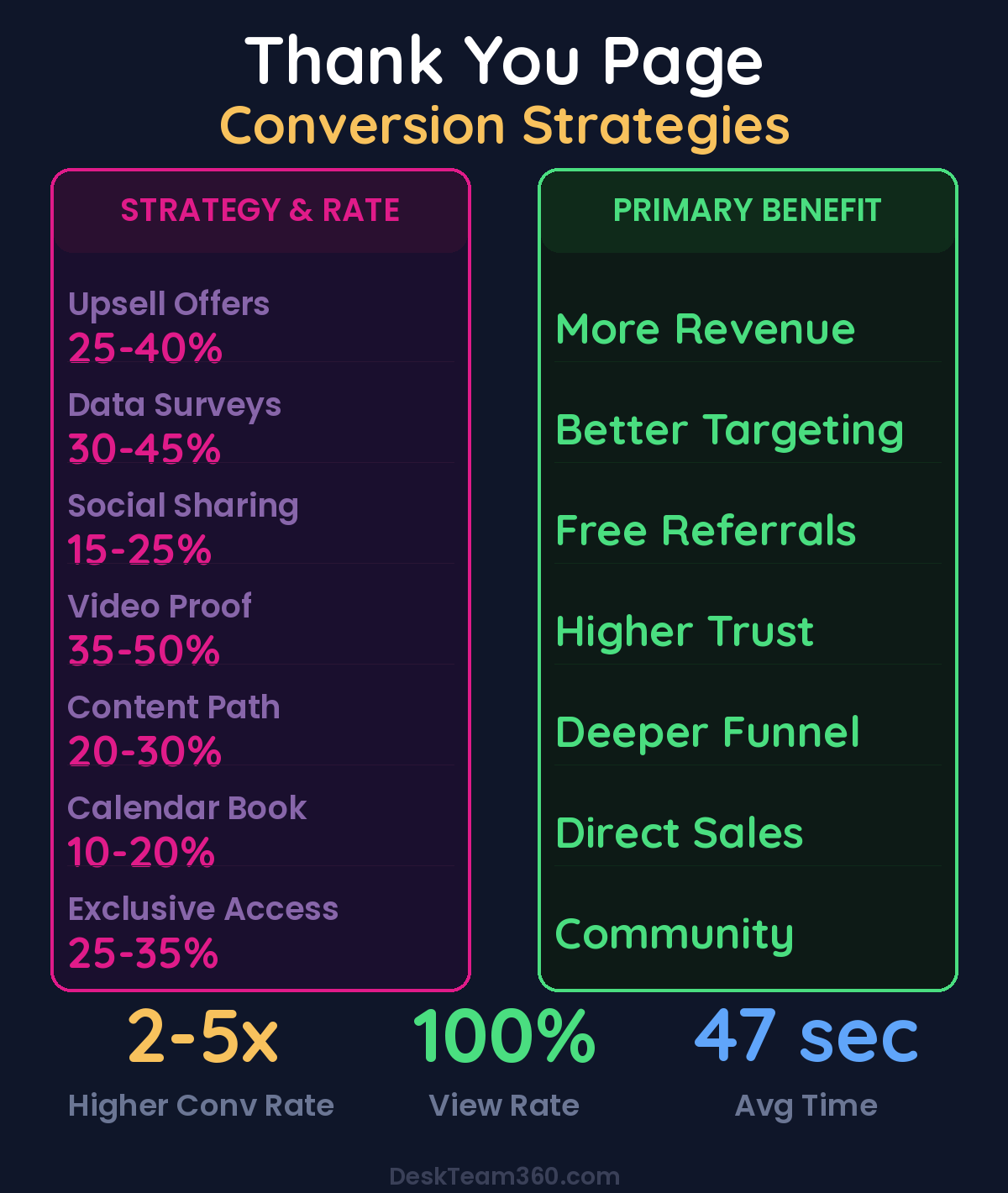
This isn’t theory, it’s backed by real data. Thank you pages get a 100% view rate because everyone who converts sees them. Users spend an average of 47 seconds on them, compared to 15 seconds on most pages. And conversion rates for secondary offers on thank you pages are 2-5x higher than cold offers to the same audience.
If your thank you page is just a confirmation message, you’re literally burning money. Every conversion is a missed opportunity to generate additional revenue, collect valuable data, or deepen the relationship.
Free 5-Minute Video
See How DeskTeam360 Works in Under 5 Minutes
Watch the short video and see exactly how we handle design, development, and marketing implementation — so you don't have to.
Watch the Video →
The Five Elements Every High-Converting Thank You Page Needs
I’ve analyzed hundreds of thank you pages that actually drive results. Every great one includes these components.
Confirmation That Reduces Anxiety
First, tell them exactly what just happened and what to expect next. Be specific, not vague. “Your download is heading to your inbox” is better than “Thanks for downloading.” “You’re registered for the March 25th webinar at 2pm EST” beats “Thanks for registering.”
People get anxious after submitting forms. Did it work? Will they get what they signed up for? Clear, immediate confirmation eliminates that anxiety and builds trust for whatever comes next.
Immediate Value Delivery
Don’t make them wait for email delivery if you don’t have to. If they downloaded something, provide a direct download link on the page. If they signed up for a webinar, give them the calendar invite link immediately. Instant gratification builds momentum and keeps them engaged.
A Strategic Secondary Offer
This is where the money is made. More on this in the next section.
Social Proof That Reinforces Their Decision
They just took action. Now convince them it was smart. A testimonial from someone who got results, a stat about how many people have downloaded the same resource, or a quick video case study. This validation makes them feel good about their choice and more likely to take the next step.
Clear Navigation Options
Never trap someone on a thank you page with nowhere to go. Provide obvious paths to your best content, your product pages, or your services overview. A confused visitor leaves. A guided visitor explores.
Seven Thank You Page Strategies That Generate Revenue
Strategy 1: The Relevant Upsell
This is the most direct path to immediate additional revenue. After someone converts, present a related offer that makes perfect sense as the next step.
Examples that work: after a free trial signup, offer an annual plan at a discount. After downloading a beginner guide, offer your advanced course. After signing up for a webinar, offer a one-on-one consultation. After buying a product, offer a complementary item at 20% off.
The key word is “relevant.” Random offers feel spammy and damage trust. The upsell should be the logical next step in their journey with your brand.
Add urgency to boost conversion rates. “This offer is only available right now” or a countdown timer creates scarcity. This isn’t manipulation if the offer is genuinely only available on the thank you page, it’s just smart marketing psychology.
Strategy 2: The Data Collection Survey
A short 2-3 question survey on your thank you page accomplishes two things. It keeps the visitor engaged, and it collects valuable segmentation data you can use to personalize everything that follows.
Questions that generate useful data: “What’s your biggest challenge with [topic]?” for prioritizing content creation. “Which best describes your business?” for audience segmentation. “How did you hear about us?” for attribution tracking. “What would you most like to learn about?” for product development insights.
Use this data to segment your email sequences. Someone whose biggest challenge is “generating leads” gets completely different follow-up emails than someone struggling with “team management.” This personalization can double email engagement rates.
Strategy 3: Social Sharing and Referral Programs
People who just found value in your content or offer are your best advocates. They’re excited, engaged, and willing to share. Make it brain-dead simple with pre-written social share buttons.
“I just downloaded [specific resource] from [your company], check it out!” with one-click sharing to Twitter, LinkedIn, and Facebook. Include a referral incentive: “Share with a friend and you both get [specific bonus].” Or prompt user-generated content: “Post about your experience and tag us for a chance to win [specific prize].”
This turns every conversion into a potential acquisition channel. And unlike paid advertising, referrals cost you nothing and convert at much higher rates.
Pro tip: Track which customers came from referrals and reward your best advocates. Someone who refers five customers should get more recognition (and incentives) than someone who refers zero.
Strategy 4: Video Testimonials and Case Studies
Your thank you page is perfect for social proof in video format. Embed a 60-90 second video featuring a customer explaining their results, a quick case study walkthrough, or a personal welcome from your founder.
Video on thank you pages increases time-on-page by 200-300% and significantly improves brand recall. People who watch a testimonial video are 85% more likely to move forward in your sales process. If video production isn’t your strength, understanding how to outsource video editing can help you create professional content without breaking your budget.
Strategy 5: Curated Content Journeys
Don’t just link to your blog and hope for the best. Create a specific path through your best content that relates to what they just downloaded or signed up for.
“Since you’re interested in [specific topic], you’ll love these three articles…” with direct links to your pillar content. “Here’s the complete learning path: Start with this foundational piece, then read this advanced guide, then try this practical tutorial.” “Our most popular resource on this topic gets downloaded 500+ times per month.”
This approach keeps visitors on your site longer, builds your authority, and moves them deeper into your funnel. The key is curation, not just dumping them into your entire content library. Having a solid content calendar strategy ensures you always have relevant, high-quality content to recommend.
Strategy 6: Calendar Booking Integration
For B2B businesses and service providers, the thank you page is prime real estate for consultation bookings. After someone downloads a whitepaper, signs up for a free tool, or requests a quote, their interest is at its peak.
Present an embedded calendar: “Want to discuss how this applies to your specific situation? Book a free 15-minute strategy call.” “Ready to see [your product] in action? Schedule a personalized demo.”
Use Calendly, HubSpot Meetings, or any tool that embeds directly on the page. Every additional click between “I’m interested” and “I booked a call” cuts your conversion rate. Make it as frictionless as possible.
Strategy 7: Exclusive Community Access
Invite them into something exclusive. A private Facebook group for customers, a Slack community for your industry, an exclusive email newsletter with insider tips, or early access to new products and features.
This creates a sense of belonging and provides an ongoing communication channel with your most engaged audience. Communities also create natural upsell opportunities as members see other customers getting results from your paid offerings.
Thank You Page Design That Actually Converts
Focus Beats Clutter Every Time
Don’t try to cram every strategy onto one page. Pick one or two approaches and execute them brilliantly. A thank you page with six different calls-to-action converts worse than one with a single, clear next step.
Too many options create decision paralysis. Your visitor just made one decision (to convert). Don’t immediately overwhelm them with five more choices.
Visual Consistency Builds Trust
Your thank you page should look like it belongs to the same website the visitor just interacted with. Same branding, same design quality, same tone of voice. A jarring visual change breaks trust and makes people question whether their information went to the right place.
If your landing pages look professional but your thank you pages look like an afterthought, that inconsistency hurts conversions. Invest in the design. Our guide on creating effective landing pages includes design principles that apply to thank you pages as well.
Mobile Optimization Is Non-Negotiable
Over 60% of web traffic comes from mobile devices. Your thank you page, including any embedded videos, survey forms, or calendar widgets, must work perfectly on phones. Don’t just test in browser dev tools, use actual devices.
I’ve seen beautiful thank you pages that completely break on mobile, turning a moment of peak engagement into frustration and abandonment.
Watch out: Page speed matters even more on thank you pages. The user just submitted a form and they’re waiting for confirmation. If your page takes five seconds to load, they’ll think something went wrong and try to resubmit.
For a deeper dive, see our guide on best website design for law firms: what actually converts clients.
For a deeper dive, see our guide on how to create a google business profile: complete setup and optimization guide.
Thank You Page Examples by Business Type
Different business models need different approaches. Here’s what works for each.
For e-commerce purchase confirmations: order details and tracking info, cross-sell recommendations (“customers who bought this also loved…”), referral incentives (“share your purchase for 10% off your next order”), and loyalty program signup opportunities.
For lead magnet downloads: direct download links plus email confirmation, upsell offers (“want the advanced version? Our complete course covers everything”), brief segmentation surveys, and consultation booking with embedded calendars.
For webinar registrations: calendar invite links with prominent “add to calendar” buttons, relevant resource recommendations (“while you wait, check out these guides”), referral sharing (“bring a colleague, share this link”), and speaker introduction videos.
For service inquiries or quote requests: clear response time expectations (“we’ll respond within 24 hours”), video introductions from your team, case studies relevant to their inquiry, and portfolio links (“explore our work while you wait”).
Measuring What Actually Matters
You can’t improve what you don’t measure. Track these specific metrics to understand your thank you page performance.
Secondary conversion rate is the big one. What percentage of people take the next action you’re asking for? This should be 15-30% for relevant offers. Time on page tells you about engagement. 45+ seconds means people are actually reading and considering your offer. Social shares, if you’re using share buttons, should happen organically if your content delivers value.
Revenue from upsells is the ultimate metric. Track the actual dollars generated from thank you page offers, not just click-through rates. Survey completion rates, if you’re collecting data, should be 25-40% for well-designed, short surveys.
Set up proper tracking in Google Analytics for your thank you page. Create custom events for each secondary call-to-action so you can measure performance accurately. If you haven’t set up analytics tracking yet, our Google Analytics guide will walk you through the process.
A/B Testing Your Thank You Pages
Once you have baseline performance data, start testing variations systematically. Different secondary offers (upsell vs. survey vs. content path), video vs. no video, one call-to-action vs. two, different urgency elements (countdown timers vs. limited quantity messaging), and social proof placement and format.
Even small improvements compound over time. If your thank you page currently converts 0% on secondary actions and you optimize it to 8%, that’s found revenue from traffic you’re already paying for. On 1,000 monthly conversions, an 8% secondary conversion rate generating $50 average order value equals $4,000 in additional monthly revenue.
Most companies never test their thank you pages because they treat them as confirmation pages, not conversion pages. That’s a expensive mistake.
Companies that optimize their thank you pages see 25-40% increases in customer lifetime value within six months.
Stop Leaving Revenue on the Table
Your thank you page isn’t the end of your funnel, it’s the beginning of your customer relationship. Every person who lands there has already demonstrated intent, trust, and willingness to take action. That’s the hardest part of marketing, and you’ve already accomplished it.
Now give them somewhere valuable to go next. Whether it’s a relevant upsell, a data collection survey, a social sharing opportunity, or a consultation booking, turn that confirmation moment into a conversion opportunity.
The math is simple. If you’re driving 500 conversions per month and your thank you page converts 0% on secondary offers, you’re leaving money on the table. Optimize it to convert 10% and suddenly you have 50 additional leads or sales every month from the same traffic investment.
Building high-converting thank you pages requires strategic thinking about customer psychology, technical implementation across multiple platforms, and ongoing optimization based on real performance data. If you want professional execution without the internal resource drain, our team at DeskTeam360 handles thank you page development as part of our comprehensive marketing asset creation service.
We’ve built hundreds of thank you pages that generate measurable additional revenue for our clients. From design and development to integration and analytics setup, we handle the technical execution so you can focus on growing your business and serving your customers.
Free Tool
How Much Is Freelancer Management Really Costing You?
Most agency owners have never done this math. Plug in a few numbers and see your real cost in 2 minutes.
Calculate Your Hidden Costs →