


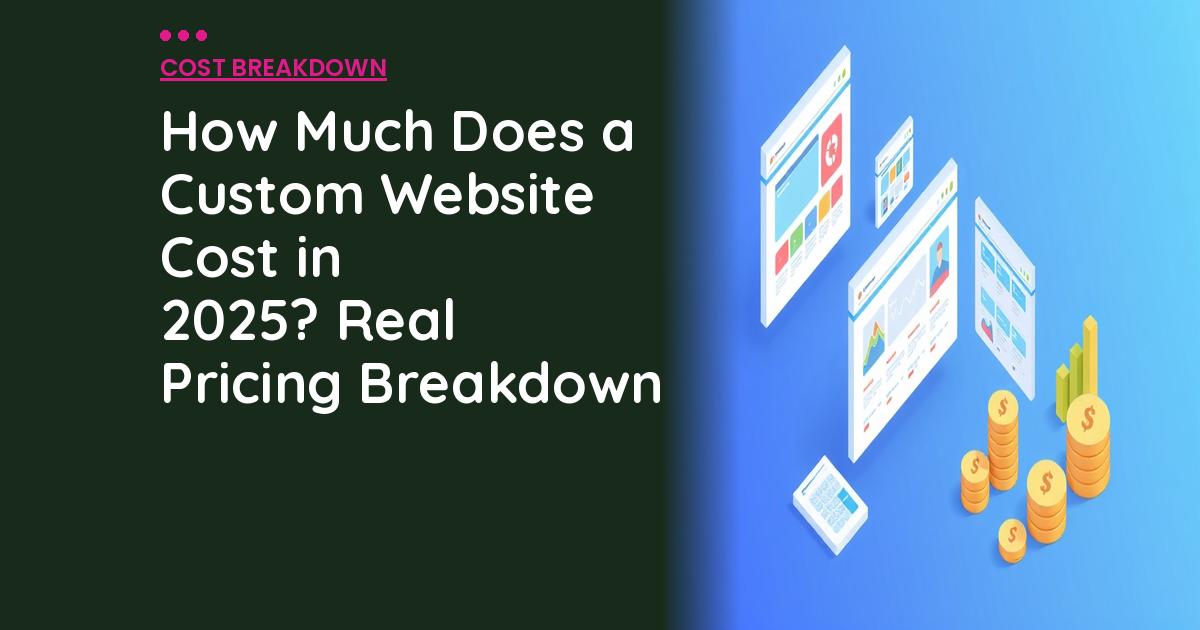
How Much Does a Custom Website Cost in 2025? Real Pricing Breakdown
The Pricing Reality Check Nobody Gives You
I get this question at least three times a week: “How much does a custom website cost?” And honestly, most of the answers floating around the internet are complete garbage. They give you these insane ranges like “$2,000 to $200,000” as if that helps anyone make a decision.
📋 Table of Contents
I’ve been running agencies for 12+ years. I’ve priced hundreds of custom websites, hired freelancers that disappeared mid-project, worked with agencies that bill $300/hour for intern-level work, and built my own subscription model to cut through all the BS. So let me give you the real numbers, no fluff, no hedging.
The answer isn’t just a price range. It’s understanding what drives those prices and how to avoid getting screwed in the process.
Why Website Pricing Is Such a Mess
The reason you can’t get a straight answer about website costs is because most people in this industry benefit from the confusion. Agencies love vague project scopes because it gives them room to jack up the price later. Freelancers lowball estimates to win projects, then hit you with change orders. And those “$500 website” services deliver exactly what you’d expect for $500.
Here’s what actually determines the cost of a custom website. Complexity matters more than page count. A 5-page site with custom animations and database integrations costs more than a 20-page brochure site. Platform choice drives development time. Building something custom from scratch takes 3x longer than customizing WordPress. Who’s building it completely changes the equation. A freelancer in Eastern Europe charges different rates than a Manhattan agency.
Watch out: Anyone who gives you a price without asking detailed questions about functionality, integrations, and business requirements is either inexperienced or planning to hit you with scope creep charges later. The initial estimate is meaningless without proper discovery.
Timeline pressure always costs extra. Need it done in two weeks instead of two months? You’re paying rush fees. Content creation is the hidden time killer. If you don’t have professional copy, images, and brand assets ready, your timeline just doubled.
Free 5-Minute Video
See How DeskTeam360 Works in Under 5 Minutes
Watch the short video and see exactly how we handle design, development, and marketing implementation — so you don't have to.
Watch the Video →
Real Costs by Provider Type

Freelancers: The $2,000 to $15,000 Gamble
Freelancers are tempting because the upfront costs look reasonable. A basic business site runs $2,000 to $5,000. Something with e-commerce or custom functionality hits $8,000 to $15,000. But here’s what those numbers don’t tell you.
Freelancers are a single point of failure. They get sick, take vacations, or ghost your project when something better comes along. I’ve seen this play out dozens of times. A business hires a freelancer for $4,000, gets 70% through the build, and the freelancer disappears. Now they’re hiring someone else to finish the work, which often costs more than starting over.
You’re also the project manager by default. You’re chasing them for updates, managing their timeline, and handling quality control. That’s not free. Your time has value.
Pro tip: If you’re hiring a freelancer, get everything in writing. Every page, every feature, every integration. And build payment milestones around deliverables, not calendar dates. Never pay more than 50% upfront, no matter what sob story they give you about needing money for tools.
Agencies: The $15,000 to $100,000+ Experience
Agencies give you a team instead of a single person, which solves the reliability problem. You get a project manager, designer, developer, and QA person. But you’re paying for their overhead, office space, account management layers, and profit margins.
A basic business site from a decent agency runs $15,000 to $30,000. Mid-complexity sites with custom functionality hit $30,000 to $60,000. Enterprise builds with complex integrations and multiple user roles can easily break $100,000.
The quality is usually higher than freelancers, but the process is slower. Everything goes through approval layers. Simple changes require project manager involvement. And once the site launches, you’re back to paying hourly rates for every update.
Subscription Services: The $399 to $999 Monthly Alternative
This is where things get interesting. Instead of a massive upfront project cost, subscription services charge a flat monthly rate and build your site as part of an ongoing relationship. At DeskTeam360, we handle websites, graphics, development, and ongoing maintenance for one predictable monthly price.
A typical custom site takes 4 to 8 weeks to build, so you’re looking at $1,600 to $8,000 total over the build period. But here’s the kicker. After your site launches, you still have a design team. Need landing pages for a new campaign? Done. Want to refresh your services page? Done. Every update used to be a new invoice with freelancers and agencies.
The Hidden Costs Nobody Warns You About
The sticker price is never the full cost. Here are the expenses that catch everyone off guard.
Hosting and domain registration runs $50 to $200 per month, depending on your traffic and requirements. Cheap hosting kills your site speed, which murders your SEO rankings. Professional content creation adds serious cost. Quality copywriting runs $150 to $500 per page. Professional photography starts at $1,000 for a half-day shoot. Even good stock photos cost $25 to $75 each.
Premium tools and plugins add up fast. WordPress sites often need SEO plugins, page builders, security tools, and backup solutions. Budget $500 to $1,500 per year for the premium versions that actually work. SSL certificates, email hosting, and analytics tools are additional line items most people forget.
Ongoing maintenance is the big one. Your site needs security updates, backups, content refreshes, and performance optimization. Agencies charge $150 to $500 per month for maintenance plans. Freelancers often disappear after launch, leaving you to figure it out alone.
What Different Website Types Actually Cost
Simple Business Site (5-10 Pages)
This covers most small businesses. Home page, about, services, contact, maybe a blog. No complex functionality beyond a contact form.
Freelancer range is $2,000 to $6,000 with a 3 to 8 week timeline. Agency range hits $10,000 to $25,000 over 4 to 10 weeks. With DeskTeam360, you’re looking at one month of our standard plan to get it built, then ongoing updates included.
E-Commerce Store
Product catalogs, shopping carts, payment processing, inventory management, and customer accounts. If you’re considering Shopify specifically, our guide to outsourcing Shopify development breaks down the platform-specific costs.
Freelancers charge $5,000 to $20,000 depending on product count and custom features. Agencies range from $20,000 to $80,000 for anything beyond basic templates. Timeline varies wildly based on integrations needed.
E-commerce builds take 2x longer than estimated 90% of the time. Payment processing integration, tax calculations, and shipping logic always reveal edge cases nobody thought about during planning.
Membership Site or SaaS Platform
User authentication, member-only content, subscription billing, dashboards, and admin panels. This is where costs explode because you’re building a web application, not just a website.
Freelancer range is $10,000 to $40,000 if you can find someone capable of handling the complexity. Most can’t. Agency range starts at $40,000 and easily hits $150,000+ for anything sophisticated. Timeline is 12 to 30 weeks minimum.
Industry-Specific Pricing Reality
Different industries have different website requirements, which directly impacts cost and complexity.
Professional services like law firms and consultants need credibility and content volume. These sites are usually 15 to 25 pages with team bios, case studies, and extensive service descriptions. Healthcare sites require HIPAA compliance, patient portals, and appointment scheduling. The compliance requirements alone add 20-30% to development cost.
Real estate sites need MLS integration, property search filters, map features, and lead capture systems. The data feeds and search functionality make these more complex than they appear. Restaurants need online ordering, reservation systems, location pages, and menu displays that work perfectly on mobile since 80% of restaurant searches happen on phones.
Understanding how to measure marketing ROI becomes critical when your website is a lead generation tool for any of these industries.
How to Avoid Getting Screwed
Start with What You Actually Need
The biggest budget killer is feature creep. You don’t need every bell and whistle on day one. Launch with the essentials, then iterate based on real user behavior. I’ve watched businesses spend $40,000 on sites with features nobody uses while their core pages convert poorly.
Prepare Your Content Before Anyone Starts Designing
Nothing kills timelines and budgets like waiting for content. Have your copy written, images sourced, and brand guidelines documented before the first design mockup. This alone cuts project timelines by 30-50%. If you need help with the content strategy, our guide to creating effective FAQ pages covers the fundamentals.
For industry research and benchmarks, check out Nielsen Norman Group.
Content delays are the #1 cause of project overruns. Designers can’t design pages without knowing what goes on them. Developers can’t build functionality without understanding the user flow. Get your content house in order first, then hire someone to build around it.
Match the Platform to Your Actual Requirements
Don’t build a custom-coded site when WordPress handles your requirements perfectly. Don’t use WordPress when Webflow or Squarespace would work fine. The platform decision drives 60% of your development cost. Choose based on what you need, not what sounds impressive.
What You Should Actually Budget
Here’s my honest advice after pricing hundreds of projects across every industry.
Startups and solopreneurs shouldn’t spend more than $8,000 on their first website. Your first site won’t be your last. Focus on launching something that converts, then iterate based on real data. If our bounce rate reduction strategies can help a basic site perform better, you don’t need enterprise features yet.
Established small businesses should budget $8,000 to $20,000. At this point, you understand your customer needs and can invest in functionality that actually drives business results. Growing companies with complex needs should plan for $20,000 to $60,000. You need custom integrations, advanced functionality, and a team that can execute without hand-holding.
Enterprise budgets start at $60,000 and go up from there, but if you’re enterprise, you already know your requirements and timeline constraints.
The ROI Question That Actually Matters
Stop asking what a website costs. Start asking what it returns. A $30,000 website that generates $300,000 in annual revenue is a fantastic investment. A $3,000 website that generates zero leads is money thrown away.
The right question isn’t “how much does a custom website cost?” The right question is “what specific business results do I need from this website, and what investment level gives me the highest probability of achieving those results?”
Businesses that track website ROI see 40% better performance from their web investments. They know which features drive results and which ones are just expensive decoration.
A well-designed website pays for itself within 6-12 months through increased leads, improved conversion rates, and reduced support overhead. If your current site isn’t generating measurable business value, the problem probably isn’t the price you paid. It’s that nobody connected the website strategy to your actual business goals.
Focus on conversion optimization, user experience, and lead generation capability. Those drive revenue. Everything else is just cost.
Free Tool
How Much Is Freelancer Management Really Costing You?
Most agency owners have never done this math. Plug in a few numbers and see your real cost in 2 minutes.
Calculate Your Hidden Costs →