


Digital Marketing for Automotive Dealerships: The Complete Playbook
Digital marketing for automotive dealerships requires a focused strategy that actually drives results.
📋 Table of Contents
Why 90% of Automotive Dealerships Are Burning Money on Digital Marketing
I’ve spent over 12 years working with businesses across every industry imaginable, and automotive dealerships are some of the biggest wasters of marketing dollars I’ve ever seen. They’ll drop $15K a month on radio spots that nobody under 65 listens to, then wonder why their website looks like it was built during the Obama administration.
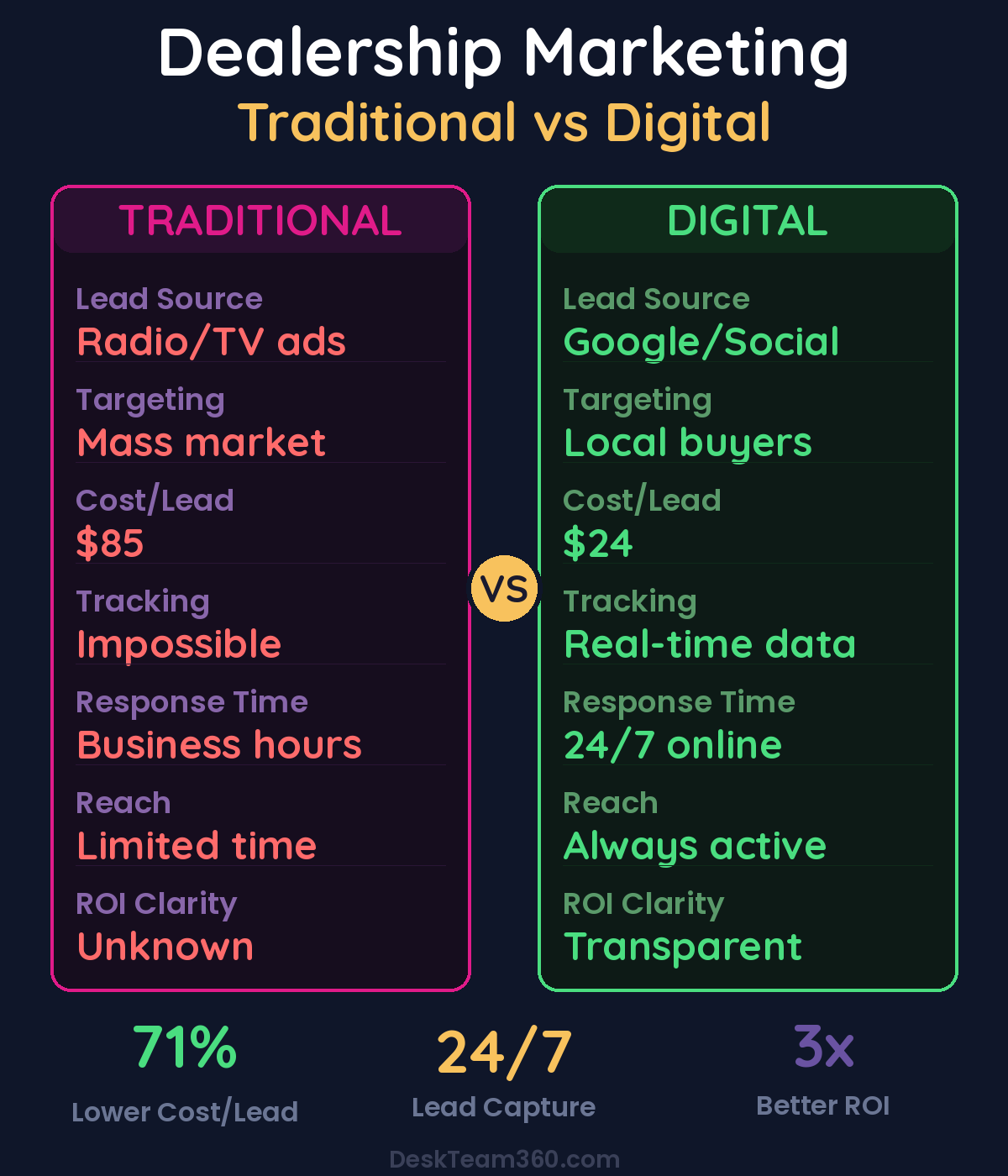
Here’s what kills me about this industry. Over 94% of car buyers start their research online before they ever set foot on a lot. They’re Googling “best family SUV under $45,000,” cross-shopping inventory across five dealerships, reading reviews, and checking your reputation scores. If your digital game is weak, you’re losing customers to the dealer down the street who figured out it’s not 2008 anymore.
Let me walk you through exactly what works for dealerships in digital marketing, what’s a complete waste of money, and how to build a system that actually drives sales instead of just pretty reports.
Your Inventory Pages Are Probably Worthless (Here’s How to Fix Them)
Your inventory is your product catalog. Period. If Amazon optimizes every product page for search, why wouldn’t you do the same for every single vehicle on your lot? Most dealerships use generic templates from their DMS that create cookie-cutter pages with zero unique content. That’s why they don’t rank for anything.
If digital marketing for automotive dealerships is on your radar, this guide is for you. Let’s talk about digital marketing for automotive dealerships. Pro tip: Every vehicle needs its own optimized page with unique content. Not just VIN, make, model, year. Write 150-200 words highlighting key features, recent service history, and why this specific vehicle is a great buy. Takes 10 minutes per vehicle but drives actual organic traffic.
The vehicles that sell fastest are the ones with compelling descriptions. “2024 Honda CR-V EX with only 8,500 miles, one owner, full maintenance records, and Honda’s factory warranty until 2027” beats “2024 CR-V EX” every single time. Include 20+ high-quality photos, 360-degree views when possible, and transparent pricing. If you’re doing “call for price,” you’re losing leads to dealers who show actual numbers.
Category pages are equally important. Create optimized landing pages for each make and model you carry regularly. A page targeting “2024 Toyota Tacoma for Sale in Phoenix” with genuine content about trim levels, local inventory, and financing options will capture search traffic from buyers actively shopping. Most dealers ignore this completely and wonder why their organic traffic sucks.
Free 5-Minute Video
See How DeskTeam360 Works in Under 5 Minutes
Watch the short video and see exactly how we handle design, development, and marketing implementation — so you don't have to.
Watch the Video →
Google Vehicle Ads Are the Single Best Investment You’re Not Making
If you’re not running Google Vehicle Ads yet, you’re missing the most effective paid channel for automotive right now. These aren’t your standard text ads that nobody clicks. Vehicle Ads show your actual inventory with photos, pricing, mileage, and key details directly in Google search results.
When someone searches “used Ford F-150 near me,” your specific trucks show up with images and pricing right at the top. It’s like Google Shopping but for cars, and the click-through rates destroy standard text ads because buyers can see exactly what you have before clicking.
Setting this up requires a Google Merchant Center account with a properly formatted vehicle inventory feed. Most major DMS providers can generate these feeds automatically. CDK, DealerSocket, Reynolds & Reynolds all support it. If your DMS doesn’t, find a new one because it’s 2026.
The other critical piece is pricing competitively. Google shows your price right next to competitors. If you’re $3,000 over market value, buyers scroll past to the next dealer. Keep your feed updated daily because showing sold vehicles in ads wastes budget and pisses off potential customers.
Local SEO Is Where Small Dealerships Beat the Big Players
Most car buyers search with local intent. “Honda dealer near me,” “best used car dealership Phoenix,” “oil change Scottsdale.” Local SEO is where smaller dealerships can compete with AutoNation and CarMax without spending millions.
Your Google Business Profile is arguably your most important digital asset. Complete every single section. Hours, services, attributes, description, photos. Add new photos weekly. Lot shots, happy customers picking up keys, new arrivals, service bays. Use Google Posts to highlight promotions, new inventory, and community events.
List all your departments as separate service categories. Sales, service, parts, body shop, financing. Most dealers only optimize for vehicle sales and completely ignore their service department, which is usually their highest-margin revenue stream.
Building location-specific content sets you apart from chain dealers. Blog posts like “Best Family Cars for Phoenix Summer Heat” or “Top 5 Road Trip Vehicles for Arizona Terrain” build local relevance and attract organic search traffic. Chain dealers can’t do this at scale, but you can.
Service department SEO is criminally underutilized. People search constantly for “oil change near me,” “brake repair Phoenix,” “transmission service.” Create landing pages for your top 10 services with real pricing, scheduling links, and what’s included. Way cheaper to rank for service keywords than vehicle sales.
Review Management Isn’t Optional (It’s Sales Prevention)
In automotive, reviews make or break deals. Someone spending $35,000 on a vehicle absolutely reads your reviews before visiting. A study by BrightLocal found 87% of consumers read online reviews for local businesses. For car purchases, that number is probably closer to 95%.
Don’t leave reviews to chance. Build a systematic process. Send automated review requests within 2 hours of vehicle delivery via text and email. Train your sales team to ask for reviews during the delivery walkthrough. Make it dead simple with a direct link to your Google review page, not some third-party review platform nobody uses.
Follow up once (and only once) if they haven’t left a review after 48 hours. More than that becomes harassment. When you get reviews, respond to every single one. Positive reviews get genuine thank-yous. Negative reviews get professional, empathetic responses that take the conversation offline.
Potential customers read your responses just as much as the original reviews. A professional response to a complaint often builds more trust than having no negative reviews at all.
Your Service Department Should Have Its Own Marketing Budget
Most dealership marketing budgets go entirely toward vehicle sales. That’s backwards thinking. Your service department probably generates higher margins than vehicle sales, it’s dramatically cheaper to market, and you have built-in customers from everyone who’s ever bought from you.
Target service-related keywords aggressively. “Oil change [city],” “brake replacement,” “Honda transmission service.” Create landing pages for your most common services with transparent pricing, online scheduling, and unique content about what’s included. If you need help structuring service content properly, our guide on creating effective FAQ pages covers the fundamentals.
Run Google Ads specifically for service appointments. Service keywords cost a fraction of vehicle sales keywords. You can run profitable campaigns for oil changes, tire rotations, brake services, and seasonal maintenance at 10% of the cost of inventory-focused campaigns.
Build an email list from every customer who’s bought a vehicle or used your service department. Send maintenance reminders based on mileage and time intervals, seasonal service specials, recall notifications. This isn’t rocket science, but most dealers completely ignore it.
Social Media That Actually Drives Sales (Not Just Likes)
Social media for dealerships isn’t about going viral. It’s about building trust, staying top-of-mind, and showcasing your inventory and team culture. Focus on content that actually converts browsers into buyers.
Vehicle walkaround videos perform incredibly well on Facebook and Instagram. Short, authentic videos of your sales team highlighting specific vehicles. Not scripted marketing speak, just genuine enthusiasm about why this particular car is a great buy. These videos get shared, commented on, and drive actual lot traffic.
Customer delivery photos (with permission) provide social proof. Happy customers with their new vehicles. Behind-the-scenes content showing your service technicians at work, detailing team prepping vehicles, team at community events. Inventory spotlights highlighting new arrivals or price-reduced vehicles.
Dealerships using dynamic inventory ads on Facebook see 40% higher conversion rates than those using generic automotive ads.
Facebook and Instagram’s dynamic inventory ads automatically show relevant vehicles to people in your area who are in-market for cars. These ads pull from your inventory feed and target users based on browsing behavior, demographics, and automotive intent signals. For creative design work, you can handle it in-house or our ad creative outsourcing guide explains how to scale high-volume variations for testing.
Retargeting: The 90-Day Follow-Up System
The average car buying journey takes 2-3 months. Someone who visits your website today might not be ready to buy for weeks. Retargeting keeps your dealership in front of those potential buyers while they’re shopping around.
Set up retargeting pixels for both Google and Facebook. Create audiences based on specific behaviors. People who viewed individual vehicle pages get retargeted with that vehicle or similar models. People who started but didn’t complete lead forms. People who visited financing or trade-in pages.
The creative for retargeting should be different from prospecting ads. These people already know who you are. Remind them of specific vehicles they looked at and give them a reason to come back. Price drops, limited availability, special financing, recent trade-ins.
Your Website Is Probably Slower Than Your Competitors (And It’s Costing You Sales)
Most dealership websites are bloated nightmares loaded with inventory widgets, chat tools, pop-ups, and tracking scripts. The result is 8-10 second load times that kill conversions before they start. A one-second delay in page load time reduces conversions by 7%.
Audit your site speed ruthlessly. Cut anything that doesn’t directly contribute to lead generation or sales. Most dealer websites have 15+ different tracking scripts running. You don’t need that many. Pick the 3-4 most important ones and delete the rest.
Simplify your lead forms. Stop asking for 15 fields on initial contact forms. Name, email, phone number, and message. That’s it. You can qualify leads further in follow-up conversations. Every additional field reduces form completions exponentially. If you’re serious about improving conversions, check out our website conversion optimization guide for the complete playbook.
Watch out: Most dealer website vendors sell you on features, not performance. Fancy inventory search tools and virtual reality showrooms mean nothing if your site takes 12 seconds to load. Speed beats features every single time.
 Digital Marketing for Automotive Dealerships Comparison” style=”max-width:100%;height:auto;border-radius:12px;box-shadow:0 4px 20px rgba(0,0,0,0.08);” width=”1200″ height=”1400″>
Budget Allocation That Actually Makes Sense
If you’re wondering where to allocate your digital marketing budget, here’s what works for most mid-size dealerships based on actual results, not vendor sales pitches.
Google Ads including Vehicle Ads should get 35-40% of your digital spend. This is your highest-converting traffic. SEO and content marketing deserve 15-20% for long-term organic growth. Social media advertising gets 15-20%, focusing on inventory promotion and local engagement. Retargeting across all platforms needs 10-15% to capture browsers who didn’t convert immediately.
Email marketing and CRM tools need 5-10% for customer retention and service reminders. Review management tools get 3-5% because reputation management isn’t optional anymore. The exact percentages depend on your market competition and whether you focus more on new or used inventory, but digital should be 70%+ of your total marketing spend, not an afterthought behind traditional media.
Stop Marketing Like It’s 2015 (Your Customers Aren’t)
The automotive industry has been embarrassingly slow to embrace digital marketing, which is actually an advantage for dealers willing to invest properly. Your competitors are still buying billboards and radio spots while customers are shopping on smartphones during their lunch break.
Get your inventory pages optimized for search. Run Google Vehicle Ads to capture high-intent shoppers. Dominate local SEO for your service area. Build systematic review generation and response processes. Market your service department as aggressively as vehicle sales. Use social media to showcase inventory and build trust, not just post generic automotive memes.
The technology exists, it’s proven, and it’s more affordable than traditional advertising. The question isn’t whether digital marketing works for dealerships. The question is whether you’re going to implement it before or after your competitors do.
At DeskTeam360, we’ve helped dealerships across the country build and optimize their digital marketing systems, from website development to ad creative design to ongoing campaign management. Our flat-rate subscription model means you can submit unlimited requests without worrying about hourly billing or surprise invoices.
Free Template
The Ultimate Task Delegation Template
Stop guessing what to hand off. This template shows you exactly what to delegate, how to brief it, and how to QA the results.
Get the Free Template →