
AI Marketing Tools: The Complete Guide for 2026
The AI Marketing Revolution Is Here, Ready or Not
Your competitor just automated their email campaigns, their content creation, and their customer segmentation. They’re generating leads while they sleep, personalizing at scale, and cutting their marketing costs by 40%. Meanwhile, you’re still manually writing every email and hoping your Facebook ads hit the right people.
📋 Table of Contents
This isn’t some distant future scenario. It’s happening right now, in 2026, and the gap between businesses using AI marketing tools and those still doing everything manually is getting wider every month.
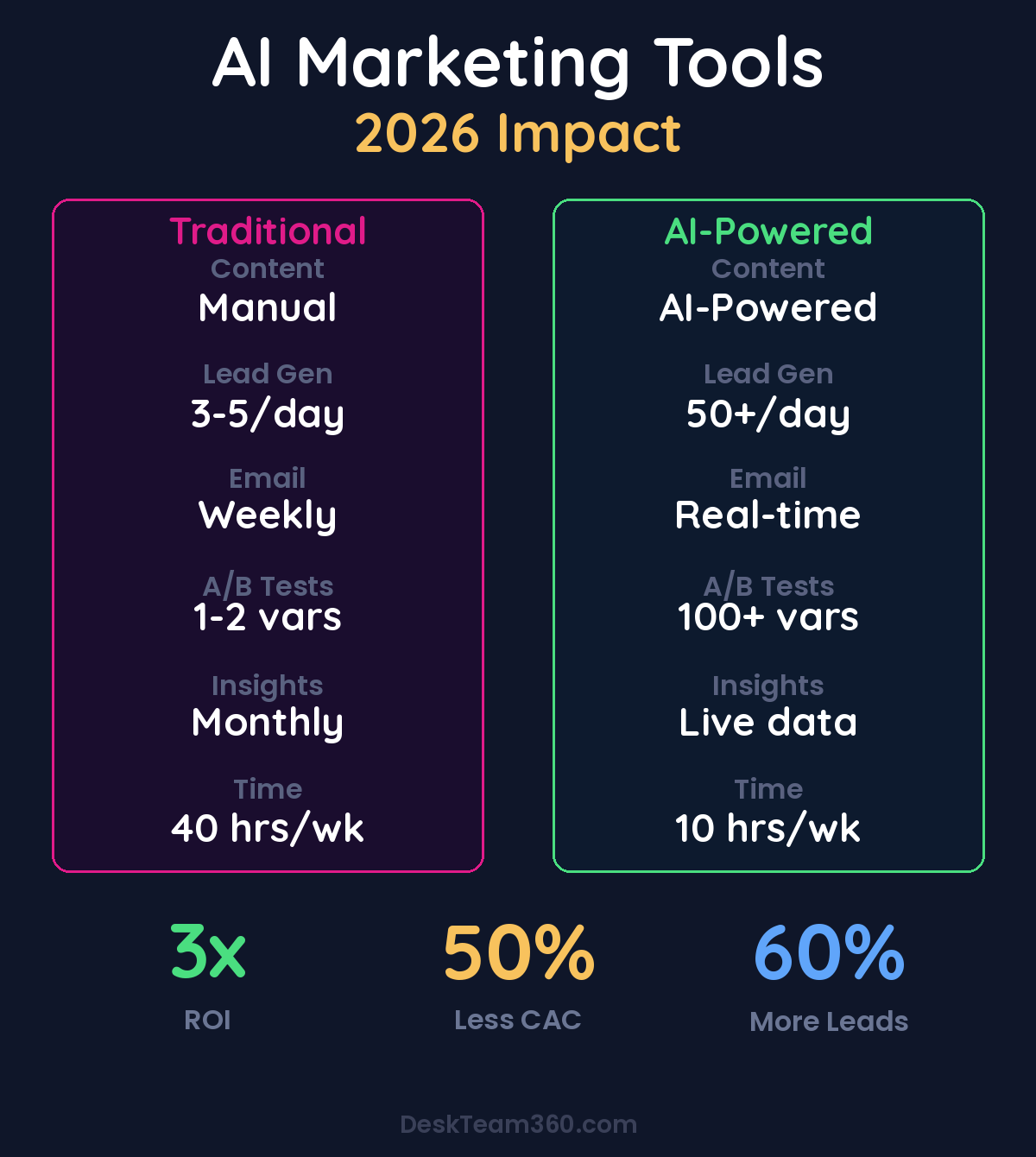
I’ve spent the last three years implementing AI marketing systems across 400+ client businesses at DeskTeam360. The results aren’t subtle. Companies that embrace AI marketing tools see 3x higher conversion rates, 50% lower customer acquisition costs, and 60% more qualified leads. The ones that don’t? They’re struggling to keep up with basic demand generation while their AI-powered competitors eat their market share.
Here’s exactly which AI marketing tools actually work in 2026, how to choose the right ones for your business, and the implementation playbook that’s generating real results.
The Five Categories of AI Marketing Tools That Matter
Not all AI marketing tools are created equal. Most are marketing gimmicks wrapped in AI buzzwords. The five categories that actually move the needle are content creation, customer intelligence, campaign optimization, lead generation, and email marketing automation. Everything else is nice to have, these five are must-haves.
Content Creation: AI That Actually Writes Like Humans
Content creation was the first AI marketing breakthrough, and it’s still the biggest time saver. But the quality gap between good and garbage AI content tools is massive. The winners in 2026 are tools that understand brand voice, industry context, and conversion psychology.
Jasper AI leads the pack for long-form content. It costs $49-125/month but generates blog posts, email sequences, and ad copy that actually converts. The brand voice training is what sets it apart from cheaper alternatives.
Copy.ai is the best value at $36-186/month, especially strong for social media content and short-form copy. Their workflow templates save hours on repetitive content tasks.
Writesonic offers solid quality at $19-100/month and includes SEO optimization features that most competitors miss. Perfect for businesses that need content and search visibility.
Pro tip: Don’t just dump AI-generated content straight onto your website. Use AI for the first draft, then edit for your specific brand voice and add real examples from your business. Pure AI content ranks poorly and converts worse than edited AI content.
Customer Intelligence: Know Your Audience Before They Know Themselves
The best marketing feels personal because it is personal. AI customer intelligence tools analyze behavior patterns, predict purchase intent, and segment audiences with precision that manual analysis can’t match.
HubSpot AI integrates customer intelligence directly into your CRM starting at $45/month. It tracks every interaction, scores lead quality, and suggests the best follow-up actions. The predictive analytics accurately identify which leads are most likely to close.
Klaviyo dominates email marketing intelligence at $20-1,700/month. Their AI predicts customer lifetime value, identifies churn risk, and automatically creates behavioral segments. The ROI tracking is incredibly detailed.
Segment provides the data foundation at $120+/month. It collects customer data from every touchpoint, cleans it automatically, and feeds insights to your other marketing tools. Think of it as the central nervous system for your marketing data.
Campaign Optimization: AI That Makes Your Ads Actually Work
Manual campaign optimization is dead. AI can test hundreds of variables simultaneously, adjust bids in real-time, and find profitable audiences you’d never discover manually. The performance difference is so dramatic that running ads without AI optimization is like bringing a knife to a gunfight.
Google Ads Smart Bidding is free with your Google Ads account and dramatically outperforms manual bidding for most businesses. The machine learning algorithms optimize for your specific conversion goals across search, display, and YouTube.
Related reading: Outsource Course Creation and Design: The Complete Production Guide.
Facebook Advantage+ campaigns automate audience targeting, creative testing, and budget allocation across Facebook and Instagram. Free with your Facebook ad account, and consistently delivers lower cost per acquisition than manual campaigns.
AdRoll specializes in cross-platform retargeting at $36+/month. Their AI identifies the best channels to re-engage prospects and automatically adjusts messaging based on where someone is in your funnel.
Campaign optimization isn’t set-and-forget. Even the best AI needs human oversight. Review performance weekly, adjust targeting parameters when needed, and feed the AI new creative assets regularly. The companies getting 10x ROAS aren’t just using AI, they’re actively managing it.
Lead Generation: AI That Finds Your Next Best Customers
The days of buying random email lists and hoping for the best are over. AI lead generation tools identify prospects based on behavior patterns, company characteristics, and purchase intent signals. The quality difference compared to traditional lead gen is night and day.
Clay is the Swiss Army knife of lead generation at $149+/month. It combines data enrichment, email finding, and personalization in one platform. The AI research assistant can build detailed prospect profiles automatically.
Apollo provides the largest B2B database at $39-79/month with AI-powered lead scoring and email sequencing. Their intent data identifies companies actively researching solutions like yours.
ZoomInfo SalesOS is enterprise-grade at $995+/month but provides the most accurate data and sophisticated targeting options. The AI conversation intelligence analyzes sales calls to improve messaging.
Email Marketing Automation: Personalization at Impossible Scale
Email marketing automation was good before AI. With AI, it’s become the highest-ROI channel for most businesses. Modern AI email tools personalize subject lines, send time optimization, content recommendations, and entire email sequences based on individual behavior patterns.
Mailchimp democratized email AI at $13-350/month. Their predictive analytics identify the best customers to target, optimal send times, and which content generates the most engagement.
Constant Contact focuses on simplicity at $12-80/month. Perfect for small businesses that want AI benefits without complexity. Their automated customer journeys are surprisingly sophisticated.
ConvertKit serves creators and online businesses at $29-208/month. The visual automation builder makes complex email sequences simple to create and optimize.
Free Template
The Ultimate Task Delegation Template
Stop guessing what to hand off. This template shows you exactly what to delegate, how to brief it, and how to QA the results.
Get the Free Template →
How to Choose the Right AI Marketing Stack
The biggest mistake I see is companies buying individual tools without thinking about how they work together. Your AI marketing stack should be integrated, not a collection of disconnected point solutions.
Start With Your Current Tools
Before adding anything new, audit what you already have. Does your CRM have AI features you’re not using? Can your email platform integrate with AI content tools? Are you maximizing the free AI optimization features in Google and Facebook ads?
I’ve seen businesses spend $2,000+/month on new AI tools when their existing $50/month CRM already included 80% of the functionality they needed. Check your current subscriptions first.
Budget for Integration, Not Just Software
AI marketing tools are only as good as the data they can access. Plan for data connectors, API integrations, and potentially custom development to make everything work together. A $100/month tool might need $500 in setup costs to reach its potential.
For more on this, check out our guide on marketing implementation for online service providers: a practical guide.
Watch out: Many AI marketing tools promise “easy setup” but require significant configuration to work properly. Budget 2-4 weeks of focused implementation time, not a weekend. The companies that rush the setup get mediocre results and blame the tools instead of the implementation.
Test Before You Commit
Every AI marketing tool offers free trials. Use them. Test with real data from your business, not demo data. Run actual campaigns. Measure real results. A tool that works perfectly for SaaS companies might be terrible for e-commerce businesses, even if they’re both “AI-powered.”
Implementation: The 90-Day AI Marketing Transformation
Don’t try to implement everything at once. Here’s the proven 90-day rollout that minimizes risk while maximizing results.
Days 1-30: Foundation and Content
Start with content creation AI because it delivers immediate value and doesn’t require complex integrations. Choose one content tool, train it on your brand voice, and use it to generate your next month of blog posts, email sequences, and social content. Document what works and what needs human editing.
During this phase, audit your current marketing data. What customer information do you have? Where are the gaps? Clean up your contact database and establish consistent tagging and segmentation. The cleaner your data, the better your AI tools will perform.
Days 31-60: Customer Intelligence and Email Automation
Layer in customer intelligence tools and upgrade your email marketing to AI-powered automation. This is where you start seeing compound returns. Better customer data leads to better segmentation, which leads to higher conversion rates across all channels.
Focus on building 3-5 automated email sequences: welcome series for new subscribers, abandoned cart recovery for e-commerce, re-engagement for dormant contacts, and lead nurturing for prospects. Let AI optimize send times and subject lines while you focus on the overall strategy.
Businesses that implement AI email automation see 25% higher open rates and 35% more revenue per email compared to traditional email marketing.
Days 61-90: Campaign Optimization and Lead Generation
The final phase adds AI campaign optimization and lead generation tools. By now you have clean data, automated content creation, and optimized email sequences. Adding AI advertising optimization and lead generation amplifies everything you’ve already built.
This is when you start seeing the full compounding effect. AI-generated content feeds AI-optimized ads, which generate leads scored by AI intelligence tools, which get nurtured through AI email sequences. Each piece makes the others work better.
Measuring AI Marketing ROI: The Metrics That Matter
AI marketing tools generate tons of data, but most of it is vanity metrics. Focus on the measurements that directly impact revenue and efficiency.
Time savings: How many hours per week are you saving on content creation, campaign management, and lead research? Value your time at your hourly rate and calculate the monthly savings.
Conversion rate improvements: Compare your pre-AI and post-AI conversion rates across all channels. Even a 20% improvement in conversion rate can double your marketing ROI.
Cost per acquisition: Track how much it costs to acquire a customer through AI-optimized channels versus manual channels. The difference is often 50%+ better with properly implemented AI tools.
Lead quality scores: AI-generated and AI-scored leads should convert at higher rates than traditional lead generation methods. If they don’t, your targeting or messaging needs adjustment.
For industry research and benchmarks, check out Harvard Business Review on AI.
For industry benchmarks and research, see McKinsey’s State of AI report.
For comprehensive ROI tracking strategies that apply to all marketing channels, our guide on measuring marketing ROI provides the complete framework.
The Five Biggest AI Marketing Mistakes
I’ve watched hundreds of businesses implement AI marketing tools. These are the mistakes that kill results before they start.
Buying tools instead of solving problems. Don’t ask “What AI tools should I use?” Ask “What marketing problems need solving?” Then find the AI tools that solve those specific problems. Tool-first thinking leads to expensive software collections that don’t improve results.
Expecting AI to replace strategy. AI tools optimize execution, they don’t create strategy. You still need to understand your customers, define your value proposition, and choose the right marketing channels. AI makes good marketing great, it doesn’t make bad marketing good.
Ignoring data quality. AI tools are only as good as the data you feed them. Garbage data in, garbage results out. Clean up your contact database, implement proper tracking, and maintain data hygiene before expecting AI magic.
Overwhelming your team with too many tools at once. Start small, master one category, then expand. A marketing team that’s overwhelmed by eight new AI tools will use none of them effectively.
What’s Coming in AI Marketing for 2026
The AI marketing landscape evolves monthly. Here’s what’s already emerging and will be mainstream by the end of 2026.
AI video marketing is becoming accessible for small businesses. Tools like Synthesia and D-ID generate personalized video content at scale. Imagine sending a personalized video to every lead with their company name, industry challenges, and specific solutions.
Conversational AI marketing goes beyond chatbots to full conversations. AI that can handle complex sales conversations, qualify leads through natural dialogue, and schedule meetings automatically. The technology exists, the integration challenges are being solved.
Predictive customer journey mapping uses AI to predict which prospects will buy, when they’ll buy, and what marketing touchpoints will influence their decision. This isn’t behavioral tracking, it’s predictive modeling that can identify your next best customers before they even know they need your solution.
Building Your AI Marketing Advantage
AI marketing tools aren’t a competitive advantage anymore, they’re table stakes. Not using them is like trying to compete in 2026 with a 2020 marketing strategy. Your competitors are already using AI to generate better content, find better leads, and optimize campaigns more effectively than manual methods allow.
The opportunity is in implementation, not just adoption. The businesses that integrate AI marketing tools properly, optimize them consistently, and use them strategically will dominate their markets. The ones that just buy subscriptions and hope for magic will waste money and fall further behind.
At DeskTeam360, we’ve implemented AI marketing systems for businesses across every industry. We handle the technical setup, integration challenges, and ongoing optimization so you can focus on growing your business instead of managing software. Our team understands both the marketing strategy and the technical requirements needed to make AI tools actually work.
The question isn’t whether to use AI marketing tools in 2026. The question is whether you’ll implement them strategically or watch your competitors pull ahead while you figure it out the hard way.
Free 5-Minute Video
See How DeskTeam360 Works in Under 5 Minutes
Watch the short video and see exactly how we handle design, development, and marketing implementation — so you don't have to.
Watch the Video →