
What Is Omnichannel Marketing? A Practical Guide for Growing Businesses
Why Most “Omnichannel” Marketing Is Just Expensive Confusion
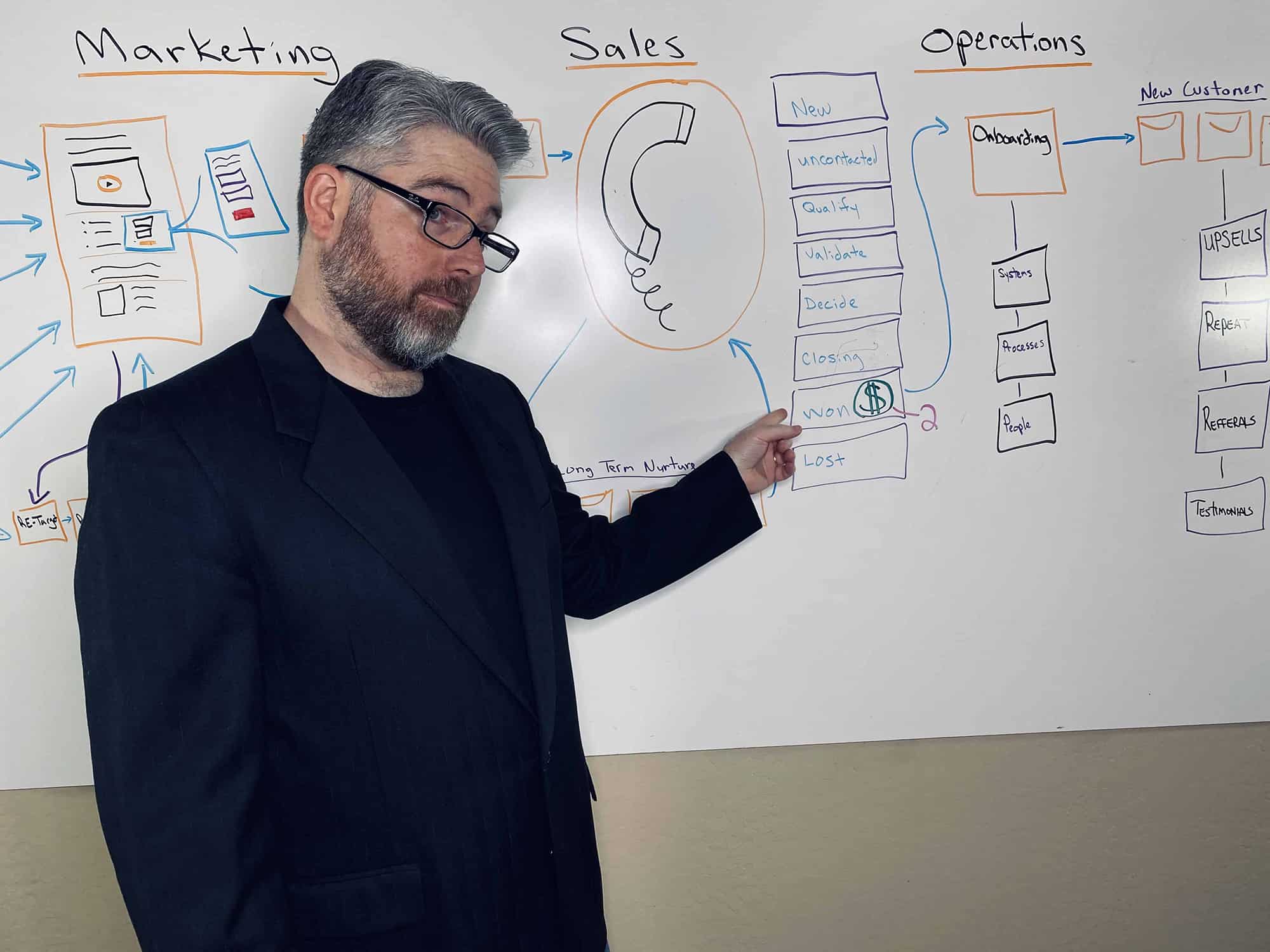
Your customer starts by finding you on Instagram. They click through to your website, browse around, maybe add something to their cart. The next day they get an email from you about a completely different product. They call your support team with a question and the rep has zero clue they were just on your website yesterday looking at Product X.
That’s not omnichannel marketing. That’s just being present on multiple channels while completely ignoring how they connect. And it’s costing you customers every single day.
Real omnichannel marketing means your customer’s experience feels seamless no matter how they interact with your business. When they switch from Instagram to your website to email to phone support, it should feel like one continuous conversation, not starting over from scratch each time.
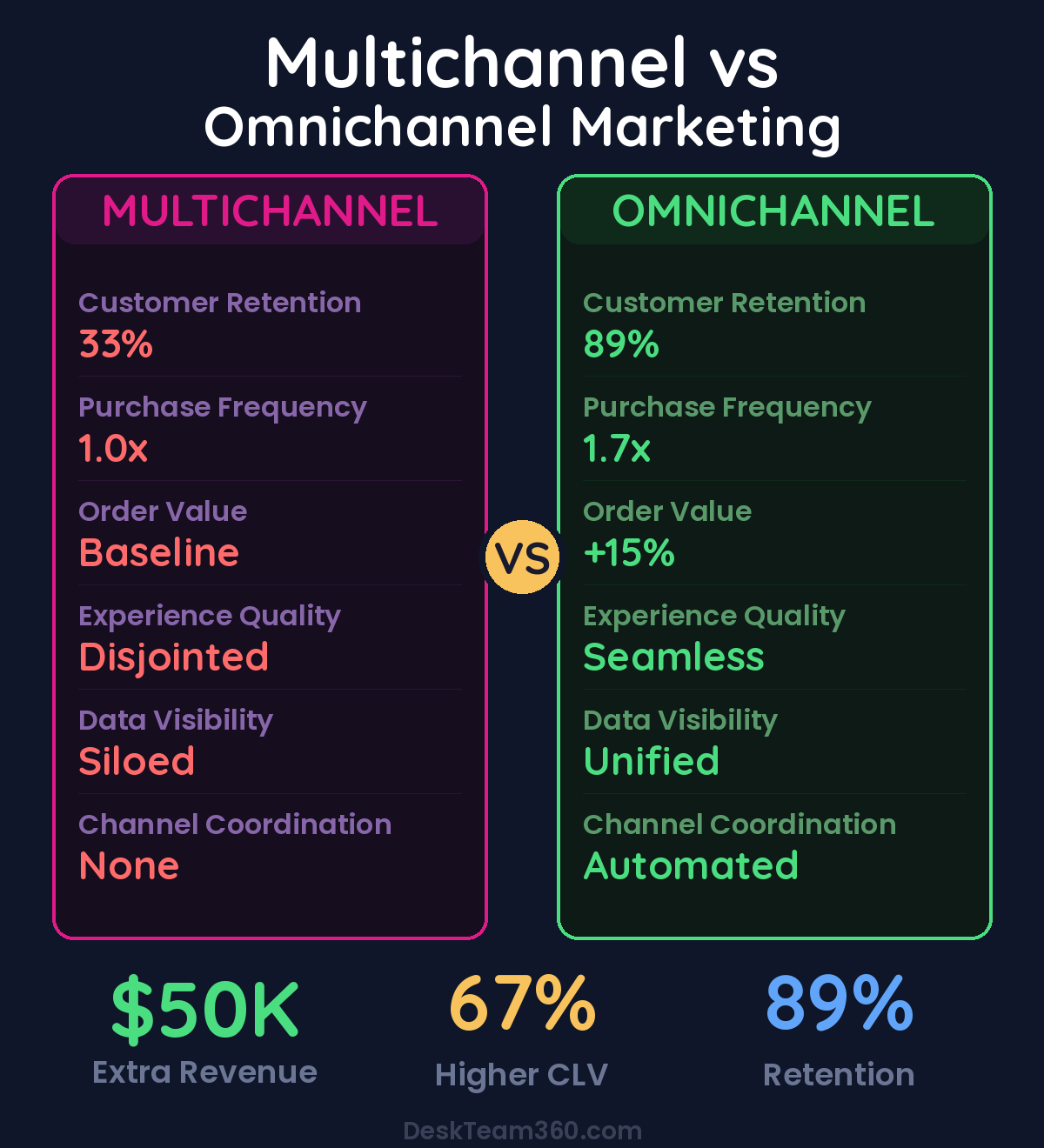
I’ve spent 12+ years helping businesses get this right, and the difference between companies that actually connect their channels versus those that just dump content everywhere is dramatic. The connected ones retain 89% of their customers compared to 33% for the disconnected ones. They see higher purchase rates, bigger order values, and customers who actually stick around.
Here’s exactly how to build a genuine omnichannel experience that drives results, not just checks boxes.
Multichannel vs Omnichannel: The $50K Difference
Most businesses think they’re doing omnichannel because they post on social media, send emails, and have a website. That’s multichannel. It’s better than nothing, but it’s not omnichannel.
Let me show you what I mean with a real scenario. A customer sees your product on Instagram, clicks through, browses your site, and adds something to cart but doesn’t buy. In a multichannel approach, they get your generic weekly newsletter the next day promoting something completely different. When they call with a question, your support rep asks them to spell their name and has no idea they’ve been engaging with your brand.
In an omnichannel approach, that same customer gets an email the next day specifically about the product they looked at, maybe with a small discount code. When they click the email, their cart is still there waiting for them. If they call with questions, your rep can see their browsing history, knows what they’re interested in, and can actually help them make a decision.
That’s the difference between treating each channel like an isolated island versus connecting them into one coherent experience. The second approach converts at double or triple the rate.
Free 5-Minute Video
See How DeskTeam360 Works in Under 5 Minutes
Watch the short video and see exactly how we handle design, development, and marketing implementation — so you don't have to.
Watch the Video →
Why Your Current Approach Probably Sucks
I see the same pattern over and over. Businesses launch on five different channels, create different content for each one, and wonder why nothing seems to work together. Here’s what’s actually happening behind the scenes.
Your email team doesn’t know what your social team is promoting. Your website shows one message while your ads show another. Your support team can’t see what marketing emails someone received. Every channel operates in its own bubble, and the customer experience feels disjointed and unprofessional.
The worst part? You’re spending more money to deliver a worse experience. You’re paying for email marketing, social media management, website updates, and advertising, but none of it builds on the others. It’s like hiring five salespeople who never talk to each other and keep pitching the same prospect different things.
The Four Pillars of Omnichannel That Actually Works
Every successful omnichannel implementation I’ve seen rests on four fundamental pillars. Miss one of them and the whole system underperforms.
Pillar 1: One Source of Customer Truth
Everything starts with unified customer data. You cannot deliver a connected experience if customer information lives in six different places that don’t talk to each other.
Your CRM should capture every interaction regardless of channel. Website visits, email opens, social media comments, support tickets, purchase history, phone calls. All of it in one place where anyone on your team can see the complete picture. This isn’t optional infrastructure, it’s the foundation that makes everything else possible.
Tools like HubSpot, ActiveCampaign, or Salesforce work well for this. The specific platform matters less than making sure it actually connects to everything else you use. If your email tool can’t sync with your CRM and your website analytics can’t feed customer data back to your CRM, you’re building on quicksand.
Pillar 2: Brand Consistency Across Everything
Your brand should look, feel, and sound identical everywhere customers encounter it. Same colors, same fonts, same voice, same core messaging. If you’re casual and friendly on Instagram but formal and corporate in your emails, you’re confusing people.
This goes deeper than just visual consistency. Your brand personality shouldn’t change based on the channel. If you take strong positions on social media, your emails shouldn’t hedge everything with corporate speak. If you use humor on your website, your support team should know they can be personable too.
Most businesses treat each channel like it needs its own personality. That’s backwards. One brand, adapted appropriately for each channel’s format and audience, but fundamentally consistent everywhere.
Pillar 3: Channel-Specific Optimization
Consistency doesn’t mean copy-paste. A product announcement should be adapted for each channel’s strengths while maintaining the core message.
On email, that might be a detailed launch message with product benefits, images, and a clear call-to-action. On Instagram, it’s a Reel showing the product in action plus a carousel with key features. On your website, it’s a dedicated landing page with full details and purchase options. Same core message, formatted for how people actually use each channel.
The companies that get this wrong either blast identical content everywhere (which performs poorly) or create completely different messages for each channel (which confuses customers).
Pillar 4: Seamless Cross-Channel Workflows
This is where omnichannel gets powerful. Customers should be able to start an interaction on one channel and continue it seamlessly on another.
Cart abandonment on your website triggers a personalized email. That email links back to their saved cart. If they call with questions, your support rep can see what they were looking at and pick up the conversation where the email left off. If they don’t convert after the call, they see retargeting ads for that specific product.
It’s one continuous experience across multiple touchpoints, not separate conversations that happen to be with the same company.
Building Your Omnichannel System: The Step-by-Step Playbook
Enough theory. Here’s exactly how to implement this, starting from where most businesses are today.
Step 1: Map Your Real Customer Journey
Before you can connect channels, you need to understand how customers actually move between them. Not how you think they should move, how they actually do.
Track your last 100 customers from first touchpoint to purchase. Where did they first hear about you? What channels did they use to research? Where did the actual purchase happen? What was the typical timeline? Where do people drop off or get stuck?
Most businesses discover their assumptions about customer behavior are completely wrong. You think people find you through Google ads and buy immediately. Reality: they find you through social media, research on your website, compare you to competitors on review sites, come back to your website three more times, and then buy two weeks later after getting an email reminder.
Understanding the real journey shows you where to focus your connection efforts for maximum impact.
Step 2: Pick Your Hub Platform
You need one central system where all customer data lives and connects. This is usually your CRM, but it could be an integrated email marketing platform like ActiveCampaign or a customer data platform.
The key requirements: it needs to capture interactions from all your channels, it needs to be accessible to everyone who interacts with customers, and it needs to trigger automated actions based on customer behavior.
Don’t overthink this choice. A decent CRM that’s properly implemented and actually used beats a perfect CRM that sits empty. HubSpot’s free tier works for most small businesses. ActiveCampaign is excellent for email-heavy businesses. Salesforce if you need enterprise features and have someone to manage it.
Step 3: Connect Your Most Important Channels First
Start with the two or three channels that matter most to your business. For most businesses, that’s website plus email, or website plus social media advertising.
Connect your website tracking to your email platform so you can send behavioral emails based on what people actually do on your site. Set up retargeting pixels so your ads reflect real browsing behavior instead of showing generic creative to everyone.
Get those connections working smoothly before adding complexity. Two channels connected well beats five channels connected poorly.
Step 4: Build One Cross-Channel Workflow
Pick one customer journey and make it seamless across channels. Cart abandonment is usually the best place to start because it has clear triggers and measurable outcomes.
Someone adds a product to cart but doesn’t buy. One hour later, they get an email reminder with their specific product. Twenty-four hours later, an SMS reminder if you have their phone number. Forty-eight hours later, they see retargeting ads for that exact product on social media. Same message, different channels, one coordinated sequence.
Track the results. How much additional revenue does the connected sequence generate compared to single-channel follow-up? That’s your omnichannel ROI in action.
Step 5: Scale to Additional Workflows
Once your abandoned cart sequence is working, add post-purchase follow-up. Then lead nurturing for people who download content but don’t buy immediately. Then re-engagement for customers who haven’t purchased in six months.
Build them one at a time, test each one, and make sure they’re actually driving results before adding the next one. The goal is profitable connected experiences, not complex automation for its own sake.
Understanding marketing automation for small businesses helps you implement these workflows without overcomplicating things.
The Technology Stack That Makes It Work
You don’t need enterprise software to do this effectively. Here’s the realistic tech stack for most growing businesses.
Your CRM handles customer data and basic automation. HubSpot, ActiveCampaign, or Zoho work well. Your email platform needs behavioral triggers and CRM integration. Most good CRMs include this, or you can use Mailchimp, ConvertKit, or Klaviyo if email is critical to your business.
Your website needs proper tracking setup. Google Analytics 4 with enhanced ecommerce, Facebook Pixel, and whatever other platform pixels you’re using for advertising. All feeding data back to your CRM.
Your social media management tool should integrate with your CRM for lead tracking. Hootsuite, Buffer, or Sprout Social all have CRM integrations available.
Your customer support platform needs access to the full customer record. Intercom, Zendesk, or Freshdesk all integrate with major CRMs.
Businesses with integrated tech stacks see 67% higher customer lifetime value compared to those using disconnected tools.
📋 Table of Contents
We break this down further in ai marketing tools: the complete guide for 2026.
For more on this, check out our guide on what is white label marketing? the complete guide for agencies.
For industry research and benchmarks, check out Think with Google.
The specific tools matter less than the connections between them. A mediocre tool that integrates well beats a great tool that operates in isolation.
Three Omnichannel Mistakes That Kill Results
I’ve watched dozens of companies blow their omnichannel implementations in predictable ways. Here’s how to avoid the most expensive mistakes.
**Trying to connect everything at once.** Start small. Website plus email. Get that working perfectly. Then add social media advertising. Then add SMS. Then add other channels. Companies that try to connect eight channels simultaneously end up with a mess that doesn’t work anywhere.
**Focusing on technology instead of customer experience.** The goal isn’t to use every integration available. The goal is to make your customers’ experience feel seamless and personal. Sometimes that means simpler technology, not more complex systems.
**Ignoring the data goldmine.** Your omnichannel system generates incredible insights about customer behavior, channel performance, and what actually drives purchases. The companies that actually analyze this data and optimize based on it improve 3x faster than those who set it up and forget it.
Measuring What Actually Matters
Track these metrics to understand if your omnichannel efforts are working. Customer retention rate should improve significantly. Omnichannel customers typically have 89% retention compared to 33% for single-channel customers. Customer lifetime value should increase as connected experiences drive more repeat purchases and higher average orders.
Cross-channel conversion rates show how effectively customers move between touchpoints toward purchase. If people who engage on multiple channels convert at the same rate as single-channel visitors, your connections aren’t working.
Attribution analysis reveals which channels actually contribute to conversions versus which ones get credit in last-click models. Multi-touch attribution shows the real customer journey and helps you invest in the channels that actually drive results.
Customer satisfaction scores should improve with better connected experiences. Support resolution times should decrease when agents have full customer context available.
Learning how to measure marketing ROI across multiple touchpoints is essential for optimizing your omnichannel investments.
Start Small, Scale Smart
Omnichannel marketing isn’t about being on every channel or using every possible integration. It’s about creating connected experiences that feel seamless to your customers and drive better business results for you.
Start with your most important channels. Connect them properly. Build one cross-channel workflow. Measure the results. Then expand from there based on what actually works, not what sounds impressive in marketing meetings.
The businesses that commit to this approach create customer experiences that feel personal and professional. Those experiences compound into higher retention, more repeat purchases, and customers who choose you over competitors even when the price is higher.
If you need help creating the consistent creative assets, content production, and technical implementation that keeps your channels connected and professional, we handle exactly this type of work at DeskTeam360. Our team manages the production requirements across every channel so your brand shows up consistently everywhere it matters.
Free Tool
How Much Is Freelancer Management Really Costing You?
Most agency owners have never done this math. Plug in a few numbers and see your real cost in 2 minutes.
Calculate Your Hidden Costs →