


Digital Marketing for Chiropractors: Strategies That Fill Your Practice
Digital marketing for chiropractors requires a focused strategy that actually drives results.
📋 Table of Contents
Why Most Chiropractors Are Marketing Like It’s 1995
It’s 2:30 AM and someone’s lower back just locked up so hard they can’t get out of bed. They grab their phone and search “emergency chiropractor near me.” The first three results? Generic websites with stock photos of smiling people doing yoga, zero reviews, and phone numbers that go to voicemail.
That person just became your competitor’s patient, not because their service is better, but because their marketing doesn’t suck.
I’ve worked with 400+ clients across every industry, and chiropractic practices face one of the most fascinating marketing challenges out there. You’re selling something that people either absolutely swear by or are deeply skeptical about. There’s almost no middle ground. Most chiropractors handle this by marketing like every other healthcare provider: boring “we care about your wellness” copy, stock photos of spines, and maybe a Facebook post when they remember.
That approach does nothing to overcome the fundamental trust barrier that exists between a potential patient who’s never been adjusted and a chiropractor they found on Google.
The practices that are crushing it right now? They’re doing something radically different. They’re educating before they’re selling. They’re showing actual results. They’re building relationships before the patient walks through the door. And they’re doing it consistently, not just when they feel like it.
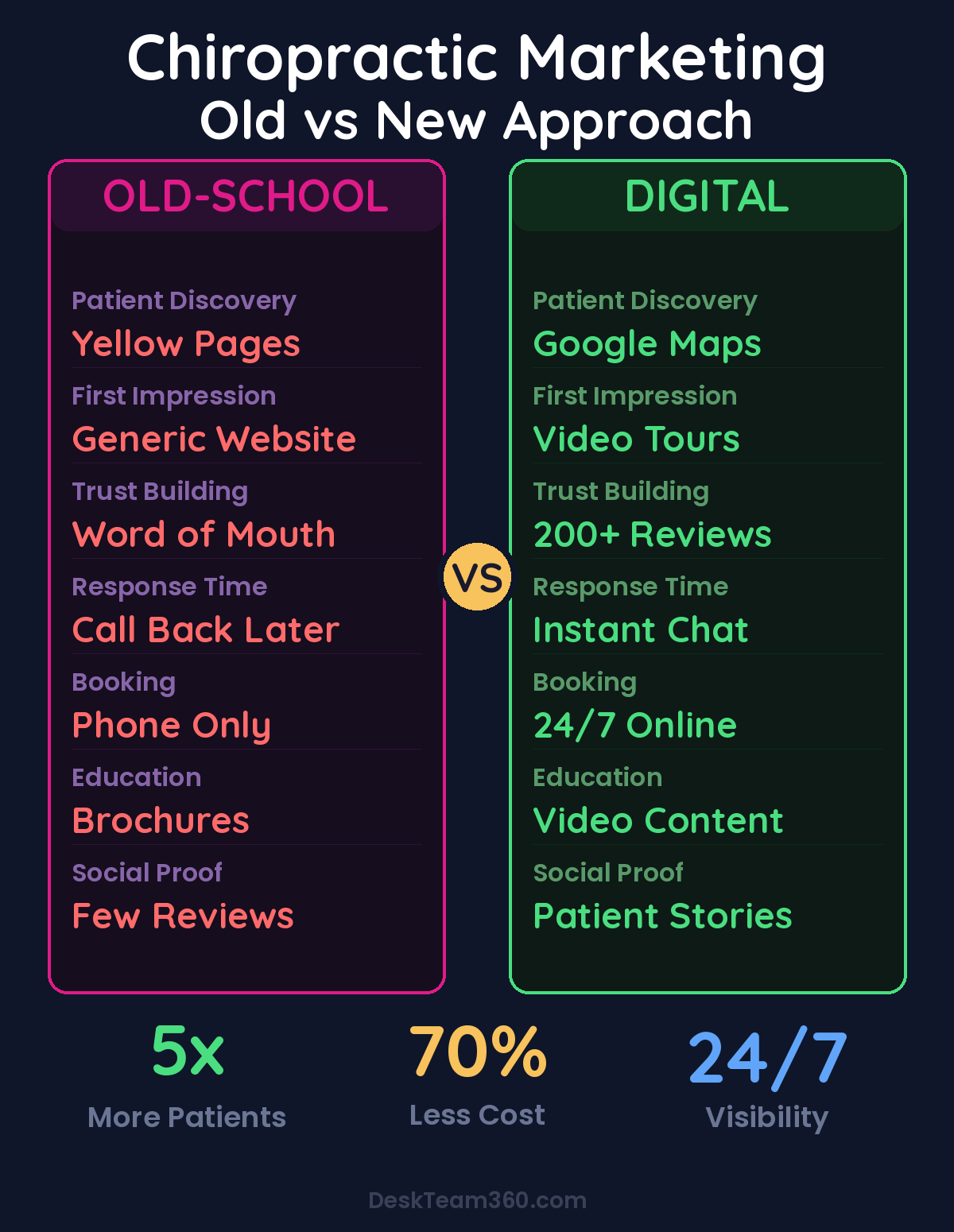
Here’s the exact playbook that works.
Local SEO Is Your Practice’s Lifeline
Before we talk about Instagram Reels or Facebook ads or any of that, we need to talk about local SEO. When someone searches “chiropractor near me” at 2 AM with a locked-up back, you need to show up first. Everything else is secondary.
Your Google Business Profile isn’t just another marketing channel. It’s the most important digital asset your practice has. It’s what shows up in the map pack, those three listings at the top of local search results that get 60% of the clicks. Miss the map pack, miss the patient.
Complete every single field in your profile. Business name exactly as it appears on your signage, no keyword stuffing nonsense. Primary category set to “Chiropractor” with secondary categories like “Sports Medicine Clinic” if you do that work. List every service you offer with descriptions that real people understand, not medical jargon. Keep your hours current because nothing kills trust faster than showing up to an office that’s supposed to be open but isn’t.
Add new photos every month. Your office, your team, your equipment, patient interactions with consent. Google rewards fresh content, and potential patients want to see what they’re walking into.
The Review Collection System That Actually Works
Most chiropractors ask for reviews wrong. They send generic follow-up emails two weeks later when the positive feeling has worn off. Here’s what works: ask at the moment of peak satisfaction. Right after a patient says “I feel so much better” or stands up from the table with visible relief, that’s your cue.
Make it stupidly easy. Create a direct link to your Google review page and send it via text message immediately. Not email, text. People check texts, they ignore emails. Follow up once if they don’t review within 48 hours. Once. Then stop. Nobody likes being pestered.
Respond to every review personally. Thank positive reviewers by name and naturally include keywords. “Thank you, Sarah! We’re glad the spinal adjustment helped with your lower back pain. We look forward to your next visit.” That’s natural, helpful, and gives Google more relevance signals to work with.
Address negative reviews professionally and take the conversation offline fast. “Hi John, I’m sorry your experience didn’t meet expectations. Please call our office at [number] so we can discuss this directly.” Don’t argue in public, ever.
Free Tool
How Much Is Freelancer Management Really Costing You?
Most agency owners have never done this math. Plug in a few numbers and see your real cost in 2 minutes.
Calculate Your Hidden Costs →
Educational Content Beats Marketing Copy Every Time
The biggest conversion barrier for chiropractors is skepticism. Many potential patients have never been to a chiropractor and don’t understand what you actually do. They’ve heard horror stories about chiropractors paralyzing people or they think chiropractic is pseudoscience. Educational content bridges that gap better than any marketing copy ever will.
Focus your content on questions potential patients are actually searching for. “Is chiropractic safe?” gets thousands of searches per month. Answer it directly and honestly. Don’t dance around the risks or pretend they don’t exist. Acknowledge concerns and explain what you do to minimize them.
“What does a chiropractor actually do?” is another massive search volume question. Most people think you just crack backs. Explain your full range of services in language a smart 12-year-old could understand. Skip the medical jargon.
“How many chiropractic sessions do I need?” Sets realistic expectations upfront, which builds trust and reduces no-shows. Most people expect instant permanent fixes. Explain why that’s not realistic without sounding like you’re trying to milk them for sessions.
Pro tip: Create comparison content like “Chiropractic vs Physical Therapy” where you’re honestly fair to both approaches. You’ll build more trust being objective than trying to trash the competition. Potential patients are smart enough to see through obvious bias.
Related: How to Get More Leads for Your Business: 15 Proven Strategies Ranked.
Video Content That Demystifies What You Do
Video is disproportionately effective for chiropractors because so much of what you do is visual and mysterious to outsiders. People want to see what an adjustment looks like before they commit to letting someone crack their spine.
Adjustment videos are wildly popular on social media. Those satisfying “crack” videos get millions of views, but more importantly, they demystify the process for nervous potential patients. Film short clips with patient consent, focus on the technique, not the drama.
Educational explainer videos perform consistently well. Use a skeleton model, whiteboard, or simple animations to explain common conditions and how chiropractic helps. These don’t need Hollywood production values. Smartphone quality works fine if the content is solid.
Patient testimonial videos are marketing gold. Real patients sharing their experience builds trust better than any copy you could write. Get written consent, keep them authentic, don’t script them.
Office tours remove the mystery of what walking into your practice looks like. Show your space, your equipment, your team. People want to know what they’re getting into, especially if they’re nervous about chiropractic care.
Social Media Strategy That Actually Builds Your Practice
Social media for chiropractors isn’t about going viral or building a massive following. It’s about building familiarity and trust with people in your local area. When someone in your city finally decides they need a chiropractor, you want to be the name they already know.
Your content should follow five pillars: educational posts with tips for posture and stretches, before-and-after content showing range-of-motion improvements, patient stories and testimonials, behind-the-scenes office life, and short adjustment videos that showcase your work.
Post 3-5 times per week minimum. Consistency matters more than frequency. Better to post three times a week reliably than seven times one week and zero the next. The algorithm rewards consistency.
Instagram Reels and Facebook Reels get significantly more reach than static posts right now. Adjustment videos, quick tips, and patient testimonial clips perform exceptionally well in short-form format. If you’re comfortable on camera, these can build awareness faster than any other content type.
TikTok is an unexpected goldmine for chiropractic content. Adjustment videos, educational content, and day-in-the-life clips regularly get hundreds of thousands to millions of views. The key is being authentic and educational, not gimmicky. TikTok’s audience detects fake immediately.
We break this down further in digital marketing for home services: the complete playbook.
Related reading: Digital Marketing for Gyms and Fitness Studios: The Complete Guide.
We covered this in detail in our post about ai marketing tools: the complete guide for 2026.
For industry benchmarks and research, see WordStream.
For industry research and benchmarks, check out Think with Google.
Social Proof That Actually Converts Skeptics
In healthcare marketing, social proof isn’t just helpful, it’s absolutely essential. Potential patients are trusting you with their physical wellbeing. They need to see that other people have had positive experiences, not just read generic “Dr. Smith is great!” reviews.
The best testimonials are specific, not generic. “I came to Dr. Johnson with chronic migraines that had plagued me for ten years. After six weeks of treatment, I went from four migraines a week to maybe one a month.” That’s a testimonial that converts because it’s specific about the problem, the timeline, and the outcome.
Get testimonials by asking patients about their specific condition, what they tried before coming to you, and exactly what changed. Record video testimonials even if it’s just smartphone quality. Authenticity matters more than production value.
Visual proof of results is incredibly persuasive. Posture comparison photos showing clear improvement, video clips demonstrating increased range of motion, X-ray comparisons with proper patient consent and HIPAA compliance. People believe what they can see.
Paid Ads That Actually Generate Appointments
When someone searches “chiropractor near me” or “back pain treatment [your city],” they’re actively looking for help. Google Ads puts you at the top of those results immediately, no waiting for SEO to kick in.
Target condition-specific keywords like “sciatica treatment [city]” and “neck pain chiropractor [city].” Use tight location targeting, usually 10-15 miles around your practice. Create dedicated landing pages for each ad group instead of sending all traffic to your homepage. Include click-to-call extensions because people with back pain want to call, not fill out forms.
Most importantly, track actual appointments, not just clicks. A 5% click-through rate means nothing if those clicks don’t turn into patients.
Facebook and Instagram ads work differently. They’re better for building awareness and nurturing interest than capturing immediate demand. Use them to promote educational content to cold audiences in your area, retarget website visitors with testimonials, and build email lists with lead magnets like free posture assessments.
Email Marketing for Patient Retention
Getting a new patient costs 5-10 times more than keeping an existing patient coming back. Email marketing is your best retention tool, but most practices use it wrong.
Send automated appointment reminders, obviously. But also send monthly wellness tips, seasonal health content like posture tips for desk workers or pre-sports season preparation, practice news and team introductions, and re-engagement campaigns for patients who haven’t visited in three months.
Keep it helpful, not salesy. The goal is staying top-of-mind as their go-to healthcare provider, not constantly pitching them.
Practices with consistent email marketing see 35% higher patient retention rates and 28% more repeat visits compared to those that only communicate at appointment time.
Website Elements That Actually Convert Visitors
Your website has one job: convert visitors into booked appointments. Most chiropractic websites fail because they’re built like brochures, not conversion machines.
Online booking is non-negotiable. If patients can’t book online 24/7, you’re losing appointments to competitors who make it easy. Your phone number should be clickable on mobile on every page. Service pages for each condition you treat, optimized for local SEO. An About page that makes it personal, not just credentials and education.
Display testimonials throughout the site, not buried on a separate page. Include new patient information about what to expect, forms to download, and insurance details. Remove friction at every step.
Most importantly, your website should load fast and work perfectly on mobile. Google prioritizes fast, mobile-friendly sites in search results, and frustrated visitors leave before booking.
Tracking What Actually Matters
Most practices track vanity metrics that don’t matter. Social media followers, website traffic, even Google Ad clicks. What matters is new patients and revenue. Track new patient appointments monthly, source of new patients to see what’s working, Google Business Profile views and actions, review count and rating growth, cost per new patient, and patient lifetime value.
Everything else is noise. Focus on metrics that directly correlate with practice growth, not metrics that make you feel good.
Why Most Practices Should Outsource Their Marketing
You became a chiropractor to help people, not to spend evenings creating Instagram posts and tweaking Google Ads. The most successful practices I’ve worked with focus on what only they can do patient care, video content featuring themselves, building relationships and outsource everything else.
If you need help with our FAQ page creation process, understanding marketing ROI measurement, or learning about outsourcing social media design, those resources can give you a solid foundation. For practices looking to improve their web presence, our guide on reducing website bounce rates and improving conversion rates covers the technical details that drive results.
The marketing that grows chiropractic practices isn’t complicated, but it requires consistency and expertise. Focus on your patients. Let professionals handle the rest.
Free 5-Minute Video
See How DeskTeam360 Works in Under 5 Minutes
Watch the short video and see exactly how we handle design, development, and marketing implementation — so you don't have to.
Watch the Video →