

What Is Programmatic Advertising? A Plain-English Guide for Business Owners
Stop Wasting Money on Ads That Don’t Work
Let’s talk about what is programmatic advertising. You spend $5,000 on Google Ads last month. Your “marketing expert” promised “amazing results.” You got 47 clicks and zero customers. Sound familiar?
📋 Table of Contents
Here’s what probably happened: your ads showed up for random searches, at random times, to random people who had zero interest in what you’re selling. Your budget got burned through faster than a campfire, and you’re left wondering if online advertising even works.
It does work, but not the way most businesses think. The problem isn’t that advertising is broken. The problem is you’re still doing advertising like it’s 1995, when the only options were putting an ad in the Yellow Pages and hoping for the best.
Programmatic advertising changes everything. Instead of spraying ads everywhere and hoping something sticks, it uses data and automation to put your message in front of exactly the right person, at exactly the right moment, for exactly the right price. I’ve helped 400+ clients implement this, and when it’s done right, the results aren’t subtle.
What Programmatic Advertising Actually Means
Let me cut through the jargon. Programmatic advertising is automated ad buying. Instead of a human calling up websites and negotiating ad placements manually (the old way), software handles the entire process in milliseconds.
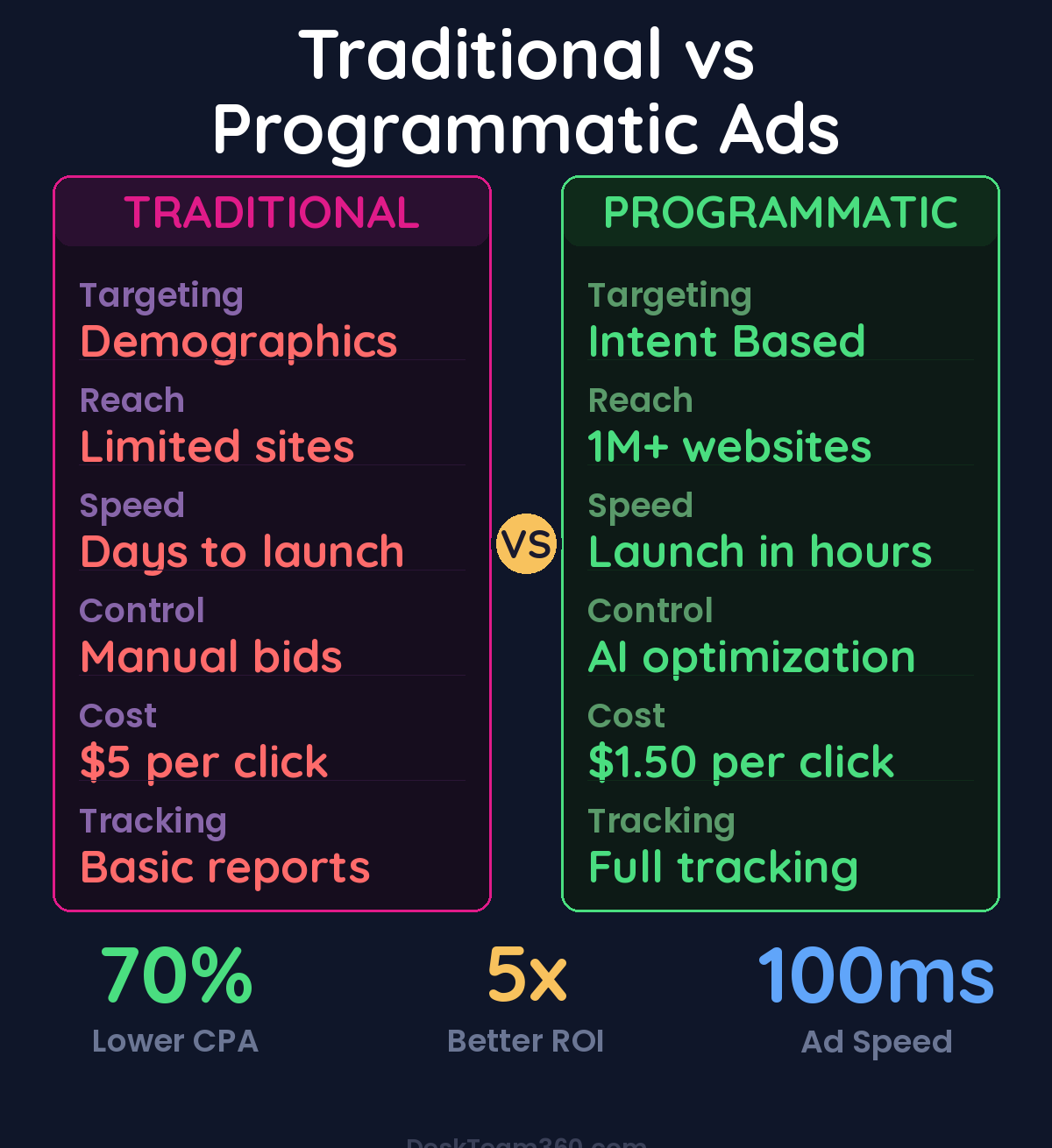
Here’s what happens: someone visits a website, that website has ad space available, an auction happens instantly where hundreds of advertisers compete for that space, the highest bidder wins and their ad appears, and the person sees your ad. This entire process takes less than 100 milliseconds, which is faster than a human can blink.
The magic isn’t the speed, though. The magic is the targeting. Traditional advertising is like throwing darts blindfolded. Programmatic advertising is like having a computer analyze every person walking by, identify the ones most likely to buy your product, and only show them your ad when they’re in the mood to make a purchase.
Free Tool
How Much Is Freelancer Management Really Costing You?
Most agency owners have never done this math. Plug in a few numbers and see your real cost in 2 minutes.
Calculate Your Hidden Costs →
The Three Types of Programmatic (And Which One You Actually Need)
Not all programmatic advertising is created equal. There are three main types, and picking the wrong one is how businesses waste money.
Real-Time Bidding (RTB)
This is the auction system I just described. Every time someone loads a webpage, an instant auction happens for that ad space. It’s fast, it’s efficient, and it’s what most people mean when they say “programmatic advertising.”
RTB works best when you want maximum reach at the lowest cost. The downside is you’re competing with everyone else in open auctions, so premium placements get expensive fast.
Private Marketplace (PMP)
This is like RTB but with a VIP section. You get invited to bid on premium ad inventory before it goes to the open auction. Think of it as first-class seating, you pay more but you get better placement and higher-quality websites.
PMPs make sense when brand safety matters (you don’t want your insurance company’s ad appearing next to questionable content) and when you need guaranteed access to specific websites your customers frequent.
Programmatic Direct
This is like traditional advertising but automated. You negotiate directly with specific websites for guaranteed ad placements. No auction, no competition, just a straight purchase.
Use this when you’ve identified specific websites where your customers spend time and you want to guarantee your ad appears there. It’s the most expensive option but gives you complete control.
Pro tip: Start with RTB for the first 90 days. Learn what websites and audiences work best for your business. Then graduate to PMPs and programmatic direct for your highest-performing placements. This approach maximizes learning while minimizing cost.
Why Your Current Ad Strategy Is Probably Backward
Most business owners approach advertising like this: pick a platform (Google, Facebook, LinkedIn), create some ads, set a budget, and hope for the best. It’s platform-first thinking, and it’s exactly backward.
Programmatic flips this around. You start with your ideal customer, figure out where they spend time online, and then buy ad space across all those locations through one system. Instead of managing five different ad accounts on five different platforms, you manage one campaign that reaches your customers everywhere they go.
Here’s a real example from one of our clients. They’re a B2B software company selling project management tools. Instead of just running LinkedIn ads (the obvious choice), we identified that their prospects also read industry blogs, visit software review sites, and check tech news websites. Through programmatic, we put their ads on all these properties through a single campaign. Results: 340% increase in qualified leads, 60% lower cost per acquisition.
The Data That Makes Programmatic Work
The reason programmatic advertising is so effective isn’t the automation, it’s the data. When you buy an ad in a magazine, you know basically nothing about who reads it beyond general demographics. When you buy programmatic ads, you know everything.
Here’s what’s available: demographic data (age, income, location, job title), behavioral data (what websites they visit, what they search for, what they buy), intent data (are they actively researching your type of product right now), and contextual data (what’s the content of the page where your ad will appear).
You can layer these targeting options together. Want to reach 35-45 year old executives in the healthcare industry who visited your website in the last 30 days but didn’t request a demo? Easy. Want to reach people who are actively researching your competitors? No problem. Want to reach your existing customers with upsell offers while excluding everyone else? Done.
This level of precision is why programmatic works. Instead of showing your ad to 1,000 random people hoping 10 might be interested, you show it to 100 people who are practically guaranteed to be interested. Better results, lower costs, happier customers.
Setting Up Your First Programmatic Campaign
Enough theory. Here’s how to actually get started.
Step 1: Define Your Ideal Customer Profile
You can’t target what you can’t define. Write down exactly who you’re trying to reach. Not “business owners” or “marketing professionals.” Be specific. “Marketing directors at SaaS companies with 50-200 employees who are currently using HubSpot but exploring alternatives.”
The more specific you are, the better programmatic targeting works. Generic targeting gets generic results.
Step 2: Choose Your Demand-Side Platform (DSP)
This is the software that actually buys your ads. You have four real options worth considering right now.
Google Display & Video 360 gives you access to the largest inventory and the best Google integration, but it’s complex and expensive (minimum $30K/month budget). Amazon DSP has unique access to Amazon’s shopping data and works great for e-commerce, starting around $10K/month. The Trade Desk is the gold standard for flexibility and transparency but requires serious technical knowledge to use well. For smaller businesses, Adobe Advertising Cloud or working with a programmatic agency is usually the practical choice.
Watch out: Don’t try to run programmatic yourself unless you have dedicated marketing staff. The platforms are powerful but complex. Most small-to-medium businesses get better results working with an agency that specializes in programmatic, at least for the first six months.
Step 3: Create Your Creative Assets
Programmatic advertising requires multiple ad sizes and formats. You’ll need display banners (300×250, 728×90, 160×600), native ad formats that blend with website content, and video ads for YouTube and other video inventory.
Here’s where most businesses go wrong: they create one ad and resize it for all formats. Bad move. Each format requires different messaging and design. A 300×250 banner has completely different constraints than a native ad that appears in a news feed.
Step 4: Set Up Your Tracking and Attribution
Before you spend a dollar, make sure you can track where your customers come from. Install conversion pixels on your website, set up goals in Google Analytics, and connect your CRM to track leads all the way to closed deals.
Programmatic campaigns generate a lot of data, but data without proper attribution is useless. You need to know which placements, audiences, and creatives drive actual business results, not just clicks.
Budgeting: How Much Should You Spend?
The honest answer is it depends on your industry and goals, but here’s what I tell clients: start with $5,000-10,000 per month minimum for 60 days. Less than that and you won’t gather enough data to optimize effectively. More than that on your first campaign and you risk burning budget while you’re still learning.
Break down your budget like this: 70% on audience testing (try 5-8 different audience segments), 20% on creative testing (different messages and formats), and 10% held back for scaling what works.
Businesses that follow the 70/20/10 budget split see 85% better performance in their first 90 days compared to those that spread their budget evenly across everything.
After 60 days, you’ll know what works and you can scale accordingly. The most successful campaigns often start small but then scale to 5-10x the original budget once the winning formula is identified. If you’re serious about understanding your return on investment, our guide on measuring marketing ROI will help you track everything properly.
Common Mistakes That Kill Programmatic Campaigns
I’ve seen businesses blow through massive programmatic budgets and conclude that “programmatic doesn’t work.” It’s almost never a problem with programmatic itself, it’s a problem with how they set it up.
Targeting too broadly. “Everyone who might buy our product” isn’t a target audience, it’s a prayer. The power of programmatic is precision. Use it.
Ignoring frequency capping. Showing the same person your ad 47 times in a day doesn’t make them 47 times more likely to buy, it makes them annoyed. Set frequency caps (3-5 impressions per person per day maximum).
Not testing ad creative. The best targeting in the world can’t save terrible ads. Create multiple versions of your creative and let the data tell you what resonates.
Optimizing for the wrong metrics. Clicks and impressions don’t pay your bills. Optimize for actual business outcomes: leads, sales, revenue. Everything else is vanity metrics.
Privacy Changes and What They Mean for Programmatic
You can’t talk about programmatic advertising in 2026 without addressing the elephant in the room: third-party cookies are disappearing, Apple’s iOS changes have limited tracking, and privacy regulations are getting stricter every year.
Does this kill programmatic advertising? Not even close. It just changes how it works.
First-party data is now king. The businesses winning at programmatic are the ones with strong customer data: email lists, website behavior tracking, CRM integration, and customer surveys. Instead of relying on third-party data brokers, they use their own customer insights for targeting.
Contextual targeting is making a comeback. Instead of targeting people based on their browsing history, you target them based on the content they’re reading right now. Someone reading an article about “best project management software” is a great target for project management tools, regardless of their tracking history.
The technical details matter less than the strategy. Focus on building direct relationships with your customers and creating content that attracts your ideal audience. The targeting technology will adapt to whatever privacy changes come next, but good customer relationships never go out of style.
When Programmatic Makes Sense (And When It Doesn’t)
Programmatic advertising isn’t right for every business. Here’s when it works and when it doesn’t.
Programmatic works when: you have a clear definition of your ideal customer, you’re selling something with a purchase price above $100 (the targeting precision justifies the cost), you have the budget for meaningful testing ($5K+ per month), and you need to reach customers across multiple websites and platforms.
Programmatic doesn’t work when: you’re selling low-priced impulse purchases (the targeting overhead costs more than the profit margin), your target audience is extremely small (under 10,000 people total), you’re in a highly regulated industry with limited advertising options, or you’re not ready to commit to 60+ days of testing and optimization.
Pro tip: If you’re unsure whether programmatic makes sense for your business, start with a small test campaign focused on retargeting website visitors. It’s lower risk, easier to measure, and gives you a feel for how programmatic works without committing to large audiences or budgets.
For industry research and benchmarks, check out Moz SEO Learning Center.
Measuring Success: The Metrics That Actually Matter
Programmatic platforms will overwhelm you with metrics. Most of them don’t matter for business results. Focus on these five.
Cost per acquisition (CPA): How much does it cost to get one customer? This is your north star metric. Everything else is secondary.
Return on ad spend (ROAS): For every dollar you spend on ads, how many dollars in revenue do you get back? Aim for 3:1 minimum, 5:1 or higher is excellent.
Conversion rate by audience segment: Which targeting segments turn into customers at the highest rate? Double down on these and eliminate the weak performers.
Brand lift: Are people more likely to search for your brand name after seeing your programmatic ads? Use branded search volume as a proxy for awareness.
Customer lifetime value attribution: Don’t just measure first purchase. If programmatic brings in customers who stick around and buy more over time, the true value is much higher than initial ROAS suggests.
Track everything through your CRM so you can see the complete customer journey from first ad impression to final purchase. Our experience helping clients with growing their businesses shows that the companies with the best data win consistently.
The Future of Programmatic Advertising
Programmatic is evolving fast, and the next wave of changes will make current capabilities look primitive.
AI optimization is getting scary good. Instead of manually setting bids and targeting, AI analyzes thousands of variables in real-time and adjusts everything automatically. Early tests show 40-60% improvement in campaign performance when AI handles the optimization.
Cross-device tracking is improving despite privacy restrictions. Businesses will be able to reach customers consistently whether they’re on their phone, laptop, or smart TV, creating truly omnichannel experiences.
Creative optimization is becoming automated. AI will generate and test hundreds of ad variations automatically, finding the perfect combination of headline, image, and call-to-action for each audience segment.
But here’s what won’t change: the need for clear strategy, good customer data, and compelling offers. Technology makes everything faster and more efficient, but it can’t fix fundamental business problems like unclear value propositions or poor product-market fit.
Getting Started With Programmatic Today
Programmatic advertising isn’t a magic bullet, but it’s the closest thing to magic you’ll find in digital marketing. When it’s set up correctly, it finds your ideal customers wherever they are online and puts your message in front of them at exactly the right moment.
The businesses that succeed with programmatic share three things: they start with clear customer definitions, they commit to proper testing periods, and they focus on business outcomes rather than marketing metrics.
At DeskTeam360, we’ve implemented programmatic campaigns for clients across industries, from SaaS startups to Fortune 500 companies. We handle everything from strategy and setup to ongoing optimization, so you can focus on running your business while we focus on bringing you qualified customers.
Understanding how to integrate programmatic advertising with your overall lead generation strategy can multiply your results. Our guide on lead generation strategies shows how programmatic fits into a complete customer acquisition system.
The technology is ready. Your competitors are already using it. The question isn’t whether programmatic advertising will transform your marketing results. The question is how long you’ll wait to get started.
Free 5-Minute Video
See How DeskTeam360 Works in Under 5 Minutes
Watch the short video and see exactly how we handle design, development, and marketing implementation — so you don't have to.
Watch the Video →