


How to Build a Personal Brand as a Consultant
Why Most Consultants Are Invisible (And Why That’s Killing Your Revenue)
Nailing your personal brand consultant sets the tone for everything else in your business. I searched LinkedIn yesterday for “business consultant.” 47,000 results. Same headshot formula. Same “helping businesses grow” headline. Same generic company description with zero personality.
📋 Table of Contents
Then I looked at their websites. Professional but forgettable. Clean but sterile. Credible but completely interchangeable with every other consultant in their space.
Here’s what those consultants don’t realize: being invisible is expensive. When you look like everyone else, you compete on price. When you compete on price, you lose to whoever’s willing to work for less. When you lose on price, you end up grinding harder for smaller margins until you burn out or give up.
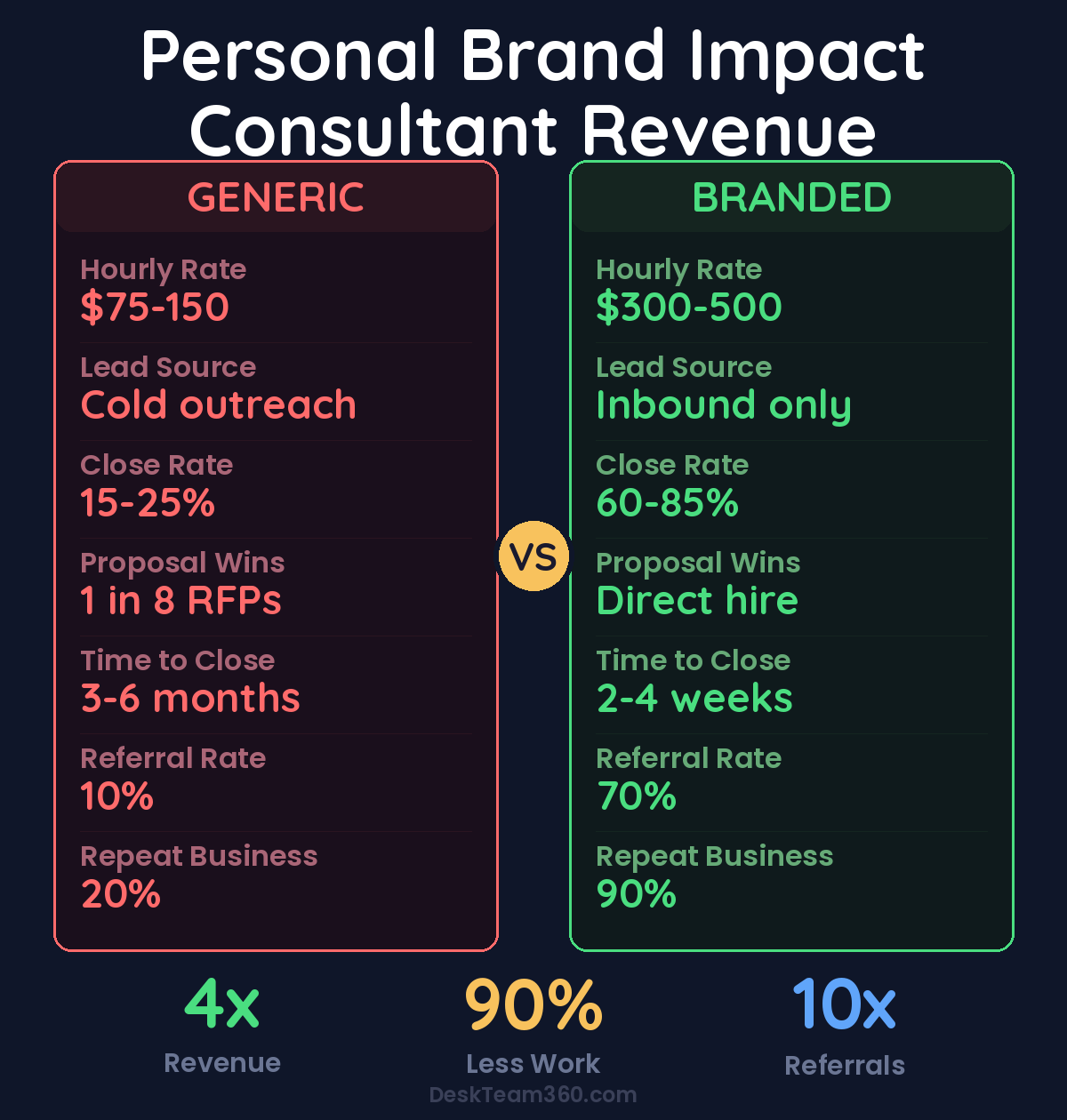
I’ve been running agencies and consulting operations for over 12 years, working with 400+ clients. The consultants who make serious money, the ones charging $300-500 per hour while their competitors scrape by at $75, all have one thing in common. They’re not better consultants. They have better personal brands.
Building a personal brand as a consultant is the difference between hunting for clients and having them come to you. Between explaining your value and having people already know it. Between charging what you’re worth and taking what you can get.
What a Personal Brand Actually Does for Your Consulting Business
Let me paint a picture of what changes when you have a strong personal brand versus when you don’t.
Without a personal brand: You respond to RFPs where you’re competing against 12 other consultants. The client picks based on the lowest price. You spend 40% of your time prospecting and chasing leads. Most prospects have never heard of you before they need your services. You have to prove your credibility from scratch every single time.
With a personal brand: Clients reach out to you directly because they’ve been following your content for months. They already trust your expertise before the sales call. You’re the only consultant they’re considering because you’ve positioned yourself as the expert in their specific problem. You can charge premium rates because they see the value before you even quote a price.
That’s not theory. That’s exactly how it works in practice. When someone searches for “supply chain optimization consultant” and your name comes up in three articles and a podcast interview they find, you’re not just another vendor. You’re the expert they’ve been looking for.
Free 5-Minute Video
See How DeskTeam360 Works in Under 5 Minutes
Watch the short video and see exactly how we handle design, development, and marketing implementation — so you don't have to.
Watch the Video →
The Five Building Blocks of a Consultant’s Personal Brand
Block 1: Your Unique Point of View
Every successful consultant has strong opinions about how their industry does things wrong. Not generic advice everyone already knows, but specific, contrarian takes based on real experience.
When I work with consultants on positioning, I ask them three questions. What does everyone in your industry believe that you think is wrong? What approach do you take that’s completely different from your competitors? What do clients consistently get wrong before they work with you?
Those answers become your positioning foundation. They’re what make people say “You need to talk to Sarah about operations strategy, she has this interesting framework that’s completely different from what everyone else does.”
Pro tip: Name your methodology. “The Culture-First Digital Transformation” or “The Revenue-Before-Scale Growth Model.” When clients can repeat and remember your approach, they can refer it to others.
Your point of view isn’t just what you think, it’s how you think differently. That difference is what justifies premium pricing. Clients don’t pay $15,000 for generic best practices they can find on Google. They pay for unique insights and proven frameworks they can’t get anywhere else.
Block 2: Consistent Content That Demonstrates Expertise
Content is how you scale your expertise beyond one-on-one conversations. One consulting engagement proves your value to one client. One viral LinkedIn post proves it to 50,000 people.
The best consultant content shows your thinking process, not just your conclusions. Don’t just say “companies should focus on culture before technology.” Show how you diagnosed a culture problem at a real client, what the symptoms were, how you fixed it, and what the results were.
I see consultants make the same content mistake repeatedly. They share generic business advice instead of their specific methodology. “Five ways to improve customer retention” could be written by anyone. “How I helped a SaaS company reduce churn by 34% using my three-phase retention framework” could only be written by you.
Start with LinkedIn posts three times per week. Mix quick insights with longer case study breakdowns. The goal isn’t to go viral, it’s to consistently demonstrate expertise to the specific audience who might hire you. Quality beats frequency every time.
Block 3: Professional Visual Consistency
This is where most consultants completely blow it. Great content with amateur visuals undermines everything you’re trying to build. If your LinkedIn posts use random stock photos, your website looks like a free template, and your proposals are basic Word documents, you’re telling clients you don’t pay attention to details.
Visual consistency means someone should recognize your brand whether they see your LinkedIn post, visit your website, or receive your proposal. Same colors, same fonts, same overall aesthetic. It signals competence subconsciously.
Invest in professional brand photography. Not headshots, but brand photography that shows you working, presenting, and consulting. Use those images across everything. Develop branded templates for your presentations, reports, and social media graphics. Make sure your website looks as premium as your hourly rate.
Visual quality signals operational quality. Clients assume that how you handle your brand is how you’ll handle their project. Sloppy branding suggests sloppy work.
Block 4: Strategic Visibility in the Right Places
Creating content is half the battle. Getting it in front of decision-makers is the other half. You need to be visible where your ideal clients spend time, and that’s almost certainly LinkedIn.
LinkedIn is the only social platform where business decision-makers actively engage with content about work. They’re not there to be entertained, they’re there to learn and network. That makes it perfect for consultant positioning.
Post consistently, but more importantly, engage consistently. Comment thoughtfully on your ideal clients’ posts. Share insights on industry discussions. Send personalized connection requests to people who could hire you or refer you business.
Beyond LinkedIn, look for speaking opportunities. Start local with chambers of commerce and industry meetups. Work your way up to conference speaking. Each presentation puts you in front of a room full of potential clients who get to see your expertise firsthand.
Podcast guesting is incredibly effective for consultants. Industry-specific podcasts have exactly the audience you want to reach. One good podcast appearance can generate more qualified leads than months of cold outreach.
Block 5: A Website That Converts Interest Into Business
Everything you build ultimately drives people to your website. That’s where interest converts to inquiries, and inquiries convert to clients. Your website has to look as professional as your consulting fees.
The biggest mistake I see consultant websites make is being too generic. “I help businesses improve operations” tells me nothing. “I help manufacturing companies with 50-500 employees reduce operational costs by 15-30% in 90 days” tells me exactly who you serve and what outcome to expect.
Your website needs detailed case studies with specific results. Not “improved efficiency,” but “reduced production downtime from 8% to 2.1%, saving $380,000 annually.” Numbers make your expertise tangible.
Related reading: 10 Best Unlimited Graphic Design Services for 2026 (Honest Rankings).
Include a clear pricing framework. Not exact prices, but ranges or project minimums. “Projects typically range from $25,000-75,000” filters out prospects who can’t afford you while attracting those who can. If you’re charging premium rates, act like it.
The Personal Brand Building Timeline (What to Expect)
Building a personal brand isn’t a sprint, it’s a systematic process that compounds over time. Here’s what a realistic timeline looks like.
Months 1-3: Foundation Setting
Define your unique positioning and methodology. Get professional brand photography done. Create your visual brand guidelines. Rebuild your website with specific positioning and detailed case studies. Optimize your LinkedIn profile completely. Start posting consistently on LinkedIn.
This phase feels slow because you’re not seeing results yet, you’re building the foundation for results. Don’t skip the groundwork to jump straight to content creation. A strong foundation makes everything else work better.
Months 4-8: Content Engine Running
By month four, you should be posting on LinkedIn five times per week and seeing engagement from your target audience. Start a weekly newsletter if your audience is large enough. Apply to speak at local events and industry meetups. Begin systematic podcast outreach.
This is when you’ll start noticing people recognizing your name. Prospects will mention they’ve seen your content. Referral partners will start connecting your name with your area of expertise. The visibility is starting to work.
Months 9-12: Authority Building
Submit speaking proposals to major industry conferences. Create premium content like white papers or research reports. Guest write for industry publications. Build relationships with other consultants and thought leaders. Track which content drives the most qualified inquiries.
By the end of year one, you should be getting regular inbound inquiries from qualified prospects. Not necessarily enough to fill your capacity, but enough to prove the system is working.
Consultants with strong personal brands charge 2-3x higher rates than those competing on credentials alone.
Year Two and Beyond: Market Leadership
Consider writing a book. Even a short book, 100-150 pages, positions you as an authority. Develop a signature keynote presentation. Create digital products or courses based on your methodology. Mentor junior consultants in your space.
Year two is when your personal brand really starts paying dividends. Speaking fees, higher consulting rates, strategic partnerships, and media opportunities all become available when you’re recognized as a thought leader.
The Mistakes That Kill Consultant Personal Brands
I’ve watched hundreds of consultants try to build personal brands. The ones who fail make predictable mistakes.
Trying to appeal to everyone. “I help businesses succeed” helps nobody and attracts nobody. The more specific your positioning, the more magnetic it becomes to the right people. “I help private equity firms improve operational efficiency in their manufacturing portfolio companies” is a hundred times more powerful than generic business consulting.
Inconsistent presence. Posting ten times in one week then disappearing for a month kills momentum. Your audience forgets about you. Consistency beats intensity every time. Three posts per week for a year beats twenty posts one month and zero the next eleven.
For industry research and benchmarks, check out 99designs Blog.
For industry benchmarks and research, see Smashing Magazine Design.
All strategy, no personality. People hire consultants, not consulting companies. Show your personality. Share stories. Have opinions. The consultants who try to sound like management consulting reports are immediately forgettable. The ones who sound like smart, opinionated humans are memorable.
Watch out: Don’t get so focused on looking professional that you become boring. Competent but boring doesn’t differentiate you from every other consultant with an MBA and a LinkedIn profile.
Not tracking what works. Pay attention to which content gets the most engagement from your target audience. Which topics generate the most inquiries. Which channels drive the highest quality leads. Double down on what works, eliminate what doesn’t.
Building Your Brand Without Doing Everything Yourself
Here’s the reality about personal branding: it requires a lot of production work that isn’t personal at all. The strategy, content ideas, and thought leadership, that’s all you. But the graphic design, website updates, presentation templates, and marketing asset creation? That’s production work you should delegate.
Focus your time on the high-value activities that only you can do. Creating content that demonstrates your expertise. Building relationships with prospects and referral partners. Serving clients at such a high level that they become case studies and testimonials. That’s how you build authority and generate revenue.
Delegate everything else. Social media graphics, website design and maintenance, presentation design, lead magnet creation, email template design. The consultants who try to do it all themselves either burn out or end up with amateur-looking materials that undermine their positioning.
When your content strategy is sound but your visual execution looks homemade, you’re leaving money on the table. Prospects judge your competence partly based on how professional your materials look. Fair or not, that’s reality.
At DeskTeam360, we work with consultants who want their personal brand to look as premium as their expertise. We handle the design and production work, from presentation design to social media graphics to website optimization, so they can focus on thought leadership and client delivery.
That’s exactly what our task delegation framework is designed for. You focus on strategy and relationships, we handle execution and production.
Your Next Steps
Stop being one of 47,000 invisible consultants on LinkedIn. Build a personal brand that positions you as the go-to expert in your space, attracts qualified inbound leads, and justifies premium pricing.
Start with your positioning. What’s your unique point of view? What methodology or framework can you name and own? How are you fundamentally different from every other consultant in your space?
Then start creating content that demonstrates that expertise consistently. Not generic business advice, but specific insights and case studies that only you could share.
If you need help with the production side, the graphic design and website optimization and marketing materials that make your personal brand look as premium as your consulting expertise, our team can handle that while you focus on what you do best.
The consultants making serious money aren’t necessarily better at consulting. They’re better at personal branding. Build yours, and watch your business transform.
Free Tool
How Much Is Freelancer Management Really Costing You?
Most agency owners have never done this math. Plug in a few numbers and see your real cost in 2 minutes.
Calculate Your Hidden Costs →