

How to Build a Personal Brand Online: The Founder's Playbook
Why Personal Branding Is the Most Underrated Business Strategy
Figuring out how to build a personal brand online doesn’t have to be complicated. Here’s something I’ve learned over 12+ years of building businesses: companies come and go, but your personal brand compounds forever.
📋 Table of Contents
I’ve watched founders pour everything into their company brand while neglecting their own. Then when they pivot, sell, or start something new, they’re back to zero. Meanwhile, the founders who invested in building a personal brand alongside their business? They carried their audience, their credibility, and their deal flow with them into every new venture.
Personal branding isn’t vanity. It’s insurance. It’s your reputation made visible and searchable. And in 2025, if you’re a founder, consultant, freelancer, or thought leader and you don’t have a deliberate personal brand online, you’re invisible to opportunities that should be coming to you.
At DeskTeam360, we’ve helped 400+ clients build their brands, both corporate and personal. The difference in business outcomes between those with strong personal brands versus those without isn’t subtle. It’s dramatic. Let me show you exactly how to build a personal brand that opens doors, generates leads, and positions you as the go-to authority in your space.
What Personal Branding Actually Means
Let’s clear up some confusion right away. Personal branding is not being famous on Instagram, posting selfies with motivational quotes, becoming an “influencer”, or manufacturing some fake persona that’s nothing like your real personality.
Personal branding is the deliberate practice of defining and communicating what you’re known for, who you help, and why you’re credible. Then consistently reinforcing that message across every touchpoint where people encounter you. It’s the answer to the question: “When someone Googles your name, what do they find?”
I see this confusion constantly. People think personal branding means becoming some polished, fake version of themselves. Wrong. The best personal brands are just amplified versions of who you already are, positioned clearly for the right audience.
Free Template
The Ultimate Task Delegation Template
Stop guessing what to hand off. This template shows you exactly what to delegate, how to brief it, and how to QA the results.
Get the Free Template →
The Three Pillars of a Strong Personal Brand
Every effective personal brand is built on three pillars. Get all three right, and you become magnetic to opportunities. Miss one, and the whole thing falls apart. I’ve seen talented people with deep expertise get ignored while less qualified competitors win deals, speaking gigs, and media attention. The difference? They understood these three pillars.
Expertise: What You Know
This is the foundation, but here’s where most people mess up. They try to be known for everything. “I’m a marketing, sales, and business strategy expert who also does life coaching and investing” isn’t a personal brand. It’s a LinkedIn profile that makes people scroll past.
Pick one lane. Dominate it. You can expand later once you’ve established authority in your core area. I’ve seen this work hundreds of times. A marketing consultant becomes THE conversion rate optimization expert. A business coach becomes THE expert for SaaS founders. A designer becomes THE expert for fintech brands. Specificity creates demand.
Your expertise needs to be something you can demonstrate consistently through your content, your work, and your results. Not just claim you know it, but prove it repeatedly in front of your audience.
Visibility: Who Sees You
Expertise without visibility is like having a Michelin-star restaurant in the middle of nowhere. You could be the best in the world at what you do, but if your target audience doesn’t see you consistently, you don’t exist to them.
This means creating content, speaking, and building a presence on the platforms where your ideal clients spend time. Not every platform, just the ones that matter for your specific audience. The founders who get this right show up consistently in their audience’s awareness until they become the obvious choice when a need arises.
Consistency: How Often and How Reliably
This is where most personal brands die. People start strong, post every day for a month, then disappear for six months when they get busy with client work. Your audience forgets you exist.
For a deeper dive, see our guide on marketing implementation for online service providers: a practical guide.
Consistency doesn’t mean posting every single day. It means maintaining a sustainable cadence that your audience can rely on. Weekly is fine. Twice a week is better. Daily is great if you can sustain it, but most can’t. Whatever frequency you choose, stick to it for at least six months before changing it.
Building Your Personal Brand Website
Your website is the only platform you fully own and control. Social media platforms change algorithms, get bought, or lose relevance. Your website is permanent, and it’s usually the first place people go when they want to evaluate your credibility.
I’ve audited hundreds of personal brand websites, and most fail the three-second test. Within three seconds of landing on your site, someone should know who you are, what you do, and who you do it for. Not your life story, not a generic “I help businesses grow” statement. Your specific positioning.
Pro tip: Test your website with people outside your industry. If they can’t clearly explain what you do after looking at your homepage for 10 seconds, your messaging needs work. Most founders are too close to their own work to see the clarity gaps.
What Your Personal Brand Website Actually Needs
A clear positioning statement above the fold. Not “Welcome to my website” or “About John Smith.” Lead with the problem you solve for a specific type of person. Then back it up with proof.
An “About” page that’s actually about them, not you. The counterintuitive truth about your About page is it should focus on how your experience benefits your audience, not be a chronological biography of your career. Start with the problem you solve, then build credibility by showing you’ve solved it before.
Proof of expertise that goes beyond testimonials. Case studies with specific results, media features, speaking engagements, published content, client wins. Show your expertise in action, don’t just claim it exists.
A content hub where you consistently demonstrate your knowledge over time. Blog, podcast, video series, whatever format you commit to. This becomes your SEO engine and your credibility library. When people Google topics in your space, your content should show up.
Clear calls to action that match your business model. If you’re a consultant, make it easy to book a call. If you’re building an audience, lead with your newsletter signup. If you’re positioning for speaking gigs, showcase your speaker materials. Don’t make people guess what you want them to do next.
Choosing Your Content Platforms
You don’t need to be on every platform. You need to be consistent on one or two platforms where your ideal audience actually spends time. I see people spreading themselves across five platforms and doing mediocre work everywhere instead of doing great work somewhere specific.
LinkedIn: The Default for B2B and Professional Brands
If your audience is business professionals, executives, or B2B buyers, LinkedIn should be your primary platform. The organic reach is still strong compared to other platforms, the audience is in professional mode, and thought leadership content gets real engagement from decision-makers.
Here’s what works on LinkedIn right now: post three to five times per week mixing educational posts, opinion pieces, and personal stories. Write in first person, be human instead of corporate. Engage with others’ content daily because comments are as important as posts. Use LinkedIn newsletters for long-form content that your network can subscribe to.
LinkedIn is still the most underutilized platform for personal branding. While everyone chases follower counts on Instagram and Twitter, executives and decision-makers are reading LinkedIn posts and making business decisions based on what they see there.
X/Twitter: For Real-Time Thought Leadership
X works best for people in tech, media, finance, and any field where real-time commentary adds value. It’s a conversation platform. You build a brand by sharing insights, engaging in discussions, and consistently adding value to trending topics in your space.
For a deeper dive, see our guide on how to outsource graphic design on a budget (without sacrificing quality).
The key to X is understanding it’s not a broadcast platform. It’s a networking event that never ends. The people who win on X are the ones who show up daily, engage authentically, and build real relationships with other users in their space.
YouTube: For Long-Form Authority Building
Video builds trust faster than any other format. If you can commit to weekly or biweekly videos, YouTube is an incredible personal brand asset. It’s also the second-largest search engine, so your content keeps working for you years after you publish it.
YouTube rewards consistency more than perfection. A simple setup with good audio and regular publishing beats elaborate production with sporadic uploads every time.
Content Strategy: What to Talk About
The biggest personal branding mistake is creating content that’s all teaching and no personality. People don’t follow brands, they follow people. Your content strategy needs to show both your expertise and your perspective on the industry you serve.
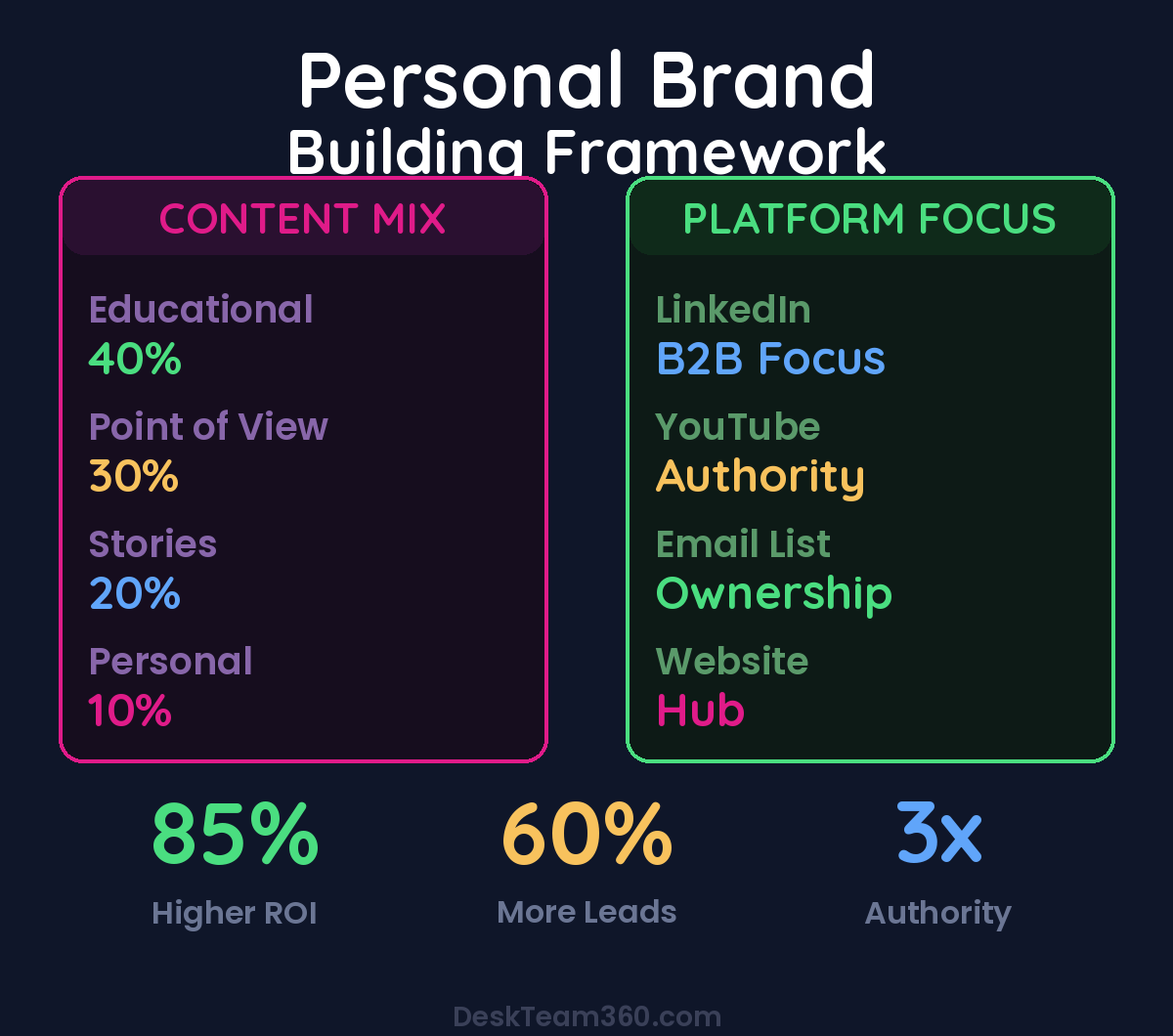
I recommend a framework I call the Content Mix: 40% educational content where you share frameworks and teach concepts, 30% point of view content where you agree or disagree with industry practices, 20% story content where you share experiences and lessons from your career, and 10% personal content that makes you human and memorable.
Creating a Sustainable Content System
The number one reason personal brands stall is content burnout. Here’s how to make it sustainable without hiring a full content team.
Batch your content creation. Set aside two to four hours once per week to create all your content for the upcoming week. Don’t try to create in real-time every day. It’s inefficient and exhausting.
Repurpose ruthlessly. One long-form piece becomes five to ten social media posts, an email newsletter edition, quote graphics and carousel posts, and short-form video clips. Most people create new content from scratch every time. That’s why they burn out.
Build a content calendar and plan themes and topics at least a month in advance. You can adjust based on current events, but having a baseline plan eliminates the daily “what should I post about” decision fatigue. Our guide on creating a content calendar walks through the exact process.
Visual Consistency: Your Brand’s Visual Identity
People make snap judgments based on visuals. A consistent visual identity across all platforms signals professionalism and builds recognition. When someone scrolls past your content in their feed, they should immediately know it’s yours before they even read your name.
This doesn’t mean everything has to look identical, but there should be clear family resemblance in colors, fonts, and overall style. The goal is instant recognition.
Essential visual elements include a professional headshot that’s not a cropped group photo or a selfie, brand colors that you use consistently across everything, typography that becomes associated with your brand, and a template system for social media posts that creates visual consistency without looking repetitive.
Watch out: Most founders underestimate the visual component of personal branding. You could have the best content in your industry, but if it looks amateur or inconsistent, people unconsciously judge your expertise as amateur too. Professional visuals aren’t optional.
If you’re not a designer, invest in professional brand assets upfront. A brand style guide ensures consistency whether you’re creating content yourself or working with a design team. For ongoing visual content, many founders outsource their social media graphics to maintain professional consistency without spending hours in design tools.
Building Authority Through Speaking and Media
Content gets you noticed. Speaking and media features get you respected. Every podcast appearance, speaking engagement, and media quote builds credibility by association and exposes you to established audiences.
For industry research and benchmarks, check out 99designs Blog.
Podcast guesting is one of the most efficient personal branding activities because each appearance gives you exposure to an established audience, content to repurpose across your platforms, SEO backlinks to your website, and credibility by association with the host. Start with smaller, niche podcasts in your industry. Build a track record, then pitch larger shows.
Live speaking, whether in-person or virtual, positions you as the authority in the room. Start with local events, industry meetups, and virtual summits. Build a speaker page on your website with topics, a bio, and clips of past talks.
Getting quoted in articles, contributing expert content to industry publications, and appearing in media builds massive credibility. Platforms like HARO, Quoted, and Connectively connect you with reporters looking for expert sources. Respond quickly and provide specific, quotable insights.
Email: Your Most Valuable Personal Brand Asset
Social media gives you reach. Email gives you ownership. Build an email list from day one because email subscribers are your most engaged audience, and email is where business relationships convert to actual business transactions.
A weekly newsletter becomes a ritual that keeps you top of mind with your audience. It doesn’t need to be long or elaborate. Share one insight, one recommendation, and one personal reflection. The key is consistency and value, not length or production quality.
Personal brands with email lists see 85% higher conversion rates to paid services compared to those relying solely on social media followers.
Your email list becomes your insurance policy. Algorithm changes, platform shifts, and social media drama can’t touch it. It’s the audience you own completely, and it’s often the highest-converting traffic source for personal brand monetization.
Measuring Personal Brand Growth
Personal branding is a long game, but you should track leading indicators to know you’re moving in the right direction. Inbound inquiries from people who found your content, search results that position you favorably when someone Googles your name, social media growth in both followers and engagement, email list growth from organic opt-ins.
Also track speaking invitations, media mentions where journalists and podcasters seek you out as an expert, and revenue you can directly attribute to your personal brand visibility. These lagging indicators prove your brand is working in business terms, not just vanity metrics.
The most successful personal brands I’ve seen can trace a clear line from their content strategy to business outcomes. New clients who mention they’ve been following their content, speaking opportunities that lead to consulting contracts, media features that generate inbound leads. Your brand should be working for your business, not just your ego.
Start Building Your Personal Brand Today
Your personal brand is being built whether you participate or not. Every LinkedIn post you don’t write, every article you don’t publish, every speaking opportunity you don’t pursue creates a brand by default: invisible, undefined, forgettable.
Or you can be intentional about it. Define your positioning, create consistent content, invest in professional visuals, and show up where your audience spends time. The founders who treat personal branding as a business asset, not a side project, are the ones who compound their opportunities year over year.
If you need help with the execution, DeskTeam360 gives you a full creative team at a flat monthly rate to handle professional web design, branded graphics, content templates, social media visuals, and presentation design. Focus on your expertise and relationships while we handle the design work that makes your brand look as sharp as your thinking.
Understanding how to measure marketing ROI applies to personal branding too. Your brand investment should generate measurable business outcomes, and our guide on professional web design covers the technical foundation every personal brand needs.
Free 5-Minute Video
See How DeskTeam360 Works in Under 5 Minutes
Watch the short video and see exactly how we handle design, development, and marketing implementation — so you don't have to.
Watch the Video →