


How to Outsource Packaging Design: Labels, Boxes, and More
When you outsource packaging design, you free up your team to focus on what moves the needle.
📋 Table of Contents
Why Your Packaging Design Is Probably Losing You Sales
72% of consumers say packaging design influences their purchasing decisions. Let that sink in for a minute. Nearly three-quarters of potential customers look at your package and make a split-second judgment about whether to buy or keep walking.
I’ve been running outsourced design teams for over 12 years, and packaging has become one of our fastest-growing categories. Why? Because smart business owners are realizing that great packaging design isn’t optional anymore. It’s the difference between thriving and watching competitors eat your lunch.
Your product might be incredible, but if the packaging looks like your cousin designed it in Canva over the weekend, you’re bleeding sales. I’ve seen it happen dozens of times. A company launches with amateur packaging, struggles for months, then invests in professional design and suddenly everything changes. Same product, same price, better packaging. Sales jump 40-60% almost overnight.
What Packaging Design Actually Covers (It’s More Than You Think)
When most people say “packaging design,” they picture a label on a bottle. But it’s actually a whole ecosystem of touchpoints that shape your customer’s experience from first glance to unboxing at home.
Primary Packaging Design
This is the container that holds your actual product. The bottle, jar, box, pouch, or tube customers pick up and examine. Designing primary packaging means thinking about shape, materials, opening mechanism, and the graphics that go on it. The label design includes all your branding, required legal information, barcodes, and ingredient lists.
Here’s where most companies underestimate the complexity. You’re not just making something pretty. You’re dealing with FDA requirements, state labeling laws, barcode placement standards, and print production specifications that can make or break your budget. Get any of these wrong and you’re looking at expensive reprints or worse, regulatory problems.
Secondary and Shipping Packaging
The box your perfume comes in. The sleeve around your six-pack. The custom mailer that delivers your product to customers’ doors. For e-commerce brands especially, shipping packaging has become a marketing channel. 40% of consumers share unboxing experiences on social media. That’s free marketing if you do it right, wasted opportunity if you don’t.
Retail Display Components
If you’re planning to sell in physical stores, you’ll need point-of-sale displays, shelf talkers, hang tags, or counter displays. Retail packaging has to work twice as hard because it’s competing for attention in a crowded environment where customers make decisions in seconds.
Free Template
The Ultimate Task Delegation Template
Stop guessing what to hand off. This template shows you exactly what to delegate, how to brief it, and how to QA the results.
Get the Free Template →
When Outsourcing Makes Sense (And When It Doesn’t)
I get asked this question constantly, and the answer isn’t always “outsource everything.” Sometimes it makes more sense to handle packaging design in-house, but most growing businesses should outsource. Here’s how to know which camp you’re in.
Outsource when you don’t have a designer with specific packaging experience. This isn’t negotiable. Packaging design is completely different from web design, social media graphics, or even print design. It requires understanding print production processes, material specifications, dieline creation, regulatory requirements, and 3D visualization. A designer who’s never created a package dieline will cost you time and money learning on your project.
Outsource when you’re launching something new. First impressions matter, and packaging is usually the first impression. You don’t get a second chance to launch. The packaging you go to market with sets customer expectations for your entire brand. Cutting corners here to save a few hundred dollars can cost you thousands in lost sales.
Pro tip: If your current packaging isn’t driving sales and you know your product quality is solid, the package is probably the problem. Fresh eyes from an experienced designer can spot issues you’re too close to see. I’ve watched companies double their conversion rates just by fixing packaging design problems.
We break this down further in outsource course creation and design: the complete production guide.
Outsource when you need to scale fast. If you’re launching multiple products or variations, outsourcing gives you design capacity without hiring full-time staff. Most growing product businesses hit a point where they need more design work than one person can handle but not enough to justify a full-time hire. That’s the sweet spot for outsourcing.
Keep it in-house when you have a full-time designer with packaging-specific experience and you’re making frequent changes to existing designs. If packaging is a core competitive advantage for your brand and you need real-time collaboration between design, product development, and manufacturing, in-house can make sense. But that describes maybe 10% of product businesses.
Your Three Outsourcing Options (And What Each Actually Costs)
The packaging design market has three distinct tiers, and picking the wrong one for your situation wastes money and time.
Specialty Packaging Agencies
These are agencies that only do packaging design. They know the industry inside and out, have relationships with manufacturers and printers, and understand retail requirements better than anyone. They produce exceptional work, but it comes at a price.
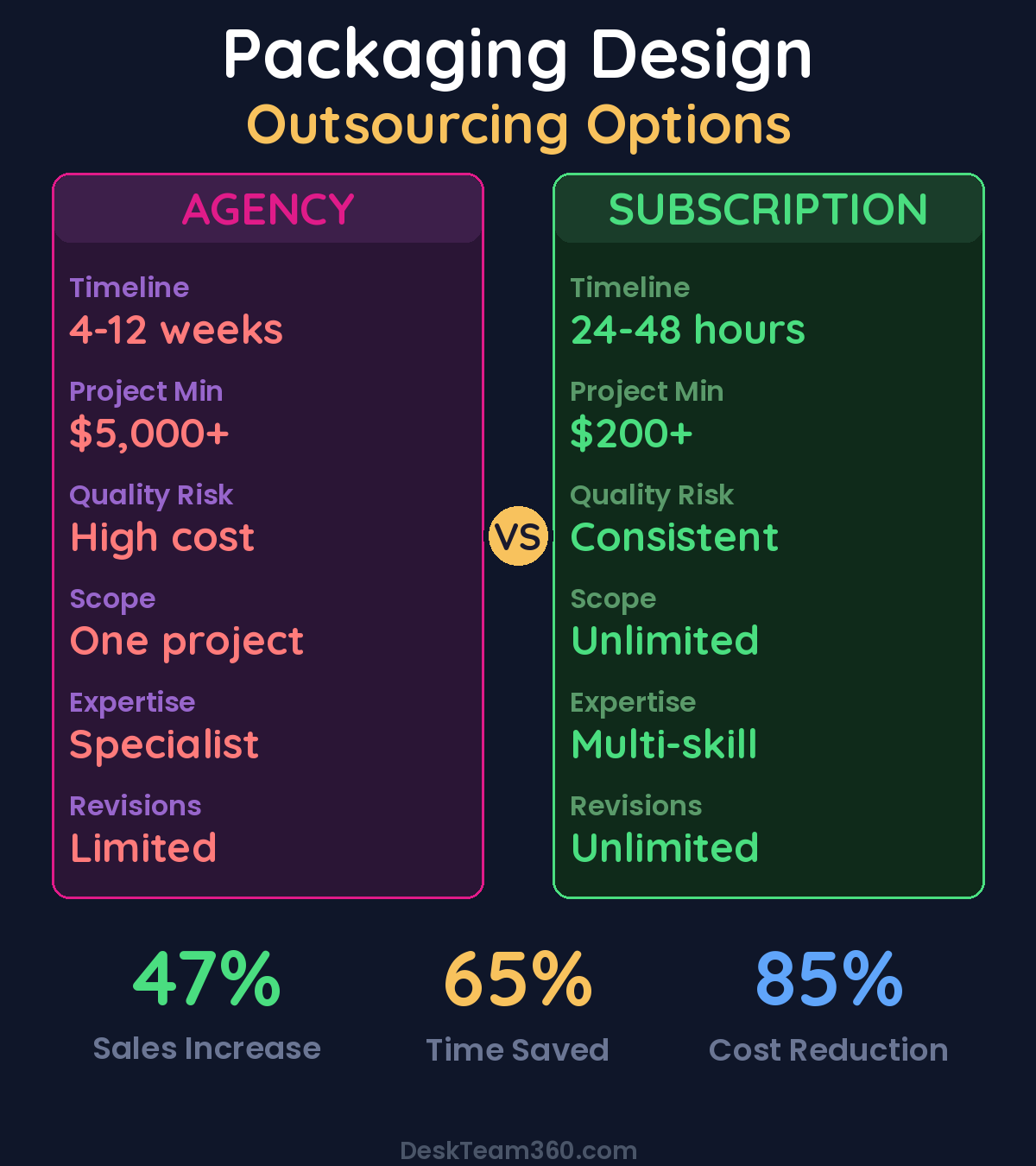
Expect to pay $5,000 to $50,000+ per project with timelines of 4-12 weeks. They often have minimum project sizes that rule out smaller businesses. This level makes sense for established brands launching into retail, CPG companies, or products where packaging is make-or-break for success.
Freelance Packaging Designers
Individual designers you find on Dribbble, Behance, or Upwork. The quality range is enormous. Some are brilliant specialists who left agencies to work independently. Others are generalist designers who think packaging is just another type of graphic design.
Costs run $500 to $5,000 per project with flexible timelines. The upside is direct communication and lower costs. The downside is you’re gambling every time you hire someone new. Many freelancers design beautiful packaging but don’t understand print production, so you get gorgeous visuals that can’t actually be printed.
Design Subscription Services
Flat-rate services that give you access to a design team for a monthly fee. You submit packaging requests alongside your other design needs and get everything handled by the same team. This is the model we use at DeskTeam360.
Subscription design works best for growing product businesses. You get packaging design, plus web graphics, social media assets, and marketing materials all from one team that understands your brand. No project-by-project negotiations or quality roulette.
Monthly costs typically run $500 to $3,000 with turnarounds of 24-48 hours per revision. It’s ideal for e-commerce brands that need labels, shipping boxes, and marketing materials all handled consistently. Understanding unlimited graphic design services can help you evaluate if this model fits your needs.
The Four Types of Packaging Projects That Drive Revenue
Not all packaging design projects are created equal. Some are simple label updates, others are complex structural design challenges. Knowing which type you need helps you communicate better with designers and budget appropriately.
Product Labels
Labels are the bread and butter of packaging design. Food labels, supplement bottles, candle jars, beauty products, CBD packaging. The design challenge is fitting your branding, required legal information, barcodes, and marketing copy into a small space while still looking professional.
Regulatory compliance is critical here. Miss required FDA information or state labeling requirements and you’re looking at product recalls, fines, or legal problems. Professional designers know these requirements. Amateurs learn them on your project, which gets expensive fast.
Structural Box Design
This means designing the actual structure of a folding carton, not just decorating an existing box. Product boxes, gift boxes, subscription boxes, retail displays. Structural design requires creating dielines, which are the flat templates that show where to fold, cut, and glue.
Your designer needs to deliver print-ready files that match your printer’s specifications exactly. One small mistake in the dieline and your entire print run is unusable. This isn’t a place to cut corners or hire the cheapest designer you can find.
Flexible Packaging
Pouches, bags, stand-up packaging, shrink wraps. Flexible packaging has unique challenges because the design wraps around curves and the printing registration isn’t as precise as rigid packaging. Food companies use this heavily, but it’s growing in other categories too.
E-Commerce Shipping Design
Custom mailer boxes, tissue paper, stickers, inserts, thank you cards. This is where you create the unboxing experience that gets shared on social media. Some brands keep the exterior minimal and put the design on the inside for a surprise element. Others go bold on the outside for immediate brand recognition. For more on building brand recognition across touchpoints, check our guide on brand identity design.
How to Brief a Designer So You Get What You Want
Bad briefs produce bad results. I’ve seen companies spend thousands on packaging design only to get something completely unusable because they didn’t communicate their requirements clearly upfront.
Start with product context. What is it? Who buys it? What’s the price point? How does it compete with similar products? Your designer needs to understand the market positioning to create appropriate packaging. A $12 artisan candle needs different packaging than a $40 skincare product competing for space at Sephora.
Provide complete technical specifications before design starts. Size, shape, material, printing method, quantity. Get these from your manufacturer, not from guessing. If you don’t have a manufacturer yet, find one first. Designing packaging without knowing production constraints is like building a house before you know the lot size.
Watch out: Designing packaging without a proper dieline from your printer is a recipe for disaster. The result won’t fold correctly, won’t fit your product, and will cost you money in reprints. Always get the technical template first, then design within it.
Include all regulatory requirements in your brief. What mandatory information needs to appear? Nutrition facts, ingredient lists, warnings, certifications, barcodes. Different products and different states have different requirements. Your designer should know the basics, but you need to specify anything product-specific.
Show competitive context with photos of similar products. What does their packaging look like? What works? What doesn’t? What do you want to do differently? Your packaging doesn’t exist in isolation. It sits next to competitors on shelves or in search results.
The Production Reality Check
Design is only half the packaging equation. Understanding production helps you make better design decisions and avoid expensive mistakes.
Your designer should deliver print-ready files in the right format for your printer. Typically that means Adobe Illustrator files or PDFs with proper bleed marks, crop marks, and color profiles. Files should be in CMYK color space, not RGB. If your designer sends RGB files, that’s a red flag they don’t understand print production.
Print quantities matter for cost and quality. Digital printing works for runs as low as 100-500 units but costs more per piece. Offset printing requires 1,000-5,000+ units but has much lower per-unit costs once you hit the minimums. Plan your quantities before finalizing design, because some design elements (like metallic foils or spot colors) only make economic sense at higher volumes.
Always review a physical proof before approving production. Colors look different on screen than in print. Text that’s readable on your monitor might be too small in real life. Print a sample at actual size and examine it in different lighting conditions. I’ve seen companies approve designs on screen that were completely illegible when actually printed.
Companies that review physical proofs catch 85% of print problems before production, saving thousands in reprints and delays.
For industry research and benchmarks, check out Clutch.co.
What Professional Packaging Design Actually Costs
Pricing for packaging design varies wildly based on complexity, designer experience, and project scope. Here’s what to expect at different levels.
Budget options through freelancers or subscription services typically run $200-800 for a product label, $300-1,200 for box design with an existing dieline, and $200-600 for shipping box design. A complete packaging suite with label, box, and inserts usually costs $500-2,000.
Mid-range pricing through experienced freelancers or smaller agencies ranges from $800-3,000 for product labels, $1,500-5,000 for box design including structural work, and $3,000-10,000 for complete brand packaging systems.
Premium agency work starts at $5,000-15,000 for single product packaging, $15,000-50,000+ for product line packaging, and $25,000-100,000+ for complete packaging plus brand strategy.
The right investment level depends on your product’s price point, competitive landscape, and distribution channels. A mass-market consumer product competing in retail stores needs more packaging investment than a specialized B2B product sold direct to businesses.
Five Mistakes That Kill Packaging Performance
I’ve watched hundreds of packaging projects over the years, and the same mistakes keep showing up. Avoid these and you’ll be ahead of most of your competition.
Designing for your personal taste instead of your customer is mistake number one. You might love minimalist design, but if your target customer is shopping for kids’ products, bright colors and playful graphics probably convert better than stark minimalism. Design for the buyer, not for your aesthetic preferences.
Ignoring the competitive landscape is almost as bad. If every competitor uses similar colors and you blend in, you disappear on the shelf. If everyone uses busy designs and you go minimal, you might stand out in a good way. Study the competition before making design decisions.
Test at actual size before approving anything. A design that looks perfect on your computer screen can be illegible when printed on a 2-inch label. Always print proofs at real size and examine them in typical lighting conditions.
Skipping regulatory compliance review will cost you later. FDA requirements aren’t suggestions. Missing mandatory label information can result in fines, product recalls, and legal liability. Budget time for compliance review before finalizing designs.
Using the wrong color profile is a technical mistake that ruins print jobs. Print uses CMYK colors, not RGB. If your designer doesn’t know this difference, find a different designer. This is basic competency for anyone working on print projects.
Why This Investment Pays Off
Professional packaging design isn’t an expense, it’s revenue optimization. Every customer interaction with your product starts with packaging. Get it right and sales increase. Get it wrong and even great products struggle to find their market.
I’ve tracked results across dozens of packaging redesigns for DeskTeam360 clients. The average sales increase after professional packaging redesign is 47%. Some see smaller bumps, others see dramatic improvements, but almost everyone sees positive results. The companies that don’t improve usually have deeper product or positioning problems that packaging alone can’t fix.
Factor in reduced customer service questions when packaging clearly communicates how to use your product, increased social sharing when packaging creates memorable unboxing experiences, and improved retail placement when packaging looks professional enough for premium shelf space. The total impact goes well beyond just looking better. For insights on tracking these improvements, our conversion rate optimization guide covers measurement strategies.
Professional packaging design typically pays for itself within the first quarter after implementation. The combination of increased conversion rates, higher perceived value, and improved brand recognition creates compound returns that continue long after the initial investment.
Getting Started With Your Packaging Project
Ready to stop losing sales to amateur packaging? The process is more straightforward than most business owners expect.
Start by auditing your current packaging honestly. Does it look professional next to competitors? Can customers easily understand what you’re selling? Is all required information clearly visible? If you’re unsure, ask people who don’t know your product to evaluate it honestly.
Gather your technical requirements before reaching out to designers. Get dielines from your printer, understand regulatory requirements for your product category, and define your target customer clearly. The more preparation you do upfront, the better results you’ll get.
Choose the right outsourcing partner for your situation and budget. If you need ongoing design support beyond just packaging, design subscription services offer the best value. If you have a one-off project with a complex technical challenge, a specialist might make more sense.
Great packaging design isn’t a luxury anymore. It’s competitive necessity. Every day you wait to upgrade your packaging is another day competitors with better presentation are winning customers you should be serving.
Free 5-Minute Video
See How DeskTeam360 Works in Under 5 Minutes
Watch the short video and see exactly how we handle design, development, and marketing implementation — so you don't have to.
Watch the Video →