


How to Create a Brand Identity From Scratch (Complete Guide + Costs)
Knowing how to create a brand identity from scratch can be the difference between growth and spinning your wheels.
📋 Table of Contents
Stop Calling Everything “Logo Design”
Let me stop you right there. If you’re saying “I need a logo,” you’re thinking about this wrong. Your logo is one piece of a much bigger system called brand identity, and jumping straight to logo design without doing the foundation work is like picking paint colors before building the house.
I’ve watched hundreds of businesses make this mistake over 12 years of managing design teams. They spend $2,000 on a gorgeous logo, then six months later their website, business cards, and social media posts look like they were made by five different companies. Their brand has no consistency, no personality, and no connection to what they actually do.
Building a brand identity from scratch isn’t just about making things look pretty. It’s about creating a complete visual and verbal system that communicates who you are, what you do, and why anyone should choose you over the competition. Here’s how to do it without wasting time or money.
Start With Strategy, Not Aesthetics
Before you touch a design program, you need to answer some uncomfortable questions about your business. Most entrepreneurs hate this part because it forces them to be specific about things they’ve kept intentionally vague.
What do you actually do? Not the elevator pitch version, the real version. “We help businesses grow” isn’t an answer, it’s corporate word salad. “We create unlimited design and development services for agencies who need reliable creative output without hiring full-time staff” is an answer.
Who do you serve? “Small businesses” and “entrepreneurs” aren’t target audiences, they’re census categories. Get specific. What size companies? What industries? What problems keep them up at night that you can solve? The more specific you get, the easier everything else becomes.
How are you different from your competitors? And don’t say “better customer service” because everyone says that. What can you do that they can’t? What do you do differently than they do? What makes you the obvious choice when someone has three options in front of them?
This strategy work isn’t fun, but it’s the foundation for every decision that follows. Your positioning statement should fit in one or two sentences and capture all of it. Write it down. Everything you design from this point forward should support that statement.
Free 5-Minute Video
See How DeskTeam360 Works in Under 5 Minutes
Watch the short video and see exactly how we handle design, development, and marketing implementation — so you don't have to.
Watch the Video →
Research Your Competition (But Don’t Copy Them)
Before you design anything, look at what your top competitors are doing visually. I’m not talking about inspiration browsing on Pinterest. I mean systematic competitive analysis.
What colors dominate your industry? What typography styles are common? What kind of imagery do they use? Most importantly, where do they all look exactly the same? That’s where your opportunity lives.
If every competitor in your space uses blue and white corporate color schemes, maybe there’s a play in bold, unexpected colors. If they’re all using the same stock photography style, maybe custom illustration sets you apart. If everyone sounds the same in their copy, that’s your opening to sound different.
The goal isn’t to copy what works. The goal is to understand the landscape so you can make informed decisions about where to stand out and where to fit in.
Define Your Brand Personality
Brand archetypes aren’t marketing fluff, they’re a practical framework for giving your design team direction. Instead of saying “make it look professional,” you can say “we’re the Sage archetype, knowledgeable and authoritative like Google, not the Rebel archetype like Harley-Davidson.”
Pick one primary archetype that aligns with your positioning. The Hero (achievement-driven like Nike), the Sage (knowledgeable like Google), the Rebel (disruptive like Apple), the Caregiver (nurturing like Johnson & Johnson), or the Creator (innovative like Adobe). This isn’t permanent, but it gives your visual identity a personality to build toward.
Logo Design: Process Over Guesswork
Now you’re ready for the actual logo design, and because you did the strategy work, your designer has clear direction instead of throwing concepts at the wall.
Most logos fall into five categories, and each one serves a different purpose. Wordmarks use your company name in distinctive typography (think Google or Coca-Cola). Lettermarks use initials or abbreviations (IBM, HBO). Logomarks are pure symbols (Apple’s apple, Nike’s swoosh). Combination marks pair an icon with text. Emblems put text inside a symbol or badge.
For new businesses, combination marks are usually the smartest choice. They give you flexibility to use the full logo on your website, just the icon as a favicon, and just the wordmark in tight spaces. You’re not locked into one application.
Pro tip: The best logos work at every size from billboard to business card. If your logo depends on tiny details or complex illustrations, it’ll fail when people see it small. Simplicity isn’t just aesthetics, it’s function.
The logo design process should be structured, not random. Share your strategy, competitive research, and inspiration with your designer. Review three to five initial concepts. Pick one or two directions for refinement. Go through two to three rounds of revisions. Get your final files in every format you’ll need (vector, high-resolution, web-optimized).
If you’re working with a freelancer, expect to spend $300-800. Agency work runs $2,000-10,000. Or use a design subscription service where logo design is included in your monthly plan without additional costs. For more detail on pricing, our guide on logo design costs breaks down all the options.
Color Strategy: Psychology Meets Function
Color drives 90% of first impressions, and choosing your palette isn’t about personal preference. It’s strategic communication.
Blue builds trust and communicates stability, which is why every bank and tech company uses it. Red creates urgency and passion, perfect for food brands and entertainment. Green suggests growth and health, natural for wellness and organic brands. Yellow and orange communicate optimism and creativity. Purple implies luxury and spirituality. Black communicates sophistication and authority.
Your color palette needs to work systematically. One or two primary colors that represent your brand. Two or three secondary colors for variety and accent use. Neutral colors (whites, grays, blacks) for backgrounds and text. One accent color for buttons, highlights, and calls-to-action.
Document the exact values in HEX, RGB, and CMYK so your colors stay consistent whether someone’s designing for web, print, or anything else. Inconsistent colors make your brand look sloppy and unprofessional.
Typography: Your Brand’s Voice
Typography sets the tone before anyone reads a word. The fonts you choose communicate personality as much as the words themselves.
You need two to three fonts maximum. More than that creates visual chaos. A primary font for headlines that’s bold and distinctive. A secondary font for body text that’s clean and readable in long paragraphs. An optional accent font for callouts or special elements.
The key is pairing fonts that are different enough to create hierarchy but complementary enough to work together. A serif paired with a sans-serif usually works well. Just make sure your body text font is readable at small sizes and your headline font has enough personality to set the tone.
Watch out: Don’t choose style over readability. That fancy script font might look beautiful in your design mockup, but if people can’t read your website copy, you’ve defeated the purpose. Function first, then aesthetics.
For digital applications, stick with web-safe fonts or Google Fonts. They load fast, work on every device, and won’t cost you licensing fees. For print materials, you have more flexibility, but budget for font licensing if you’re using premium typefaces.
Brand Voice: How You Sound Matters
Visual identity gets attention, but brand voice builds relationships. Your brand voice is how you communicate across every touchpoint, from website copy to customer service emails.
Define your voice with three to four adjectives. Professional but approachable. Bold and direct. Warm and encouraging. Witty and irreverent. Then create boundaries with “this, not that” guidelines. We’re confident, not arrogant. We’re casual, not sloppy. We use humor, but never at someone’s expense.
Build a messaging hierarchy that covers every situation. Your tagline (three to seven words that capture your essence). Your value proposition (one sentence explaining your core offer). Your elevator pitch (30-second business explanation). Key messages that support your positioning. A boilerplate paragraph for press releases and company profiles.
This messaging framework ensures everyone on your team communicates consistently. Whether it’s your CEO giving an interview or your customer service team responding to complaints, the voice stays consistent.
Document Everything in Brand Guidelines
All this work is worthless if it’s not documented properly. Brand guidelines aren’t just for big companies with design teams. They’re for any business that wants consistency across their marketing.
Your brand guidelines should include your brand story and mission (the why behind everything). Logo usage rules with correct and incorrect examples, minimum sizes, and clear space requirements. Your complete color palette with codes for digital and print. Typography rules with font families, sizes, and weights. Imagery guidelines covering photography style, illustration approach, and what to avoid. Voice and tone examples showing how your brand communicates.
Include templates for common applications. Business cards, email signatures, social media graphics, letterhead. This way, anyone creating materials for your brand has a starting point that’s already on-brand.
Understanding how to create comprehensive brand guidelines prevents the inconsistency problems that plague most growing businesses.
Your brand guidelines are your consistency insurance policy. They ensure your brand looks and sounds the same whether your CEO is presenting to investors or your newest employee is creating a social media post.
For industry research and benchmarks, check out 99designs Blog.
The Real Cost of Building Brand Identity
Let’s talk numbers, because cost is usually the first question and the last consideration.
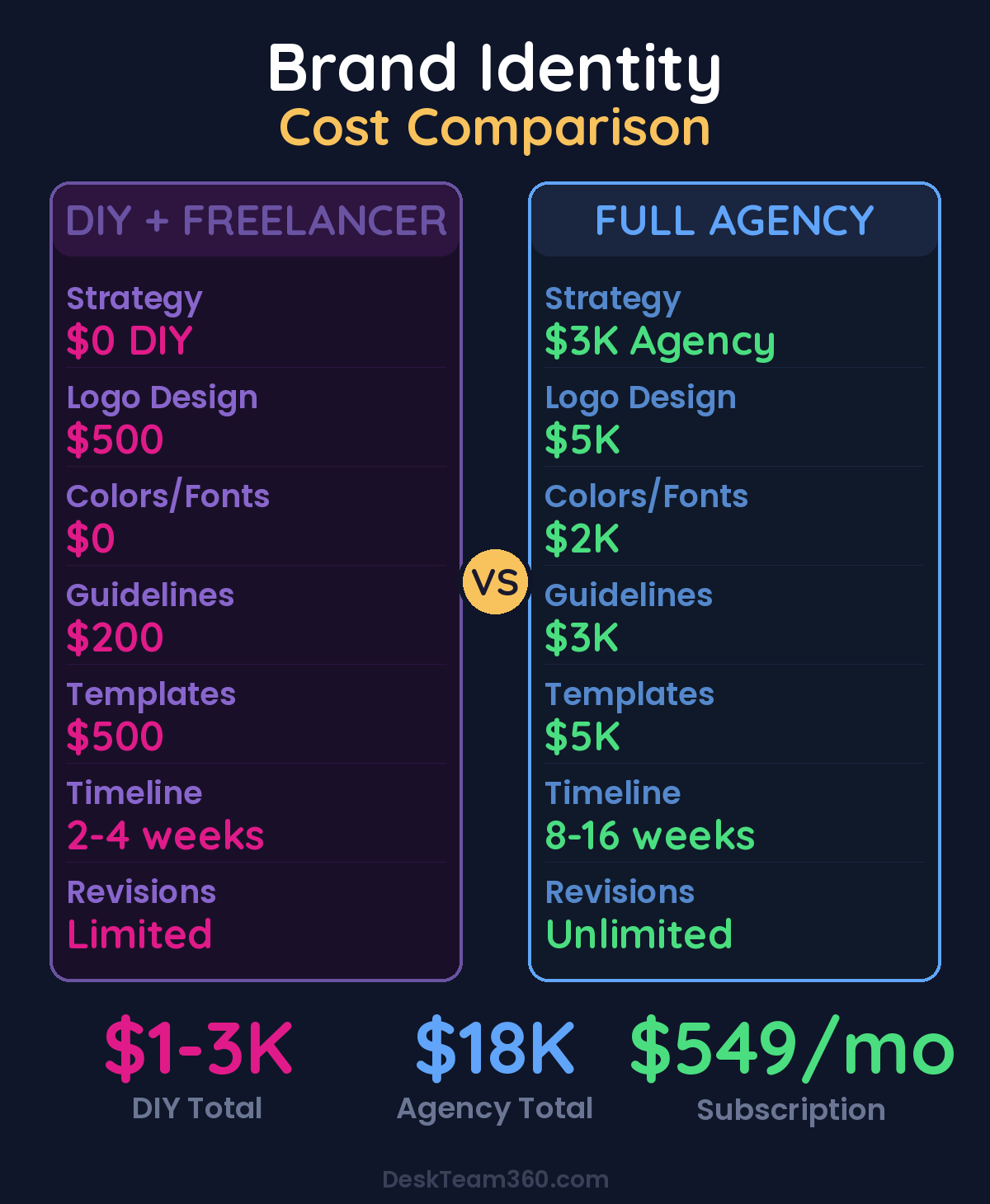
The DIY route with freelancers runs $500-3,000 total. You handle strategy yourself, hire a freelancer for logo design ($300-800), use free fonts and color tools, and create basic guidelines from templates. This works if you have time and some design sense.
The full agency experience costs $5,000-25,000 or more. Complete strategy and research, professional logo design, full identity system development, professionally designed brand guidelines, and ongoing support. This makes sense if brand is critical to your business and you want everything handled professionally.
Design subscription services run $449-899 per month and include logo design, brand guidelines, business cards, social media templates, website design, and ongoing updates as part of your monthly plan. No additional costs for revisions or new assets.
Where Most Brands Fail
Designing by committee kills more brands than bad designers. When ten people have input on every decision, you end up with a boring, inoffensive mess that pleases no one and attracts no one. Limit brand decision-makers to two or three people maximum.
Chasing trends instead of building for longevity is another killer. Gradients, neon colors, and maximalist design might be trending now, but your brand needs to work for five to ten years. Choose timeless over trendy.
Skipping strategy and jumping straight to design is like building a house without blueprints. It might look okay, but it won’t function properly. The pretty exterior can’t fix fundamental structural problems.
Inconsistent application destroys even the best brand identities. Your brand only works if it’s applied consistently across every touchpoint. This means training your team, educating your vendors, and auditing your materials regularly. For guidance on maintaining consistency, our article on writing effective creative briefs ensures everyone understands your brand requirements.
Businesses with consistent brand presentation see 23% more revenue than those with inconsistent branding across channels.
Make the Investment
Building a brand identity from scratch is one of the highest-return investments you can make. Strong brand identity builds recognition, increases perceived value, and makes every piece of marketing more effective.
Don’t rush it. Do the strategy work first. Hire professionals for execution if you can afford it. Document everything so it can be applied consistently. And then commit to using it everywhere, every time.
Your brand identity isn’t something you set and forget. It’s a living system that grows with your business. The companies that invest in building it right from the beginning save thousands in rebranding costs later and build market value that compounds over time.
At DeskTeam360, we handle the entire brand identity process from strategy through implementation. Logo design, brand guidelines, website development, and ongoing creative support, all included in our monthly plans.
Free Tool
How Much Is Freelancer Management Really Costing You?
Most agency owners have never done this math. Plug in a few numbers and see your real cost in 2 minutes.
Calculate Your Hidden Costs →