


How to Launch an Online Course: The Complete Checklist
Why Most Course Launches Feel Like Chaos (And How to Change That)
Figuring out how to launch an online course doesn’t have to be complicated. It’s 2am, three days before your course goes live, and you’re staring at a sales page that looks like it was built by a drunk intern. Your email automation is broken, you haven’t recorded the welcome video, and your “branded” slides are still using the default PowerPoint template. Sound familiar?
📋 Table of Contents
I’ve watched hundreds of course creators go through this exact nightmare. They spend months creating brilliant content, then scramble through launch week like their hair’s on fire because they forgot about the other 50 things that actually sell courses.
After 12+ years running DeskTeam360 and supporting course launches from $10K first attempts to seven-figure repeatable systems, here’s what I know: the creators who succeed aren’t necessarily smarter. They’re just more organized. They have a system. They don’t wing it.
This is that system. The complete checklist for everything you need before, during, and after launch. Not theory, not fluff, just the exact steps that separate successful launches from expensive disasters.
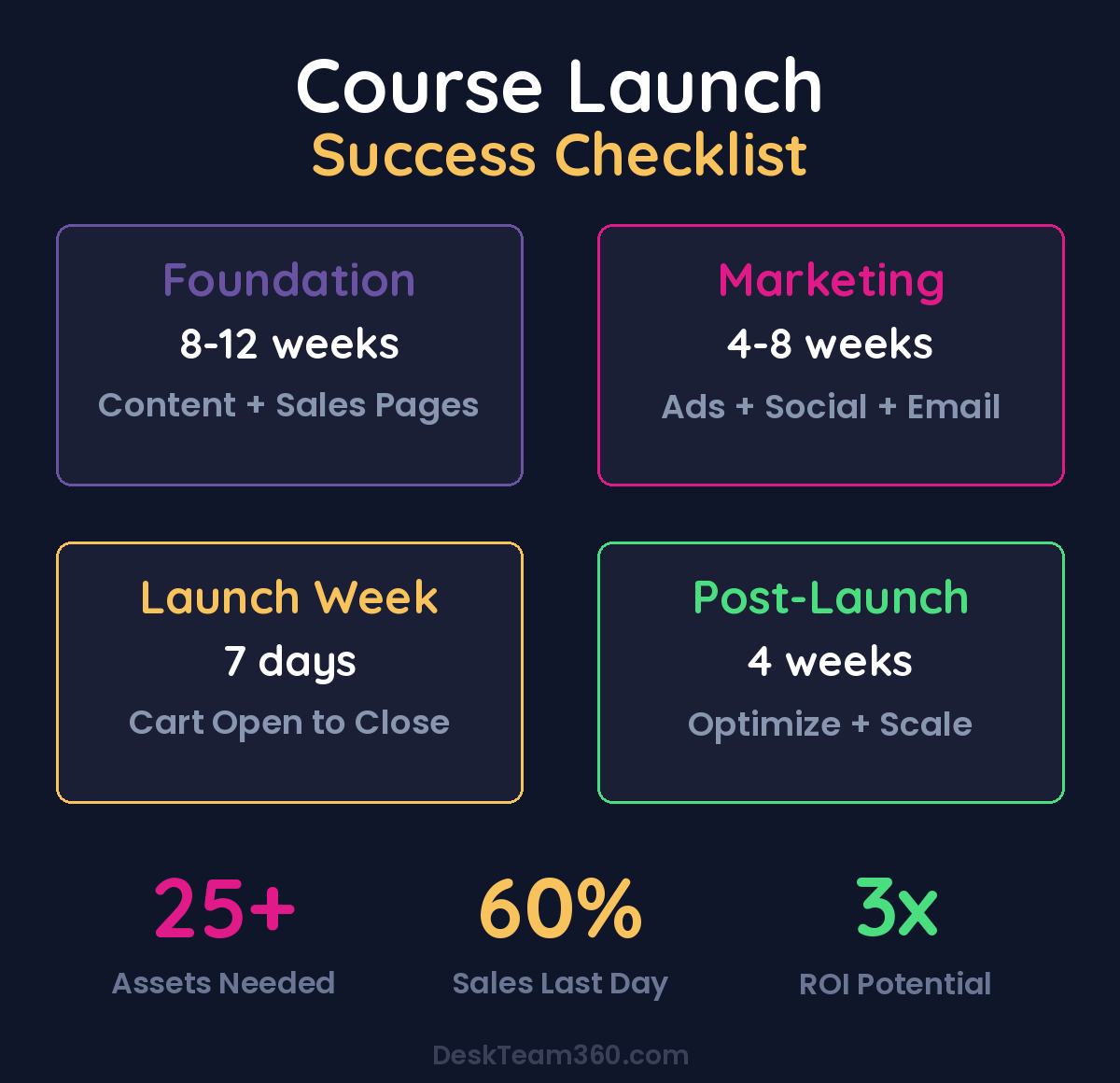
Foundation Phase: Building Your Launch Infrastructure (8-12 Weeks Out)
This is where 90% of the real work happens. Get this phase right and launch week becomes pure execution instead of panic-driven improvisation.
Your Course Content Needs More Than Just Videos
Most creators think “course content” means recording some videos and uploading them. That’s maybe 40% of what you actually need. The rest is all the supporting materials that make your content usable and professional.
Start with your course outline finalized down to individual lesson objectives. Not a rough idea, a complete roadmap. Then draft scripts or talking points for every video. You don’t need word-for-word scripts, but you need enough structure that you’re not rambling for 45 minutes hoping something valuable comes out.
Your slide deck matters more than you think. A professional, branded presentation makes you look like an authority. Default PowerPoint templates scream “amateur.” Get this designed properly or your students will notice the difference immediately.
Workbooks and worksheets are where students actually apply what you’re teaching. Skip these and your course becomes entertainment instead of education. Templates, cheat sheets, and bonus resources turn a video course into a complete learning experience.
Pro tip: Record all your videos before you edit any of them. Batch recording is 3x faster than bouncing between recording and editing modes. Set aside two full days, get everything recorded, then move to editing with consistent energy and voice.
Once everything’s recorded, you need professional editing. Raw footage from your webcam doesn’t cut it anymore. Proper intros, outros, branded overlays, and clean audio aren’t optional. Students judge course quality in the first 30 seconds of video one.
Platform selection matters too. Kajabi, Teachable, and Thinkific all work, but they’re not identical. Pick one before you start building, not after you’ve already created everything in the wrong format.
Sales Infrastructure: The Systems That Actually Generate Revenue
Your course content doesn’t sell itself. The sales infrastructure does. This is where most creators completely underestimate the scope of work required.
Your sales page is the most critical piece of the entire launch. For courses over $500, you need long-form copy that addresses every objection, builds massive value, and guides readers toward the purchase decision. This isn’t a feature list, it’s a persuasive document that takes days to write correctly.
The design and build of that sales page is equally important. Mobile optimization isn’t optional when 60% of your traffic comes from phones. Fast loading speeds aren’t optional when a three-second delay kills 40% of conversions. Professional design isn’t optional when amateur-looking pages destroy credibility instantly.
Payment processing needs to be bulletproof. Your checkout page should be tested on multiple devices and browsers. Payment plans should be configured if you’re offering installments. Order bumps or upsells should be ready if you’re using them. One technical glitch during launch week costs you sales you’ll never recover.
Your thank you page is pure missed opportunity if it’s just “thanks for buying.” This is where excited new students land immediately after purchase. Use it for onboarding, community invites, bonus delivery, or upsells to related products. Don’t waste it.
For a deeper dive, see our guide on marketing implementation for online service providers: a practical guide.
Email confirmations, refund policies, terms and conditions, privacy policies all need to be written, reviewed, and published. Boring stuff that kills launches when it’s missing or incorrect.
Email Marketing: The Engine That Drives Everything
Email marketing isn’t just “send some emails during launch week.” It’s a complex automation system that needs to be built and tested weeks before launch.
Your email platform configuration matters. ConvertKit, ActiveCampaign, and Mailchimp all work differently. Pick one and learn it properly. Don’t switch platforms two weeks before launch because you saw a YouTube video about something “better.”
List segmentation is critical. Existing customers, warm leads, and cold leads all need different messaging. Sending the same launch emails to everyone is leaving money on the table.
Pre-launch sequence building anticipation, launch sequence from cart open to cart close, post-purchase onboarding, and abandoned cart recovery all need to be written, designed, and automated. That’s 20-30 individual emails minimum. Each one needs to be valuable, persuasive, and on-brand.
Email templates should match your brand visually. Default platform templates look generic. Custom-designed templates build recognition and trust. If you’re not sure how to structure effective email campaigns, our guide on email marketing automation covers the fundamentals.
Lead Generation: Filling Your Launch Pipeline
You can’t launch to an empty email list and expect success. Lead generation assets need to be built and deployed weeks before launch to create a pipeline of interested prospects.
Your lead magnet should directly relate to your course topic and provide genuine value. Generic “tips” PDFs don’t work anymore. People want substantial, useful resources that solve real problems. This takes time to create properly.
Landing pages for lead magnets need to be conversion-optimized, not just functional. The difference between a 15% and 45% conversion rate is often just better copy and design. Delivery automation needs to work flawlessly. One broken download link destroys trust immediately.
Webinars or free training sessions work incredibly well for course launches, but they require substantial preparation. Content creation, slide design, platform testing, registration pages, reminder sequences, and follow-up automation all take weeks to execute properly.
Free 5-Minute Video
See How DeskTeam360 Works in Under 5 Minutes
Watch the short video and see exactly how we handle design, development, and marketing implementation — so you don't have to.
Watch the Video →
Pre-Launch Marketing: Building Momentum (4-8 Weeks Out)
Infrastructure is built, now it’s time to fill it with people. This phase is all about generating awareness and anticipation for what you’re releasing.
Social Media Content That Actually Drives Sales
Random posts about your course don’t move the needle. Strategic content campaigns do. You need launch announcement content that gets people excited, behind-the-scenes content that builds connection, and educational content that demonstrates your expertise.
Testimonials from beta testers or past clients provide social proof. Countdown graphics create urgency. Carousel posts that teach valuable concepts related to your course topic establish authority and generate shares.
Video content performs better than static posts across every platform. Instagram and TikTok reels, LinkedIn native videos, and YouTube shorts all drive more engagement than graphics alone. Plan and record video content in batches to stay consistent.
Paid Advertising: Amplifying Your Organic Reach
Organic reach is great, but it’s not predictable or scalable. Paid advertising gives you control over who sees your content and when. But it requires proper setup and testing before launch week.
For a deeper dive, check out our guide on digital marketing for luxury brands: the complete strategy guide.
We cover this in more detail in marketing for business coaches: the complete strategy guide.
Ad creative needs multiple variations for testing. One ad graphic or video isn’t enough. Create 3-5 different approaches and let data determine what works best. Ad copy needs the same treatment. Write multiple versions and test everything.
Facebook and Instagram campaigns need proper audience targeting, retargeting pixel installation, and conversion tracking setup. Custom audiences from your email list and website visitors provide the highest conversion rates.
Budget allocation should be planned and scheduled in advance. Don’t guess at ad spend during launch week. Know exactly how much you’re spending and when. If you need help scaling your advertising efforts, optimizing Facebook ads becomes much easier with the right framework.
Partnerships and Affiliates: Leveraging Other People’s Audiences
Your audience is limited. Other people’s audiences aren’t. Partnership and affiliate promotion can 2-3x your launch revenue if set up correctly.
Affiliate program setup needs to happen weeks before launch. Swipe copy and promotional graphics need to be created for your affiliates to use. Partner outreach should begin 4-6 weeks before launch to allow time for relationship building and content creation.
Guest content on relevant platforms builds awareness with new audiences. Podcast interviews, newsletter features, and collaborative content all extend your reach beyond your existing following.
Launch Week: Pure Execution Mode
Everything should be prepared. Launch week is just pulling triggers on systems you’ve already built and tested.
Cart Open: The Starting Line
Day one is announcement day. Your full email list gets the cart open message. Social media announcements go live across all platforms. Paid ads activate if you’re running them. Affiliates get notified to start promoting.
The first few sales tell you if your systems are working. Technical issues need immediate attention. Payment processing problems, broken checkout flows, or email automation failures can’t wait until tomorrow.
Building Momentum: Days 2-6
Daily emails keep your launch top of mind. Different angles each day: testimonials, case studies, objection handling, behind-the-scenes content. Variety prevents people from tuning out.
Social media content should vary too. Don’t post the same “cart is open” message every day. Share student wins, answer questions, address concerns, and maintain energy throughout the entire launch period.
Live content works incredibly well during launch week. Instagram Live sessions, Facebook Live Q&As, or impromptu videos answering common questions build connection and handle objections in real time.
Most launches see 40-60% of total sales on the final day. Don’t panic if days 2-5 feel slow. The deadline creates urgency that drives most purchase decisions.
Cart Close: The Final Push
The last 24 hours require intense email frequency. Final day, final 12 hours, final 3 hours, final hour. This isn’t spam, it’s serving people who want to buy but need deadline pressure to take action.
Social media countdown posts throughout the day remind people across different platforms. Not everyone checks email, but they might see your Instagram story.
Cart closes at the stated deadline. No extensions, no “last chance” reopening. Credibility matters more than short-term revenue. Honor your deadlines or lose trust permanently.
For industry benchmarks and research, see HubSpot Blog.
Post-Launch: Turning One Launch Into a Repeatable System
Launch week ends, but the real optimization work begins. This phase turns a one-time event into a predictable, repeatable revenue system.
Student Success and Testimonial Generation
New student onboarding determines course completion rates. Welcome sequences, community access, first assignments, and early check-ins all impact whether students actually finish what they bought.
Live Q&A calls during the first week answer questions and build engagement. Personal attention during the first few days sets expectations for the entire course experience.
Feedback collection should happen early and often. What do students love? What’s confusing? What would they change? This input improves future versions and provides testimonial content.
Watch out: Most course creators disappear after launch week. Students notice. Ongoing engagement and support distinguish professional courses from abandoned products. Schedule regular touchpoints before you launch, not after.
Data Analysis and Future Optimization
Revenue numbers are just the beginning. Conversion rates from traffic to sales, email performance metrics, ad costs and returns, and sales page analytics all provide insight for future launches.
Heat mapping tools show where visitors drop off your sales page. Email metrics reveal which messages work best. Ad performance data identifies winning creative and copy approaches.
Document everything that worked and everything that didn’t. Future launches build on this knowledge instead of starting from scratch every time.
Evergreen Transition or Next Launch Planning
Live launches create urgency and community. Evergreen systems provide consistent revenue. Decide which approach fits your business model and audience preferences.
Evergreen automation requires different systems: automated webinars, deadline automations, and always-on advertising campaigns. More complex to set up, but potentially more profitable long-term.
The Hidden Truth About Course Launch Success
Most course creators underestimate the scope by about 300%. They think course creation is the hard part. Content creation is maybe 40% of the total work required for a successful launch.
The other 60% is all the systems, assets, and marketing materials that actually sell courses. Sales pages, email sequences, social media content, ad creative, webinars, landing pages, automation setup, and ongoing optimization.
Trying to handle all of this yourself leads to one of two outcomes: burnout before launch or amateur-quality execution that kills results. Neither is acceptable when you’ve spent months creating valuable content.
The successful course creators I work with focus on what only they can do: creating content, recording videos, showing up live, and building relationships. Everything else gets delegated to teams that specialize in launch execution.
At DeskTeam360, we handle the complete design and development infrastructure for course launches. Sales pages, email templates, social media graphics, webinar slides, ad creative, and all the technical implementation that turns your course content into a professional, branded launch experience.
Stop trying to do everything yourself. Your course content is too valuable for DIY sales pages and amateur marketing materials. Focus on what you do best and let specialists handle the rest.
Free Template
The Ultimate Task Delegation Template
Stop guessing what to hand off. This template shows you exactly what to delegate, how to brief it, and how to QA the results.
Get the Free Template →