Tripled Their Revenue and Increased Their Net Profits Dramatically

The $450K Revenue Jump That Almost Didn’t Happen
Let’s talk about deskteam360 case study tripled revenue. Kirstin Carey was trapped in her own business. Despite helping hundreds of clients reverse autoimmune diseases and chronic illnesses over 12 years, she couldn’t take on more people. Her calendar was the bottleneck strangling growth at Nourish123.com.
📋 Table of Contents
“There are people out there suffering that need our help,” she told me. “But my schedule couldn’t handle it.” She was working 60-hour weeks, doing everything herself, and watching potential revenue slip away because she literally had no time left to serve more clients.
Sound familiar? It should. This is the classic founder trap that kills growth at the six-figure mark. You built something successful, but success becomes your prison.
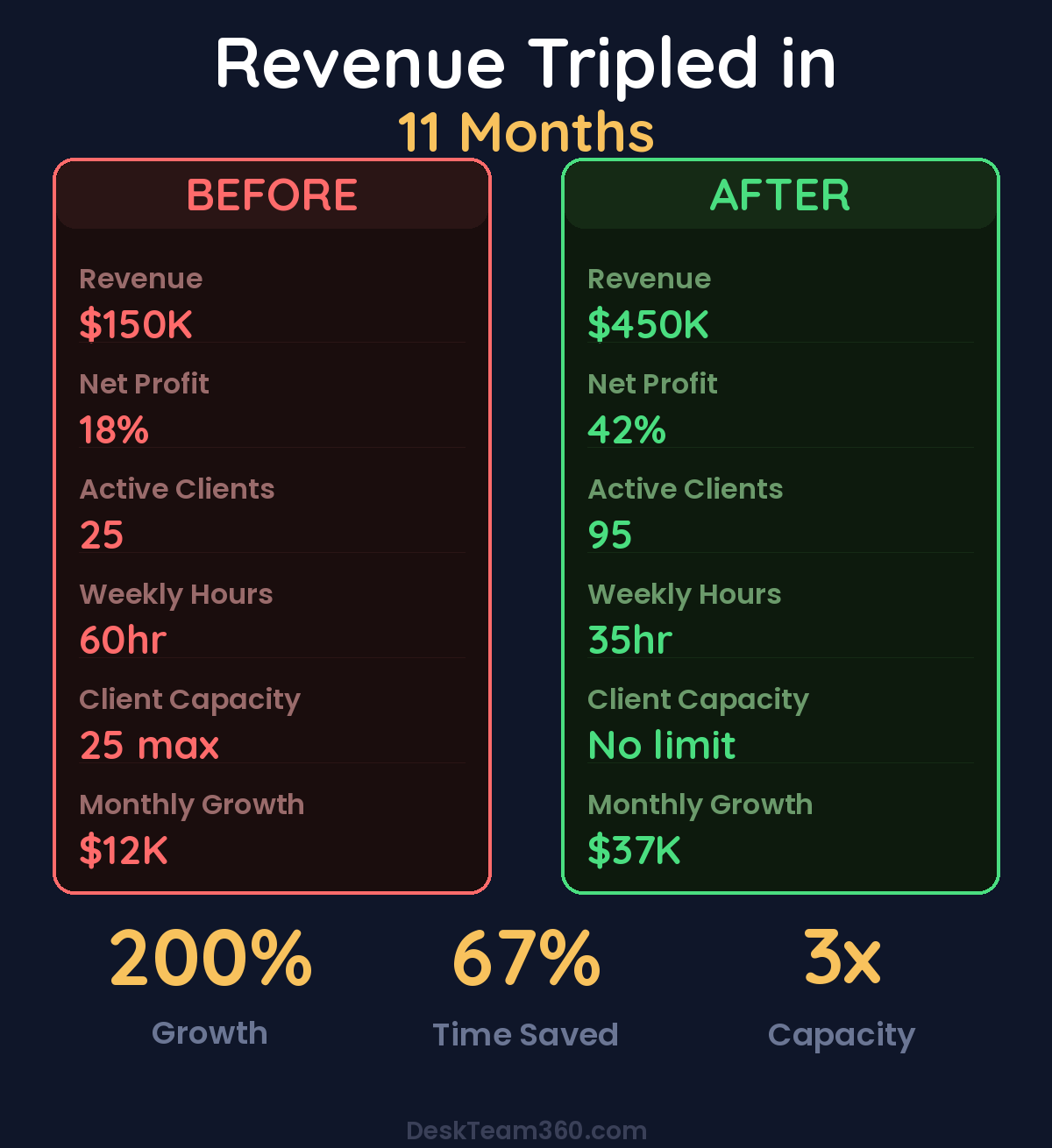
Kirstin’s story is different because she broke out. In 11 months after implementing strategic delegation with DeskTeam360, Nourish123 tripled their revenue from $150K to $450K annually. Net profit margins increased from 18% to 42%. Client capacity expanded from 25 active clients to 95. The transformation wasn’t gradual, it was explosive.
Here’s exactly how she did it, and why her first three attempts with other VA companies failed spectacularly.
The Three VA Disasters That Nearly Killed Her Business
Kirstin didn’t start working with us first. She tried three different virtual assistant companies over two years. Each one was a trainwreck for different reasons, but they taught her exactly what not to do.
Disaster #1: The Disappearing Act. Her first VA worked great for six weeks, then vanished. No warning, no handoff, no explanation. Just gone, taking three weeks of in-progress client work with them.
Disaster #2: The Time Zone Nightmare. The second company assigned her VAs who only worked while she slept. Every question required a 12-hour round trip. A simple email approval became a two-day process.
Disaster #3: The Wild West. The third company had no oversight. VAs would interpret instructions differently each week. Quality was inconsistent. There was no point person to escalate issues to when things went sideways.
Watch out: These aren’t edge cases. This is what happens when you pick a VA company based on price instead of systems. Cheap VAs cost more than expensive ones when you factor in the rework, stress, and lost opportunities.
After the third failure, Kirstin went back to doing everything herself. “I got so used to doing it myself,” she said. “It felt easier than trying to explain the process again.” She was burnt out on delegation entirely.
That’s exactly when her business growth flatlined. You can’t scale past yourself without systematically removing yourself from day-to-day operations. It’s mathematically impossible.
The Systematic Delegation Framework That Changed Everything
When Kirstin finally agreed to try strategic delegation again, we didn’t start by throwing tasks over the wall. We started with what she called “the learning curve navigation.” Three phases that prevent the chaos that killed her previous attempts.
Phase 1: The Task Archaeology (Week 1-2)
Most founders don’t actually know what they do all day. They just react to whatever’s on fire. Kirstin was no different. She knew she was busy, but couldn’t list her recurring tasks or estimate how much time each one consumed.
So we did task archaeology. For two weeks, Kirstin logged everything she touched for more than five minutes. Every email sequence, every client onboarding step, every piece of content creation, every administrative task that kept her business running.
The results were eye-opening. 68% of her time was being spent on tasks that didn’t require her specific expertise. Client research, email drafts, calendar management, follow-up sequences, basic graphic design work, these could all be systematized and delegated.
That 68% represented 27 hours per week that Kirstin could redirect to revenue-generating activities like client sessions, program development, and business strategy.
Phase 2: The Systems Documentation (Week 3-4)
Here’s where most delegation attempts die. Founders try to explain complex processes in a 10-minute Loom video, then wonder why the results don’t match expectations. Information transfer isn’t delegation.
Instead, we built what I call “delegation-ready systems.” For each task Kirstin wanted to hand off, we created step-by-step documentation with decision trees, quality checkpoints, and escalation triggers.
Her client onboarding process, for example, went from a vague “send them the welcome materials and schedule their first session” to a 47-step checklist with specific templates, timing requirements, and quality standards. Nothing was left to interpretation.
Phase 3: The Gradual Handoff (Week 5-8)
We didn’t flip a switch and hope for the best. Each task moved through a three-stage handoff process: shadow mode (VA watches Kirstin do it), assisted mode (VA does it with Kirstin’s review), and autonomous mode (VA owns it completely).
The most complex tasks, like client intake assessments, took three weeks to fully transfer. Simple tasks like calendar management moved to autonomous in five days. But every single handoff was methodical and reversible.
Pro tip: Never delegate more than three task categories at once. Your brain can only handle tracking so many process changes simultaneously. Rush the handoff and you’ll create more work, not less.
The Revenue Explosion: Month by Month Breakdown
With 27 hours per week freed up, Kirstin didn’t waste time. She reinvested every hour into revenue-generating activities. The growth trajectory was steep and consistent.
Month 1-2: Used freed time to increase client session capacity from 15 to 22 per week. Revenue jumped from $12.5K to $18K monthly.
Month 3-4: Launched a group coaching program that had been “on the someday list” for 18 months. Added $8K monthly recurring revenue.
Month 5-6: Developed and launched an online course. Generated $35K in the first launch, then $12K monthly in ongoing sales.
Month 7-9: Expanded team with two in-house practitioners, increasing client capacity to 65 active clients. Monthly revenue hit $32K.
Month 10-11: Second course launch generated $48K. Monthly recurring revenue stabilized at $37K.
The math is straightforward. Kirstin went from $150K annually to $450K annually because she tripled her effective working capacity. She wasn’t working three times harder, she was working three times smarter.
The Profit Margin Transformation
Revenue growth is impressive, but profit improvement is where the real business transformation happens. Kirstin’s net margins jumped from 18% to 42% despite significantly increasing her team size.
How? Strategic delegation lowered her cost per client served while increasing average client lifetime value. When she was doing everything herself, onboarding a new client cost her 8 hours of billable time spread across two weeks. With systematic delegation, that dropped to 2.5 hours of her time and happened in three days.
The efficiency gains compounded. Faster onboarding led to faster time-to-results for clients. Faster results led to better testimonials and case studies. Better social proof led to higher-quality leads that converted at higher prices.
Meanwhile, her cost structure became more predictable. Instead of her time being the variable cost (and bottleneck), she could forecast capacity and plan growth with actual numbers. Understanding how to measure ROI became possible because she had reliable systems generating the data.
The Business Model Evolution
What started as operational delegation evolved into strategic business model optimization. With her time freed up, Kirstin could finally work on the business instead of just in it.
She restructured her service offerings based on what generated the highest profit margins. The one-on-one sessions that used to be her only revenue source became the premium tier. Group coaching became the volume driver. Online courses provided passive income streams.
Client experience improved across every touchpoint because systems were consistent and professional. Her previous approach worked when she was handling 25 clients personally. At 95 clients, only systematic delegation could maintain quality standards.
Systems create freedom, not just efficiency. When your business can run without your constant attention, you can make strategic decisions based on long-term goals instead of just reacting to daily fires.
For a deeper dive, see our guide on deskteam360 vs no limit creatives: full-service team vs design subscription.
The strategic thinking time also led to better marketing decisions. Kirstin could finally analyze what was working, double down on effective channels, and cut spending on underperforming activities. Her cost per lead dropped by 35% while conversion rates increased by 28%.
The Team Expansion That Multiplied Results
Six months into her delegation journey, Kirstin did something she thought was impossible. She hired two in-house practitioners to expand her clinical capacity.
“Before DeskTeam360, I was the bottleneck,” she explained. “I couldn’t even imagine training other practitioners because I didn’t have time to create training materials or oversee their development.”
But with her administrative tasks systematically delegated, she had the bandwidth to build practitioner training systems. More importantly, she had working templates and processes that could be adapted for training in-house team members.
The delegation skills she learned externally transferred perfectly to internal team building. The same documentation, quality checkpoints, and gradual handoff processes that worked with VAs worked with employees.
This created a multiplier effect she hadn’t anticipated. Instead of one practitioner serving 25 clients, she now had three practitioners serving 95 clients. But because all the administrative and marketing support was systematized, the overhead per practitioner was actually lower than when she was working alone.
The Four Critical Success Factors
After watching Kirstin’s transformation and implementing similar results for dozens of other clients, four patterns consistently separate successful delegation from expensive disasters.
Factor 1: Process documentation before delegation. Never hand off a task until you can explain it clearly enough that a smart stranger could execute it correctly. If you can’t document it, you don’t understand it well enough to delegate it.
Factor 2: Quality standards with enforcement mechanisms. “Do your best” isn’t a quality standard. “90% of clients should rate their onboarding experience 8/10 or higher” is a measurable standard with clear accountability.
Factor 3: Regular communication rhythms. Daily check-ins for the first two weeks, then weekly status updates ongoing. Problems caught early are easily fixed. Problems ignored for a month become expensive disasters.
Factor 4: Progressive complexity increases. Start with simple, low-stakes tasks and gradually increase responsibility as trust and competence build. Don’t hand off your most important client relationship on day one.
Businesses that follow all four factors see 85% delegation success rates compared to 23% for those that skip process documentation and quality standards.
The Mindset Shift That Made It All Possible
The tactical delegation strategies were important, but Kirstin’s biggest breakthrough was psychological. She had to unlearn the “if you want it done right, do it yourself” mentality that got her business to six figures but was preventing her from reaching seven.
“I had to understand the difference between what only I could do versus what I just really should be handing off to somebody else,” she said. That distinction is everything.
Only Kirstin could develop new treatment protocols, diagnose complex autoimmune cases, or make strategic partnership decisions. But anyone with proper training could handle appointment scheduling, email sequences, or content formatting.
The mental shift required recognizing that perfection isn’t the goal, systematic improvement is. A VA might not format an email exactly how she would, but if it achieves the same result 90% of the time and frees up her time for higher-value activities, that’s a massive win.
For guidance on building these types of systematic processes in other areas of your business, our articles on automating business processes and effective task delegation strategies provide additional frameworks.
The 90-Day Implementation Roadmap
Based on Kirstin’s transformation and similar successes with other clients, here’s the proven roadmap for implementing strategic delegation in your business.
Days 1-14: Task Audit Log everything you do for two weeks. Categorize tasks by complexity and revenue impact. Identify the top 10 tasks that consume the most time but don’t require your specific expertise.
For industry research and benchmarks, check out Clutch.co.
Days 15-30: Documentation Sprint Create step-by-step documentation for your top 3 delegation targets. Include templates, quality checkpoints, and escalation triggers. Test the documentation by having someone else follow it and identify gaps.
Days 31-45: First Handoffs Begin delegating your three documented tasks using the shadow, assisted, autonomous progression. Start with the lowest-stakes task first.
Days 46-60: Quality Optimization Refine processes based on real-world results. Update documentation, adjust quality standards, and fine-tune communication rhythms.
Days 61-90: Capacity Reinvestment Use your freed time for revenue-generating activities. Develop new offerings, increase client capacity, or work on strategic projects that were previously impossible.
The key is treating delegation as a systematic business capability, not just hiring help. Companies that approach it strategically see results like Kirstin’s. Those that wing it usually end up back where they started, doing everything themselves.
Why Most Delegation Attempts Fail
Before working with us, Kirstin experienced the three most common delegation failures. Understanding why they happen helps you avoid repeating them.
Failure Mode 1: Inadequate onboarding. Most business owners explain their needs in a 20-minute call and expect perfect execution. Delegation requires the same systematic approach as any other business process.
Failure Mode 2: No quality standards. “Just handle my emails” isn’t delegation, it’s hope. Without clear expectations and measurement criteria, you’re guaranteed to be disappointed with the results.
Failure Mode 3: All-or-nothing handoffs. Giving someone complete responsibility for a complex process on day one is a recipe for disasters. Progressive handoffs with increasing responsibility work better.
Watch out: The biggest delegation killer is impatience. Founders want immediate relief from their workload, so they skip the documentation and training phases. This creates more work in the short term, not less.
The Long-Term Business Impact
Eighteen months later, Nourish123 has maintained its growth trajectory. Annual revenue hit $525K in year two. Kirstin now works 35-40 hours per week instead of 60+ and takes actual vacations without business emergencies.
More importantly, the business isn’t dependent on her anymore. She has systems, team members, and processes that operate reliably whether she’s available or not. That’s true business freedom.
The transformation also created unexpected opportunities. With reliable operations handling day-to-day work, Kirstin launched a practitioner training program that generated $85K in its first year. She’s considering franchising opportunities that would have been impossible when she was stuck doing everything herself.
“We were bottlenecked before and couldn’t get past this,” she said. “Now with DeskTeam360, the flow is there. We’ve broken through the dam and it’s flowing in a whole different way, but still controlled.”
The business model has evolved from “Kirstin plus some help” to “systematic client transformation company that Kirstin founded.” That’s the difference between having a job and owning a business.
For additional insights on scaling service-based businesses, our content on service business growth strategies and improving client retention covers complementary approaches to building scalable operations.
Your Delegation Transformation Starts Here
Kirstin’s story isn’t unique because she’s exceptionally talented or lucky. It’s repeatable because she followed a systematic approach to delegation that any service-based business can implement.
The three revenue-killing bottlenecks she overcame (time constraints, operational chaos, and growth plateau) are the same challenges facing thousands of business owners right now. The solution isn’t working harder or hiring randomly. It’s implementing strategic delegation with proper systems, training, and oversight.
At DeskTeam360, we’ve guided over 400 business owners through this same transformation. We handle the documentation, training, and quality management so you can focus on the revenue-generating activities that only you can do.