📋 Table of Contents
Living The Potential – I Couldn't Have Scaled My Business WIthout DeskTeam360
When a Solopreneur Hit Her Growth Ceiling
When you scale business outsourced team, you’re making a strategic move. Renee Beth Poindexter was stuck. Like every smart solopreneur, she’d built her business around what she did best, but now she was drowning in all the stuff she wasn’t good at. Every time she tried to scale, the technical requirements multiplied faster than her ability to handle them.
Sound familiar? It should. I see this pattern constantly with ambitious entrepreneurs who hit the same wall around the $100K-200K revenue mark. They need multiple websites, integrated systems, professional graphics, and technical infrastructure that would normally require a team of specialists. But hiring individual contractors for each piece? The costs add up fast, coordination becomes a nightmare, and you’re managing more people than actually growing your business.
Renee’s story perfectly illustrates what happens when you solve this the right way. Here’s exactly how she went from tech headaches to seamless scaling, and what you can learn from her approach.
The Problem: Multiple Systems, Multiple Vendors, Multiple Headaches
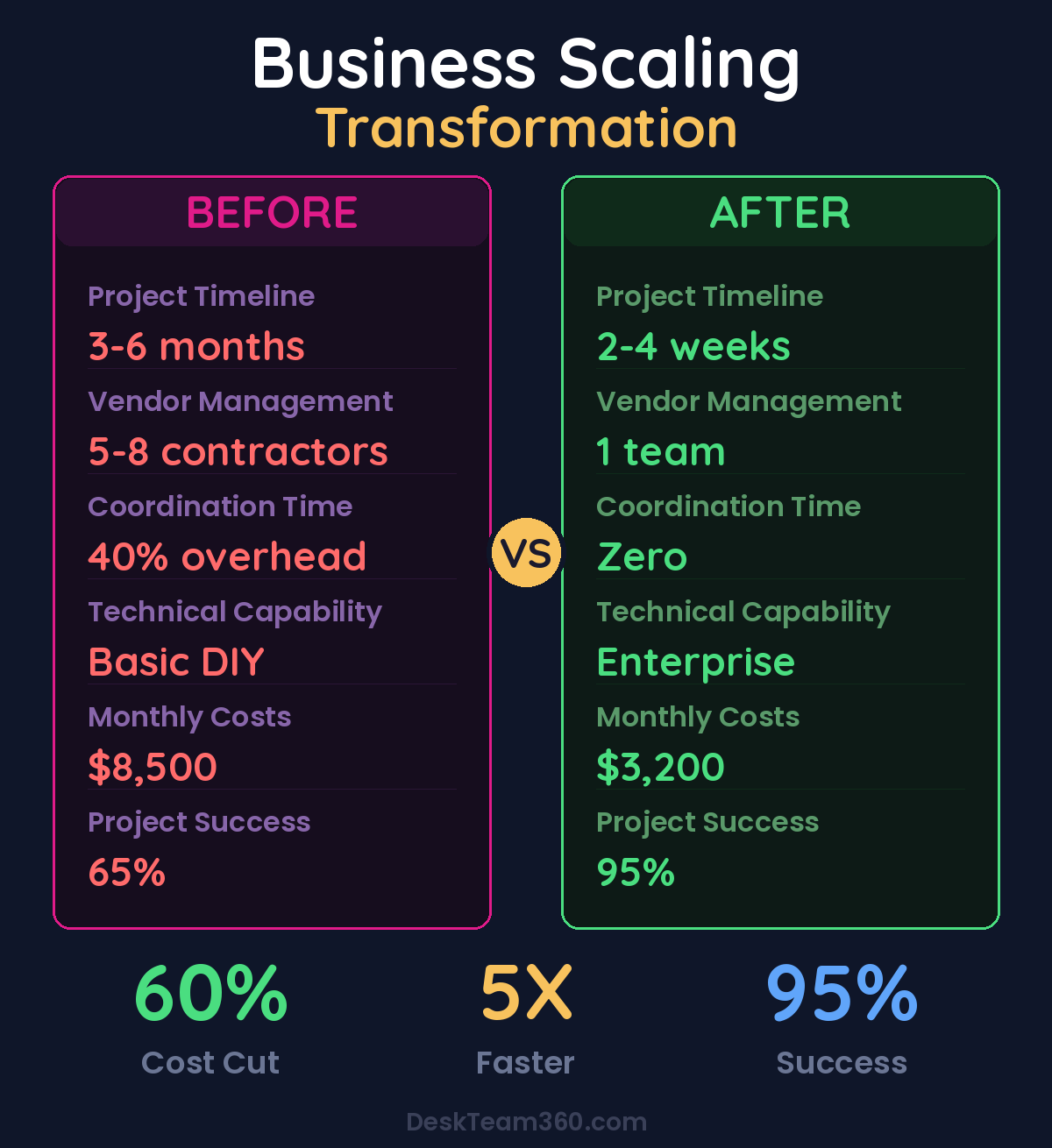
Before finding the right solution, Renee was juggling separate contractors for everything. One company for hosting, another for email issues, a different person for graphics, someone else for lead pages. Each vendor had their own timeline, their own communication style, their own way of doing things.
The worst part? None of them talked to each other. When systems needed to integrate, she became the middleman trying to explain one vendor’s setup to another. “I’d have to pay individually for all of it,” she told me. “But if you’re managing those systems and you don’t have someone on the team, that’s a big time sink instead of trying to be an expert in all things.”
Watch out: The “separate vendor” approach looks cheaper upfront, but hidden costs kill you. Project coordination, communication gaps, incompatible systems, and the time you spend managing it all adds up to way more than a unified solution.
This hits every growth-stage business. You reach a point where you need legitimate technical infrastructure, but you’re not big enough to hire a full internal team. The choice feels like either stay small and handle it yourself, or blow your budget on specialists you can’t afford to keep busy full-time.
The Breakthrough: One Team, All Capabilities
When Renee first heard about our approach, she was skeptical. “Okay, so I pay one monthly fee and I get all the work I need to get done?” The concept was simple but the implications were huge.
Instead of managing multiple contractors, she now had one point of contact for everything: website development, graphic design, system integrations, technical troubleshooting, and ongoing maintenance. One team that already knew how to make different tools work together. One monthly cost that was predictable and scalable.
“In the early days I probably maxed out your team,” she admitted, “and there’s no way I could have afforded everything I needed to get done if it wasn’t for your wonderful service.”
Pro tip: When evaluating any business service, don’t just compare the monthly cost. Calculate the true cost of coordination, delays, and your own time managing multiple vendors. The cheapest option is rarely the most cost-effective option.
The shift happened immediately. “That was shifting two or three websites and all the branding all at the same time, in a short time frame. It was magical how you all pulled it together.” What would have taken months of back-and-forth with separate contractors happened in weeks with a coordinated team.
Real Results: From Survival Mode to Scale Mode
The transformation wasn’t just about efficiency, it was about what became possible. Renee went from avoiding technical projects to confidently planning ambitious integrations.
“Right now we are launching a membership with MightyNetworks and integrating my email system, website, and payment process. There is just so much stuff that needs to go on behind the scenes, and right now DeskTeam360 is integrating that in a powerful way.” This is the kind of project that breaks solopreneurs who try to manage it with separate contractors.
The quality level jumped too. “Amazing graphics. I was trying to portray a message using imagery and I wanted to get the message across that something was harder than a camel going through the eye of a needle. And sure enough they created an amazing graphic with a camel and a needle.” Try explaining that creative brief to three different freelancers and see what you get back.
The Technical Capability That Actually Matters
Here’s what impressed me most about Renee’s story: she stopped trying to become a technical expert herself. “I probably don’t know all the technical names for things because I’m not the technical person. I have DeskTeam360 who handles all of that for me.”
That’s exactly the right mindset. Your job as a business owner isn’t to understand the technical details, it’s to focus on the strategy while someone else handles the implementation. “There is a level of technical expertise and I can’t really describe how they do what they do. All I know is that there is no big issue that we needed help with that they couldn’t handle.”
The key phrase: “they couldn’t handle.” When you have a real technical team, edge cases become solvable problems instead of business-stopping roadblocks. “There’s been a couple of times we had to do some workarounds because some of the original programs wouldn’t allow for certain things to happen. We test it, and work it out, and we’re ready to go.”
That’s the difference between working with specialists and working with generalists who know how to Google things. Specialists find solutions to problems that don’t have obvious answers. If you’re curious about the technical planning process behind complex integrations, our guide on website development project planning covers the framework.
We break this down further in deskteam360 vs no limit creatives: full-service team vs design subscription.
Staying Ahead of the Technology Curve
One advantage Renee mentioned surprised me: “DeskTeam360 brings in the latest and greatest new tools to use technology that people seem to be still catching up to. You’re always ahead of the curve.” This wasn’t something she was looking for initially, but it became a huge competitive advantage.
When your technical team works with dozens of businesses, they see patterns and tools that individual business owners miss. They know what’s working, what’s not, and what’s coming next. “As your clients we get that benefit, and have access to the innovation because you’re on top of things.”
Businesses working with unified technical teams implement 3x more tools than those managing separate contractors, simply because coordination barriers disappear.
From Founder Stress to Team Confidence
The psychological shift was just as important as the technical one. “Because of DeskTeam360 as a leader in an organization we have to say ‘don’t worry we got this’ but the reality is we are thinking ‘man, I hope we got this.’ The reality is DeskTeam360 came through and it was the best faith that I had that everything was going to be alright.”
This is what leadership confidence looks like when you have the right support infrastructure. Instead of crossing your fingers and hoping nothing breaks, you can focus on strategy and growth while someone else handles the execution details.
“It used to be you and me meeting and now my team is meeting with your team. It’s exciting because the scalability of my business has occurred because of the services DeskTeam360 provides.” That’s the goal: growing from founder-dependent to team-dependent operations.
Scaling isn’t just about revenue, it’s about capability. When your business can handle more complex projects, serve more demanding clients, and operate more sophisticated systems, the revenue follows naturally. The constraint is usually technical execution, not market opportunity.
The ROI Math That Convinced Her Board
Renee’s business evolved into a nonprofit, and she had to justify the investment to her board. Here’s how she made the case: “Let’s go ahead and price each individual thing that we need to get done this year to an outsourced solution and you tell me what that would cost, and you tell me what we’d be getting by having a consistent team with DeskTeam360.”
The numbers weren’t close. Individual contractors would have cost 40-60% more for the same scope of work, with lower quality and longer timelines. When you factor in the coordination time, project delays, and compatibility issues that come with managing multiple vendors, the unified approach saved money and reduced risk.
For industry research and benchmarks, check out Clutch.co.
This math applies to any growing business. Price out the individual components of what you need: web development, graphic design, system integration, ongoing maintenance, and technical support. Then add 25-30% for coordination overhead and timeline buffers. That’s your real cost of the “separate contractors” approach.
Understanding the true cost structure helps with more than just vendor decisions. Our article on measuring marketing ROI uses similar frameworks for comparing different approaches to complex business problems.
What This Means for Your Business
Renee’s story illustrates a pattern I see with every business that scales successfully past the solopreneur stage. At some point, you need technical capabilities that you can’t build internally but can’t afford to manage externally with traditional approaches.
The solution isn’t to stay small or blow your budget. It’s to find partners who can provide enterprise-level capabilities at startup-friendly costs and structures. That might mean unified teams instead of individual specialists, monthly retainers instead of project-based billing, or ongoing relationships instead of one-off transactions.
“There’s no way in hell that I could’ve done it without your team,” Renee said, “so thank you for saving my sanity.” But she could have found a way to get the work done. The question is whether it would have been cost-effective, strategically aligned, and scalable for future growth.
If you’re hitting similar bottlenecks in your business growth, the framework is straightforward. List everything you need for the next 12 months. Price it out with individual contractors. Factor in coordination costs and timeline delays. Then compare that to what unified technical support would cost and enable.
Most entrepreneurs are surprised by the math. The unified approach isn’t just more cost-effective, it’s often the only approach that actually works at the scale you’re trying to reach. For additional perspective on building scalable business operations, check out our guide on reducing website bounce rate and our comprehensive overview of creating effective FAQ pages.
Renee went from managing technical headaches to confidently scaling her organization. The difference wasn’t just finding the right team, it was finding the right approach. And that approach is replicable for any business ready to move past the constraints of the solopreneur model.