Smash Wave Has Been Able To Save 20 Hours A Week And Has Tripled Their Profit, “I Couldn’t Have Done It Without DeskTeam360!”
Why Most Marketing Agencies Hit a Revenue Ceiling at $50K/Month
Let’s talk about deskteam360 case study smash wave. There’s a moment every agency owner recognizes. You’re pulling 70-hour weeks, your team is maxed out, and you just landed another $5K website project. You should be celebrating, but instead you’re calculating how many all-nighters it’ll take to deliver without disappointing existing clients.
📋 Table of Contents
That’s exactly where Smash Wave Marketing found themselves in July 2022. Fresh digital marketing agency in Jupiter, Florida, with big ambitions and a dangerous habit of saying yes to everything. Website builds, SEO campaigns, social media management, graphic design. Classic agency growth trap: more clients, same capacity, profit margins shrinking with every new hire.
Twelve months later, they’d tripled their revenue and were selling $10,000 websites they couldn’t have delivered before. Their secret wasn’t hiring more designers or working longer hours. They did something most agencies think is impossible: they found leverage that actually scales.
The Agency Scaling Problem Everyone Ignores
Agency math is brutal when you’re doing everything in-house. Take website builds, the profit center every agency wants to crack. A decent 20-page business website takes 40-60 hours between design, development, content, and revisions. Even paying a good developer $30/hour, your hard costs hit $1,800. Add project management, revisions, and client communication time, and you’re at $2,500 in real costs to deliver a $4,000 website.
That leaves $1,500 gross profit, which sounds great until you factor in sales time, overhead, and the fact that half your projects run over budget. Suddenly your $4,000 website is generating $800-1,200 in actual profit. Scale that across 10 websites and you’ve got a decent month. Scale it across 25 and you’ve got a logistics nightmare.
Smash Wave was living this reality. They were good at what they did. Their clients loved the results. But every new project made the business harder to run, not easier. The owner was spending 20+ hours per week just managing website projects, leaving no time for sales or strategy.
How Smash Wave Broke Through the $50K Ceiling
The breakthrough came when they stopped trying to build everything themselves and started thinking about leverage. Not hiring more people (that makes the coordination problem worse), not automating everything (clients still want human creativity), but finding specialized partners who could deliver agency-quality work at scale.
In August 2022, Smash Wave partnered with DeskTeam360 for their website development and maintenance. Not outsourcing to some random Upwork contractor or overseas dev shop, but working with a team that understood agency workflows and client expectations.
The change was immediate. Instead of spending 20 hours per week project-managing website builds, the Smash Wave team could brief a project on Monday and see polished pages by Wednesday. Client has an existing website with 100+ pages and 250 blog posts? No problem. The DeskTeam360 team takes complex redesign briefs and executes them without the back-and-forth that kills agency timelines.
Pro tip: The magic isn’t in finding cheap developers. It’s in finding partners who understand your business model and can work within your client relationships without breaking them. Quality and communication matter more than cost savings.
The Results: 20 Hours Saved, Revenue Tripled
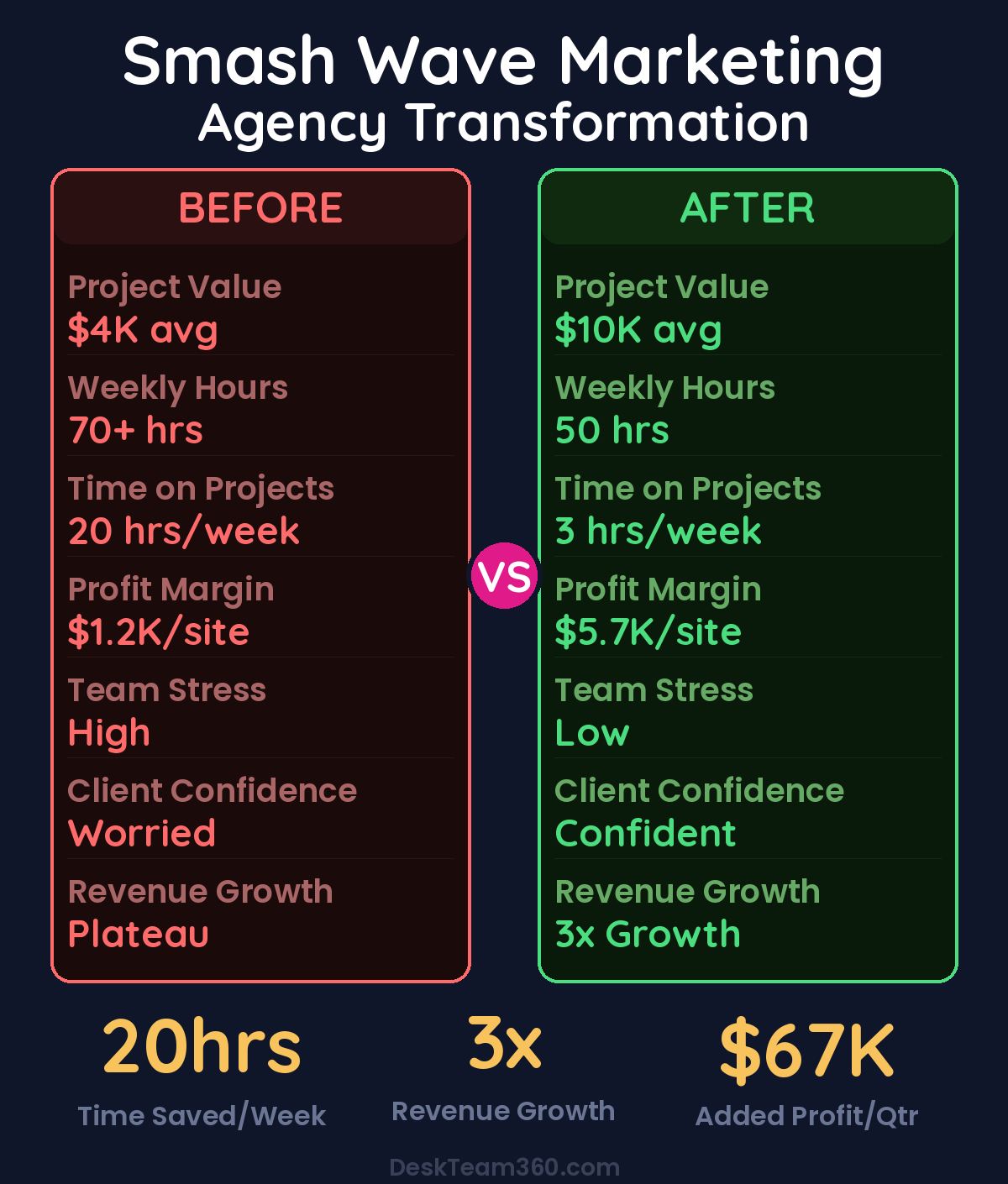
Twelve months after implementing their new workflow, Smash Wave had fundamentally transformed how they operated. The owner went from spending 20 hours per week on website project management to maybe 3-4 hours reviewing final deliverables. That’s 16-17 hours per week freed up for sales, strategy, and actually running the business.
More importantly, they could finally sell bigger projects with confidence. Before the partnership, quoting a $10,000 website meant sleepless nights wondering if they could actually deliver something worth that price. After building a proven delivery system, $10K websites became standard packages they could sell and deliver without stress.
The math is compelling. If you’re saving 20 hours per week at a billing rate of $150/hour, that’s $3,000 in recovered time weekly. Over a year, that’s $156,000 in additional capacity to sell new clients or work on higher-value projects. Factor in the ability to take on bigger website projects (jumping from $4K to $10K average project size), and the revenue impact multiplies quickly.
Smash Wave tripled their revenue within 12 months by focusing on leverage over hiring and specialization over doing everything in-house.
Why Most Agencies Choose the Wrong Outsourcing Partners
Here’s where most agencies get it wrong. They think outsourcing is about finding the cheapest option that can technically do the work. Hire some developers on Upwork for $15/hour and pocket the difference. This approach fails spectacularly about 90% of the time.
The problem isn’t technical skill. It’s understanding how agency businesses actually work. When a client wants a “quick revision” to their homepage hero section, you need a partner who understands that “quick” means same-day turnaround, not next week. When a client describes their vision as “more modern but not too modern,” you need a team that can translate vague feedback into actual design decisions.
Cheap outsourcing fails because it optimizes for the wrong metric. You save money per hour but lose days in communication overhead, quality issues, and revision cycles. Your $15/hour developer becomes a $50/hour nightmare when you factor in management time.
Watch out: Agency outsourcing isn’t about labor arbitrage, it’s about specialization. You want partners who are better at specific functions than your in-house team, not just cheaper. Price shopping for agency services usually backfires.
What to Look For in Agency Partners
Based on Smash Wave’s experience and dozens of similar agency transformations, here’s what actually matters when evaluating outsourcing partners. They should understand your client communication style and be able to work within your existing processes without requiring you to completely change how you operate. They need proven experience with your specific service offerings (website builds, SEO campaigns, whatever your core focus is). Quality control systems that catch issues before they reach your clients. Consistent turnaround times you can build into your project timelines. And transparent pricing that makes sense as your project volume scales up.
Most importantly, they should improve your client relationships, not complicate them. The best agency partnerships are invisible to your clients. They just notice that projects deliver faster and with fewer revisions.
The Hidden Benefits of Scaling Through Partnership
Smash Wave discovered advantages they hadn’t expected. Beyond saving time and increasing revenue, partnering for specialized functions solved problems they didn’t know they had.
No more imposter syndrome. Selling a $10,000 website when you’re not sure your team can deliver it creates constant anxiety. Having proven delivery systems eliminates that doubt. You can sell bigger projects with confidence because you know exactly how they’ll get executed.
Predictable project timelines. When you’re managing everything in-house, every project becomes a custom challenge with unique timelines. Working with specialized partners creates repeatable workflows. You can quote delivery dates and actually hit them.
24/7 coverage for maintenance issues. Website problems don’t happen Monday through Friday 9-5. Having a partner team that can handle urgent fixes means your clients get professional-level support without you building a round-the-clock support structure.
Room to focus on what you’re actually good at. Agencies that try to do everything end up being mediocre at most things. Smash Wave could focus their internal talent on strategy, client relationships, and sales while having world-class execution for technical deliverables.
For a deeper dive, see our guide on agency white label services: the complete guide to scaling without hiring.
The compounding effect is real. Better delivery leads to happier clients, which leads to more referrals and larger projects. Agencies that nail their delivery systems grow faster than those constantly fighting fires with project management.
Building Systems That Scale With Your Agency
The key insight from Smash Wave’s transformation is that growth comes from building systems, not just adding people. Here’s their current workflow for website projects.
Client consultation and discovery happens in-house. Their team captures requirements, understands the business goals, and creates a creative brief. That brief gets handed off to their development partner with clear specifications and timeline expectations. Development and initial testing happen externally with regular check-ins and milestone reviews. Quality assurance and client presentation happen in-house to maintain the relationship.
This division of labor means Smash Wave stays connected to their clients while leveraging specialized skills for technical execution. It scales beautifully because adding more clients doesn’t require proportional increases in their internal team size.
For hosting and maintenance, they’ve white-labeled their partner’s services. Clients sign hosting agreements with Smash Wave, but the actual server management, security updates, and maintenance happen behind the scenes. This generates recurring revenue without requiring them to become a hosting company.
The Economics of Agency Leverage
Let’s break down the actual numbers because the business case is stronger than most agencies realize. Before partnering with DeskTeam360, Smash Wave’s typical website project looked like this: $4,000 project revenue, $1,800 in direct costs (development and design), $800 in project management time, $200 in revision and communication overhead. Net profit: $1,200 per project.
After implementing their partnership model: $10,000 project revenue, $3,500 in partner costs, $500 in project management time (dramatically reduced), $300 in revision costs (better quality control). Net profit: $5,700 per project.
That’s not just 150% more revenue per project, it’s 375% more profit per project with less internal effort required.
Scale that across 15-20 projects per quarter, and you’re looking at an additional $67,500 in quarterly profit just from optimizing one service line. Factor in the time savings (20 hours per week), and they have capacity for additional services or more client acquisition activities.
Common Mistakes That Kill Agency Partnerships
Not every agency outsourcing relationship works out. I’ve watched agencies blow partnerships in predictable ways. Here’s how to avoid the most common pitfalls.
Trying to micromanage every detail. If you’re spending 15 hours per week managing your outsourcing partner, you haven’t actually outsourced anything. You’ve just added complexity. Good partners need clear briefs and regular check-ins, not constant supervision.
Choosing based on price alone. The cheapest option usually requires the most management time. Factor in your true cost per hour when evaluating options. A partner who costs 40% more but requires 60% less management time is probably the better deal.
For industry research and benchmarks, check out Forbes Agency Council.
Not setting clear communication expectations. Different time zones, response time expectations, revision processes, emergency escalation procedures. Hash out the details upfront so there’s no confusion when deadlines get tight.
Expecting perfection immediately. Every partnership has a learning curve. Plan for a few bumpy projects while your partner learns your style and client expectations. Judge the relationship on month three performance, not week one.
Understanding how to create clear documentation for your processes makes the partnership onboarding much smoother.
What This Means for Your Agency
Smash Wave’s story isn’t unique. They identified the bottlenecks in their business and found specialized partners to solve them. The specific numbers will vary for your agency, but the principles are universal.
Look at how you’re spending your time. What activities generate the most revenue per hour? What tasks could be systematized and handed off to specialists? Where are you spending expensive internal talent on work that could be done better and faster by a focused partner?
Most agencies are sitting on 10-20 hours per week of leverage opportunities. Time spent project-managing instead of selling. Internal talent doing routine work instead of strategic thinking. Manual processes that could be systematized.
Pro tip: Start with one service line and perfect the partnership model before expanding. Smash Wave focused on website development first, proved the system worked, then added hosting and maintenance. Trying to outsource everything at once usually creates chaos.
The goal isn’t to become a middleman agency that just resells other people’s work. It’s to build a business where your core team focuses on high-value activities (strategy, client relationships, sales) while having reliable systems for execution.
Ready to Scale Your Agency?
Smash Wave’s transformation from overwhelmed operators to scalable business happened because they stopped trying to do everything in-house and started building systems for growth. The result: tripled revenue, 20 hours per week in saved time, and the confidence to sell bigger projects.
Your agency probably has similar leverage opportunities. The question is whether you’ll keep grinding harder or start working smarter. Building the right partnerships isn’t just about freeing up time, it’s about creating a business that can scale without killing you.
At DeskTeam360, we’ve helped hundreds of agencies break through their growth ceilings by handling their website development, maintenance, and technical execution. Our approach on measuring marketing ROI applies to agency partnerships too. The numbers have to make sense.
If you’re ready to stop being the bottleneck in your own business, the solution isn’t hiring more people or working longer hours. It’s building systems that create leverage. Smash Wave proved it works.