📋 Table of Contents
Wicked Wine Run/Fit Tribe Gym – Launched a New Business in 2 Weeks During Pandemic With DeskTeam360's Help
Two Weeks to Launch a Business During a Pandemic
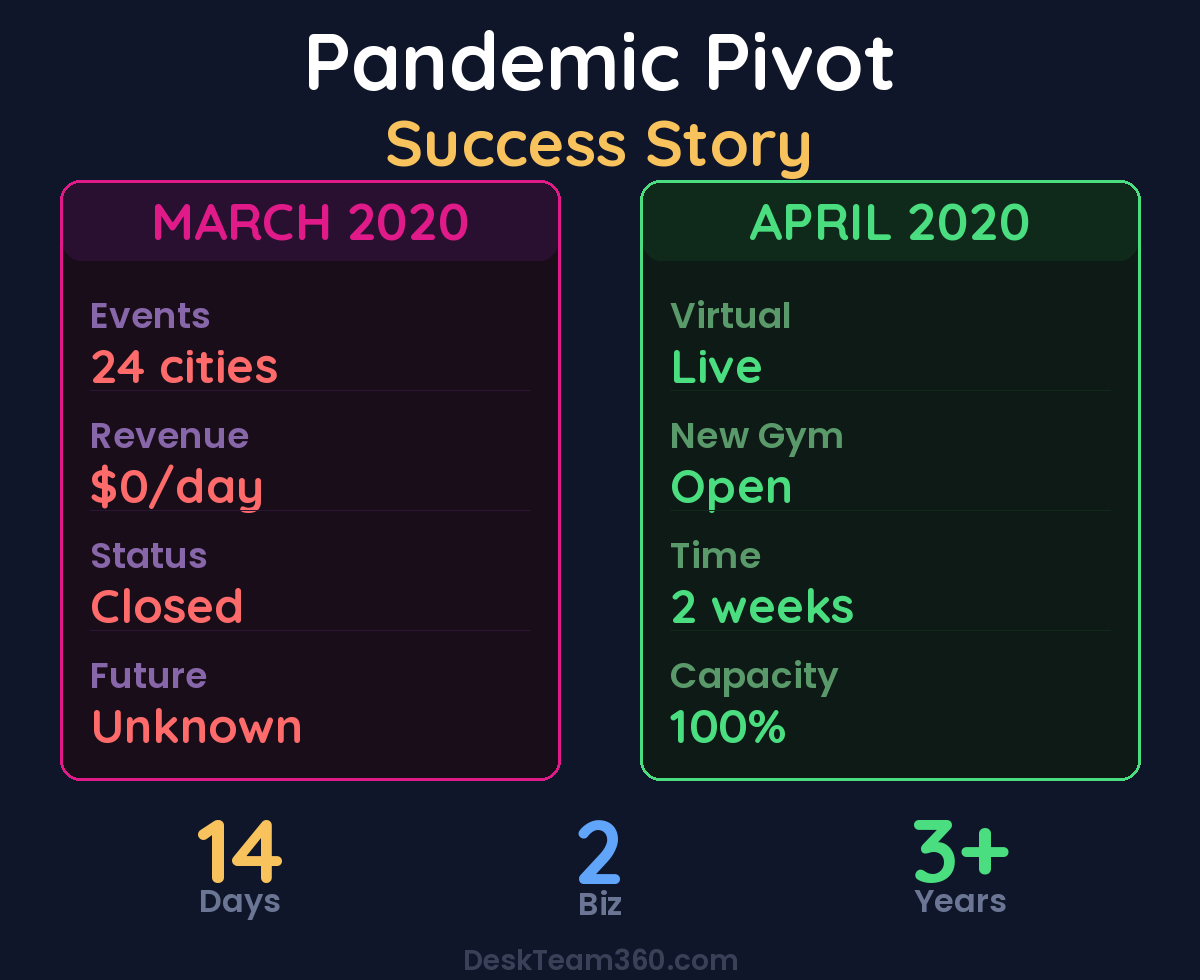
Let’s talk about launch website fast. March 2020. The world shuts down overnight. Krystal Davis watches her Wicked Wine Run events get canceled in 24 cities across the US. Revenue goes to zero instantly.
Most people would panic. Krystal did something different. She called me and said, “Jeremy, we need to pivot to virtual events and rebrand everything. How fast can your team work?” Two weeks later, she had a completely new virtual business running and generating revenue again.
That’s not luck. That’s what happens when you have the right support team in place before the crisis hits.
I’ve worked with 400+ business owners through every kind of disaster — market crashes, supply chain collapses, platform changes that kill traffic overnight. The ones who survive and thrive have one thing in common: they can execute fast when everything changes. And execution speed comes down to having systems and people who can move without you becoming the bottleneck.
When Your Business Model Dies Overnight
Krystal and her husband Sam had built something beautiful. Since 2013, their Wicked Wine Run brand partnered with vineyards to host evening 5K events followed by wine tastings. Think fun fitness meets social drinking, and you’ve got the idea.
By early 2020, they were running events in 24 cities with consistent growth year over year. They had corporate partnerships with Fortune 500 companies. The business was hitting its stride.
Then COVID happened.
Every single event canceled. Zero revenue. Most business owners would spend weeks trying to figure out what to do next. Krystal started planning her pivot before the lockdowns even officially started.
But pivoting fast requires infrastructure. You can’t rebrand 24 cities worth of marketing materials, build new virtual event platforms, and redesign everything yourself in two weeks. That’s where having the right team makes all the difference.
The Two-Week Rebrand That Saved Their Business
Krystal had been working with DeskTeam360 for months before the pandemic hit. Smart move. She’d started small, testing us with graphic design work even though she could do it herself. The difference wasn’t skill — she’s incredibly talented — it was time. An hour of her time was worth more growing the business than perfecting a logo.
When everything shut down, she already trusted our work and knew our speed. So when she needed to completely rebrand Wicked Wine Run for virtual events, she knew exactly who to call.
Here’s what we delivered in 14 days: completely new branding for virtual events, new website with virtual event registration and streaming capabilities, marketing materials for 24 different markets, social media content and graphics for the pivot announcement, email templates for existing customers explaining the change, and landing pages for corporate virtual team-building events.
Most companies would take 6-8 weeks to plan this kind of rebrand. Another 4-6 weeks to execute it. Krystal had paying customers for virtual events before her competitors even decided what to do about the lockdowns.
Pro tip: Speed is everything during a crisis. The first company to market with a solution captures the majority of demand. Being 80% ready and live beats being 100% ready and still planning. Get in market fast, then iterate based on real customer feedback.
Opening a Gym During a Pandemic
While most fitness businesses were closing, Krystal and Sam made another bold move. They opened Fit Tribe Gym, a brick-and-mortar fitness studio in Mansfield, Texas. In the middle of a pandemic.
For a deeper dive, see our guide on 15 small business website mistakes that are costing you customers.
This wasn’t reckless optimism. It was calculated opportunity. Their reputation for service excellence preceded them. They had waiting lists for classes before the doors even opened.
But launching a physical location while running virtual events meant double the workload. New branding for the gym, completely different marketing materials, local advertising campaigns, safety protocol documentation, membership systems, and class scheduling platforms.
Again, speed mattered. The longer they waited, the more competitors would figure out safe reopening protocols. Being first to market with a safe, clean, professional gym experience meant capturing members who were desperate to get back to in-person fitness.
Our team handled everything: gym branding that matched their existing reputation for quality, website development with class booking and payment processing, local SEO optimization for Mansfield-area searches, safety protocol graphics for posting around the facility, social media campaigns targeting their geographic area, and print materials for local business partnerships.
Both locations filled 100% capacity within their first month of operation because they moved fast while competitors hesitated.
Why Most Outsourcing Fails
Before working with us, Krystal had tried the typical approach — different freelancers for different tasks. Graphic designer here, web developer there, copywriter somewhere else. Sound familiar?
Here’s why that approach fails during a crisis: coordination overhead kills speed, different quality standards across vendors, communication breakdowns between team members who don’t work together regularly, no single point of accountability when deadlines slip, higher costs because you’re paying markup to multiple people, and inconsistent branding because nobody sees the full picture.
When the pandemic hit, Krystal didn’t have time to manage five different vendors. She needed one team that could handle everything and move fast without requiring project management from her end.
Watch out: The freelancer marketplace approach seems cheaper upfront but becomes exponentially more expensive during urgent projects. When you need five different people to coordinate on a tight deadline, somebody always becomes the bottleneck. Usually the cheapest one.
The companies that thrive during disruption have unified teams that can execute complex projects without the business owner becoming the project manager. That’s not a luxury during a crisis, it’s a survival requirement.
What Three Years of Partnership Looks Like
Krystal’s been with DeskTeam360 for over three years now, which tells you something important about consistency. Most business owners can’t stand working with the same service provider for three months, let alone three years.
The difference is evolution. Our team learned her style, her preferences, her brand voice. Now when she sends a rough sketch of a supplement label idea, she gets back exactly what she envisioned because we understand how she thinks about design.
Here’s how the relationship works in practice: some weeks she sends zero requests, some weeks she fires off four requests before noon, the team knows her style so revisions are rare, complex projects get delivered without her managing every detail, and she focuses on business growth instead of task management.
Last week she sketched a new label design for their supplement products. Could she have designed it herself? Absolutely, she’s skilled enough. Would it have taken her 2+ hours to get it perfect? Yes. Instead, she spent 5 minutes sketching her idea, sent it to our team, and used those two hours to close a deal with a soccer team for off-season training at the gym.
That’s leverage. Her time goes toward revenue generation and business growth while routine execution happens without her involvement.
For a deeper dive, see our guide on best outsourced marketing services for small business [2026 guide].
The compound effect of good delegation is massive. Two hours saved per week equals 100+ hours annually. That’s 2.5 weeks of full-time work you get back to focus on strategy and growth instead of execution tasks.
The Real Cost of Doing Everything Yourself
Let’s talk numbers, because the math here is compelling for any business owner billing more than $50/hour for their time.
Before DeskTeam360, Krystal spent approximately 8-10 hours per week on design work, website updates, and technical tasks. Her effective hourly rate for business development and training is around $150/hour. That’s $1,200-$1,500 per week in opportunity cost.
Our monthly retainer covers all those tasks for a fraction of that cost. She gets back 8-10 hours weekly to focus on high-value activities like business development, strategic planning, and revenue generation. The ROI payback happens in the first week.
But the bigger win isn’t cost savings — it’s speed and consistency. During the pandemic pivot, doing everything herself would have meant 6+ weeks to launch virtual events. By that time, the market opportunity would have been captured by faster competitors.
Speed isn’t just about getting things done faster. Speed determines which opportunities you can capture versus which ones you miss entirely. This applies whether you’re launching a startup quickly or pivoting an existing business during crisis.
How to Delegate Without Losing Control
The biggest fear business owners have about outsourcing is quality control. What if the work doesn’t match your standards? What if timelines slip? What if the team doesn’t understand your vision?
Here’s how Krystal solved this: she started small with low-risk projects to test quality and communication, provided clear examples of what she liked and didn’t like, established regular check-in points for larger projects, and gradually increased project complexity as trust built over time.
The key insight is that delegation isn’t about losing control — it’s about systematizing control. Instead of controlling every task directly, you control standards, processes, and outcomes. The work gets done to your standards without requiring your direct involvement.
Pro tip: Start delegation with projects that have clear success criteria and low downside risk. Graphic design work, social media content, or website updates are perfect starting points. Save high-stakes strategic work until you’ve established trust and communication patterns.
For insights on measuring the ROI of business investments like outsourcing, our guide on calculating marketing ROI covers the framework that applies to any business expense.
Why Ego Kills Outsourcing Relationships
Here’s something Krystal mentioned that I think is critical: “They have the experience but they don’t have ego. Never once have I encountered any ego with anybody from the team.”
This is huge. Most freelancers and agencies want to prove how smart they are. They argue with your vision, suggest unnecessary changes, or push their preferred tools and methods instead of adapting to yours.
Professional service providers understand their role: execute your vision, not substitute their vision for yours. The goal is making you successful, not showcasing their creative genius.
When someone has experience without ego, they can suggest improvements without fighting you when you choose a different direction. They can bring expertise to the table while still staying in service of your goals.
That’s the difference between a team member and a vendor. Team members want you to win. Vendors want to prove they’re right.
For industry research and benchmarks, check out Clutch.co.
Building Crisis-Proof Business Operations
The pandemic taught us that any business model can disappear overnight. Supply chains break. Platforms change algorithms. Regulations shut down entire industries. Economic recessions eliminate customer budgets.
The businesses that survive and thrive have built-in agility. They can pivot business models, rebrand quickly, launch new products, and adapt to changing markets without the execution becoming the limiting factor.
That agility comes from having systems and people in place before you need them. Krystal wasn’t scrambling to find designers and developers during the crisis — she already had trusted relationships and proven processes. Building those relationships requires following outsourcing best practices from the start.
When the world changed, she could focus on strategy and adaptation while execution happened automatically in the background. That’s what separated her from competitors who spent months just trying to figure out how to implement their pivot plans.
For business owners looking to improve their operational efficiency, our guide on reducing operational costs covers strategies that apply across industries.
The 2024 Competitive Advantage
Fast execution is becoming the ultimate competitive advantage. Product quality is table stakes — everybody can build good products now. Customer service is expected — it’s not a differentiator anymore. What separates winners from losers is speed to market and speed of adaptation.
The companies that can conceptualize, design, build, and launch new initiatives in weeks instead of months are capturing opportunities while their competitors are still in planning mode. The companies that can pivot entire business models in days instead of quarters are surviving disruptions that kill their slower competitors.
This isn’t about being reckless or cutting corners. It’s about having the infrastructure to move fast when opportunities arise or when adaptation becomes necessary for survival.
Krystal’s story isn’t unique because she’s exceptionally talented (though she is). It’s unique because she built the capability to execute fast before she needed it. When the crisis hit, she had the team and systems to pivot immediately while competitors spent months figuring out basic logistics.
Your Two-Week Challenge
Here’s what I want you to think about: if your primary business model disappeared tomorrow, how fast could you pivot to something new? Do you have the team and systems to rebrand, rebuild, and relaunch in two weeks? Or would you spend months just trying to coordinate the execution?
Most business owners realize they couldn’t move that fast, and that’s a massive vulnerability in today’s economy. Markets change overnight. Customer preferences shift. New technologies disrupt entire industries. Regulations can eliminate business models instantly.
The time to build execution capability is before you need it, not during the crisis. Krystal’s success during the pandemic wasn’t luck — it was preparation meeting opportunity.
At DeskTeam360, we’ve helped hundreds of business owners build the execution infrastructure that allows them to move fast when opportunities arise or adaptation becomes necessary. We handle the design, development, and implementation so you can focus on strategy and business development.
Whether you’re planning a pivot, launching a new product line, or just want the peace of mind that comes from knowing you can execute fast when needed, we’re here to help you build that competitive advantage.