
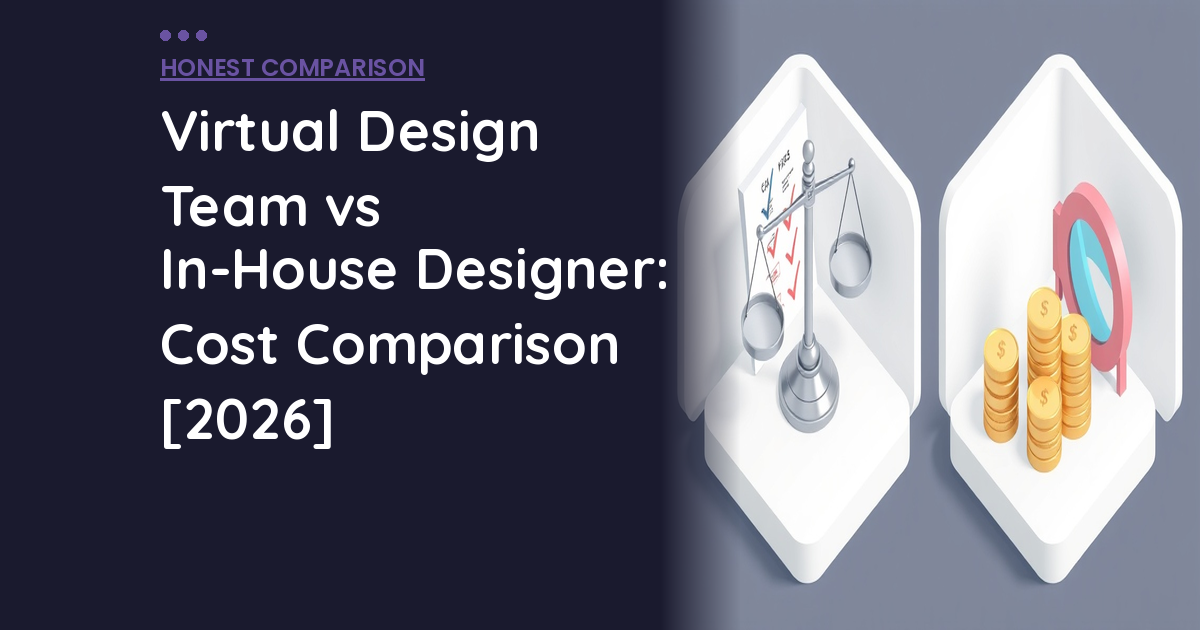
Virtual Design Team vs In-House Designer: Cost Comparison [2026]
Why I Almost Fired My In-House Designer in a Panera Parking Lot
Let’s talk about virtual design team. I was sitting in a Panera parking lot in 2019, staring at a spreadsheet on my laptop, and I wanted to throw the thing out the window.
📋 Table of Contents
I’d just added up what our in-house designer was actually costing us. Not the salary number I’d agreed to. The real number, with benefits, software licenses, the desk she sat at, the health insurance, the two weeks she took off, and the three weeks she was “working” but really just not producing much.
The number was $127,000. For one person. Who could do web design but couldn’t touch print. Who was great at brand stuff but needed a freelancer for every landing page build.
That was the moment I started researching what a virtual design team could actually do. And honestly? It changed everything about how I run DeskTeam360 today.
Look, if you’re trying to figure out whether to hire a designer or go virtual, you’re asking the right question. But most people get the answer wrong because they’re only looking at salary. I made that mistake for years. Let me save you the headache.
The Real Cost of an In-House Designer (Spoiler: It’s Brutal)
When I hired my first in-house designer, I thought I was being smart. “Sixty-five grand a year, she’s all mine, no more chasing freelancers.” Right?
Wrong. So wrong.
According to the Bureau of Labor Statistics, the median salary for graphic designers in 2024 was around $58,910. But mid-level designers with 3-5 years of experience in metro areas? You’re looking at $55,000 to $80,000 base. A senior designer or creative director pushes $90,000 to $150,000 and up.
Here’s the thing. Salary is maybe 55-60% of what you’re actually paying. Let me break down a $70,000 mid-level designer’s real cost.
Base salary is $70,000. Benefits and taxes add another 30%, which is $21,000. Health insurance alone runs $6,000 to $15,000 a year, plus 401k match, unemployment insurance, employer-side Social Security. Equipment and software runs about $5,000. MacBook Pro every 3 years, monitors, Adobe Creative Suite, Figma Pro. Office space costs around $6,000, even a modest desk allocation runs $500 a month. Training adds $2,500 for conferences, courses, certifications. Then there’s management overhead at 20%, which is $20,900 for recruiting costs, HR time, performance reviews, onboarding.
Total: $125,400 a year. That’s nearly 80% more than the salary you shook hands on.
Watch out: Your designer isn’t designing 40 hours a week. Studies from Atlassian found the average employee spends only about 60% of their time on actual productive work. Meetings eat 15-20%. Admin tasks take another 10%. You’re getting maybe 25 hours of design out of a 40-hour week.
So that $125,400? Divide it by actual productive hours and you’re paying about $96 per hour of real design work. For one person. With one skill set.
I learned this the hard way over 12 years and more than $1M spent on outsourcing and hiring. You don’t have to.
Free Template
The Ultimate Task Delegation Template
Stop guessing what to hand off. This template shows you exactly what to delegate, how to brief it, and how to QA the results.
Get the Free Template →
What a Virtual Design Team Actually Looks Like
When most people hear “virtual design team,” they picture a random freelancer on Upwork sitting in their pajamas missing deadlines. I get it. I’ve been burned by that exact scenario more times than I can count.
But a real distributed creative team is completely different. Here’s what I mean.
At DeskTeam360, our team sits in one physical office in Indonesia. Not scattered remote workers, an actual office with desks, managers walking the floor, and real-time collaboration happening all day. For the cost of one mid-level in-house designer, our clients get 2 specialized designers covering brand, web, print, and digital. They get 2 developers handling front-end, back-end, and WordPress. They get 2 virtual assistants for project support and admin. They get 1 team leader doing quality control. And they get 1 account manager who’s your single point of contact.
That’s 8 people. Eight. For less than what you’d pay one designer in Phoenix or Austin.
Side-by-Side Cost Comparison: In-House vs Virtual vs Freelancer vs Agency
I’ve tried all four of these. Some for years. Here’s what the numbers actually look like in 2026.

In-House Designer costs you $85,000 to $125,000 annually. That’s total cost, not just salary. What you get is 1 person, around 25 productive hours per week, limited to their specialty. The catch? They go on vacation. They call in sick. They quit, and now you’re scrambling for 2-3 months to hire and train a replacement. I’ve lived that nightmare twice.
Freelancers cost $36,000 to $120,000 annually, wildly variable. What you get is 1 person, usually specialized in one thing, availability is a coin flip. The catch is you become the project manager. I once had a freelancer ghost me mid-project on a client website launch. 2am on a Saturday, I’m rebuilding the homepage myself. Never again.
Traditional agencies cost $100,000 to $500,000 and up on retainer. What you get is a team of 3-8, full capabilities, professional processes. The catch? You’re paying for their fancy office, their account managers’ account managers, and their 40% profit margins. According to Clutch.co’s agency pricing research, the average small business spends $10,000 to $50,000 per month on agency services. That’s insane for most companies under $5M.
Virtual design teams like DeskTeam360 cost $60,000 to $120,000 annually. What you get is a 6-8 person team, multiple specializations, built-in QA, account management included. The catch? It’s remote. You need to be comfortable with async communication and clear briefs. But if you’ve managed anyone remotely since 2020, you already know how to do this.
When you break it down to cost per productive design hour: In-house costs around $96 per hour, freelancers run $50-$150 per hour and you’re managing them, agencies cost $150-$300 per hour, virtual teams run around $42 per hour with project management included.
I didn’t believe these numbers when I first ran them either. But after serving 400+ clients and processing over $2.5M through our platform with zero chargebacks, the data is pretty clear.
When In-House Still Makes Sense
I’m not going to pretend in-house never works. That’d be dishonest. There are real scenarios where hiring makes more sense.
You need 6+ hours of design every single day. If you’re an e-commerce brand launching products daily or a SaaS company iterating UI constantly, a dedicated person might pencil out. Your brand is your product. Fashion companies, luxury brands, design agencies. If design IS the thing you sell, you probably need in-house creative leadership. You need same-hour turnaround regularly. Media companies, event businesses, crisis comms. If “I need this in 45 minutes” is a weekly thing, in-house gives you that. Extreme IP sensitivity matters. Defense contractors, medical devices, heavily regulated finance. Some industries need everything on-site and locked down.
But here’s the honest truth: most businesses don’t fit those categories. Most businesses have variable design needs. Busy months and slow months, big projects and small tweaks. And paying $125K for one person to handle that roller coaster? The math just doesn’t work.
When a Virtual Team Wins (Most of the Time)
Going virtual makes the most sense when your workload is uneven. Some weeks you need 30 hours of design, some weeks you need 5. A team flexes with you. An employee costs the same either way. You need multiple skills. Web design Monday, social graphics Tuesday, email template Wednesday, brand refresh Thursday. One designer can’t do all of that well. A team can.
You want predictable costs. A Deloitte Global Outsourcing Survey found that 59% of businesses cite cost-cutting as their primary reason for outsourcing. But the real win is predictability. Flat monthly rate, no surprise invoices, no overtime costs. You’re tired of being the project manager. When you hire freelancers, YOU manage them. A virtual team comes with management built in. You send a brief, you get deliverables. That’s it.
I talk to agency owners every week who are drowning in freelancer management. They’ve got a web developer in Eastern Europe, a graphic designer in the Philippines, a copywriter in California. They spend 10 hours a week just keeping everyone coordinated. That’s not running a business. That’s being a traffic cop.
How to Make the Switch Without Losing Your Mind
If you’re thinking about moving from in-house or freelancer chaos to a virtual design team, here’s how I’d do it. This is the same process I’ve walked dozens of our clients through.
Month 1: Test the waters. Don’t go all-in day one. Pick 3-5 projects that aren’t mission-critical. Social media graphics, sales collateral updates, a landing page refresh. Send those to your virtual team and see how the workflow feels. Get comfortable with the briefing process.
For industry research and benchmarks, check out Search Engine Journal.
Months 2-3: Expand the scope. Start routing more complex work over. Website redesign pages. Email campaigns. Branded presentations. This is where you’ll see whether the quality holds up and the communication works. Spoiler: with a good team, it does.
Months 4-6: Full transition or hybrid. By now you know if this works for your business. Most clients go one of two ways. Full virtual means transitioning all design and development to the virtual team. This works great for companies under $5M revenue. Hybrid means keeping a creative director in-house for brand strategy and oversight, letting the virtual team handle all execution. This is the sweet spot for $5M+ companies.
The hybrid model is something I see more and more smart businesses doing. Your in-house creative director runs at $90K-$130K. Your virtual execution team handles production at $60K-$100K. Total investment: $150K-$230K for what used to require 3-4 full-time hires at $350K+.
For detailed guidance on managing remote teams effectively, we’ve covered the fundamentals that apply whether you’re coordinating freelancers or a full virtual department.
Making Your Call in 2026
Here’s where I’ll be real with you. The design world has shifted hard since 2020. Remote work went from “weird” to “default.” Cloud design tools like Figma made collaboration seamless across time zones. And companies like ours built real infrastructure around the virtual model. Physical offices, trained teams, QA processes.
A McKinsey report found that companies accelerated their digital transformation by 3-4 years during the pandemic. That includes how they build and manage creative teams. The businesses that adapted? They’re spending less and getting more done. The ones still clinging to “I need a butt in a seat”? They’re overpaying for less.
Pro tip: Here’s my decision framework, distilled from 12+ years of trial and error. If your design budget is under $100K per year, go virtual. No question. You’ll get 3-4x the output of a single hire. If your budget is $100K-$200K, go virtual or hybrid depending on how brand-critical your work is. If your budget is $200K+, consider the hybrid model with an in-house creative lead plus virtual execution team.
The bottom line? For most small and mid-size businesses, a virtual design team gives you more talent, more flexibility, and more output at a lower total cost. The 30-50% savings are nice. But what really matters is getting your time back. You started your business to grow it, not to manage designers.
Understanding how to measure marketing ROI applies to your creative investments too. Whether you’re evaluating design costs or campaign performance, the same principles help you make data-driven decisions. And if you’re looking to optimize your entire outsourcing strategy beyond just design, we’ve written about the broader considerations that affect most growing businesses.
At DeskTeam360, we’ve built virtual design systems internally and helped our clients do the same, from team selection to workflow optimization to ongoing quality control. We handle the coordination so you can focus on running your business. After 12 years of testing every model imaginable, I can confidently say that for most businesses under $10M, a well-managed virtual team beats in-house hiring on cost, flexibility, and results.
If you want to see what our approach looks like for content marketing strategy or any other creative work, the same principles apply. Clear communication, defined processes, built-in quality control, and predictable costs. That’s how you scale creative work without scaling creative headaches.
Free 5-Minute Video
See How DeskTeam360 Works in Under 5 Minutes
Watch the short video and see exactly how we handle design, development, and marketing implementation — so you don't have to.
Watch the Video →