


How to Hire a Graphic Designer: Full-Time vs Freelance vs Subscription
Your Brand Looks Like Amateur Hour
Figuring out how to hire a graphic designer doesn’t have to be complicated. Your website screams 2019. Your social media graphics look like they were made in PowerPoint by someone’s nephew. Your marketing materials have that unmistakable “I did this myself” vibe that makes potential customers scroll past without a second thought.
📋 Table of Contents
Meanwhile, your competitor just launched a complete rebrand that makes your stomach turn, not because it’s bad, but because it’s so much better than yours. Their Instagram looks like a Fortune 500 company. Their website converts at double your rate. Their entire visual presence commands attention and builds trust instantly.
I’ve been running agencies for 12+ years, and I’ve seen this story play out hundreds of times. The business owners who figure out design hiring early pull ahead of their competition and command premium pricing. The ones who don’t? They spend years fighting uphill against amateur visuals that undermine everything else they’re doing right.
Here’s what most people get wrong about hiring graphic design help. It’s not just about finding someone who can use Photoshop. It’s about matching your business needs with the right type of relationship, at the right price point, with the right expectations. Get this wrong and you’ll waste months and thousands of dollars. Get it right and you’ll build a visual brand that actually grows your business.
The Three Ways to Get Professional Design
You have exactly three viable options for getting professional graphic design work done: hire a full-time designer, work with freelancers project by project, or subscribe to an unlimited design service. Each approach works brilliantly in specific situations and fails miserably in others.
The businesses that nail this decision build consistent, professional visual brands that convert customers and justify higher prices. The ones that blow it spend years with inconsistent, amateur-looking design work that makes them look smaller than they actually are.
 vs Subscription graphic designer hiring options” style=”max-width:100%;height:auto;border-radius:12px;box-shadow:0 4px 20px rgba(0,0,0,0.08);” width=”1200″ height=”3670″>
Full-Time: The Premium Control Option
A full-time graphic designer makes sense when design is core to your business model and you can keep someone busy 40+ hours weekly. Marketing agencies, e-commerce brands, product companies, and businesses launching 2-3 campaigns monthly typically hit this threshold.
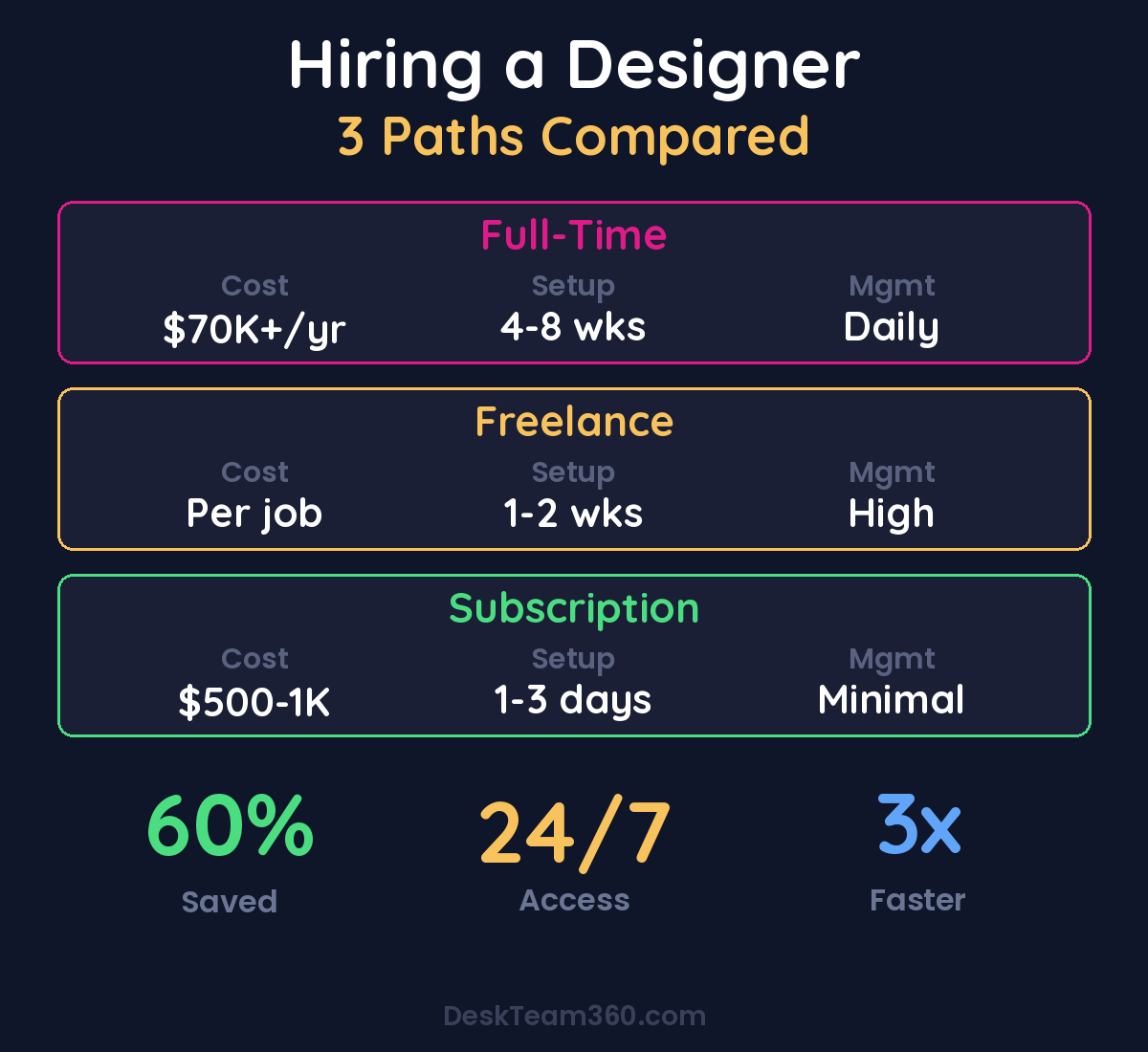
You’re looking at $70K-$90K in salary plus benefits, equipment, software, and office space. Total cost easily hits $100K+ annually. But if you need 50+ design pieces monthly with tight deadlines and complex brand requirements, the math works.
Pro tip: Full-time designers specialize. Your social media expert probably can’t design packaging. Your web designer might struggle with print materials. Factor specialization gaps into your hiring decision.
Freelance: Maximum Flexibility, Maximum Management
Freelance designers excel for specific projects with defined scopes. Logo redesigns, website mockups, product packaging, or campaign-specific graphics where you need specialized skills for a limited time.
Pricing varies wildly based on experience and project complexity. Social media templates run $50-$150 each. Logo design ranges from $500-$5,000. Complete brand packages cost $3,000-$15,000 from quality designers.
The hidden cost is project management time. You’re handling discovery calls, reviewing portfolios, negotiating rates, providing briefs, managing revisions, and coordinating deadlines. For complex projects, that’s easily 10-15 hours of your time before seeing the first concept.
Subscription Services: The New Standard
Design subscriptions operate on unlimited requests for a flat monthly fee, typically $500-$1,500 depending on turnaround speed and service level. Submit requests through their platform, get initial concepts in 1-3 days, provide feedback, get revisions until you’re satisfied.
This model works best when you need design assets regularly but can’t justify a full-time salary. Most services handle social media graphics, web elements, presentations, print materials, and basic illustration work.
Free Template
The Ultimate Task Delegation Template
Stop guessing what to hand off. This template shows you exactly what to delegate, how to brief it, and how to QA the results.
Get the Free Template →
The Real Cost Breakdown
Let’s run the numbers for a growing business that needs about 20-25 design pieces monthly across social media, web, and marketing materials.
Full-time approach: $85K salary plus $15K in benefits and overhead equals roughly $8,300 monthly. You get unlimited work but you’re locked into that cost whether you use their full capacity or not. Hiring and onboarding takes 4-8 weeks minimum.
Freelance approach: Social graphics at $75 average, web banners at $125, presentation slides at $200. You’re looking at $2,500-$4,000 monthly for equivalent volume, plus significant project management overhead. Setup time is 1-2 weeks per project to find, vet, and brief new designers.
Subscription approach: $500-$1,500 monthly depending on turnaround requirements and complexity levels you need. Setup takes 1-3 days to establish brand guidelines and submit your first batch of requests.
For most growing businesses, design subscriptions deliver 60% cost reduction compared to equivalent freelance work, with 3x faster setup times and zero ongoing project management.
When Each Option Actually Makes Sense
The decision framework is simpler than most business owners make it. Don’t overthink this.
Choose Full-Time When:
Design directly impacts your revenue and you can keep someone busy 40+ hours weekly. You’re a marketing agency, e-commerce company, or product business where visual assets are core to your offering. Your design needs are complex enough to require deep brand knowledge and creative strategy, not just execution.
You also need experienced management to direct creative work. Full-time designers require clear briefs, actionable feedback, and steady workflow management. If you’ve never managed creative talent before, factor that learning curve into your timeline and budget.
Choose Freelance When:
You need specialized skills for specific, time-limited projects. Package design for a new product launch. Website redesign with complex user experience requirements. Brand identity development where you want to explore multiple creative directions before committing.
Your design needs are truly sporadic, maybe 5-10 pieces quarterly, and you have bandwidth to manage vendor relationships and project timelines personally.
Choose Subscription When:
You need 15+ design pieces monthly but can’t justify a full-time hire. Speed matters more than finding the absolute perfect designer for each individual project. You want predictable monthly costs without project-by-project negotiations and scope discussions.
Your design requirements are diverse but not highly specialized. Social media graphics, web banners, presentation templates, marketing materials, basic illustration work. Standard business design needs that don’t require deep technical expertise.
Implementation: How to Actually Make This Work
Picking the right approach is only half the battle. Execution determines whether you get professional results or waste time and money on subpar work.
For a deeper dive, check out our guide on outsource annual report design: from boring data to compelling visuals.
Setting Up Full-Time Design Right
Start recruiting before you desperately need help. Quality designers evaluate multiple offers and negotiate timelines. Create a portfolio of work you admire from inside and outside your industry. Define the role clearly: are they executing your creative vision or developing it?
Establish review processes and feedback chains upfront. Nothing kills designer productivity faster than unclear approval workflows or contradictory feedback from multiple stakeholders. Budget for professional tools: Adobe Creative Cloud, Figma subscriptions, stock photo access, and equipment updates aren’t optional.
Managing Freelancer Relationships
Develop template creative briefs that cover project scope, timeline, budget, brand guidelines, deliverable formats, and revision limits. Having these documented prevents 90% of scope creep disasters.
Build relationships with 2-3 designers in different specialties rather than starting from scratch for every project. Pay promptly and provide clear, actionable feedback. Good freelancers have options, so treat them professionally and you’ll get priority scheduling.
Watch out: Always require source files and outlined fonts from freelancers. I’ve seen businesses trapped with unusable designs because they only received final JPEGs. Own your creative assets completely, or you’ll regret it later.
Optimizing Design Subscriptions
Establish comprehensive brand guidelines before submitting your first request. Color palettes, font selections, logo usage rules, tone preferences, and style examples. The clearer your guidelines, the faster you’ll get usable results without multiple revision rounds.
Submit requests in strategic batches rather than one at a time. Most services work more efficiently when they can see your full monthly pipeline and prioritize accordingly. Be specific with feedback and reference examples. “Make it more modern” isn’t actionable. “Use our secondary blue and increase font weight to match our website headers” gets results.
Common Mistakes That Waste Money
I’ve watched hundreds of businesses approach design hiring, and the mistakes are painfully predictable.
Choosing based purely on cost. Design directly impacts customer trust and conversion rates. Saving $100 per project on mediocre work costs thousands in lost sales and weakened brand perception.
Not establishing brand standards first. Every designer interprets “clean and modern” differently. Without documented guidelines, you’ll get inconsistent results regardless of talent level.
Mixing multiple approaches without coordination. Using freelancers for some projects, subscriptions for others, and internal team members for overflow creates visual inconsistency that confuses customers and weakens market positioning.
Underestimating management requirements. Every design relationship needs briefing, feedback, revision coordination, and file organization. Factor this time investment into your decision, especially with freelancers where management overhead is highest.
For industry research and benchmarks, check out HBR on Outsourcing.
The DeskTeam360 Approach: Why Subscription Services Win
At DeskTeam360, we’ve tested every approach to design hiring across our 400+ clients. Full-time works for large marketing agencies and e-commerce companies. Freelance makes sense for specialized projects with tight deadlines.
But for most growing businesses? Design subscriptions deliver the best combination of quality, speed, cost predictability, and management simplicity. You get professional design assets without the hiring headaches, project management overhead, or budget uncertainty that comes with other approaches.
Our design subscription service operates exactly like our other specialized teams. Unlimited requests, predictable turnarounds, consistent quality, and a dedicated project manager who understands your brand guidelines and business objectives. You submit requests through our client portal and get professional design assets back within 1-3 business days, every time.
Here’s why our subscription model works better than freelancers or agencies. No project scoping calls. No hourly negotiations. No surprise invoices. Just professional design work delivered consistently, month after month, at a flat rate you can budget around.
We’ve optimized our process across social media graphics, web design elements, presentation templates, marketing materials, and brand asset development. Our team handles everything from initial concepts through final revisions, so you get exactly what you need without managing multiple vendor relationships.
Making the Decision: Your Five-Minute Framework
Calculate your monthly design volume and multiply by average freelance costs in your market. If that number exceeds $3,000 monthly and you can provide creative direction, consider full-time hiring. If it’s under $1,000 monthly or highly irregular, stick with project-based freelancers.
If your monthly design needs fall between $1,000-$3,000 in freelance equivalent costs, subscription services almost always win on total cost of ownership and management simplicity.
Factor in your available management bandwidth. Both full-time employees and freelance relationships require significant oversight and project coordination. Design subscriptions handle most project management internally, which matters more than cost differences if you’re already stretched thin running other business functions.
Consider timeline requirements. Need assets for a campaign launching next week? Subscription services can usually accommodate rush requests within their normal workflow. Freelancers might be booked solid. Full-time hiring takes months to complete.
Build a Visual Brand That Actually Converts
Professional design isn’t a luxury expense, it’s a business requirement. Your visual brand either reinforces your market position or undermines it. Customers make trust decisions within seconds based on how polished your materials look, and those snap judgments directly impact your conversion rates and pricing power.
The businesses that get design hiring right build consistent visual identities that justify premium pricing and generate customer loyalty. The ones that get it wrong spend years fighting against amateur-looking marketing materials that make them appear less established than their actual capabilities warrant.
Your design approach should scale with your business growth and operational complexity. Start with what matches your current volume and management capacity, but build relationships and processes that can evolve as your requirements expand.
Ready to build a professional visual brand without the hiring headaches? Our design team handles everything from brand development through ongoing asset creation, delivered through the same reliable subscription model that our 400+ clients use for other specialized functions. We understand growing businesses need predictable costs and consistent quality, not project management overhead and budget surprises.
Free 5-Minute Video
See How DeskTeam360 Works in Under 5 Minutes
Watch the short video and see exactly how we handle design, development, and marketing implementation — so you don't have to.
Watch the Video →