


How to Outsource Graphic Design for Agencies (The White-Label Guide)
Why Most Agencies Get Graphic Design Outsourcing Backwards
When you outsource graphic design for agencies, you’re making a strategic move. Here’s a conversation I’ve had with agency owners at least fifty times in the past five years. They’re swamped with design work, missing deadlines, and burning out their in-house team. So they decide to outsource. Fast forward three months, and they’re dealing with off-brand deliverables, constant revision cycles, and clients asking why the work looks different than before.
📋 Table of Contents
They made the classic mistake, treating design outsourcing like ordering from a menu instead of building a white-label extension of their team. There’s a massive difference between the two, and understanding it will save you months of frustration and thousands in lost revenue.
I’ve built and scaled outsourced teams for 400+ clients across twelve years. I’ve seen every possible way this can go wrong and the handful of ways it goes right. Here’s exactly how to outsource graphic design while maintaining your brand quality and client relationships.
The Hidden Cost of Bad Design Outsourcing
Let’s start with why this matters. When you outsource design badly, you don’t just get subpar work, you create operational chaos that ripples through everything else you do.
Bad outsourcing means spending half your day managing revisions instead of winning new business. Your account managers waste time playing design police instead of expanding client relationships. Your clients start questioning your capabilities because deliverables feel inconsistent. You end up working nights and weekends to fix work that should have been right the first time.
Agencies that outsource design poorly spend 35% more time on project management and see client satisfaction drop by an average of 18%.
The agencies that get this right see the opposite. Their design capacity scales seamlessly. Project timelines compress. Client satisfaction goes up because they’re delivering more creative options faster. Most importantly, the agency owner gets their time back to focus on growth instead of playing creative director on every single asset.
Free Template
The Ultimate Task Delegation Template
Stop guessing what to hand off. This template shows you exactly what to delegate, how to brief it, and how to QA the results.
Get the Free Template →
White-Label vs Project-Based: Choose Your Pain
There are exactly two ways to outsource design work, and the choice you make determines everything that comes after.
Project-based outsourcing is what most agencies try first. You find freelancers or design studios, send them briefs, and hope what comes back matches your vision. It’s cheap upfront, requires no ongoing commitment, and gives you access to specialized talent for specific projects.
It’s also a management nightmare. Every project starts from scratch. Brand guidelines get interpreted differently by each designer. Quality varies wildly. You spend massive amounts of time briefing, reviewing, and revising. And when you find someone good, they’re usually not available when you need them most.
White-label partnerships flip this completely. You work with one design team that becomes an extension of your agency. They learn your brand standards, understand your client types, and develop institutional knowledge about what works and what doesn’t. The best white-label teams can replicate your internal design style so closely that your clients never know the work was outsourced.
The white-label advantage isn’t just consistency. It’s predictability. When you know exactly what you’re going to get, when you’re going to get it, and what it’s going to cost, you can scale confidently. Project-based outsourcing keeps you guessing on all three.
The trade-off is commitment. White-label partnerships require ongoing retainer relationships, dedicated time for onboarding and training, and clear communication protocols. But for agencies doing more than 20 design pieces per month, the economics strongly favor white-label.
The Four Pillars of Successful Design Outsourcing
Whether you go project-based or white-label, four things determine success or failure. Get any one wrong, and the whole system breaks down.
Pillar 1: Crystal Clear Brand Standards
Your design guidelines need to be so specific that someone who’s never seen your work before can produce on-brand assets. I’m not talking about a one-page mood board. I mean comprehensive documentation that covers typography hierarchies, color applications, logo usage rules, spacing standards, and approved design elements.
The best agencies I work with create sample templates for every type of asset they regularly produce. Social media posts, email headers, presentation slides, web graphics. Each template includes annotation callouts explaining why specific choices were made. It takes a week of focused work to create this documentation, but it eliminates 90% of revision cycles down the line.
Pillar 2: Structured Feedback Loops
Design review can’t be an afterthought. You need standardized feedback formats, defined revision limits, and clear approval hierarchies. Otherwise, you end up with endless back-and-forth that kills timelines and budgets.
Here’s what works: initial concepts get reviewed within 24 hours with consolidated feedback from all stakeholders. Revisions are limited to two rounds except for major scope changes. Final approval comes from one person only, no design-by-committee. And feedback always includes specific directional guidance, not just “make it pop” or “try something different.”
Pro tip: Create a feedback template that forces specific language. Instead of “I don’t like the colors,” the template requires “Change the background from blue (#2563eb) to green (#16a34a) to better match the spring campaign theme.” This eliminates interpretation guesswork.
Pillar 3: Scalable Workflow Integration
Your outsourced design team needs to plug seamlessly into your existing project management workflow. That means shared project boards, consistent file naming conventions, standardized asset delivery formats, and clear handoff protocols between design, account management, and client approval.
The agencies that struggle with this try to manage outsourced work through email and Slack. That works until you have multiple projects running simultaneously, then it becomes chaos. Invest in proper project management tools that give everyone visibility into what’s in queue, what’s in progress, and what’s waiting for approval.
Pillar 4: Quality Assurance Systems
Every piece of work needs quality checkpoints before it reaches your clients. That includes technical QA (correct file formats, proper resolution, accurate text), brand compliance review (guidelines adherence, consistent style), and strategic alignment (brief requirements met, campaign objectives supported).
Build these checkpoints into your timeline. Quality review isn’t something that happens after design is “done,” it’s part of the design process itself. The best outsourcing relationships include QA as a joint responsibility, both the design team and your internal team check work before client presentation.
Finding the Right Design Partner
The market is flooded with design agencies, freelancers, and offshore studios all promising the same thing. Here’s how to separate the professionals from the pretenders.
Portfolio depth matters more than breadth. You want teams that have deep experience in your specific type of work, not generalists who’ve done a little bit of everything. An agency that’s designed 200 social media campaigns will understand platform-specific requirements better than one that’s designed five campaigns across forty different industries.
Process documentation is everything. Ask potential partners to walk through their actual workflow, from brief to delivery. How do they handle revisions? What’s their typical turnaround time? How do they ensure brand consistency across multiple designers? Vague answers are red flags.
Reference checks reveal the truth. Don’t just look at portfolio pieces, talk to their actual clients about the working relationship. How responsive are they? Do they meet deadlines? How do they handle rush requests? How many revision cycles do projects typically require?
Watch out: Teams that can’t show you work similar to what you need them to produce. If you run B2B campaigns and their portfolio is all e-commerce product shots, they’re going to have a learning curve on your dime.
Price is obviously important, but it shouldn’t be the primary decision factor. The cheapest option usually costs more in the long run through extended revision cycles, missed deadlines, and relationship management overhead.
The Economics: Build vs Buy Analysis
Let’s do the math on hiring internally versus outsourcing, because the real costs aren’t as obvious as they seem.
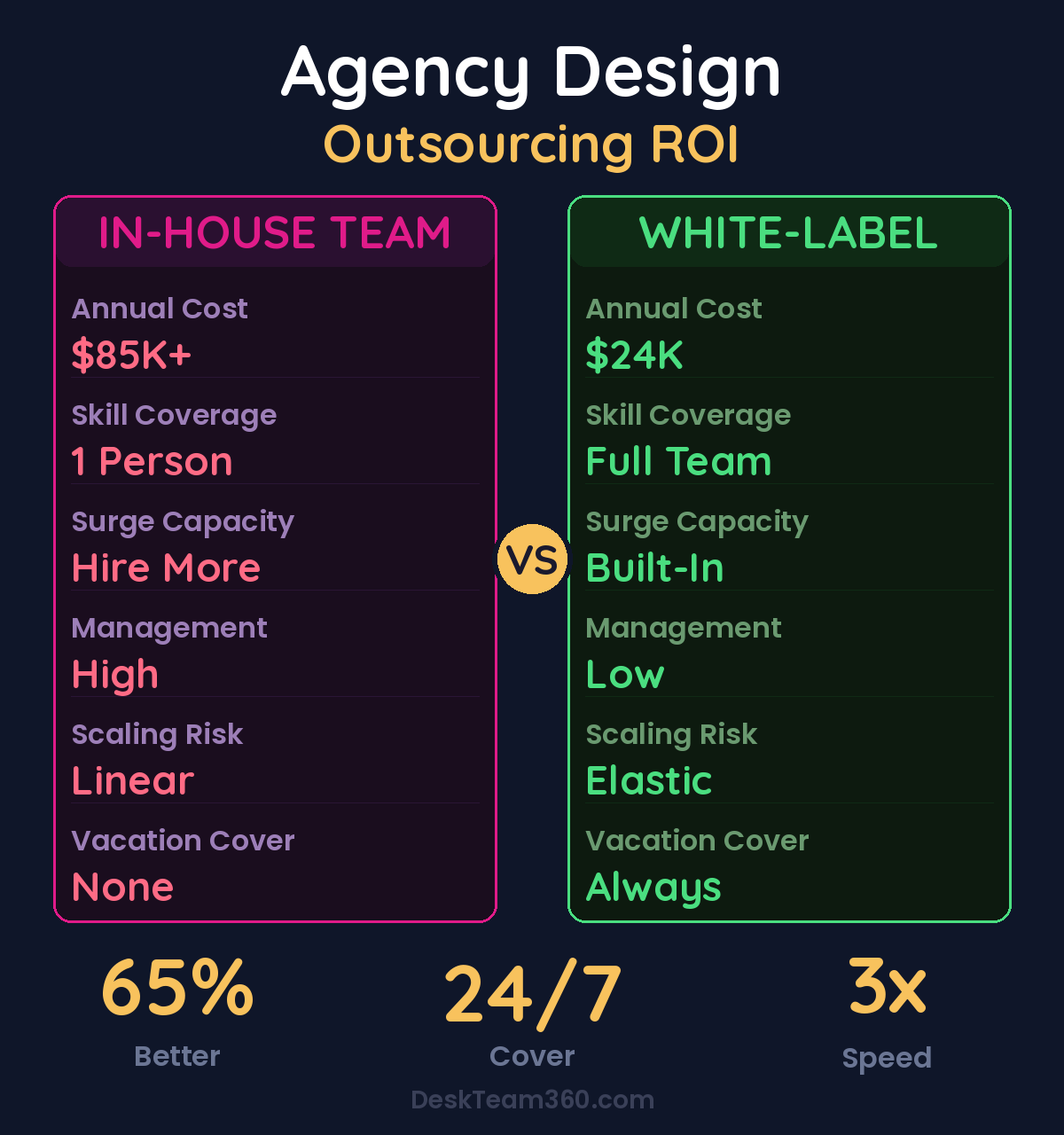
Internal team costs: A mid-level graphic designer runs $65,000-85,000 annually in most markets, plus 25-30% in benefits, plus equipment, software licensing, management overhead, and the cost of coverage during vacation or sick time. You’re looking at $85,000+ per year for one person with limited skill coverage.
White-label outsourcing costs: Quality design partnerships typically run $2,000-5,000 monthly depending on volume commitments. That gets you access to an entire creative team with specialized skills, built-in redundancy, and no management overhead on your end.
Related reading: 10 Best Unlimited Graphic Design Services for 2026 (Honest Rankings).
The break-even point is usually around 40-60 hours of design work per month. Below that, project-based freelancers make more sense. Above that, white-label partnerships deliver better economics and substantially better results.
But the real advantage isn’t cost savings, it’s capacity scaling. When you land a big client that needs twice your normal design volume, an internal hire takes months to onboard. A white-label partner can absorb the extra load immediately. When you lose a big client and need to reduce capacity, laying off internal staff is expensive and demoralizing. Scaling down outsourced work is just a conversation about revised monthly commitments.
Client Communication: Transparency vs Confidentiality
The question every agency asks: do you tell clients that design work is outsourced?
There’s no universal right answer, but there are strategic considerations that should drive your decision. Full transparency builds trust and can actually be a selling point when positioned correctly. “We partner with specialized design teams so you get access to broader creative talent without paying for full-time overhead.” Some clients love this approach.
White-label confidentiality maintains the illusion of a fully integrated in-house team. This works when your outsourcing is truly seamless and clients care more about results than process. The risk is that if clients discover the arrangement unexpectedly, it can damage trust.
Selective disclosure is what most successful agencies actually do. They’re transparent when it serves the relationship (explaining access to specialized skills or faster turnarounds) and keep it internal when clients are process-focused or skeptical about outsourcing.
Whatever approach you choose, the deliverable quality needs to be indistinguishable from your best internal work. If clients can tell something was outsourced because it doesn’t meet your standards, you haven’t solved the capacity problem, you’ve created a brand problem.
Managing Multiple Outsourcing Relationships
As your agency grows, you’ll probably end up working with multiple design partners for different specializations. Web design, print collateral, social media assets, and video production often require different skill sets and different vendors.
This creates coordination challenges that single-partner relationships don’t have. You need consistent brand application across different teams, coordinated project timelines, and unified quality standards. The agencies that manage this well create centralized brand management and cross-vendor communication protocols.
Assign one internal person as the design operations manager. Their job isn’t to design anything, it’s to ensure consistency across all outsourced work. They maintain the master brand guidelines, coordinate project schedules, conduct quality reviews, and serve as the single point of contact for all design vendors.
This might seem like overhead, but it’s actually efficiency. Instead of every account manager learning every vendor’s process, one person becomes expert at managing all of them. Instead of brand guidelines drifting differently with each vendor, one person ensures consistent application. The role pays for itself in reduced revision cycles and faster project delivery.
Red Flags That Kill Design Partnerships
I’ve seen hundreds of outsourcing relationships fail, and the patterns are predictable. Here’s what to watch for and how to address problems before they become disasters.
Scope creep without pricing adjustment. When vendors consistently deliver more than contracted without raising prices, they’re subsidizing your growth. That’s unsustainable and usually leads to either quality drops or relationship termination. Address scope increases with budget increases, even if the vendor doesn’t ask.
Declining responsiveness. When a vendor who used to respond to messages in hours starts taking days, they’re probably overcommitted or losing interest in your account. Address this directly rather than hoping it improves. Sometimes it’s a temporary capacity issue, sometimes it’s a signal to find a new vendor.
For industry research and benchmarks, check out Clutch.co.
Quality inconsistency. If work quality varies significantly between projects, it usually means the vendor is using different team members for your work without proper oversight. Consistent team assignment is critical for brand consistency. You should know who’s actually working on your projects, not just who’s managing the account.
Communication breakdown is the most common failure mode. When vendors stop proactively updating you on project status, when feedback gets ignored or misinterpreted, when deadlines slip without advance notice, the relationship is in trouble. Emergency fixes rarely work. Start looking for alternatives.
The DeskTeam360 Approach to Design Outsourcing
Everything I’ve described above is exactly how we handle design outsourcing at DeskTeam360. We’ve built our entire model around the white-label partnership approach because we’ve seen how dramatically it outperforms project-based alternatives.
Our design team functions as a seamless extension of our clients’ agencies. We learn their brand standards, understand their client types, and deliver work that’s indistinguishable from their internal capabilities. We handle everything from social media graphics and email templates to complete rebranding projects and presentation design.
The difference is predictability. Our clients know exactly what they’re going to get, when they’re going to get it, and what it’s going to cost. No surprise revision cycles, no missed deadlines, no quality inconsistency. Just professional design work that helps them scale their client relationships without scaling their overhead.
Our subscription model means you get access to an entire creative team for less than the cost of hiring one internal designer, with the flexibility to scale up or down based on your actual needs. No long-term contracts, no setup fees, no surprises.
Implementation Timeline: 30-60-90 Days
Here’s the realistic timeline for implementing a successful design outsourcing system.
Days 1-30: Foundation and Partner Selection. Document your brand standards and create template examples. Research and vet potential partners through portfolio review and reference checks. Run pilot projects with your top two candidates. Select your primary vendor and establish contracts.
Days 31-60: Process Integration and Training. Onboard your chosen partner with comprehensive brand training. Establish workflow integration with your project management tools. Create feedback and approval protocols. Run 3-5 projects to identify and resolve process gaps. Train your internal team on the new workflow.
Days 61-90: Optimization and Scaling. Analyze quality and timeline performance from the first month. Refine processes based on actual results. Scale up project volume gradually. Establish backup vendor relationships for surge capacity or specialization gaps.
The agencies that try to compress this timeline usually regret it. Taking shortcuts on partner vetting or process documentation creates problems that compound over time. Three months of careful implementation prevents years of operational headaches.
Scale Your Agency Without the Operational Chaos
Design outsourcing isn’t about finding someone cheaper than your internal team. It’s about building scalable creative capacity that grows with your agency without adding management overhead or quality risk.
The agencies that get this right treat their design partners as strategic assets, not vendors. They invest in proper onboarding, maintain clear communication protocols, and build relationships that last years rather than projects. In return, they get predictable creative capacity that lets them take on bigger clients and more ambitious projects.
At DeskTeam360, we’ve refined this process across 400+ client relationships. We know what works, what doesn’t, and how to make the transition seamless. Whether you need ongoing design support or specialized project help, our team can integrate with your agency operations and deliver work that strengthens your client relationships.
Ready to scale your creative capacity without the hiring headaches? Explore our plans and see how we can become your white-label design team.
Free 5-Minute Video
See How DeskTeam360 Works in Under 5 Minutes
Watch the short video and see exactly how we handle design, development, and marketing implementation — so you don't have to.
Watch the Video →