

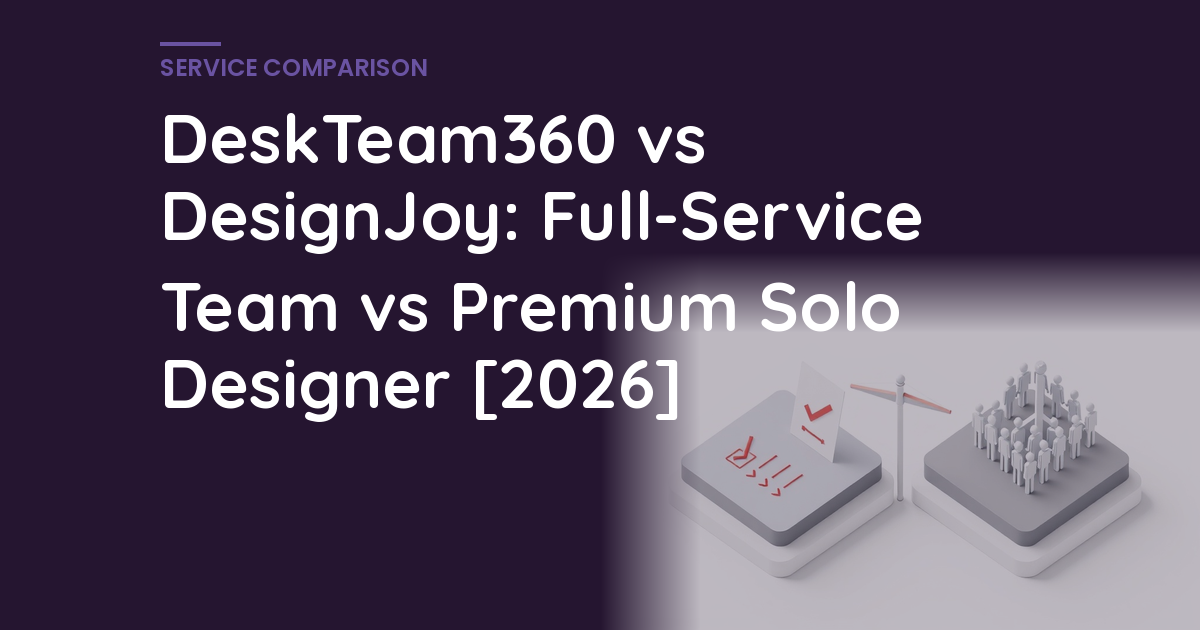
DeskTeam360 vs DesignJoy: Full-Service Team vs Premium Solo Designer [2026]
Why Choosing Between DT360 and DesignJoy Isn’t About “Better”
When it comes to deskteam360 vs designjoy, the details matter. Last week, I got asked point-blank: “How does DT360 stack up against DesignJoy?” Fair question. I’ve been watching Brett Williams build DesignJoy into a million-dollar business, and honestly, I respect the hell out of what he’s done. But here’s the thing, comparing DT360 to DesignJoy is like comparing a full-service restaurant to a master chef’s private kitchen. Both feed you well, but they’re solving completely different problems.
📋 Table of Contents
I’m going to lay out the real differences here, no sugar-coating. Yes, I run DT360, so I have skin in the game. But after 12 years in this space and working with 400+ clients, I know exactly where we win and where we don’t. Brett has built something genuinely impressive, and pretending otherwise would be dishonest.
The choice between us isn’t about which service is “better.” It’s about which model fits how your business actually operates.
The DesignJoy Model: One Designer, Premium Everything
DesignJoy is Brett Williams. That’s it. One incredibly talented designer handling every request personally. No project managers, no account reps, no team coordination. You submit through Trello, Brett designs it, you get beautiful work back.
And the work really is beautiful. Brett’s portfolio would make most design agencies jealous. His brand identity work is clean, his product design is thoughtful, and his execution is consistently high-level. There’s a reason he’s charging $5K a month and has a waiting list.
But that model comes with hard limits. Brett processes one request at a time. If you need a landing page, email template, and social media graphics for a product launch, they happen sequentially, not simultaneously. Request three gets started after requests one and two are completely finished. For some businesses, that works fine. For others, it’s a bottleneck that kills momentum.
Free Tool
How Much Is Freelancer Management Really Costing You?
Most agency owners have never done this math. Plug in a few numbers and see your real cost in 2 minutes.
Calculate Your Hidden Costs →
The DT360 Model: Full Team, Multiple Skill Sets
We built DT360 around a different philosophy. Instead of one exceptional designer, you get access to specialists: graphic designers, web developers, WordPress experts, video editors, presentation designers. Different projects go to different people based on their expertise.
This approach lets us handle multiple requests simultaneously. While one designer works on your social media graphics, a developer can be building your landing page and a video editor can be cutting your promotional video. When you’re launching a campaign or pushing a product release, that parallel capacity makes the difference between hitting your deadline and missing it.
We break this down further in in-house designer vs agency vs subscription: which one actually works? [2026].
The trade-off is creative consistency. Different designers have different styles, even when working from the same brand guidelines. We minimize this through project management and quality reviews, but it’s not the same as having Brett Williams personally touch every pixel.
Most businesses need execution capacity more than creative perfection. If you’re running marketing campaigns, launching products, or managing ongoing content needs, having multiple specialists working in parallel often matters more than having one designer’s unified vision.
Price Reality: $5K vs $1K-3K

Let’s talk numbers because the difference is significant. DesignJoy’s standard plan is $4,995 a month. That’s $59,940 a year for design-only services. Brett’s work justifies premium pricing, but that’s premium pricing.
DT360 starts at $997 a month for basic graphics and goes up to $2,997 for our Growth plan that includes design, development, video, and more. Even our highest tier costs $24,000 less per year than DesignJoy while covering broader service needs.
I’m not saying cheaper is automatically better. If you’re a well-funded startup and design quality is your top priority, DesignJoy’s premium might be worth it. But most businesses need to balance quality with budget reality, and that $36,000 annual difference buys a lot of other marketing tools and talent.
Service Coverage: Design Only vs Full Production
This is where the models diverge most sharply. DesignJoy does exceptional design work, period. Brand identity, product interfaces, marketing visuals, presentation design. If it’s about making things look good, Brett handles it beautifully.
But design is only one piece of most marketing efforts. You need websites built, not just designed. You need video content edited, email templates coded, WordPress sites maintained. DesignJoy doesn’t do development work beyond basic Framer or Webflow sites.
At DT360, development is core to what we do. WordPress custom themes, WooCommerce stores, landing page builds, email template coding, ongoing site maintenance. We handle the entire execution chain from initial design through final implementation. When 43% of the internet runs on WordPress and your business needs real functionality, not just pretty mockups, that development capability matters enormously.
Pro tip: If you’re considering design-only services, add up what you’ll spend on separate developers, video editors, and other specialists. The total cost often exceeds a full-service provider while creating coordination headaches between different vendors.
Capacity and Turnaround: Sequential vs Parallel
Brett’s turnaround time is impressive. Submit a request, get beautiful work back in 1-2 business days. But remember, it’s one request at a time. If you submit five tasks, number five doesn’t start until tasks one through four are completely finished and approved.
Our approach is different because we have different people with different specialties. Your brand guidelines can be updated while your website is being developed and your video is being edited. Three different specialists working on three different projects simultaneously. This parallel processing matters hugely when you’re launching campaigns or managing seasonal pushes.
The single-designer model works well for businesses with steady, predictable design needs. One or two requests per week, consistent workflow, no rush deadlines. The team model works better for businesses with burst needs, multiple simultaneous projects, or tight launch schedules.
Who Should Choose What
After watching both models succeed with different types of clients, here’s how I’d make the call.
Choose DesignJoy if you’re a well-funded startup where design is central to your competitive advantage. If your product is design-heavy, your brand needs to be pixel-perfect, and budget isn’t a primary constraint. If you have low-volume needs and other specialists already on staff. If you value having one creative visionary who understands your brand intimately.
Choose DT360 if you’re a growing business that needs design plus development plus video plus ongoing marketing support. If you’re an agency needing white-label production capacity for client work. If you have high-volume or burst needs that require multiple specialists working simultaneously. If budget efficiency matters and you want maximum output per dollar spent. If you need WordPress development, which is a massive gap in most design-only services.
Watch out: Don’t choose based on the prettiest portfolio. Choose based on which operational model matches how your business actually works. The best design in the world doesn’t help if it bottlenecks your launch schedule or leaves you scrambling to find developers.
For industry research and benchmarks, check out Clutch.co.
Both Brett and I have built successful businesses around fundamentally different approaches to the same core problem. Neither approach is universally superior. The right choice depends on your specific situation: budget constraints, volume needs, service breadth requirements, and how design work fits into your broader operations.
The Honest Truth About Team vs Solo
I’ve run team-based operations for 12 years, so I’m biased toward the team model. But I’ll give you the real pros and cons of each approach.
Solo designer advantages: complete creative consistency, personal relationship with your designer, no context switching between team members, streamlined communication. Solo designer disadvantages: limited by one person’s capacity and availability, single point of failure, can’t handle multiple projects simultaneously, restricted to design-only services.
Team advantages: broader skill coverage, parallel project capacity, no single point of failure, scalable volume handling. Team disadvantages: potential style variation between designers, more complex coordination, less personal relationship with individual creators.
The businesses that thrive with DesignJoy are typically design-focused startups with deep pockets and specific aesthetic requirements. The businesses that thrive with DT360 are typically growth-stage companies and agencies that need consistent marketing execution across multiple channels and disciplines.
Neither model is right for everyone. But understanding these trade-offs upfront prevents expensive mistakes and frustration down the road. Choose based on how your business actually operates, not which option sounds more appealing in theory.
If you want to see how we compare to other full-service providers, our Design Pickle comparison covers the subscription design space more broadly. And if you’re thinking about building internal creative capacity instead of outsourcing, our guide on outsourcing video editing explains the cost analysis that applies to all creative roles.
The subscription design space has room for both premium solo artists and full-service teams. The key is matching the right model to your actual business needs, not just picking the one with the fanciest marketing.
Free 5-Minute Video
See How DeskTeam360 Works in Under 5 Minutes
Watch the short video and see exactly how we handle design, development, and marketing implementation — so you don't have to.
Watch the Video →