
How to Automate Your Marketing With AI
Why Most Marketing Is Still Stuck in 2020
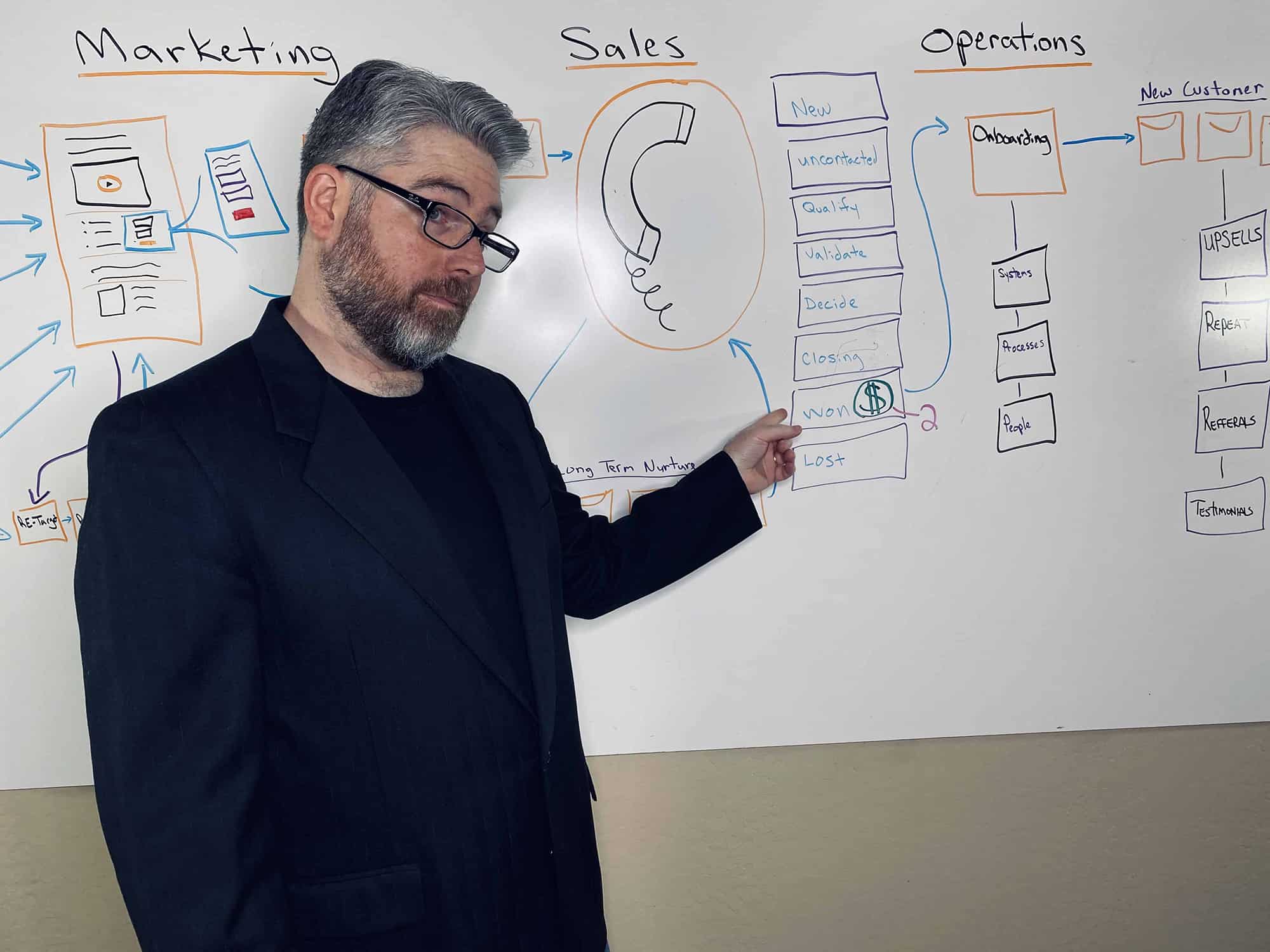
Getting automate marketing with ai right is one of the highest-leverage moves you can make. It’s 2026 and I’m still watching businesses run marketing like it’s five years ago. Someone manually writes every email. Someone manually posts to social media. Someone manually pulls reports. Someone manually follows up with leads three days later if they remember to.
📋 Table of Contents
This is insane.
Every manual step is a failure point waiting to happen. Every time you rely on humans to remember something, there’s a decent chance it won’t get done. And in marketing, consistency beats creativity nine times out of ten. The businesses crushing it right now aren’t necessarily smarter, they’re just more consistent. And they’re consistent because they’ve automated the grunt work.
I’ve been running marketing operations for 12+ years, and the single biggest game-changer I’ve seen is AI-powered automation. Not the basic “if this, then that” workflows from 2019. I’m talking about genuinely intelligent systems that personalize content, make decisions, create campaigns, and optimize performance without anyone touching them.
Here’s exactly how to automate your marketing with AI, no fluff, just what actually works.
Email Marketing That Actually Thinks
Basic email personalization is embarrassing. “Hi {FirstName}” isn’t personalization, it’s mail merge from 1995. Real AI email automation rewrites entire messages based on recipient behavior, engagement history, company size, and what they’ve clicked on before.
Here’s what intelligent email automation looks like in practice. Someone downloads your lead magnet, and AI sends a follow-up that references the specific content they downloaded and suggests the next logical piece they need. Someone visits your pricing page three times, and AI triggers a personalized demo offer with details relevant to their company size and industry. Someone opens five emails but never clicks anything, and AI completely changes the approach with different subject lines, different content formats, different calls to action.
The tools that actually work for this are ActiveCampaign for predictive sending and behavioral triggers, Klaviyo if you’re in e-commerce and need product recommendations, or you can build something custom with Make.com plus the GPT API if you want full control. If you’re just getting started with email automation, our guide on creating email drip campaigns covers the fundamentals.
Free 5-Minute Video
See How DeskTeam360 Works in Under 5 Minutes
Watch the short video and see exactly how we handle design, development, and marketing implementation — so you don't have to.
Watch the Video →
Social Media on Complete Autopilot
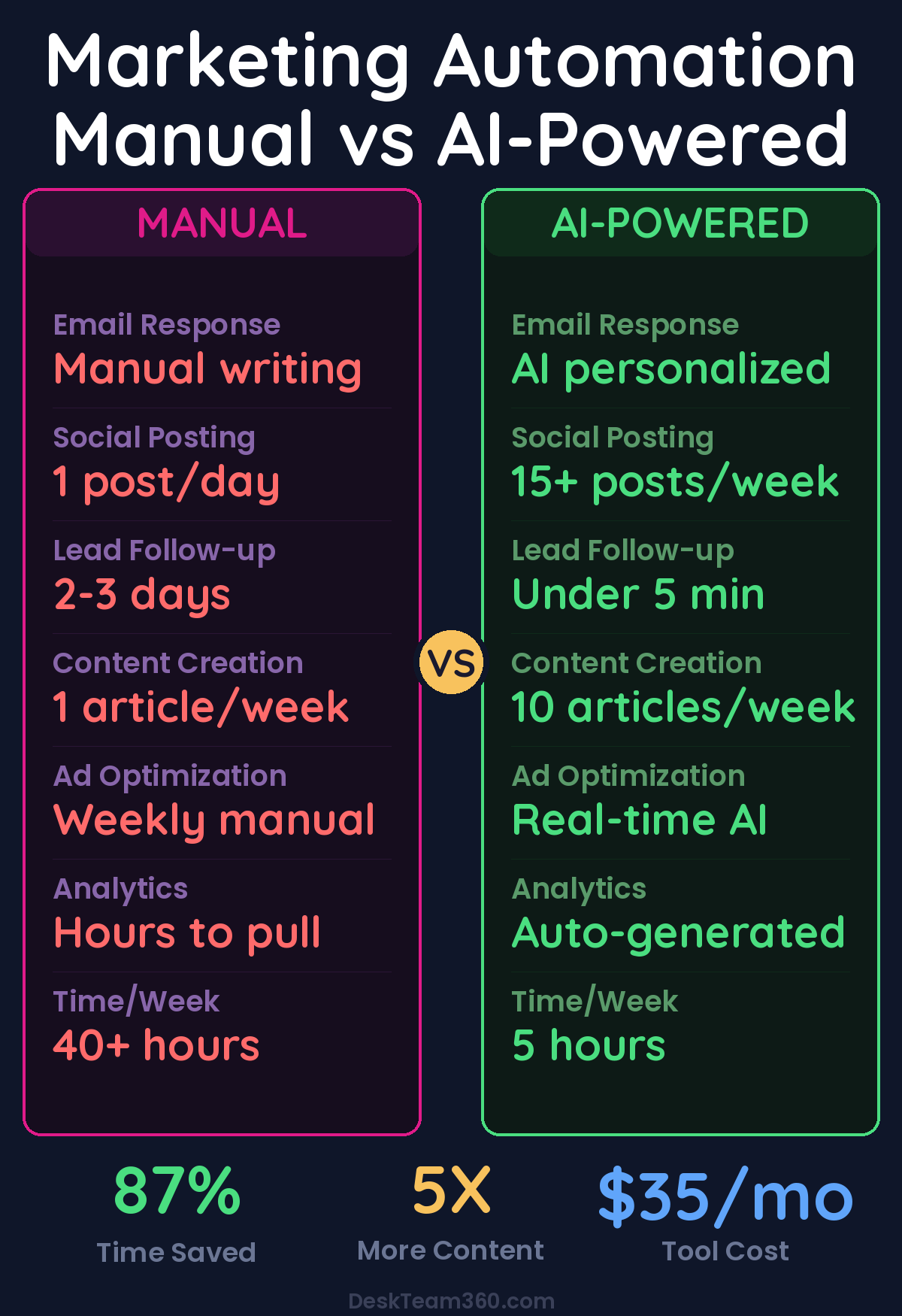
Here’s an automated social workflow that runs with minimal human input. Monday at 8am, AI analyzes industry trends, competitor posts, and your content performance data, then generates 15 post topics for the week. Monday at 9am, AI writes platform-specific versions of each post. LinkedIn gets professional and detailed. X gets punchy and thread-worthy. Instagram gets visual and story-focused. Facebook gets conversational.
Monday at 10am, AI generates or selects images, graphics, and video thumbnails for each post. Monday at 11am, one person reviews all 15 posts, makes edits, approves or rejects. This takes about 45 minutes. Approved posts get scheduled across all platforms at optimal times for the rest of the week. AI monitors comments and mentions daily, drafts responses, flags anything requiring human attention. Weekly, AI generates a performance report showing what worked, what didn’t, and recommendations for next week.
Total human time required: 2 hours per week for consistent, multi-platform social presence.
For implementation, Buffer plus Make.com plus ChatGPT is the best budget option. Hootsuite if you need robust social listening and team management. Opus Clip if you’re creating video content and want to automatically cut long-form videos into social-ready clips.
Ad Campaigns That Optimize Themselves
The fastest way to find winning ad creative is to test more variations faster than your competitors can keep up with. AI makes this possible.
Here’s the process: AI generates 20+ headline variations and 10+ description variations from your campaign brief. AI creates multiple ad image concepts for each campaign. You launch all variations with small budgets per variation. After 48 hours, AI identifies top performers based on CTR, cost per acquisition, and return on ad spend. Budget automatically shifts to winning combinations.
AI excels at the math-heavy optimization side too. It redistributes budget from underperforming campaigns to top performers automatically. It identifies optimal bidding strategies based on historical performance data. It predicts when campaign fatigue will set in and rotates creative preemptively. It adjusts daily budgets based on day-of-week and time-of-day performance patterns.
Google Performance Max and Meta Advantage+ have built-in AI for cross-channel optimization. AdCreative.ai generates creative with performance scoring. Revealbot handles automated rules for budget management and creative rotation. Use what’s already available before building anything custom.
Lead Scoring That Actually Predicts Revenue
Traditional lead scoring is primitive. Opened email equals five points, visited pricing page equals 10 points. AI lead scoring is exponentially more sophisticated.
AI looks at behavioral patterns, not just individual actions. A lead who visited your pricing page, read three blog posts about your specific service, and downloaded a case study gets scored completely differently than someone who just submitted a generic contact form. AI automatically enriches leads with company data including revenue, employee count, industry, technology stack, and recent funding, then factors this into the score. AI monitors external intent signals whether they’re searching for solutions like yours on G2, Capterra, or industry forums. Based on historical conversion data, AI predicts how likely each lead is to become a paying customer.
Once scored, leads get routed automatically. Score 80 and above gets immediate notification to a senior sales rep plus automated meeting booking. Score 50 to 79 gets added to a targeted nurture sequence plus SDR follow-up within 24 hours. Score 30 to 49 gets added to an educational content sequence. Score below 30 goes into the general newsletter.
This ensures your best leads get the fastest, most personalized response while everyone else gets appropriate nurturing. It’s the intelligent version of what we cover in our guide on getting more leads.
Chatbots That Convert Instead of Annoy
The chatbots from 2019 deserved to die. “Hi! How can I help you today?” followed by the bot not understanding anything the user typed, followed by frustration, followed by the user leaving. Garbage.
Modern AI chatbots read the page the visitor is on, understand their likely intent, and proactively offer relevant help. If someone’s on the pricing page, the bot offers to explain plan differences. If they’re reading a case study, it offers to show similar results for their industry. If they’re on the contact page, it offers immediate answers to common questions instead of making them fill out a form.
Related: How to Outsource Marketing Tasks Without Getting Burned (From 12 Years and $1M in Lessons).
Pro tip: Train your chatbot on your entire website, knowledge base, FAQ, and product documentation. Define clear conversion goals where the bot guides conversations toward booking a demo, downloading a resource, or starting a trial. Build in qualification questions that capture budget, timeline, decision-maker status, and specific needs naturally in conversation.
Intercom Fin resolves 50%+ of conversations and is the best overall option. Drift is best for B2B lead qualification. Tidio is the best budget option with solid AI capabilities.
SEO Content That Writes and Optimizes Itself
Here’s an AI-powered SEO workflow that keeps your content machine running with minimal manual input. Monthly, AI scans your rankings, identifies declining positions, finds new keyword opportunities, and analyzes competitor content gaps. For each target keyword, AI creates detailed briefs including recommended word count, heading structure, questions to answer, related keywords to include, and internal linking opportunities.
AI writes SEO-optimized first drafts following the brief. A human editor refines for accuracy, adds original insights, and ensures brand voice consistency. AI generates title tags, meta descriptions, image alt text, and schema markup. AI identifies opportunities to link new content to existing pages and vice versa. AI tracks ranking changes, traffic, and engagement metrics weekly, adjusting the strategy based on results.
This is how you build a content engine that compounds. Each month, your content library grows, your rankings improve, and your organic traffic increases with one editor doing what used to require a team of five.
Analytics That Actually Give You Insights
Stop wasting hours pulling numbers and making charts. Connect all your marketing platforms to a central dashboard tool. Data updates automatically. AI generates weekly analysis of key metrics with plain-English explanations of what changed and why. You get immediate notification if any metric moves significantly outside the normal range. Weekly and monthly reports get generated and emailed to stakeholders without anyone touching a spreadsheet.
Watch out: Don’t just automate data collection, automate insight generation. Raw numbers without context are useless. AI should be telling you what the data means, not just showing you what happened.
Google Looker Studio plus Supermetrics is the best free dashboard option. Databox has the easiest setup with AI-powered insights. You can build custom AI analysis with Make.com plus GPT plus Google Sheets if you want something specific. Understanding how to measure marketing ROI ensures you’re tracking the right metrics from the start.
The Smart Way to Build This
Don’t try to automate everything at once. You’ll overwhelm yourself and probably break something important. Here’s the sequence that actually works.
Week one and two, implement email automation. It has the highest ROI, the most mature tools, and the fastest implementation. Week two and three, add lead scoring and routing for immediate sales impact. Week three and four, automate social media for the biggest time savings. Week four and five, automate analytics for optimization foundation. Week five through eight, build your SEO content engine because it compounds over time. Week eight and beyond, optimize ad campaigns because this requires data from all the other systems.
Your minimum tech stack is Make.com at $9 per month to connect everything, ChatGPT API at $20 to $50 per month for AI decision-making and content generation, whatever email platform you’re already using, whatever CRM you’re already using, and Buffer at $6 per month for social scheduling. Total monthly investment: $35 to $85 for marketing automation that would have cost $2,000+ per month three years ago.
What to Automate vs. What to Keep Human
Automate email sequences and follow-ups, social media scheduling and publishing, data collection and reporting, lead scoring and routing, content first drafts and SEO optimization, and ad creative variations and performance tracking.
Keep brand strategy and positioning human. Keep creative direction and campaign concepts human. Keep relationship-based selling and client communication human. Keep crisis communication and reputation management human. Keep content editing and quality assurance human. Keep strategic decision-making based on AI-generated insights human.
If you’re not sure whether to automate something, ask this question: does this task require judgment, creativity, or relationship-building? If yes, keep it human. Does this task involve repetitive execution, data processing, or pattern recognition? If yes, automate it.
The Real ROI
Track these metrics to measure your automation impact. Time saved per week because freed-up hours are real money. Lead response time should drop to under five minutes. Content output in posts, emails, and articles produced per month should increase dramatically. Conversion rate should improve as personalization and speed increase. Cost per lead should decrease as efficiency improves. Revenue per marketing dollar is the ultimate metric that matters.
Most businesses see measurable results within 30 days and significant ROI within 90 days.
The key is starting with the highest-impact automations first and building from there. Don’t get distracted by shiny new AI tools that solve problems you don’t have. Focus on automating the manual tasks that are currently eating up your time and preventing you from growing.
For choosing the right foundation, our guide on choosing the right CRM will help you pick the system that everything else connects to.
Stop Doing Marketing the Hard Way
AI marketing automation isn’t a future luxury anymore, it’s table stakes. Your competitors are already using these tools. Your customers expect the speed and personalization that only automation can deliver at scale. The technology is mature, affordable, and proven.
At DeskTeam360, we don’t just talk about AI-powered marketing, we run on it. Our team combines human expertise with AI-driven workflows to deliver more marketing output at lower cost than any traditional agency model. Whether you need content creation, design, development, or full marketing implementation, we’ve built the systems to deliver results at scale.
Free Template
The Ultimate Task Delegation Template
Stop guessing what to hand off. This template shows you exactly what to delegate, how to brief it, and how to QA the results.
Get the Free Template →