
How to Build an AI Team for Your Company
Your Next Hire Costs $200 a Month and Never Takes Vacation
When you build ai team company, you’re making an investment that pays off for years. When I tell business owners they need to build an AI team, they usually picture hiring a bunch of data scientists and machine learning engineers. That’s not what I’m talking about. I’m talking about assembling a team of AI agents that work specific roles in your business like any other employee, except they cost $200-500 per month instead of $4,000-8,000, work 24/7, and never call in sick.
📋 Table of Contents
This isn’t about replacing your entire team. It’s about building a hybrid organization where AI handles the volume and routine work while your human team focuses on what actually requires human judgment: creativity, relationships, complex problem-solving, and leadership. We’ve been doing this at DeskTeam360 for the past year, and it’s fundamentally changed how we think about scaling a business.
Here’s the thing most people miss: an AI team isn’t just individual tools working in isolation. It’s agents that communicate with each other, hand off tasks, and collaborate just like your human team does. When your sales agent qualifies a lead, it automatically triggers your marketing agent to add them to a targeted sequence. When your support agent spots a product issue trend, it alerts your operations agent to create tasks for your product team.
The companies figuring this out first are going to have an enormous competitive advantage. Let me show you exactly how to build one.
The Modern AI Org Chart
Think about your current organization chart. You’ve got people in sales, marketing, customer support, operations, and finance. Now imagine some of those seats filled by AI agents that never get tired, never have personal problems, and execute tasks with perfect consistency.
The CEO agent monitors your key business metrics every morning and generates strategic briefings. It tracks competitor activity, spots market changes, and flags risks and opportunities based on pattern analysis across all your data sources. It doesn’t make the strategic decisions, but it presents you with everything you need to make them intelligently. I start every day with a report from ours that would have taken a human analyst 3-4 hours to compile.
Your marketing agent drafts blog posts, creates social media content, and manages email campaigns. It optimizes everything for SEO using real keyword and competitor data, repurposes content across platforms automatically, and monitors performance to adjust strategy. The key distinction here is that a human marketer still directs the agent and handles high-level creative work. The agent handles production volume. Our marketing agent publishes 40+ pieces of content per week that would have required three full-time people to produce.
The sales development agent responds to inbound leads within seconds, enriches lead data from multiple sources, scores leads based on fit and intent signals, sends personalized outreach sequences, and books meetings directly on your sales team’s calendar. It follows up on no-shows and keeps stalled conversations moving. I’ve watched ours turn a 23% lead-to-meeting conversion rate into 67% by simply being faster and more consistent than any human could be.
For more on this, check out our guide on what is a marketing implementation team? bridging strategy and execution.
For a deeper dive, see our guide on how to outsource marketing tasks without getting burned (from 12 years and $1m in lessons).
Your customer support agent handles 70-85% of incoming tickets by accessing your knowledge base and product documentation, processing routine requests, and escalating complex issues with full context to human agents. It also tracks support trends and generates weekly reports. The result isn’t just cost savings, it’s customer satisfaction improvements because responses are instant and accurate.
Free 5-Minute Video
See How DeskTeam360 Works in Under 5 Minutes
Watch the short video and see exactly how we handle design, development, and marketing implementation — so you don't have to.
Watch the Video →
How to Actually Build This Team
Before you build anything, audit your current operations. For every role in your company, document what tasks each person does daily and what percentage are repetitive versus requiring genuine creativity or human judgment. In most businesses, 40-60% of every role involves repetitive tasks that an AI agent could handle. That’s your opportunity map.
Don’t try to build six agents simultaneously. I’ve seen companies attempt this and create a chaotic mess of conflicting workflows. Prioritize based on revenue impact first, then time savings, then ease of implementation. My recommended order for most businesses is sales development agent first because it has the highest revenue impact, followed by customer support for time savings, then marketing for compound growth over time.
Start with your highest-impact, most data-rich process. Your first agent needs to succeed decisively to build internal confidence and justify investment in additional agents.
For your first agent, define the exact scope of what it will handle. Write this down as a clear job description with specific tasks, decision criteria, and edge cases. Document step-by-step procedures for each task the way you would train a new employee. Choose a simple tech stack: Make.com or n8n for workflow orchestration, GPT-4o or Claude for decision-making and content generation, and integration tools to connect with your existing CRM, email, and business tools.
Build the workflow, run extensive test scenarios, and iterate until quality is consistent. Deploy with human oversight for at least two weeks before granting the agent autonomy. Every mistake in those first weeks is valuable data for improving the system. Our first sales agent made errors on about 15% of lead qualification in week one. By week three, it was down to under 2%.
The real power comes when you add inter-agent communication. When our sales agent qualifies a lead, it triggers our marketing agent to add them to a targeted content sequence. When our support agent identifies a product issue trend, it alerts our operations agent to create tasks for the product team. When our finance agent flags an overdue payment, it triggers our sales agent to pause outreach to that account until payment is resolved.
The Technology Stack That Actually Works
You don’t need custom AI models or complex infrastructure. The winning combination for most businesses is Make.com for workflow automation, GPT-4o or Claude Sonnet for AI processing, and your existing business tools connected through APIs. This setup handles 90% of use cases without requiring any custom development.
Every agent needs a human owner responsible for monitoring performance, updating instructions, and handling escalations. Without clear ownership, agents drift and degrade over time. Our support agent owner reviews a sample of conversations weekly and updates response templates based on real customer feedback. Our sales agent owner adjusts qualification criteria monthly based on what actually converts to closed deals.
Pro tip: Build a simple monitoring dashboard that shows what each agent is doing right now, tasks completed in the last 24 hours, error rates, and key metrics per agent. You can’t improve what you can’t measure.
The Economics Are Compelling
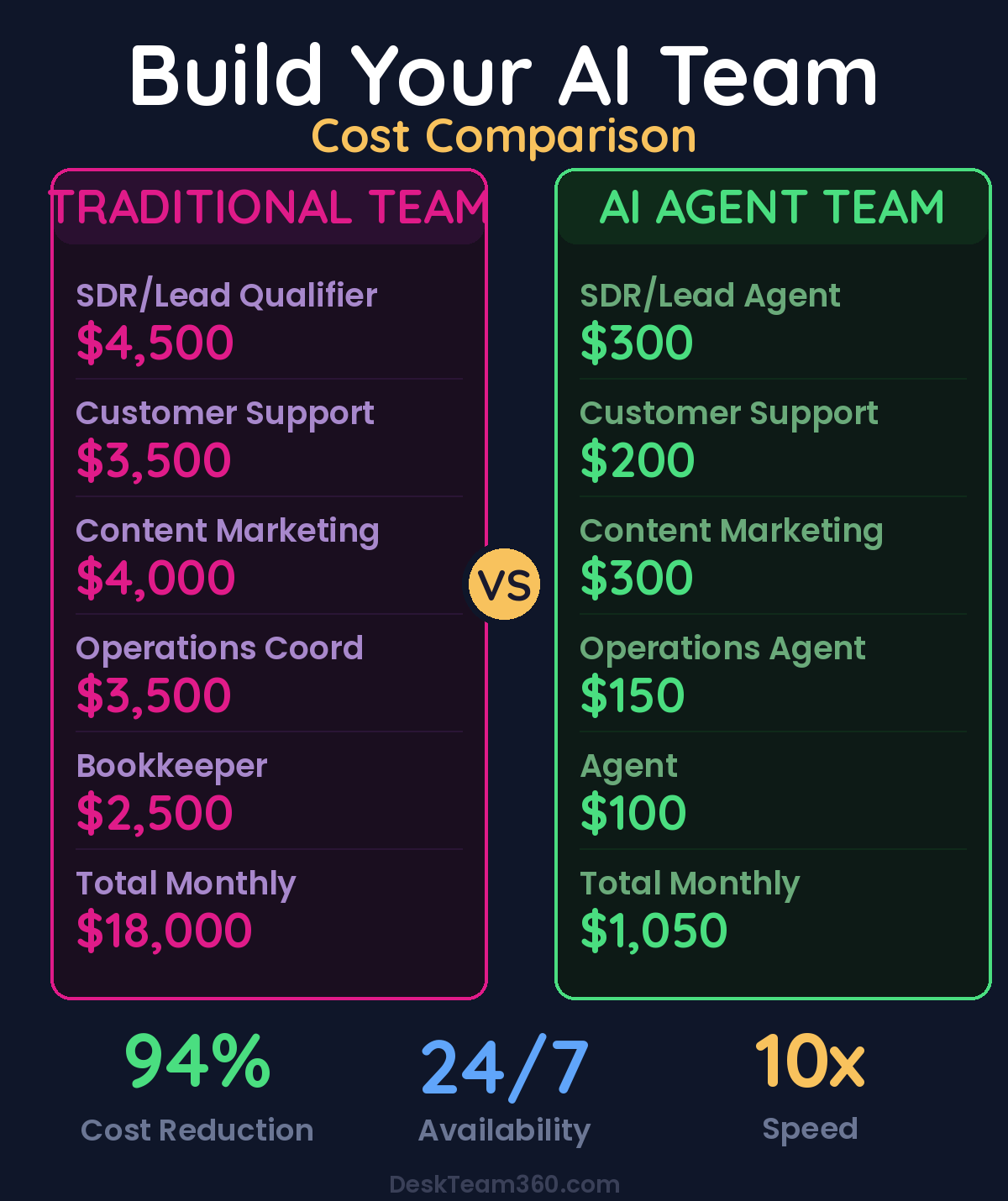
Let’s talk real numbers because this is where the business case becomes undeniable. A traditional team with an SDR, customer support rep, content marketing associate, operations coordinator, and bookkeeper costs about $18,000 per month in salaries. The equivalent AI team costs $750-1,500 per month in API and platform fees.
But here’s the critical distinction: the AI team doesn’t fully replace the human team. What it does is allow you to run a much leaner human team focused on high-value work while AI handles the volume. The realistic scenario is going from 5 full-time employees at $18,000 per month to 2 senior employees at $10,000 per month plus an AI team at $1,000 per month. That’s $11,000 total, a 39% cost reduction with significantly better output quality and consistency.
The output improvements are often more valuable than the cost savings. Our marketing agent publishes content 10x faster than our human team could while maintaining quality that’s indistinguishable from human-written content. Our sales agent follows up with leads within 30 seconds instead of 4-6 hours, which alone improved our conversion rate by 2.8x. Our support agent resolves tickets in an average of 3 minutes instead of 2-3 hours.
The Coordination Challenge
The hardest part of building an AI team isn’t the individual agents, it’s coordination. Your CRM becomes the single source of truth that all agents read from and write to. No silos, no conflicting information. Agents communicate through events, not direct connections. When the sales agent qualifies a lead, it creates an event that both the marketing agent and CRM respond to independently.
At critical handoff points, include human approval checkpoints. The sales agent might qualify a lead and recommend a meeting, but a human confirms before the meeting actually gets booked with your CEO. This prevents expensive mistakes while maintaining speed for routine decisions.
Watch out: Don’t expect perfection immediately. Your agents will make mistakes in the first weeks. Budget 2-4 weeks of iterative tuning per agent by reviewing errors, updating rules, and refining prompts. This improvement process is normal and necessary.
Address your human team’s concerns about AI agents head-on. These agents handle the tasks your team probably hates doing anyway, routine administrative work, repetitive customer questions, and data entry. Their roles evolve toward higher-value work, they don’t disappear. Frame it as an upgrade to more interesting and strategic work, not a replacement threat.
Common Mistakes That Kill AI Team Projects
I’ve watched dozens of companies attempt this and fail in predictable ways. The biggest mistake is building everything custom instead of using existing platforms and APIs. Make.com plus GPT-4 plus your existing tools handles 90% of use cases. Custom solutions are for the other 10%, and you should exhaust platform-based options first.
Another fatal error is launching without clear ownership. Every AI agent needs a human owner responsible for monitoring, updating, and troubleshooting. Without this, agents drift and degrade over time until they’re causing more problems than they solve. Document every agent’s behavior, rules, and decision logic extensively. When something breaks, you need to diagnose problems quickly instead of troubleshooting in the dark.
The most expensive mistake is ignoring data quality. Agents are only as good as the data they work with. Clean up your CRM, standardize your processes, and establish clear data entry protocols before deploying agents. Garbage in, garbage out applies intensely to AI systems.
What This Looks Like in Practice
By next year, the most competitive small and mid-size businesses will operate with a human leadership team of 2-5 people handling strategy, relationships, and creative direction, an AI agent team of 5-10 agents managing execution, data processing, and operational management, and human specialists brought in as needed for complex creative work and novel problem-solving.
This isn’t a prediction, it’s already happening. We’re living proof at DeskTeam360. Our hybrid team produces output that neither humans nor AI could achieve alone. We built our remote marketing team with AI agents working alongside human experts, and the results have exceeded what we thought possible 18 months ago.
Companies implementing AI agent teams report 300-500% productivity increases in automated functions while improving quality consistency and reducing operational costs.
The technology is ready, costs are minimal, and the competitive advantage is massive. The companies that figure this out first will have an enormous head start while their competitors are still arguing about whether AI is ready for business use. If you’re already using our marketing team as a service, adding AI agents to that model creates even more leverage and value.
Building an AI team requires understanding both the technology and human change management aspects. Each agent needs careful design, testing, and optimization to reach peak performance. The integration between agents and your existing human team requires thoughtful planning to maximize both efficiency and employee satisfaction. Getting this right is the difference between a productivity revolution and an expensive science experiment.
The window for early-adopter advantage is still open, but it won’t stay that way long. Every month you wait is a month your competitors might be building systems that will be extremely difficult to catch up to once they’re running smoothly. The tools are accessible, the process is proven, and the ROI is immediate for businesses that execute this correctly.
Free Tool
How Much Is Freelancer Management Really Costing You?
Most agency owners have never done this math. Plug in a few numbers and see your real cost in 2 minutes.
Calculate Your Hidden Costs →