
How to Outsource Event Marketing Materials: Complete Guide
When you outsource event marketing materials, you free up your team to focus on what moves the needle.
📋 Table of Contents
Why Event Marketing Materials Make or Break Your Event
I’ve been to hundreds of trade shows, conferences, and networking events over 12+ years of running agencies and managing outsourced teams for 400+ clients. You know what separates the booths that attract crowds from the ones people walk right past? It’s not the product. It’s not even the pitch. It’s the materials.
The signage that’s professionally designed instead of cobbled together in PowerPoint the night before. The branded booth setup that looks intentional instead of like it fell out of a rental truck. The social media buzz that builds anticipation instead of those generic “Come see us at Booth #47!” posts that get zero engagement.
Here’s the problem I see constantly: businesses treat event marketing materials as a last-minute scramble. They’re designing banners two days before the trade show, rushing to get badges printed while driving to the venue, and posting afterthought social graphics that scream “we forgot this was happening.”
This isn’t sustainable. And it’s killing your event ROI.
I’ve watched clients transform their event presence by getting the materials right, and I’ve seen others waste tens of thousands on prime booth space with materials that look like they came from a 1997 Kinko’s. The difference is planning and execution. Here’s exactly how to get it right.
The Three-Phase Approach to Event Materials
Event marketing materials fall into three distinct phases, and most businesses only think about the middle one. That’s their first mistake.
Pre-Event Materials: Building Anticipation
This is where you generate awareness and registrations before the event happens. I’m talking about email sequences that actually get people excited, not those lifeless “save the date” messages that get deleted immediately. Social media campaigns with countdown graphics, speaker spotlights, and behind-the-scenes content that makes people feel like they’re missing out if they don’t attend.
You need landing pages designed specifically for event registration, not your generic contact form dressed up with event details. Digital ads that target your exact audience with compelling visuals and clear calls to action. For high-touch events like VIP dinners or product launches, printed invitations still work, especially when they’re designed to feel exclusive and valuable.
Don’t forget press kits for media outreach if you’re after coverage. A good press kit with professional photos, speaker bios, and story angles makes a reporter’s job easier, which makes them more likely to write about your event.
During-Event Materials: The Physical Experience
This is where the rubber meets the road. Your booth displays and banners need to work from 20 feet away and up close. Retractable banners are the workhorses here, standard 33″ × 80″ or 36″ × 92″ sizes. Keep the text minimal, put key information at eye level, and for the love of everything holy, use high-resolution images at 300 DPI. I’ve seen too many pixelated logos on expensive booth spaces.
Signage and wayfinding matter more than people realize. Attendees get lost, frustrated, and they blame the event organizers, even when it’s your fault for not having clear directional signs. Programs and agendas should be scannable, not novels. People want to find their next session quickly, not read your company history.
Name badges seem simple until you screw them up. Large first names readable from 3-4 feet away, color coding for different attendee types, and please make sure the event branding doesn’t overpower the actual attendee information. The badge is for networking, not advertising.
Promotional swag is where most people go wrong. Bad swag is worse than no swag. Nobody wants another cheap stress ball or pen that stops working after two uses. Quality drinkware, decent tote bags, and notebooks that people actually want to use, that’s how you stay top of mind for months after the event ends.
If outsource event marketing materials is on your radar, this guide is for you. When you outsource event marketing materials, you’re making a strategic move. Pro tip: Order swag samples before committing to a large run. That “premium” notebook might feel like cardboard when it arrives. The “high-quality” water bottle might have a cheap cap. Touch and feel everything before you order 500 units.
Post-Event Materials: Extending the Investment
Your event investment doesn’t end when people leave the venue. Post-event materials extend that ROI for weeks or months. Thank-you emails with actual highlights, not generic “thanks for attending” messages. Social media recaps with curated photos and key takeaways that remind people why they enjoyed themselves.
Follow-up email sequences for the leads you collected should be planned before the event, not scrambled together afterward. Event recap reports for internal stakeholders or sponsors should tell a story with data, photos, and clear next steps.
If you had speakers or presentations, get those recordings edited and branded for distribution. That content can drive leads for months after the event is over.
Free Template
The Ultimate Task Delegation Template
Stop guessing what to hand off. This template shows you exactly what to delegate, how to brief it, and how to QA the results.
Get the Free Template →
Why Outsourcing Event Materials Actually Saves You Money
Here’s something most business owners don’t realize: trying to handle event materials in-house usually costs more than outsourcing them. Not just in dollars, but in opportunity cost, stress, and results.
The Volume Reality
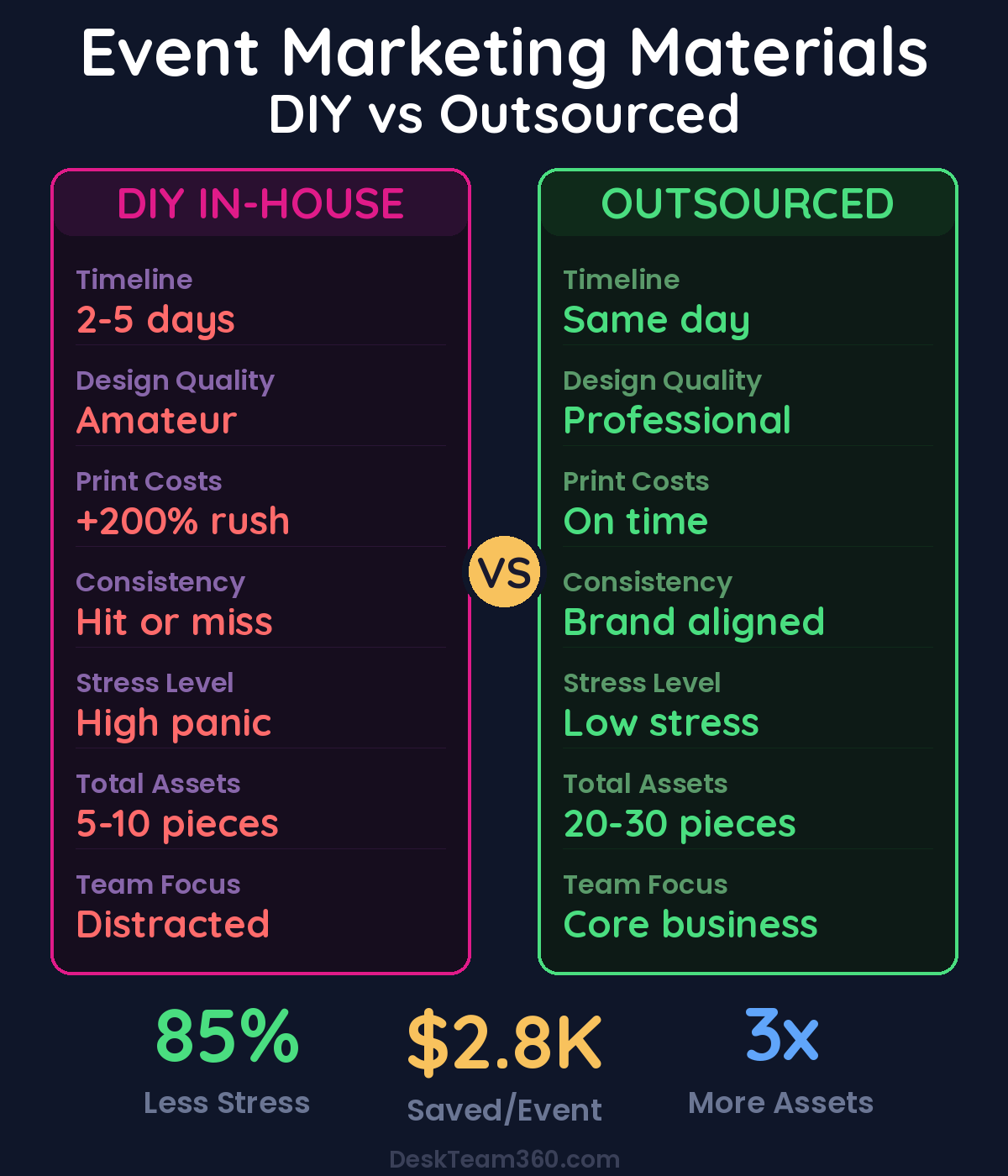
A single trade show can require 20-30 different design assets when you count all the size variations, print specs, and last-minute changes that always happen. Your marketing coordinator who’s already handling a dozen other projects can’t suddenly become a graphic designer for three weeks. That’s not a side project, that’s a full design sprint that needs dedicated attention.
I’ve seen companies try to save money by having their intern design booth banners. Those banners end up looking like intern work, and that reflects on your entire brand at an event where first impressions are everything.
The Consistency Problem
Every piece needs to feel like it came from the same brand. Same colors, fonts, imagery style, messaging tone. When different people create different pieces, or when you’re rushing to finish things, consistency gets thrown out the window. You end up with a booth banner that looks professional next to name badges that look like they were made in MS Paint.
Outsourcing to a single design team ensures everything works together visually. They build templates and style guides that keep everything aligned, even when creating dozens of different assets.
The Timeline Crunch
I’ve watched businesses pay 200-300% markup for rush printing because they couldn’t get their materials finalized on time. That premium you pay for last-minute printing usually exceeds what you would have spent on professional design from the start.
Having a dedicated design team that can turn things around in 24-48 hours eliminates deadline panic. At DeskTeam360, we handle event timelines for clients constantly. We know the print deadlines, the revision cycles, and how to keep everything moving without drama.
Trade Show Booth Materials That Actually Work
Your booth is your storefront for the day, and most people treat it like a garage sale setup. Here’s what you need and how to get it right.
Retractable banners are your foundation. Standard sizes work best: 33″ × 80″ or 36″ × 92″. Keep text minimal because people are walking by, not stopping to read paragraphs. Your company name, one clear value proposition, and a website URL with QR code. Leave the bottom 12 inches relatively clean because the base blocks that area anyway.
Table covers and runners instantly make your setup look professional instead of like you borrowed tables from the hotel. Full-color printing, include your logo, match your brand colors exactly. It’s not complicated, but it makes a huge visual difference.
For larger booths, backdrop displays create an immersive environment that works great for photos people share on social media. These get seen by hundreds of people who weren’t at the event, so make sure they look good in photos, not just in person.
Don’t overload your booth with printed collateral. Bring one strong brochure or one-pager with your best pitch, business cards because people still exchange them, and a digital lead capture system that’s more efficient than paper forms. For guidance on creating brochures that people keep instead of throwing away, our guide on outsourcing brochure design covers the fundamentals.
Event Signage and Wayfinding Design
If you’re hosting the event instead of just attending, signage becomes critical for the overall experience.
Entrance signage sets the tone with welcome banners and event branding at the door. Directional signs help people find breakout rooms, restrooms, and registration without wandering around looking lost. Stage banners and backdrops provide branded elements visible during presentations and in photos that get shared later.
For design, readability from distance matters more than looking pretty up close. Headings should be readable from 10+ feet away with high contrast between text and background. Keep the same branding across all signage with consistent color palettes, fonts, and logo treatment.
Make sure your designer delivers print-ready specs: CMYK color mode, 300 DPI resolution, proper bleed marks, and exact dimensions the print vendor needs. Getting these wrong is the number one reason print jobs come back looking different than expected.
Watch out: Large format signage vendors sometimes accept 150 DPI at full size due to viewing distance, but confirm specs with your specific vendor before approving final files. Don’t assume, ask explicitly what they need.
We covered this in detail in our post about outsource course creation and design: the complete production guide.
Programs, Badges, and Essential Printed Materials
Event programs enhance the attendee experience when designed right. Include the schedule with times and locations, speaker bios with headshots, venue maps, sponsor acknowledgments, WiFi info, and event hashtags. Add QR codes linking to digital versions, feedback forms, or event apps.
Keep the design clean and scannable. Nobody reads programs front to back, they’re looking for specific information quickly while juggling coffee and trying to find their next session.
Name badges seem simple until you mess them up. Large first names readable from 3-4 feet away are the priority. Company names and titles go smaller, below the first name. Use color coding for different attendee types: speakers, VIPs, staff, general attendees. Include event branding but don’t let it overpower the attendee’s actual information that people need for networking.
Swag and Promotional Items That Don’t End Up in the Trash
Bad swag is worse than no swag. I see businesses waste thousands on branded junk that nobody wants. Cheap pens, stress balls, and plastic trinkets that break before people get home don’t build brand awareness, they associate your brand with low quality.
Quality drinkware like branded water bottles, tumblers, or coffee mugs actually get used. Tote bags work well at conferences where people collect materials. Good notebooks with your branding get used for months. Tech accessories like portable chargers, cable organizers, and webcam covers solve real problems people have.
If you’re doing apparel, it needs to look good enough that people would actually wear it in public. A poorly designed t-shirt doesn’t get worn, which means zero brand exposure for your investment.
For design, keep it simple with your logo and maybe a tagline, not your entire website URL. Consider the item’s color and material when choosing your design colors. Provide print-ready vector files in AI or EPS format that vendors actually need. Order samples before committing to large quantities because what looks good on screen might feel cheap in person.
Social Media Assets That Build Event Buzz
Your event marketing on social media needs dedicated visual assets, not afterthought posts thrown together five minutes before publishing.
Create template systems, not one-off graphics. Design announcement templates, speaker spotlight templates, countdown templates that can be customized for each post. This ensures consistency and speeds up content creation when you’re posting daily in the weeks leading up to the event.
For a deeper dive, check out our guide on how to outsource vehicle wrap and graphics design.
For industry benchmarks and research, see Clutch.co.
For industry research and benchmarks, check out HBR on Outsourcing.
Pre-event campaigns should include announcement graphics with event names, dates, locations, and registration links. Speaker spotlight graphics with headshots, names, talk titles, and event branding. Countdown posts for “3 weeks out,” “1 week to go,” and “tomorrow!” Behind-the-scenes content showing setup progress and planning snapshots.
Make sure you have properly sized versions for every platform: Instagram squares and stories, Facebook posts, LinkedIn updates, and Twitter graphics. Each platform has different optimal dimensions, and posting the wrong size makes your content look unprofessional.
For live event content, create branded photo templates, quote card templates for sharing speaker insights in real time, and Instagram story templates with polls and Q&A elements. Post-event content should include thank-you graphics, photo carousel posts with curated event photography, and video recaps even if they’re just 60-second highlight reels.
If social media graphics are part of your marketing strategy, our social media graphics outsourcing guide walks through the complete process.
Presentation Design That Reinforces Your Brand
If you or your team are speaking at the event, your presentation deck is a marketing asset that hundreds or thousands of people will see. A poorly designed deck undermines even the best content and reflects badly on your brand.
Great event presentation decks follow consistent brand templates with every slide using the same visual system. Keep text minimal per slide with key points only, not paragraphs. Use high-quality imagery with professional photos, custom icons, and clear data visualizations. Charts and graphs should communicate information at a glance, not require detailed study.
Pay special attention to opening and closing slides because these get photographed and shared most often on social media. Make sure they include your branding and contact information in case someone shares them weeks later.
For businesses that regularly present at events, having professional presentation templates saves time and ensures consistency. Our presentation design outsourcing guide covers how to get this set up properly.
The Event Marketing Materials Timeline That Prevents Panic
Here’s a realistic timeline that accounts for print vendor lead times, revision cycles, and the inevitable last-minute changes that happen with every event.
Eight to ten weeks before the event, finalize your overall event branding, design booth materials, and place orders with print vendors. Six to eight weeks out, create social media asset templates, design email invitation campaigns, and build dedicated landing pages for registration.
Four to six weeks before, launch your email and social campaigns, place swag orders with samples confirmed, and finalize program designs with all speaker information locked. Two to four weeks out, design name badges with final attendee counts, complete signage designs, and create presentation decks for any speaking sessions.
One week before, handle final proofs and approvals, confirm print deliveries are on schedule, and queue up social media content for event week. During the event, focus on real-time social content using the templates you created weeks earlier.
Companies that follow this timeline see 85% fewer last-minute panics and save an average of $2,800 in rush printing fees per event compared to those who scramble.
One week after the event, send thank-you emails with highlights and photos, post social media recaps, and launch follow-up email sequences for leads collected during the event.
Print Specifications That Prevent Expensive Mistakes
When outsourcing event materials, make sure your design team delivers files in the correct specifications. Wrong specs are the number one reason print jobs come back looking different than expected.
Color mode should be CMYK for anything printed and RGB for digital displays. Resolution needs to be 300 DPI for printed materials and 72 DPI for screens. Include 0.125″ bleed on all sides for printed materials to account for cutting tolerances. File formats should be PDF for print, PNG or JPG for digital use, and AI or EPS for vector logos that can be resized without quality loss.
Large format signage sometimes accepts 150 DPI at full size due to viewing distance, but confirm with your specific vendor. Some have different requirements, and assuming costs money when you have to reprint.
A professional design team knows these specifications and delivers print-ready files that vendors can use immediately. That’s the difference between smooth production and scrambling to fix files while your deadlines approach.
Stop Scrambling, Start Planning
Events are stressful enough without adding “become a graphic designer” to your already overwhelming to-do list. The companies that nail their event marketing materials are the ones that plan early, outsource to professionals, and follow systems that prevent last-minute panic.
At DeskTeam360, our design team handles the complete suite of event marketing materials for our clients. Booth graphics, signage, programs, social media assets, email templates, presentation decks, swag designs, everything delivered on-brand and on schedule. You submit requests through our system, we handle the design and revisions, and you focus on the actual event instead of hunting for fonts at midnight.
No more scrambling for freelancers who disappear when deadlines get tight. No more posting projects on crowdsourcing platforms and hoping someone delivers quality work. No more internal team members trying to be graphic designers while handling their regular responsibilities.
We’ve helped 400+ clients nail their event marketing, from small networking dinners to major industry conferences. Our team understands event timelines, print specifications, and how to keep everything moving smoothly while you focus on running your business.
Free 5-Minute Video
See How DeskTeam360 Works in Under 5 Minutes
Watch the short video and see exactly how we handle design, development, and marketing implementation — so you don't have to.
Watch the Video →