

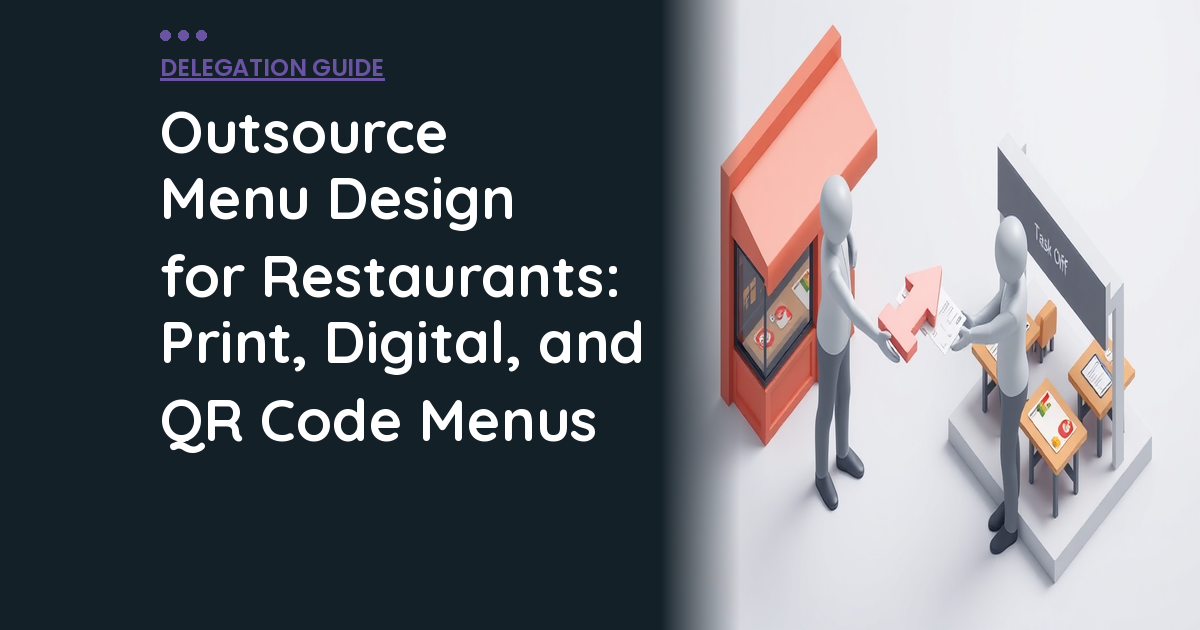
Outsource Menu Design for Restaurants: Print, Digital, and QR Code Menus
Why Restaurant Owners Suck at Menu Design
When you outsource menu design, you free up your team to focus on what actually moves the needle. Your menu is the single most important marketing document your restaurant has. It influences what customers order, how much they spend, and whether they come back. Yet most restaurant owners treat menu design like an afterthought, spending more time picking napkin brands than crafting the one piece of marketing that directly drives revenue.
📋 Table of Contents
I’ve watched restaurant owners blow thousands on fancy point-of-sale systems while using a Microsoft Word template from 2015 for their menu. They’ll hire a marketing agency for social media but design their own menu on Canva. It’s backwards, and it’s costing them real money.
The restaurants that get menu design right see 18-25% increases in average order value. They guide customers to high-margin items. They reduce decision fatigue. They create a dining experience that starts before the first bite. Here’s exactly how to outsource menu design properly, for every format your restaurant needs.
The Three Menu Types Every Restaurant Needs
Let’s get one thing straight: you can’t just create one menu and slap it everywhere. Print menus have different constraints than digital displays. QR codes need mobile-optimized layouts. Instagram requires visual elements that work in a square format. Each platform needs its own approach, but they all need to work together as a system.
Most restaurants make the mistake of designing for one format and adapting everything else. That’s like designing a billboard and then shrinking it down for a business card. The hierarchy breaks, the text becomes unreadable, and customers can’t find what they’re looking for.
Print Menus: Still the Foundation
Physical menus aren’t dead, they’re just doing a different job now. They’re your brand’s first impression, your fallback when WiFi fails, and your upselling powerhouse for dine-in customers. But designing effective print menus requires understanding eye movement patterns, paper costs, and durability requirements that most restaurant owners have never considered.
Professional menu designers know that customers scan in predictable patterns. They read the top right quadrant first, then move in a Z-pattern across the page. High-margin items go in those prime spots. Descriptions hit the emotional triggers that drive impulse orders. Typography guides the eye without overwhelming it.
DIY print menus almost always fail at hierarchy. Everything looks equally important, so nothing stands out. Descriptions are either too short (no emotional hook) or too long (decision paralysis). Pricing gets buried or highlighted so aggressively it screams “expensive.” The result is confused customers who default to the cheapest option they can find quickly.
Digital Menu Boards: The Upselling Engine
Digital displays give you dynamic content, real-time updates, and the ability to promote specials without reprinting anything. They also let you A/B test different layouts, highlight sold-out items, and adjust messaging based on time of day or season. But only if they’re designed to take advantage of these capabilities.
Most restaurant digital menus are just print menus displayed on screens. They’re static, cluttered, and impossible to read from ordering distance. Professional digital menu design uses animation sparingly, maintains readability at 8-10 feet, and creates clear visual paths from category to item to price.
Pro tip: Digital menu boards should update content automatically based on inventory and time of day. Breakfast items disappear after 11am. Sold-out specials get replaced instantly. Weekend promotions activate themselves. This requires backend integration during the design phase, not as an afterthought.
QR Code Menus: Mobile-First Design
QR codes became standard during COVID and they’re not going anywhere. Customers expect them now, especially for casual dining and quick service. But QR menus have unique design challenges: thumb navigation, variable screen sizes, loading speed on poor connections, and the need for one-handed operation while holding food or drinks.
Amateur QR menu design copies desktop layouts and hopes for the best. Text becomes microscopic on phones. Images load slowly on restaurant WiFi. Navigation requires precision finger movements that don’t work when you’re holding a beer. The customer experience falls apart, and orders suffer.
Professional mobile menu design prioritizes loading speed, uses thumb-friendly navigation zones, and creates visual categories that work on 5-inch screens. It’s not just responsive design, it’s mobile-native thinking.
Free Tool
How Much Is Freelancer Management Really Costing You?
Most agency owners have never done this math. Plug in a few numbers and see your real cost in 2 minutes.
Calculate Your Hidden Costs →
What Professional Menu Design Actually Costs
Let’s talk numbers, because this is where restaurant owners either invest wisely or waste money on the wrong things.
Related: Outsource Course Creation and Design: The Complete Production Guide.
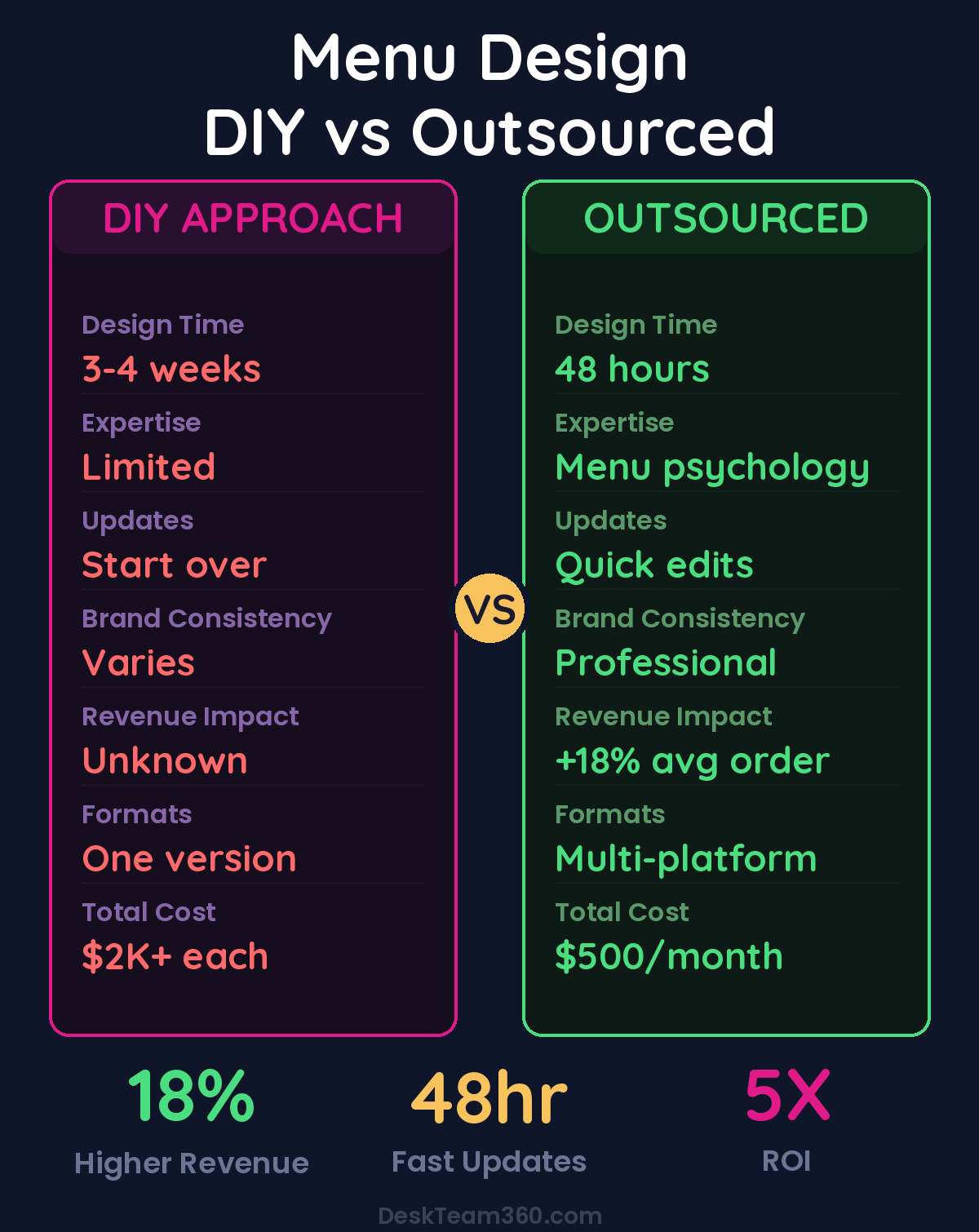
DIY menu design seems free until you factor in your time, software subscriptions, printing costs for multiple revisions, and the opportunity cost of amateur-looking materials. I’ve seen owners spend 40+ hours across three weeks trying to get their Canva template “just right.” Their hourly rate makes that a $2,000+ project, and it still looks amateur.
Professional menu design ranges from $1,500 for basic print-only work to $8,000+ for comprehensive multi-platform systems. That sounds expensive until you consider the impact. A 15% increase in average order value pays for itself in weeks for most restaurants. Better menu design also reduces ordering confusion, speeds up service, and creates upselling opportunities that compound over time.
Restaurants with professionally designed menus see 18-25% higher average order values compared to DIY alternatives.
Freelance designers charge $75-150 per hour and typically need 15-25 hours for comprehensive menu systems. Specialized menu design agencies charge flat project fees but deliver faster turnarounds and deeper industry expertise. The key is finding designers who understand restaurant psychology, not just graphic design.
How to Hire Menu Designers Who Actually Get It
Not all designers understand restaurant marketing. Hiring a wedding invitation designer to create your menu is like hiring a real estate photographer for product shots. The technical skills overlap, but the psychology is completely different.
Ask potential designers for restaurant portfolio examples, specifically from similar concepts to yours. Fine dining menus need different approaches than fast-casual. Coffee shops have different challenges than full-service restaurants. A designer who’s created 50 restaurant menus will understand problems you didn’t even know existed.
During the selection process, ask about their approach to menu psychology. How do they guide customers toward high-margin items? What’s their philosophy on description length? How do they handle dietary restrictions without cluttering the layout? Designers who focus only on aesthetics will give surface-level answers. Specialists will geek out on the psychology.
Watch out: Designers who promise “unlimited revisions” usually deliver mediocre first drafts and expect you to art-direct the fixes. Instead, look for designers who ask detailed questions upfront and nail the concept on revision 2-3. The best designers solve problems you didn’t articulate.
Get examples of their work across different formats. If they’ve only done print menus, they’re not equipped for digital or mobile design. Menu design is becoming a multi-platform challenge, and your designer needs experience with all three formats.
The Menu Design Brief That Gets Results
Most restaurant owners give designers way too little information and then wonder why the first draft misses the mark. Professional menu design starts with a comprehensive creative brief that covers brand positioning, customer psychology, operational constraints, and business goals.
Your brief should include target customer demographics, average order values you’re trying to hit, high-margin items you want to promote, dietary restrictions you need to accommodate, and operational constraints like kitchen capabilities and ingredient sourcing. It should also cover brand personality, competitive landscape, and any existing design assets you want incorporated.
Include photos of your current menu, your restaurant interior, and 3-5 competitor examples you admire (and why). Provide sales data showing which items perform well and which ones struggle. The more context you give upfront, the better the first draft will be.
Don’t forget practical details: print budget and quantities, digital display specifications, QR code hosting requirements, and timeline for launch. These constraints shape design decisions, and surprising your designer with them after concept approval leads to expensive changes.
Managing the Design Process
Professional menu design follows a predictable process: discovery and brief, concept development, design execution, revision cycles, and final delivery. Each phase has specific deliverables and approval gates. Understanding this process helps you give better feedback and avoid costly scope creep.
During concept development, you’re choosing overall direction, not nitpicking fonts. During design execution, you’re reviewing layout and hierarchy, not rewriting item descriptions. Save copy changes for early phases and design refinements for later phases. Mixing these creates revision loops that blow budgets and timelines.
Give consolidated feedback, not piecemeal reactions. Review everything with your team, compile notes, and deliver them in one organized document. Designers work more efficiently with structured feedback than scattered observations delivered over multiple days.
Multi-Platform Menu Strategy
Your print menu, digital displays, QR code menu, and social media images all need to work together as a cohesive system. Colors, fonts, photography style, and brand voice should be consistent across every touchpoint. But the layouts, information hierarchy, and user experience need optimization for each platform.
This is where restaurant marketing gets sophisticated. Your print menu might highlight seasonal specials prominently, while your QR menu promotes online ordering incentives. Your digital displays might push high-margin beverages, while your Instagram stories feature photogenic desserts. Different goals, consistent brand, optimized execution.
Brand consistency doesn’t mean identical layouts. Professional design systems adapt the brand expression to each platform’s strengths while maintaining recognizable visual DNA across every customer touchpoint.
Plan for updates and seasonal changes during the initial design phase. How will you handle limited-time offers? What’s the process for removing sold-out items? How quickly can you update pricing across all platforms? These operational questions need design solutions, not just policy answers.
If you’re interested in broader restaurant marketing strategies, our guide on restaurant marketing automation covers how menu design fits into larger customer acquisition systems.
Menu Engineering: The Science Behind the Art
Menu engineering combines sales data, cost analysis, and design psychology to maximize profitability. It’s not about creating the prettiest menu, it’s about creating the most profitable one. Professional menu designers understand this and incorporate engineering principles into their visual design decisions.
High-margin items get premium placement in the top-right quadrant of print menus and prominent positioning on digital displays. Item descriptions use psychological triggers that justify premium pricing. Visual elements guide attention without being obvious about it. Pricing strategies reduce sticker shock while highlighting value.
This requires collaboration between your designer, your kitchen team, and your accountant. Item costs, profit margins, prep complexity, and ingredient availability all influence design decisions. The best-looking menu is worthless if it promotes items you can’t execute profitably.
Track performance after launch. Which items see increased orders? Are customers upgrading more frequently? Is average order value trending up? Menu design is measurable marketing, and the data tells you what’s working. For more insights on measuring marketing effectiveness, check out our article on measuring campaign ROI.
Avoiding the Common Pitfalls
I’ve seen restaurants make predictable mistakes with outsourced menu design. Here’s how to avoid the biggest ones.
Choosing designers based on price alone. Cheap menu design is expensive when it doesn’t drive sales. A $500 amateur menu that reduces average order value costs more than a $3,000 professional design that increases it. Focus on ROI, not initial investment.
Skipping the mobile optimization. Even if you’re not launching QR codes immediately, design for mobile from day one. Customers will photograph your print menu and zoom in on their phones. If it’s not readable at mobile scale, you’re creating friction in the ordering process.
Ignoring operational constraints. Beautiful designs that your kitchen can’t execute create customer disappointment and operational stress. Make sure your designer understands your prep capabilities, storage limitations, and service model before finalizing concepts.
Not planning for updates. Menus change seasonally, prices fluctuate, and promotions need quick implementation. Design systems that accommodate changes without full redesigns. This requires upfront planning and file organization that amateur designers often skip.
For industry research and benchmarks, check out HBR on Outsourcing.
Restaurants that update their menus quarterly see 12% higher customer retention compared to those with static annual menus.
Beyond Design: Menu as Marketing System
Professional menu design isn’t just about making things look good, it’s about creating a marketing system that works 24/7. Every menu interaction is a branding moment, an upselling opportunity, and a chance to guide customer behavior toward profitable outcomes.
Your menu design should integrate with your broader marketing strategy. QR menus can collect email addresses for loyalty programs. Digital displays can promote social media hashtags. Print menus can include QR codes that link to reviews or special offers. Each touchpoint should advance your customer relationship, not just list available items.
Consider the full customer journey. How does your menu design support first-time visitors versus regulars? How does it accommodate dietary restrictions without overwhelming mainstream customers? How does it handle peak rush periods when decision speed matters more than browsing experience?
These strategic questions separate professional menu designers from amateur freelancers. The best designers think like marketers who happen to use visual tools, not artists who occasionally work on business projects.
Making Menu Design Pay for Itself
Let’s get specific about ROI because that’s how you justify the investment and measure success.
Track baseline metrics before launching new designs: average order value, items per transaction, time from seating to ordering, and customer satisfaction scores related to menu experience. These become your benchmarks for measuring improvement.
After launch, monitor the same metrics weekly for the first month, then monthly thereafter. Look for trends, not daily fluctuations. Menu design impact compounds over time as customers get familiar with the new layout and your staff becomes comfortable promoting highlighted items.
Calculate the payback period based on increased average order value. If your new menu design costs $4,000 and increases average orders by $3 per transaction, you break even after 1,334 transactions. For most restaurants, that’s 4-8 weeks depending on volume.
Don’t forget secondary benefits: reduced ordering confusion speeds up service, better upselling increases tips for servers, improved brand perception supports premium pricing, and social-media-worthy design generates free marketing through customer photos. These compound the direct revenue impact.
Understanding comprehensive business metrics helps with all marketing investments, not just menu design. Our guide on conversion rate optimization covers similar measurement principles for digital marketing.
Your Next Steps
Professional menu design isn’t a luxury for established restaurants, it’s a competitive necessity for any restaurant serious about maximizing revenue. The difference between amateur and professional design shows up directly in your sales numbers, customer satisfaction, and operational efficiency.
Start with an honest audit of your current menu performance. What’s working? What confuses customers? Where are you leaving money on the table? Use this analysis to create a comprehensive design brief that sets your project up for success.
Budget for professional work that covers all three formats: print, digital, and mobile. Half-measures create inconsistent brand experiences that confuse customers and limit your marketing opportunities. The upfront investment in comprehensive design pays dividends across every customer interaction.
At DeskTeam360, we help restaurant owners navigate complex marketing projects like menu design outsourcing. From vendor selection to project management to performance tracking, we handle the details so you can focus on running your restaurant. Our team has managed hundreds of design projects across every industry, and we know how to get professional results on restaurant timelines and budgets.
Free 5-Minute Video
See How DeskTeam360 Works in Under 5 Minutes
Watch the short video and see exactly how we handle design, development, and marketing implementation — so you don't have to.
Watch the Video →