

Digital Marketing for SaaS Companies: Strategies That Drive Growth
Digital marketing for saas companies requires a focused strategy that actually drives results.
📋 Table of Contents
SaaS Marketing Isn’t Like Selling Widgets
Most SaaS founders take traditional marketing advice and wonder why it doesn’t work. You can’t market software subscriptions the same way you market physical products. Your “product” lives in the cloud, your revenue comes monthly instead of once, and your biggest competitor is always “we’ll just build it in-house.”
After working with 400+ clients over 12+ years, including dozens of SaaS companies, I’ve watched founders burn through marketing budgets trying strategies that work for e-commerce but fail spectacularly for software. SaaS marketing is its own animal, with its own rules, metrics, and failure modes.
The companies that figure this out scale predictably. The ones that don’t? They churn through marketing directors every 18 months wondering why their CAC keeps climbing while their conversion rates stay stuck.
Product-Led Growth: Your Product Is Your Best Salesperson
The fastest-growing SaaS companies don’t rely on sales teams to close deals. They let users experience the product directly, fall in love with it, and convert themselves. Slack, Dropbox, Zoom, and Figma all grew this way. Their products sold themselves.
Here’s why this matters: traditional sales-led approaches require expensive sales teams, long sales cycles, and complex demos. Product-led growth (PLG) flips that. Your product becomes the demo, the trial, and the sales pitch all rolled into one.
But PLG only works if you design for it from day one. Your onboarding needs to deliver value in minutes, not weeks. Your core features need to be self-explanatory. And your upgrade prompts need to feel helpful, not pushy.
The mistake most SaaS companies make is bolting a free trial onto a product that was built for enterprise sales. It doesn’t work. Enterprise products require configuration, training, and hand-holding. PLG products work out of the box.
If your product takes 30 minutes to set up and three weeks to see value, PLG isn’t your path. You need a sales team. But if users can sign up and get immediate value? PLG can scale faster than any sales team you’ll ever hire.
Making PLG Actually Work
Real PLG isn’t about hoping users figure it out. It’s about removing every possible point of friction between signup and that first “aha moment” when they see the value.
Your signup process should take 60 seconds, not 10 minutes. Skip the company size dropdown, the “how did you hear about us” survey, and the password complexity requirements that make people hate you before they’ve even started. Get them into the product immediately.
Time to value is everything. If your product helps people organize their tasks, they should be able to create their first project and add tasks within 2 minutes of signing up. If it takes 30 minutes to configure integrations before they can see any value, most users will abandon it.
In-product sharing drives viral growth. Calendly exploded because every meeting link exposed new people to the product. Figma grew because designers share mockups with stakeholders who then need Figma accounts to leave feedback. Build collaboration into your core workflow, not as an afterthought.
Free Tool
How Much Is Freelancer Management Really Costing You?
Most agency owners have never done this math. Plug in a few numbers and see your real cost in 2 minutes.
Calculate Your Hidden Costs →
Content Marketing: The Channel That Actually Scales
Content marketing is the most effective long-term growth channel for SaaS companies, but most do it backwards. They write about their product instead of their customers’ problems. They optimize for keywords instead of actual value. And they wonder why their blog gets traffic but doesn’t convert.
The companies winning with content understand that people don’t Google “best project management software” when they’re happy with their current solution. They Google “how to manage remote team deadlines” when they’re struggling with a specific problem.
Start with the problems your customers had before they found you. Document every pain point, every inefficiency, every workflow breakdown that drives people to seek solutions like yours. Those problems become your content topics.
Pro tip: Go through your last 50 customer onboarding calls and list every problem they mentioned having before they found your product. Those are your content ideas for the next six months.
Write for people who don’t know your product exists yet. Your best content marketing pieces should be so useful that readers bookmark them even if they never become customers. When you help people solve problems, they remember you when buying time arrives.
The framework that works is simple: educational content first, comparison content second, product-focused content last. Someone searching “how to track project deadlines” is months away from buying. Someone searching “Asana vs Monday.com” is days away. Someone searching “Asana pricing” is ready right now.
Programmatic SEO for SaaS
If your SaaS serves multiple industries, use cases, or integrates with other tools, you have a massive opportunity most companies miss. Create pages for every combination: “[Your Product] for Marketing Teams,” “[Your Product] for Real Estate,” “[Your Product] + Salesforce Integration.”
These pages individually might get 200 visitors per month. But 50 pages at 200 visitors each is 10,000 monthly visitors, and they’re all highly targeted. Someone searching “CRM for real estate agents” knows exactly what they want.
The content formula is straightforward: industry-specific pain points in the first section, how your product addresses those specific needs in the second section, and real customer examples from that industry in the third section. If you need help scaling content production without burning through internal resources, our guide on outsourcing content creation covers the systems that work.
Email Onboarding: Where Trials Convert or Die
Your onboarding email sequence is the highest-leverage piece of content you’ll ever write. You’ve spent money to get someone to try your product. Now you need to activate them before they forget why they signed up.
Most SaaS companies send generic welcome emails that sit in inboxes and get ignored. The companies that convert trials into customers use email to guide users through their first successful experience with the product.
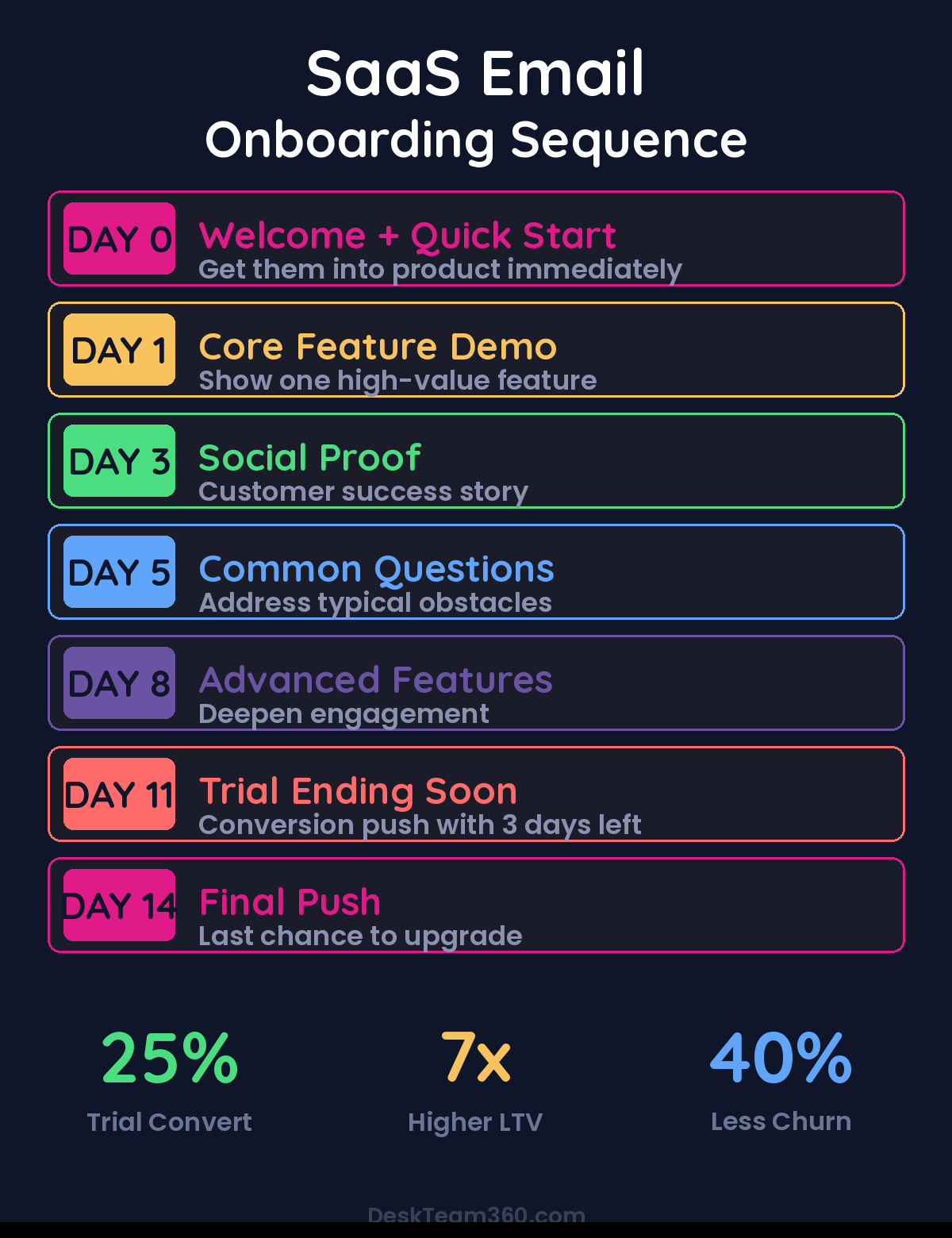
Your first email should get them to take one action immediately. Not five actions. One. “Create your first project,” “Upload your first document,” “Invite your first team member.” Whatever that core action is, make it dead simple and give them a reason to do it right now.
The second email, sent 24 hours later, should highlight the feature that delivers the biggest value. Don’t explain every feature. Focus on the one thing that makes users say “this is exactly what I needed.”
Email three is social proof. Show them how similar customers use the product to solve the same problems they have. “Here’s how TechStart increased their project completion rate by 40% using [Feature].” Make it real and specific.
Email four addresses the most common sticking points. “Stuck getting started? Here are the three questions new users ask most often.” This catches people who signed up but never fully engaged.
The sequence should build momentum toward conversion, not just dump information. Each email should reference previous emails and build on what they’ve hopefully already done. By email five or six, they should be experienced enough with your product that upgrading feels like the obvious next step.
Timing Your Email Sequence
For 14-day trials, spread the sequence over the entire trial period. Don’t front-load everything in the first three days. Users need time to actually use the product between emails.
Send your conversion push with three days left in the trial, not on the last day. People need time to process the decision and possibly discuss it with their team. If the first time they hear about upgrading is when their trial expires, you’ve waited too long.
Trial conversion rates vary wildly by industry and price point. B2B SaaS typically sees 15-25% conversion from opt-in trials. Consumer SaaS often sees 2-5%. If you’re below these ranges, your onboarding needs work before you scale acquisition.
We break this down further in ai marketing tools: the complete guide for 2026.
Landing Pages That Actually Convert Trials
Your landing page is where all your marketing traffic converges. Content marketing, paid ads, social media, email campaigns. If your landing page doesn’t convert, everything upstream was wasted effort.
Most SaaS landing pages fail because they try to appeal to everyone instead of speaking directly to their ideal customer. “Project management software for teams” is generic. “Ship client projects on time without the constant follow-up emails” speaks to a specific pain point that project managers face.
Your headline should state the outcome, not the category. People don’t want “customer support software.” They want to “resolve 80% of customer issues without hiring more support staff.” Lead with the result they care about.
Show the actual product above the fold. Don’t make people scroll to see what they’re signing up for. Screenshots, product tours, or demo videos work. Stock photos of people pointing at laptops don’t.
Watch out: Don’t hide your pricing. Users who can’t find pricing leave and find a competitor who’s transparent. If your pricing is “contact us,” you better have enterprise-level complexity to justify it.
Social proof above the fold builds trust immediately. Customer logos, G2 ratings, user counts, or testimonials. But make it real. “Trusted by 10,000+ teams” is better than “Trusted by innovative companies worldwide.”
Your CTA should promise the trial experience, not the product. “Start Free Trial” works. “Get Started Free” works. “See How It Works” works. “Learn More” doesn’t convert because it doesn’t promise anything.
Address objections before they become deal-breakers. Common objections for SaaS products: “How long does setup take?” “Do we need to migrate data?” “What happens after the trial?” “Can we cancel anytime?” Answer these on the landing page or lose conversions to uncertainty.
Reducing Churn: Stop the Revenue Leak
Here’s a truth most SaaS founders don’t want to hear: reducing churn by 5% can increase profitability more than increasing signups by 20%. Customer acquisition gets all the attention, but retention is where the money lives.
Churn is especially brutal for SaaS because it compounds. Lose 5% of customers per month and you’re replacing 60% of your revenue annually just to stay flat. Reduce that to 2% monthly churn and the same acquisition efforts deliver 50% more growth.
The biggest driver of early churn is incomplete onboarding. Users who don’t reach their first success milestone within 30 days rarely make it to month two. Users who don’t integrate the product into their actual workflow churn as soon as their trial ends.
Companies with structured onboarding processes see 40% higher trial conversion and 30% lower first-month churn compared to companies that just send login credentials.
For a deeper dive, check out our guide on digital marketing for contractors: the no-bs guide to getting more jobs.
Track engagement metrics religiously. Login frequency, feature usage, team member invitations, data uploads. When these metrics decline, it’s a leading indicator of churn. Automated re-engagement campaigns triggered by behavior changes can save 20-30% of at-risk customers.
Exit surveys are crucial but most companies do them wrong. Don’t ask “Why are you canceling?” in a text box. Nobody writes essays about why your product sucks. Use multiple choice options based on common churn reasons: “Found a better solution,” “Too expensive for value received,” “Too difficult to use,” “Needed features you don’t have.”
The answers guide your product roadmap and help you spot patterns. If 40% of churned customers cite “too expensive,” you have a pricing problem. If 60% cite “too difficult,” you have a UX problem. Let the data guide your retention strategy.
Building Switching Costs Ethically
The more invested users become in your product, the harder it is to switch. Encourage data imports, team member invitations, integrations with other tools, and customization. Every connection they make to your product creates friction for switching to a competitor.
But do this ethically. Don’t make it impossible to export data or disconnect integrations. That builds resentment, not loyalty. Make your product so valuable that customers don’t want to leave, not so difficult to leave that they feel trapped.
Paid Advertising for SaaS: Making the Math Work
Paid ads can work brilliantly for SaaS companies, but the economics are different from e-commerce. Your customer lifetime value (LTV) is spread over months or years, so your payback period is longer. This changes how you think about acceptable cost per acquisition.
Google Ads work best for high-intent keywords. People searching “Slack alternative” or “best CRM for small business” are ready to evaluate solutions. People searching “what is project management” are six months away from buying anything.
Focus your Google Ads budget on solution-aware keywords. “[Category] software,” “[Competitor] alternative,” “best [category] for [use case].” These searches have intent behind them. The traffic volume is lower but the conversion rates are 5-10x higher than informational keywords.
For social media ads, retargeting drives the highest ROI. Show ads to people who visited your pricing page, started a trial, or watched a demo video but didn’t convert. These audiences have shown interest and just need the right nudge at the right time.
Video ads perform exceptionally well for SaaS products on social media. 30-60 second product demos showing the software in action convert better than static images or text-heavy carousels. Show the problem, show your product solving it, show the result.
Lead magnets work for top-of-funnel social campaigns. Free templates, checklists, industry reports, or tool comparisons in exchange for email addresses. This builds your retargeting audience and email list for longer-term nurturing.
SaaS Advertising Metrics That Matter
Customer Acquisition Cost (CAC) is your primary metric, but context matters. If you spend $500 to acquire a customer worth $2,000 over two years, that’s sustainable. If you spend $500 for a customer worth $600, you’re heading toward bankruptcy.
CAC payback period tells you how long until a customer’s subscription revenue covers their acquisition cost. Aim for 12-18 months for most SaaS businesses. Longer than 24 months and you’ll struggle with cash flow unless you have substantial funding.
Trial-to-paid conversion rates vary by industry and price point, but 15-25% is typical for B2B SaaS with opt-in trials. If you’re below 10%, fix your onboarding before scaling acquisition. Throwing more traffic at a broken trial experience just burns money faster.
Building Your SaaS Marketing Team
Early-stage SaaS companies often try to hire full marketing teams before they’ve proven any channels work. You end up with expensive generalists who can do everything poorly instead of specialists who excel at specific channels.
The smarter approach is keeping strategy in-house and outsourcing execution. Your team decides what to build and test. An external team handles the production work, designing landing pages, building email templates, creating ad creative, and developing content.
This gives you the capacity of a large marketing team without the overhead. Your in-house marketers focus on strategy, analysis, and optimization instead of wrestling with design tools or HTML email templates.
For content marketing specifically, most SaaS companies need more volume than one person can produce at quality. If you’re publishing 2-3 articles per week plus comparison pages, case studies, and email sequences, you need production help. Our guide on outsourcing email marketing covers the systems that scale without compromising quality.
Pro tip: Start with one marketing channel and scale it to profitability before adding others. It’s better to dominate one channel than to be mediocre at five.
For industry research and benchmarks, check out Think with Google.
For industry benchmarks and research, see WordStream.
The SaaS Marketing Execution Plan
If I were building SaaS marketing from scratch today, here’s exactly where I’d start. First, nail your positioning. If you can’t clearly explain who this is for, what problem it solves, and why it’s different in one paragraph, nothing else will work.
Build a conversion-focused website with your homepage, pricing page, and at least two landing pages optimized for different audiences or use cases. Don’t try to appeal to everyone. Pick your best customer segment and build for them first.
Set up your onboarding email sequence using the framework above. This is the highest-leverage marketing asset you’ll create. Optimize this before you scale trial acquisition.
Start content marketing with 1-2 in-depth articles per week targeting problems your customers had before they found you. Focus on search traffic first, social distribution second. Optimizing for search builds compound growth over time.
Launch retargeting campaigns to capture people who visited but didn’t convert. These campaigns typically have 5-10x higher conversion rates than cold traffic campaigns.
After 90 days, analyze what’s working and double down. Scale the channels that produce paying customers, not just traffic or trial signups. Revenue metrics matter more than vanity metrics.
Scale Your SaaS Marketing Without the Overhead
SaaS marketing requires consistent execution across multiple channels. Content creation, landing page design, email marketing, ad creative, and conversion optimization. Most early-stage teams can’t handle this volume without burning out or compromising quality.
At DeskTeam360, we handle the marketing production so you can focus on strategy and growth. We build landing pages, design email templates, create ad creative, write content, and manage campaigns for a flat monthly rate. Scale your marketing capacity without scaling your payroll.
Free 5-Minute Video
See How DeskTeam360 Works in Under 5 Minutes
Watch the short video and see exactly how we handle design, development, and marketing implementation — so you don't have to.
Watch the Video →