

How to Scale a Digital Marketing Agency: The Complete Growth Playbook
The Agency Growth Ceiling Nobody Talks About
Figuring out how to scale a digital marketing agency doesn’t have to be complicated. Every agency owner hits the same wall. You’re at $30K-$50K/month in revenue, you’ve got a solid client base, and you know you could grow if you just had more capacity. But hiring is expensive, slow, and risky, and you’re already working 60-hour weeks managing the team you have.
📋 Table of Contents
I’ve been in this game for 12+ years. I’ve watched hundreds of agency owners hit this ceiling, and I’ve seen what separates the ones who break through from the ones who stay stuck.
The answer isn’t “just hire more people.” The answer is building a scalable operation, and that usually means rethinking how your agency delivers work.
Here’s the playbook for scaling a digital marketing agency without burning out, going broke, or sacrificing quality.
Why Traditional Hiring Kills Agency Growth
The instinct when you need more capacity is to hire. But traditional hiring creates its own set of problems that most agency owners don’t see coming until it’s too late.
Let’s do the math on what a single hire actually costs. A full-time designer runs $50K-$80K/year. A developer costs $80K-$130K. Add benefits, tools, training, and the time you spend managing them, and each hire adds $70K-$160K in annual overhead before they generate a dollar of value.
Then there’s the time factor. Finding, interviewing, hiring, and onboarding takes 2-4 months. Your capacity problem exists now, not in four months when someone’s finally up to speed.
Watch out: Bad hires happen more often than you think. 30% of new employees leave within the first year. Every departure costs you the hiring investment plus the client work that doesn’t get done during the gap.
But here’s the killer. Every hire is a fixed cost. Win a big client? Great, you have capacity. Lose a big client? You’re paying salaries for people you can’t keep busy. I’ve seen agencies go from profitable to underwater in a single month because they built their team around peak capacity instead of average capacity.
Free 5-Minute Video
See How DeskTeam360 Works in Under 5 Minutes
Watch the short video and see exactly how we handle design, development, and marketing implementation — so you don't have to.
Watch the Video →
The Three Stages of Agency Growth
Understanding where you are in the growth cycle changes everything about your scaling strategy. Most agency owners make the wrong moves because they’re applying Stage 3 solutions to Stage 1 problems.
Stage 1: Founder-Led ($0-$20K/Month)
You’re doing everything. Sales, delivery, client management, invoicing, troubleshooting, late-night deadline pushes. Growth comes from working more hours, which has a hard ceiling somewhere around “complete burnout.”
The key move here isn’t hiring. It’s stopping trading time for money. Package your services into productized offerings with clear deliverables and pricing. This makes your revenue predictable and your delivery systematizable. No more custom proposals for every single client.
Stage 2: Small Team ($20K-$75K/Month)
You’ve hired a few people. Maybe a designer, a VA, a junior marketer. You’re spending more time managing than doing, which feels wrong because you started this agency to build things, not run meetings about building things.
This is where outsourcing becomes critical. Instead of hiring more in-house staff, partner with an outsourced production team that can absorb your overflow and scale with your client load. You get the capacity without the fixed costs.
We break this down further in ai marketing tools: the complete guide for 2026.
Stage 3: Scaled Operation ($75K-$250K+/Month)
You have a real team, clear processes, and consistent deal flow. Growth is about efficiency, increasing revenue per client, reducing cost per deliverable, and systematizing everything so it runs without you micromanaging every detail.
The key move is optimizing your delivery model. The agencies that scale past $100K/month are the ones with the lowest cost per deliverable, usually through a combination of in-house strategy and outsourced production.
The Outsourced Production Model
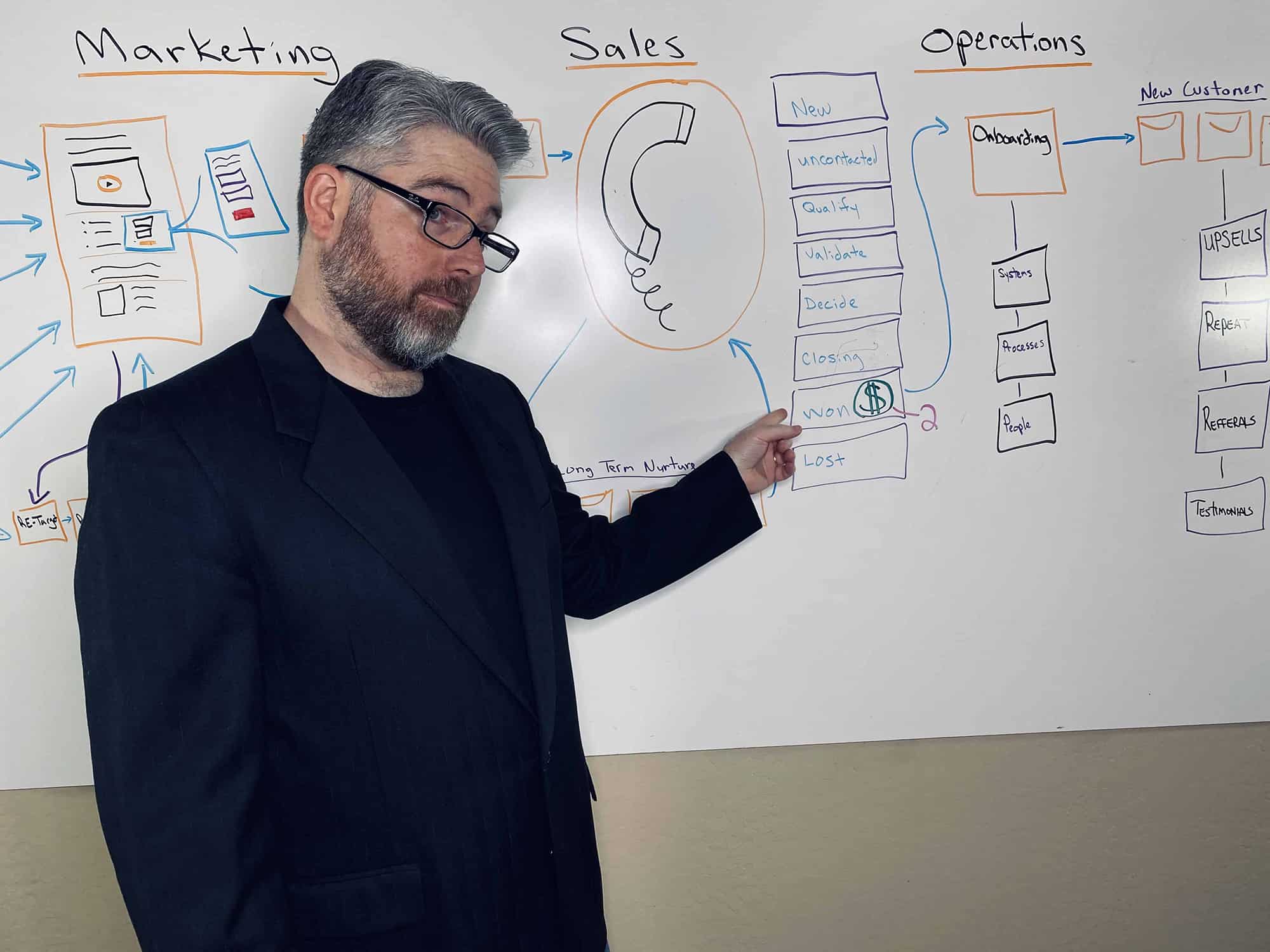
Here’s what the fastest-growing agencies figured out: separate strategy from production.
Strategy stays in-house. Client relationships, strategic planning, brand positioning, campaign architecture. This is your core value. This is where agencies justify premium pricing. Keep it close.
Production gets outsourced. Graphic design, web development, video editing, landing page builds, email template creation. This is execution. It should be systematized and scalable, and you shouldn’t be paying San Francisco salaries for work that can be done equally well for half the price in other markets.
This is the model DeskTeam360 was built for. Agencies use us as their production department, submitting design, development, and video requests under their own brand, with white-label delivery their clients never see behind.
Seven Strategies for Scaling Your Agency
1. Productize Your Services
Stop selling custom proposals for every client. It’s killing your efficiency and making your delivery unpredictable. Package your services into 2-3 clear tiers with defined deliverables and pricing.
Here’s what this looks like in practice. Website package: 5-page WordPress site, branded, responsive, launched in 2 weeks for $5,000. Monthly marketing package: 4 social posts per week, 2 blog articles, 1 email campaign, monthly reporting for $3,000/month. Growth package: everything in monthly plus paid ads management plus conversion optimization for $7,500/month.
Productized services are easier to sell, easier to deliver, and easier to scale. They also eliminate the back-and-forth that kills margins on custom projects.
2. Build Standard Operating Procedures for Everything
If it happens more than twice, document it. SOPs for client onboarding, project kickoffs, design reviews, QA processes, and client reporting reduce errors, speed up delivery, and make it possible for anyone, in-house or outsourced, to execute consistently.
The agencies that scale smoothly are the ones where any team member can pick up any project and know exactly what to do next. That doesn’t happen by accident.
3. Implement the Right Project Management Stack
Your project management tool is the backbone of your operation. Whether it’s Asana, Monday.com, ClickUp, or Basecamp, pick one, commit to it, and build your entire workflow around it. Don’t switch every six months chasing the latest features.
Your tool needs client-facing access for approvals and feedback, internal task management for your production team, time tracking even if you don’t bill hourly because you need cost data, and templates for recurring project types. If you can’t set up a new client project in under 10 minutes using templates, your system isn’t systematic enough.
4. Master Client Onboarding
Bad onboarding creates scope creep, miscommunication, and churn. Great onboarding sets expectations, captures brand guidelines, establishes communication protocols, and builds trust from day one.
Your onboarding should include a welcome packet with timelines and process overview, brand discovery questionnaire, asset collection for logos, fonts, brand colors, and existing content, communication channel setup, and a KPI alignment meeting where you define what success looks like.
Pro tip: Record a personal welcome video for each new client explaining your process and introducing your team. It takes five minutes and prevents 90% of the “how does this work” questions that clog up your project management system.
The goal is zero surprises. By the end of onboarding, your client should know exactly what to expect, when to expect it, and how to get help if they need it.
5. Focus on Client Retention Over Client Acquisition
Acquiring a new client costs 5-7x more than retaining an existing one. The fastest path to growth is reducing churn and increasing revenue per client. Most agencies obsess over lead generation and ignore retention, which is backwards.
Retention tactics that actually work: monthly reporting that ties your work to their business outcomes, not just vanity metrics. Proactive recommendations, don’t wait for them to ask for improvements. Regular check-in calls even when everything is going well. Fast turnaround on requests because nothing kills trust faster than slow delivery. And account expansion, identifying additional services you can provide to existing clients.
6. Build a Referral Engine
The highest-quality leads come from referrals. The close rate is higher, the price sensitivity is lower, and the onboarding is smoother because they already trust you through a mutual connection.
Systematize your referral process. Ask for referrals at specific moments: after a successful project launch, after a positive review, during renewal conversations. Create a referral incentive program with a discount, gift card, or commission. Make it easy by providing templates or introduction emails they can forward. And follow up personally with every referral within 24 hours.
Most agency owners are terrible at asking for referrals. They either never ask, or they ask at the wrong time, or they ask in a way that feels pushy. The right approach is confident and specific: “Who else do you know that could benefit from results like these?”
7. Leverage Outsourcing as Your Growth Lever
This is the big one. Outsourcing isn’t about cutting costs, it’s about unlocking capacity. The agencies that figure this out grow 2-3x faster than the ones that try to build everything in-house.
Here’s how the math works for a typical agency. Without outsourcing, you can handle 10 clients. Revenue: $30K/month. Team cost: $15K/month. Profit: $15K/month. With outsourced production, you can handle 25 clients. Revenue: $75K/month. In-house team cost: $15K/month. Outsourcing cost: $5K/month. Profit: $55K/month.
The outsourced model gives you nearly 4x the profit because you’re scaling revenue without proportionally scaling fixed costs. Your overhead stays manageable while your capacity grows exponentially.

Common Scaling Mistakes Agency Owners Make
I’ve watched agencies make the same mistakes over and over. Here are the five that kill growth most often.
For a deeper dive, see our guide on how to outsource event marketing materials: complete guide.
For industry research and benchmarks, check out Forbes Agency Council.
Hiring too fast. The excitement of growth makes owners hire before they need to. Every hire should be justified by revenue you already have, not revenue you hope to get. If you can’t show exactly which client work will pay for that new hire, don’t make the hire.
Not raising prices. If you haven’t raised prices in 2+ years, you’re effectively taking a pay cut. Your costs have gone up, your skills have improved, and the value you deliver has increased. Review pricing annually and adjust for reality, not for what you charged three years ago.
Trying to be everything to everyone. Niching down feels risky but it’s the fastest path to premium pricing and efficient delivery. The best-positioned agencies serve a specific industry or solve a specific problem, not “full-service digital marketing for anyone with a pulse.”
Watch out: Ignoring operations will kill your growth faster than bad marketing. Flashy sales skills get you clients. Operations keep them. Invest in systems, processes, and quality control before investing in more sales and marketing.
Not tracking profitability by client. You’d be shocked how many agencies don’t know which clients are profitable and which are underwater. Track time and costs per client, and don’t be afraid to fire clients that consistently cost more to serve than they pay.
The Agency Scaling Roadmap
Here’s the exact sequence that works. Don’t skip steps.
Months 1-3 is foundation building. Productize your top 2-3 services. Document SOPs for delivery and onboarding. Set up project management and reporting systems that actually get used. And identify an outsourcing partner for production work.
Months 3-6 is optimization. Transition production work to your outsourced team. Free up in-house time for strategy and client relationships. Implement client retention systems that run automatically. Build your referral engine so it generates leads without you remembering to ask.
Months 6-12 is growth. Increase client acquisition because you now have the capacity to deliver. Expand service offerings using your outsourced team’s capabilities. Hire strategically for high-value in-house roles only. Review pricing and packaging based on what the market will actually pay, not what you think they should pay.
The whole process takes about a year, but you’ll see results in the first quarter if you execute consistently.
Scale Smart, Not Just Big
The agencies that scale successfully aren’t the ones that hire the fastest. They’re the ones that build the best systems, combining strategic in-house talent with scalable outsourced production.
The result is an agency that can say “yes” to every qualified prospect, deliver consistently high-quality work, and maintain healthy margins at any revenue level. That’s not theory. That’s the playbook I’ve watched work hundreds of times over the past 12 years.
It starts with one decision: are you going to keep doing everything in-house, or are you going to build a scalable operation? The agencies that choose scalability are the ones that break through the growth ceiling while everyone else stays stuck.
Free Template
The Ultimate Task Delegation Template
Stop guessing what to hand off. This template shows you exactly what to delegate, how to brief it, and how to QA the results.
Get the Free Template →