First Call Digital Agency Has Increased Their Quality Of Work And Reduced Their Wait Time On Tasks With DeskTeam360!

Why Most Digital Agencies Burn Out Their Owners
Let’s talk about agency quality improvement and why it matters for your business. Picture this: you’re running a digital agency, juggling fifteen different vendors for graphic design, web development, social media, and everything else your clients need. Each vendor has different pricing models, inconsistent delivery times, and wildly varying quality standards. You spend more time managing suppliers than actually growing your business.
📋 Table of Contents
Sound familiar? That’s exactly where First Call Digital Agency found themselves before making a change that transformed their entire operation. Their story isn’t unique, but their solution might surprise you.
I see this pattern constantly across the industry. Agency owners who started their businesses to escape the corporate grind end up trapped in an even worse situation, micromanaging a web of unreliable subcontractors. There’s a better way, and I’m going to show you exactly how one Montana-based agency broke free from this cycle.
The Vendor Management Nightmare
First Call Digital Agency serves MSPs across the United States with full-service digital marketing. Web development, graphic design, paid advertising, social media management, print materials, the whole package. Like most growing agencies, they started by doing everything in-house until they hit capacity.
That’s when the vendor circus began.
They found themselves managing separate contractors for web development, graphic design, content creation, and technical tasks. Each vendor operated on their own timeline, used different communication methods, and charged according to their own pricing structure. Some delivered on time, others didn’t. Some produced quality work, others required multiple revisions.
Watch out: The hidden cost of vendor management isn’t just the time spent coordinating. It’s the opportunity cost of not focusing on client acquisition, strategy, and business growth. Every hour spent chasing vendors is an hour not spent building your agency.
The real problem wasn’t finding individual contractors who could do good work. The problem was creating a predictable, scalable system that could handle their growing client base without requiring constant oversight.
When delivery estimates proved unreliable and quality control became a full-time job, they realized their vendor management strategy wasn’t sustainable. They needed a different approach entirely.
What Actually Matters in Agency Operations
Before diving into solutions, let’s talk about what separates successful agencies from the ones that burn out their founders. It comes down to three core operational principles that most agencies ignore until it’s too late.
Consistency beats perfection every time. Your clients would rather receive good work on schedule than perfect work two weeks late. Predictable delivery timelines allow you to manage client expectations and plan future projects confidently.
Communication overhead kills profitability. If you’re spending more time explaining projects to vendors than the vendors spend executing them, your margins are evaporating. Clear communication systems and standardized processes aren’t luxury items, they’re survival tools.
Quality control can’t be an afterthought. Reviewing deliverables shouldn’t feel like rolling dice. When you can’t predict the quality of vendor work, you end up over-delivering on revisions to maintain client relationships. That’s unsustainable.
The vendor coordination trap is real. Agencies that manage 5+ separate vendors typically spend 20-30% of their time on vendor coordination alone. That’s time that should be invested in client strategy, business development, or actually running the agency.
Understanding these principles helps explain why piecemeal vendor management rarely scales beyond a certain point. The administrative overhead grows faster than the revenue, creating a bottleneck that limits growth regardless of demand.
The Single-Source Solution
First Call Digital Agency discovered DeskTeam360 through a recommendation from Duct Tape Marketing, who had switched from their previous agency and couldn’t stop talking about the improvement. The value proposition was immediately clear: instead of managing multiple vendors across different specializations, they could work with one team that handled everything.
The transition wasn’t just about consolidating vendors. It was about fundamentally changing how they approached project delivery and client service. Instead of coordinating between web developers, graphic designers, and content creators, they could submit a comprehensive project through a single ticketing system and receive consistent, quality deliverables.
Here’s what changed in their day-to-day operations: project requests went from scattered emails and phone calls to standardized tickets with clear specifications. Delivery timelines became predictable because they were working with a team that understood their quality standards and communication style. Quality control shifted from reactive damage control to proactive project management.
Pro tip: When evaluating any outsourcing solution, pay attention to their onboarding process. If they don’t invest time understanding your quality standards, communication preferences, and project requirements upfront, you’ll spend months training them through trial and error.
The most significant change wasn’t technical, it was psychological. Instead of dreading vendor coordination, they could focus on client strategy and business growth. That shift in mental bandwidth made everything else possible.
The Real ROI of Consolidated Operations
Let’s talk numbers, because the financial impact of vendor consolidation goes beyond the obvious cost savings. First Call Digital Agency saw improvements across multiple metrics that compounded into significant business growth.
Time savings were immediate and measurable. No more chasing individual vendors for project updates. No more explaining the same project requirements to multiple people. No more quality control firefighting when deliverables didn’t meet standards. The time savings alone allowed them to take on additional clients without hiring internal staff.
Pricing became predictable. Instead of variable pricing across different vendors, they could budget accurately for each project type. This predictability improved their own client proposals and profit margin calculations.
Quality consistency improved client satisfaction. When deliverables meet expectations consistently, client relationships strengthen. Happy clients provide referrals, approve additional projects, and renew contracts at higher rates.
Agencies that consolidate to a single outsourcing partner typically see 40-60% reduction in project management overhead within the first quarter.
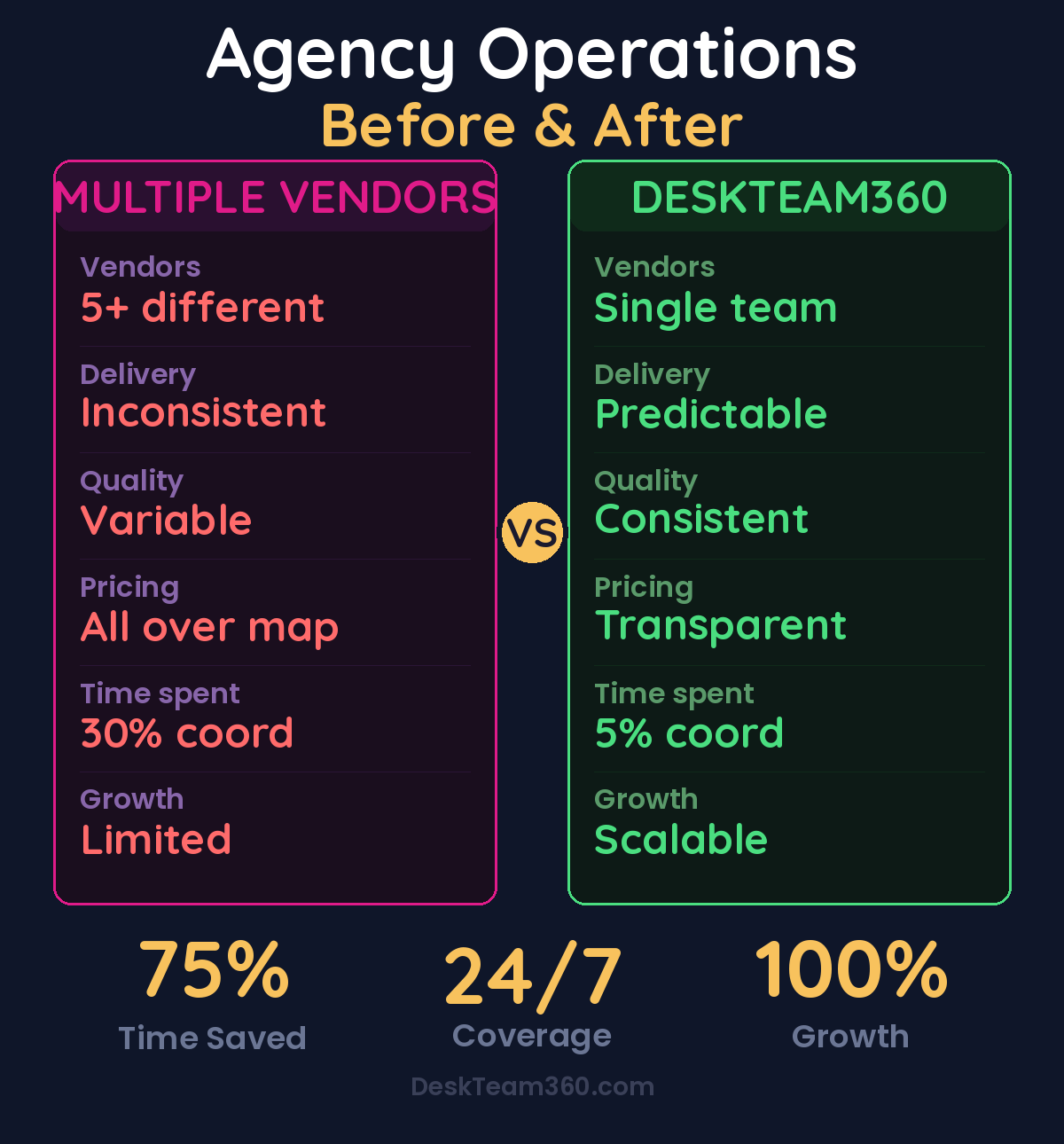
The compound effect of these improvements allowed First Call Digital Agency to scale their client base without proportionally increasing their operational complexity. They could confidently take on larger projects and more demanding timelines because they trusted their delivery capabilities.
For agencies looking to understand similar transformations, our guide on scaling business operations covers the fundamentals of operational efficiency.
Implementation Strategy That Actually Works
Transitioning from multiple vendors to a consolidated approach requires careful planning. You can’t just flip a switch and expect everything to work perfectly. Here’s the proven process that minimizes disruption while maximizing results.
Start with your highest-volume, lowest-risk projects. Don’t test a new vendor relationship on your most important client deliverable. Begin with routine tasks like social media graphics, blog content, or basic web maintenance. Build confidence in the relationship before expanding scope.
Establish clear communication protocols upfront. How will you submit project requests? What information must be included? How will revisions be handled? What are the expected turnaround times for different project types? Document everything to avoid miscommunications later.
Run parallel operations during the transition period. Keep your existing vendors active for 2-4 weeks while testing the new arrangement. This safety net prevents client delivery issues if the transition hits unexpected roadblocks.
Monitor performance metrics closely during the first month. Track delivery times, revision rates, and client satisfaction scores. This data will guide your expansion strategy and help you identify areas where additional training or process refinement might be needed.
For agencies considering similar transitions, understanding how to choose the right partners can prevent costly mistakes during vendor selection.
Related reading: How to Outsource Marketing Tasks Without Getting Burned (From 12 Years and $1M in Lessons).
For a deeper dive, check out our guide on women in white coats – saved 20 hours a week & started growing the business.
Common Pitfalls and How to Avoid Them
I’ve watched dozens of agencies attempt vendor consolidation, and the failures follow predictable patterns. Here’s what goes wrong and how to avoid each mistake.
Rushing the transition without proper testing. Moving all your projects to a new vendor immediately is like jumping out of a plane without checking your parachute. Start small, test thoroughly, then scale gradually based on performance.
Failing to document processes and standards. Your new vendor can’t read your mind. If you don’t explicitly document your quality standards, communication preferences, and project requirements, you’ll spend months correcting misaligned expectations.
Choosing price over capability. The cheapest option is rarely the most cost-effective when you factor in revision time, communication overhead, and opportunity costs. Focus on finding a partner whose capabilities align with your needs, not just your budget.
Neglecting client communication during the transition. Your clients don’t care about your internal operational changes, but they will notice if project quality or delivery times suffer. Communicate proactively about any changes that might affect their experience.
Watch out: Some agencies try to maintain relationships with previous vendors “just in case” the new arrangement doesn’t work out. This backup plan often becomes a crutch that prevents full commitment to the new process. Make a clean break once you’ve validated the new approach.
Understanding these pitfalls helps explain why vendor transitions succeed or fail. Most failures stem from inadequate planning rather than incompatible partnerships.
Measuring Success Beyond Cost Savings
Cost reduction is the obvious metric, but it’s not the most important one. The real value of operational consolidation shows up in areas that directly impact business growth and owner satisfaction.
Owner time allocation. Track how many hours per week you spend on vendor management versus client-facing activities. The goal is shifting more time toward business development, strategy, and actual client work.
Project delivery predictability. Measure how often projects deliver on time and on spec. Improved predictability allows you to take on more aggressive timelines and increase client satisfaction.
Client retention and referral rates. Better operational consistency typically improves client relationships. Monitor retention rates and referral generation to understand the compound benefits of operational improvements.
Revenue per employee. As operational efficiency improves, your team should be able to generate more revenue without proportional increases in headcount. This metric captures the productivity gains from better vendor relationships.
Agencies with streamlined operations typically achieve 25-35% higher revenue per employee compared to those managing fragmented vendor relationships.
For agencies interested in comprehensive performance measurement, our analysis of measuring marketing ROI provides frameworks that apply to operational efficiency as well.
The Long-Term Competitive Advantage
Operational efficiency isn’t just about reducing costs or saving time. It’s about building sustainable competitive advantages that compound over years, not months.
When your delivery capabilities are predictable and scalable, you can confidently pursue larger clients and more complex projects. Your competitors who are still juggling multiple vendors will struggle to match your consistency and reliability.
For industry research and benchmarks, check out Forbes Agency Council.
The mental bandwidth you recover from vendor management can be redirected toward strategic initiatives: developing new service offerings, improving client acquisition, optimizing pricing strategies, or building internal capabilities that differentiate your agency.
First Call Digital Agency experienced this firsthand. Once they eliminated vendor coordination overhead, they could focus on expanding their service offerings and pursuing higher-value clients. The operational foundation supported business growth that wouldn’t have been possible under their previous vendor management approach.
Sustainable growth requires operational leverage. Agencies that scale successfully build systems that improve efficiency as they grow, rather than creating more complexity. Vendor consolidation is one of the most effective leverage points for service-based businesses.
The companies that understand this principle early gain years of compounding advantages over competitors who continue fighting vendor management battles instead of focusing on business growth.
For agencies looking to develop comprehensive growth strategies, our guide on digital marketing strategies for small businesses covers the strategic frameworks that become possible when operational complexity is under control.
Making the Transition
If First Call Digital Agency’s story resonates with your current situation, the path forward is clearer than you might think. The key is approaching vendor consolidation as a strategic business decision, not just a cost-cutting measure.
Start by auditing your current vendor relationships. How much time do you spend coordinating between different providers? What’s the total cost, including your management overhead? Where are the biggest quality and consistency issues? This baseline measurement will help you evaluate potential improvements objectively.
Look for partners who demonstrate operational maturity through their onboarding process, communication systems, and quality control procedures. The right partner should be asking detailed questions about your requirements, not just promising to handle everything.
Remember that vendor consolidation is ultimately about business growth, not just operational efficiency. The time and mental bandwidth you recover should be reinvested in activities that directly contribute to revenue and client satisfaction.
Pro tip: Document everything during your transition. Track time savings, quality improvements, and client satisfaction changes. This data will guide your ongoing optimization and help you make informed decisions about expanding or adjusting your outsourcing strategy.
The agencies that succeed with vendor consolidation treat it as an ongoing partnership rather than a simple vendor relationship. They invest time in communication, feedback, and process refinement to maximize the long-term value of the arrangement.
What This Means for Your Agency
First Call Digital Agency’s transformation illustrates a broader principle about agency growth: sustainable scaling requires operational simplification, not just more resources. The agencies that thrive long-term are those that build systems and partnerships that improve efficiency as they grow.
Vendor consolidation represents one of the highest-impact operational improvements available to service-based businesses. When executed properly, it reduces costs, improves quality, and frees up owner time for strategic activities that drive real business growth.
The question isn’t whether vendor consolidation makes sense for your agency. The question is how quickly you can implement it without disrupting client delivery. The companies that move fastest gain the biggest competitive advantages.
At DeskTeam360, we’ve helped hundreds of agencies make this transition successfully. We understand the challenges of vendor coordination because we’ve built our entire business model around solving them. Our approach focuses on becoming a true operational partner, not just another vendor to manage.
Your agency has the potential to operate as efficiently as First Call Digital Agency. The tools, processes, and partnerships exist today. The only question is whether you’re ready to make the commitment to operational excellence that sustainable growth requires.