📋 Table of Contents
DeskTeam360 Was Able To Help Lemonade Legend Recover Hijacked Website From Previous Provider!

When Your Previous Provider Hijacks Your Website
Let’s talk about recover hijacked website. Picture this: you wake up one morning and your business website is completely inaccessible. Not down for maintenance, not experiencing technical difficulties, but literally held hostage by the very person you paid to help you run it. Your marketing campaigns are driving traffic to a dead end. Your revenue is bleeding out hour by hour. And the person with the keys? They’ve gone completely silent.
That’s exactly what happened to Lemonade Legend, a media platform helping people share their stories through publishing and video. Their marketer didn’t just quit, she effectively hijacked their entire online presence. Website, hosting access, critical business files, everything locked away on her personal hosting platform with zero cooperation on transferring control back.
I’ve seen this nightmare scenario play out dozens of times over 12 years of running agencies. It’s a devastating wake-up call about the risks of putting all your digital eggs in one person’s basket. But here’s the thing, it’s also completely preventable when you work with the right team structure.
Watch out: If your entire digital presence depends on one person’s personal accounts, hosting, or access credentials, you’re one bad relationship away from losing everything. Always maintain ownership of your core business assets.
The Lemonade Legend Story: From Crisis to Control
Lemonade Legend’s founder had built something meaningful. Her platform gave people with “lemon stories” (life’s sour moments turned into something sweet) a place to share their experiences through various media channels. She was passionate about the mission and had found a marketer who seemed talented and trustworthy.
Maybe too trustworthy.
The marketer had convinced her to let her handle all the technical aspects. She moved the website to her own hosting platform, managed all the accounts, held all the access credentials. From a business owner’s perspective, it felt like delegation, one less thing to worry about while focusing on content and growth.
When Delegation Becomes Dependency
Things worked fine for a while. The website functioned, campaigns ran, and business continued. But then the marketer started a critical project and vanished mid-way through. Not just disappeared from work, but completely unresponsive to emails, calls, and attempts to get access to business-critical systems.
The founder was left in what she describes as “crisis mode.” Half-finished projects, inaccessible systems, and a business that couldn’t function without the very person who’d abandoned it. Worse, the marketer was holding back about 10% of critical functionality, the most important pieces that could make or break the business.
The Recovery Mission
When Lemonade Legend came to DeskTeam360 in July 2021, we inherited a mess. A hostile handoff situation where the previous provider wasn’t just uncooperative, they were actively making recovery difficult. Our team had to be diplomatic while being persistent, trying to extract whatever cooperation we could get while building workarounds for what we couldn’t access.
The approach was methodical. First, we secured new hosting and rebuilt what we could from scratch. Then we worked with the founder to identify what specific functionality was being held hostage and engineered alternative solutions. For the 10% that seemed impossible to recover? We found creative ways around those obstacles entirely.
This kind of recovery mission requires more than technical skills. You need project management experience, diplomatic communication abilities, and the creative problem-solving that comes from handling dozens of complex migrations. A single freelancer, no matter how talented, can’t match the depth of resources a full team brings to crisis situations.
Why Website Hijacking Happens
Before I break down how to prevent this nightmare, let’s understand why it happens in the first place. I’ve seen this pattern repeat across hundreds of client relationships.
The Control Creep Pattern
It starts innocently. A marketer or developer offers to “handle everything” for you. They set up hosting, register domains, create accounts, all under their name for “simplicity.” You’re busy running your business, so you say yes. After all, one less thing to manage, right?
Over time, your entire digital infrastructure becomes dependent on their personal accounts. Your website lives on their hosting. Your email runs through their domain management. Your analytics, social accounts, and advertising all flow through credentials only they control.
The dependency trap is insidious. By the time you realize how much control you’ve given up, extricating yourself feels impossible without their cooperation.
When Relationships Sour
Most freelancers and agencies start with good intentions. But people change, business priorities shift, and working relationships deteriorate. Maybe they get a bigger client and deprioritize you. Maybe there’s a payment dispute. Maybe they decide to pivot their business entirely.
When someone controls your digital assets and the relationship goes bad, you’re not just losing a service provider. You’re potentially losing years of SEO work, customer data, email lists, and brand presence. The switching costs become so high that some business owners feel trapped in bad relationships just to maintain access to their own assets.
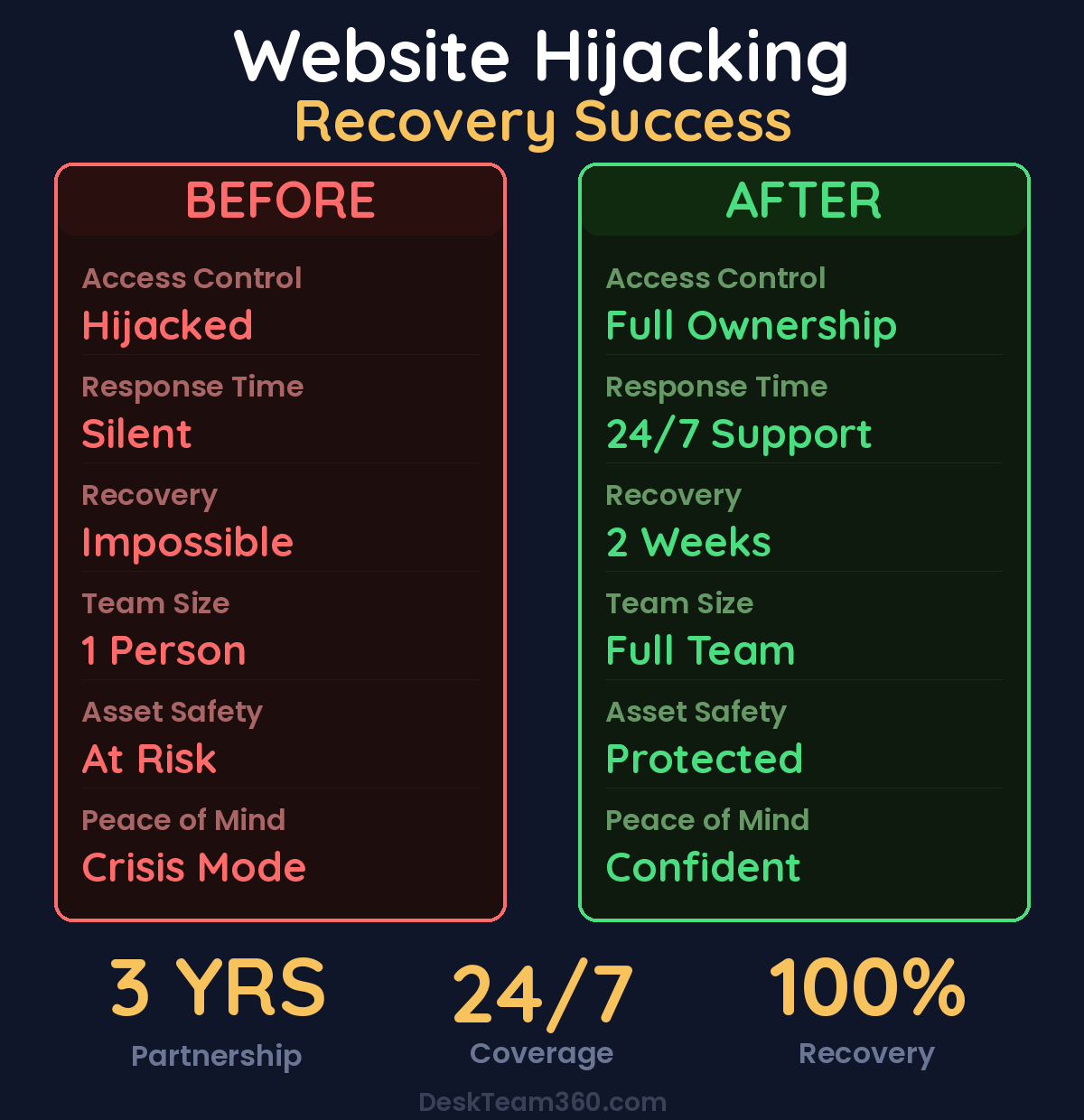
The DeskTeam360 Approach: Transparency and Ownership
Our entire business model prevents these scenarios by design. Here’s how we structure relationships to protect client ownership while delivering results.
You Own Everything, Always
Every account we set up is registered under your business name and contact information. Website hosting, domain registration, email accounts, social media, advertising platforms, analytics tools. If we’re managing it, you still own it legally and practically.
This isn’t just good practice, it’s risk management. You can fire us tomorrow and walk away with complete control of every system we’ve touched. Try doing that with a freelancer who’s registered everything under their personal accounts.
Documentation and Knowledge Transfer
We document everything we build and maintain those docs in real time. Not because we plan to leave, but because transparency builds trust and protects your business. You get access to our project management system where you can see exactly what we’re working on, what we’ve completed, and what’s coming next.
Compare that to the typical freelancer relationship where you get status updates in random email threads and pray they’ve documented their work somewhere accessible.
Pro tip: Before hiring any marketing help, ask specifically who will own hosting accounts, domain registration, and platform access. If they can’t give you a clear answer or push back on client ownership, that’s a red flag.
Team Redundancy vs Single Points of Failure
When Lemonade Legend’s marketer disappeared, everything stopped. With DeskTeam360, if one team member is unavailable, others pick up the work without missing a beat. We have account managers, developers, designers, and project specialists all familiar with your business.
As the founder put it: “Even though DeskTeam360 works on one task at a time, I can give them 10 tasks so once they finish one they can move on to the next thing. Another amazing thing about DeskTeam360 is they work 24/7 and that is so helpful. I can wake up the next morning, check my email and it will say task 5473 is done.”
That’s the difference between depending on one person’s availability and working with a structured team that operates around the clock.
Preventing Digital Asset Hijacking: Your Protection Checklist
Whether you work with us or someone else, here are the non-negotiables for protecting your business from website hijacking and digital asset loss.
Domain and Hosting Ownership
Your domain registration must be under your business name with your contact information as the administrative contact. Your hosting account should be registered under your business email, not your provider’s. Even if they manage it day-to-day, you should be able to log in and transfer to another provider without their permission.
Platform Access Documentation
Maintain a spreadsheet with every platform, the associated login credentials, and recovery methods. Google Analytics, social media accounts, email marketing platforms, CRM systems, everything. Update this quarterly and store it securely. When someone claims they “can’t transfer access,” you’ll know exactly what accounts need to be recovered.
Regular Access Audits
Every six months, actually log in to your critical business accounts. Make sure you can still access them and that your contact information is current. Test password resets and two-factor authentication. The time to discover access problems isn’t when you’re trying to fire someone.
Businesses that conduct quarterly access audits recover from provider changes 85% faster than those that don’t maintain documentation.
Backup and Export Procedures
Your data should be exportable at any time. Website backups, email lists, customer databases, analytics data, everything that matters to your business should have a clear export path that doesn’t require your provider’s cooperation. Test these exports periodically to make sure they actually work.
What Sets DeskTeam360 Apart: The Client Perspective
Let me share what Lemonade Legend’s founder told me about working with different providers over the years. She’s been through the freelancer nightmare and now has a stable team relationship. Here’s her perspective on the difference.
Reliability and Predictability
“I have worked with a lot of different people, with a lot of different price points. What I see with DeskTeam360 is definitely value, based on what they charge and what they produce and what you get.”
Value isn’t just about the hourly rate. It’s about getting consistent work quality, meeting deadlines, and having reliable communication. When you’re comparing costs, factor in the hidden expenses of unreliable providers: missed deadlines, redoing poor work, and crisis recovery situations.
The 24/7 Advantage
Our team operates across multiple time zones, which means work continues while you sleep. For Lemonade Legend, this was a game-changer after dealing with a single-person operation limited by one person’s schedule and availability.
More importantly, having multiple team members means your projects aren’t held up by someone’s vacation, sick days, or personal emergencies. Work flows continuously regardless of individual availability.
Crisis Management Experience
When you’re dealing with a digital asset recovery situation, experience matters enormously. We’ve handled dozens of hostile handoffs, unresponsive previous providers, and complex migration scenarios. We know which battles to fight and which obstacles to work around.
A freelancer encountering their first website hijacking situation will waste weeks trying approaches that don’t work. We’ve seen these patterns before and can cut straight to solutions that actually resolve the problem.
The Long-Term Partnership Difference
Lemonade Legend has been with us since August 2021. That’s over three years of consistent partnership, growing from crisis recovery to ongoing business growth. Here’s what that relationship evolution looks like and why it matters.
From Crisis to Growth
We started with damage control, recovering what could be recovered and rebuilding what couldn’t. But once the crisis was resolved, the relationship shifted to growth-focused activities. Website optimization, content development, marketing automation, strategic planning.
This is the trajectory you want: starting with tactical fixes but building toward strategic growth. It’s only possible when you have a team that understands your business deeply and has the capacity to scale their involvement as your needs evolve.
We cover this in more detail in see how deskteam360 has helped sidecar marketing solutions save thousands of dollars a month and free countless hours a week!.
Institutional Knowledge
After three years, our team knows Lemonade Legend’s business inside and out. We understand their audience, their messaging, their technical requirements, and their growth goals. That institutional knowledge makes every project faster and more effective.
Compare that to constantly onboarding new freelancers who need weeks to understand your business before they can contribute meaningfully. The efficiency gains from long-term relationships are substantial and often undervalued.
Relationship depth drives efficiency. A team that knows your business can execute projects in half the time it takes a new provider to understand your requirements and deliver results.
Warning Signs Your Current Provider Might Be a Risk
Based on patterns I’ve seen across hundreds of client situations, here are the red flags that should trigger immediate action to protect your digital assets.
Technical Red Flags
You can’t log in to your own hosting account. Domain registration is under their personal information. Email systems run through their accounts. You don’t have admin access to your own website. Analytics and social accounts are registered under their credentials.
Communication Red Flags
Response times are getting slower and less reliable. They’re vague about project status or timelines. Requests for access credentials are deflected or ignored. They seem overwhelmed or distracted in recent interactions.
Business Relationship Red Flags
Payment terms keep changing or becoming more demanding. They’re pushing back on reasonable requests for documentation or transparency. You feel like you’re walking on eggshells to avoid upsetting them. The relationship feels more like dependency than partnership.
Watch out: If three or more of these patterns are present, you’re at high risk for a situation like Lemonade Legend faced. Start documenting your assets and planning for provider transition before the crisis hits.
How We Structure Client Relationships to Prevent These Problems
Our client onboarding process is specifically designed to prevent the dependency traps that create hijacking situations. Here’s how we structure relationships for maximum transparency and client protection.
Asset Ownership Documentation
During onboarding, we create a comprehensive asset inventory. Every platform, every account, every system component gets documented with ownership details and access procedures. This document gets updated in real time as we add new systems or modify existing ones.
Shared Access Protocols
You get administrative access to everything we build or manage. We use shared dashboard systems where you can see our work progress, but you also maintain independent access to all your business-critical systems. Think of us as authorized users on your accounts, not account owners.
Regular Access Verification
Quarterly, we verify that you can still access all your critical business systems without our assistance. We test password resets, review recovery procedures, and confirm contact information is current. This isn’t because we expect to leave, it’s because business continuity planning is professional best practice.
Our approach to website security best practices includes these access audits as standard procedure.
The Real Cost of Digital Asset Dependency
Let me break down the true cost of putting all your digital assets under one person’s control, because the recovery expenses go far beyond what most business owners realize.
Immediate Crisis Costs
Website downtime costs revenue immediately. If your site generates $1,000 per day in business and you’re down for a week during recovery, that’s $7,000 in direct lost revenue. Emergency recovery services run $2,000-5,000 for complex migrations. Legal consultation for hostile provider situations adds another $1,500-3,000.
Long-Term Recovery Costs
SEO rankings drop during extended downtime, requiring 3-6 months to fully recover. Customer trust erodes when your business appears unprofessional or unreliable. Email deliverability suffers when you’re forced to change domains or providers hastily. Marketing campaigns get interrupted, wasting ad spend and losing momentum.
The average cost of website hijacking recovery is $15,000-25,000 in direct expenses plus lost revenue. Prevention through proper asset ownership costs exactly $0.
Opportunity Costs
During the 2-4 weeks of crisis recovery, you’re not growing your business. You’re not launching new products or optimizing existing systems. You’re in survival mode, fighting to get back to where you were before the crisis hit.
For Lemonade Legend, this meant months of recovery time instead of focusing on their core mission of helping people share their stories. The emotional and business momentum loss is harder to quantify but just as real as the direct financial costs.
Why Team-Based Providers Are the Future
The freelancer economy has matured, and smart business owners are recognizing the risks of single-person dependency. Here’s why team-based providers like DeskTeam360 are becoming the standard for serious businesses.
Redundancy and Reliability
Teams don’t get sick, take vacations, or have personal emergencies that halt all work. Individual team members do, but the work continues seamlessly. For ongoing business operations, this reliability difference is enormous.
As Lemonade Legend’s founder noted about our 24/7 operations: “I can wake up the next morning, check my email and it will say task 5473 is done.” That’s only possible with team coverage and multiple time zones.
Diverse Skill Sets
Complex business problems require diverse expertise. Website security, content development, technical troubleshooting, project management, strategic planning. One person can’t be genuinely expert at everything, but a team can cover all these areas with actual specialists.
For industry research and benchmarks, check out Clutch.co.
Quality Control and Review
Teams have internal review processes. Before work gets delivered to you, it’s been reviewed by other team members who catch errors, suggest improvements, and ensure quality standards. Freelancers are often their own QA department, which means errors get passed through to clients.
Pro tip: Ask potential providers about their internal review processes. If they can’t describe how work gets quality-checked before delivery, you’re looking at a single-person operation regardless of how they market themselves.
Making the Switch: From Risky to Reliable
If you’re currently in a situation similar to what Lemonade Legend faced, here’s the roadmap for transitioning to a more secure provider relationship without the drama and crisis.
Asset Audit and Documentation
Before making any moves, document everything you can access. Login credentials, hosting details, platform accounts, domain registration info. Create this inventory while relationships are still cordial and access is available.
Gradual Transition Strategy
Don’t announce you’re switching providers until you’ve secured your critical assets. Start with the most important systems first: domain registration, hosting accounts, and primary business email. Move these to accounts you control directly before addressing secondary platforms.
Professional Communication
When you’re ready to transition, be professional but firm. Thank them for their service and explain that you’re bringing services in-house or consolidating providers. Most professionals handle this gracefully when approached respectfully.
For the few who don’t, having documented ownership and independent access means their cooperation becomes helpful but not essential.
Our guide on website migration best practices covers the technical aspects of these transitions in detail.
The DeskTeam360 Difference: Partnership, Not Dependency
What makes our relationship with clients like Lemonade Legend work long-term is that we’ve designed it as true partnership rather than provider dependency. You’re not hiring us to own your systems, you’re hiring us to manage systems you own.
Transparent Operations
You have real-time access to our project management system where you can see exactly what we’re working on, how long tasks are taking, and what’s coming up next. No guesswork, no chasing status updates, no surprises.
Flexible Engagement
Our task-based system means you control the workload and priorities. Need us to focus on one big project? Submit one task and we’ll work on it continuously. Have multiple small items? Send us 10 tasks and we’ll work through them in priority order.
This flexibility prevented the bottlenecks that frustrated Lemonade Legend with their previous provider, where everything had to fit one person’s schedule and capacity constraints.
Business Growth Focus
Crisis recovery is important, but it’s not the goal. The goal is stable, reliable business growth. Once we’ve resolved any immediate problems and established solid operational foundations, the focus shifts to growth activities that actually move your business forward.
Lemonade Legend’s Success: From Crisis to Confidence
Three years later, Lemonade Legend’s founder has the confidence that comes from working with a reliable team. She knows her digital assets are secure, her projects will get completed consistently, and she won’t wake up to crisis situations created by provider problems.
“If you’re on the fence, I would say, I have worked with a lot of different people, with a lot of different price points. What I see with DeskTeam360 is definitely value, based on what they charge and what they produce and what you get.”
That’s the perspective that comes from experiencing both sides: the vulnerability of single-person dependency and the security of team-based partnership. She can focus on her passion of helping people share their stories because the business operations are handled reliably by a team she trusts.
Protect Your Business from Provider Hijacking
Website hijacking and digital asset control aren’t abstract risks, they’re predictable outcomes of poor provider relationship structures. The solution isn’t finding better freelancers, it’s working with teams that build transparency and client ownership into their operating procedures from day one.
At DeskTeam360, we’ve helped dozens of businesses recover from provider nightmares and transition to stable, growth-focused partnerships. More importantly, we’ve structured our services to prevent these crises from happening in the first place.
Your business deserves better than crossing your fingers and hoping your current provider doesn’t disappear with your website. You deserve partnership that puts your ownership and growth first, with the redundancy and reliability that only professional teams can provide.
Ready to move from risky to reliable? Let’s talk about building a provider relationship that protects your business while driving real growth.