

How to Outsource Podcast Production: The Complete Guide
Why Most Podcast Outsourcing Fails Before It Starts
When you outsource podcast production, you’re making a strategic move. It’s Tuesday at 2pm and you’re staring at 47 minutes of raw podcast audio that needs editing by Friday. Your guest rambled for 15 minutes about their cat. There’s a lawnmower in the background from minutes 12-18. And somewhere in the middle, you forgot you were recording and started ordering lunch.
📋 Table of Contents
Sound familiar? I’ve been there. Everyone has.
But here’s what really kills me: entrepreneurs spending 8-12 hours every week editing their own podcasts. That’s not content creation, that’s digital manual labor. And it’s completely preventable with the right outsourcing setup.
I’ve helped 400+ clients build outsourced production systems for everything from weekly interview shows to daily business podcasts. The ones that work share five specific characteristics. The ones that fail skip at least three of them. Here’s exactly how to build a system that actually works, no trial and error, just the blueprint.
The Four-Layer Podcast Production System
Professional podcast production isn’t one job, it’s four distinct roles working in sequence. Most people try to hire “a podcast editor” and wonder why their show sounds amateur. It’s because they’re missing three critical layers.
Each layer requires different skills and different rates. A $15/hour audio editor from the Philippines can’t write compelling show descriptions any more than a $45/hour copywriter can master noise reduction. Match the skill to the task.
Layer 1: Pre-Production and Research
This happens before you hit record. Guest research, question development, show notes outline, technical setup verification, and calendar coordination. A good pre-production specialist eliminates 90% of the awkward dead air and “uh, what should we talk about next” moments that plague amateur podcasts.
Here’s what this role actually handles: researching guests (background, recent achievements, speaking topics), preparing 8-12 smart questions that avoid surface-level answers, creating show notes templates with key talking points, coordinating recording schedules across time zones, and technical pre-checks to catch audio issues before recording starts.
Layer 2: Audio Production and Editing
This is where most people start, and it’s a mistake. Raw audio cleanup, intro/outro integration, music and sound design, noise reduction, and level balancing. But without proper pre-production, even the best editor is just polishing garbage.
A skilled audio editor removes filler words and long pauses, balances audio levels between host and guest, adds intro/outro music and transitions, cleans background noise and echo, and creates chapter markers for easy navigation. The difference between amateur and professional editing is immediately obvious to listeners. It’s worth paying for quality here.
Layer 3: Content and Show Notes Creation
This is the most undervalued piece of the puzzle. Episode titles, compelling descriptions, timestamp chapters, key quotes and takeaways, social media snippets, and blog post adaptation. This layer turns your audio content into a full content marketing system.
Pro tip: The show notes writer should listen to the final edited episode, not the raw recording. They need to hear what your audience will actually hear, including all the music cues and chapter breaks. This typically adds 2-3 hours per episode but creates dramatically better content.
Layer 4: Distribution and Promotion
Upload to podcast platforms, social media content creation, email newsletter integration, website updates, and cross-platform promotion. This role turns your podcast into a lead generation machine instead of just audio content that disappears into the void.
Most businesses treat distribution as an afterthought. That’s backwards. Your distribution specialist should be thinking about marketing angles during the editing process, creating audiogram clips for social media, writing email newsletters that drive podcast downloads, updating website content with new episodes, and tracking which episodes drive the most leads and sales.
Free Tool
How Much Is Freelancer Management Really Costing You?
Most agency owners have never done this math. Plug in a few numbers and see your real cost in 2 minutes.
Calculate Your Hidden Costs →
The Real Cost Breakdown
Let’s talk numbers, because this is where the business case gets interesting.
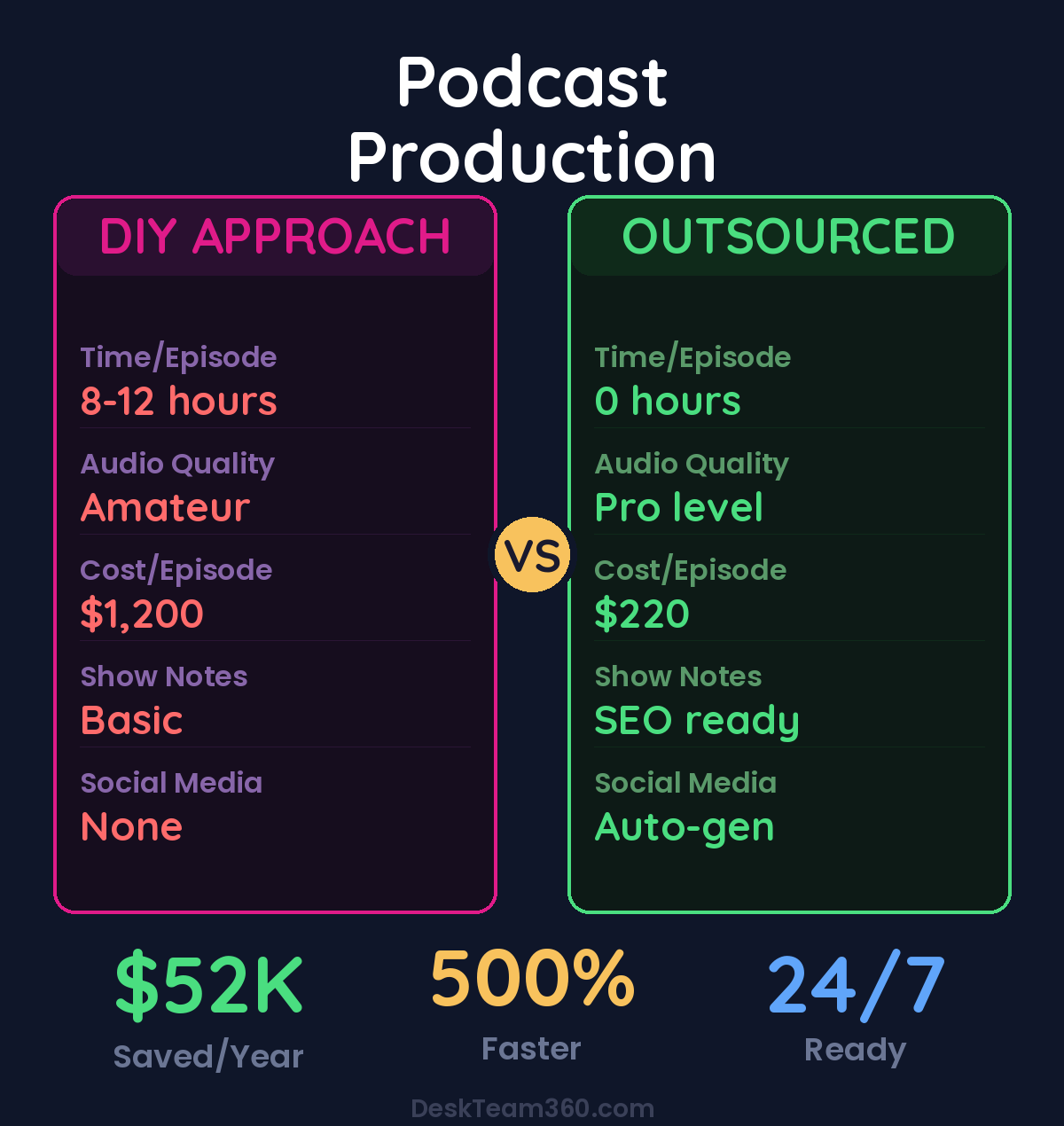
Doing it yourself: 8-12 hours per episode at your billing rate. If you charge $150/hour, that’s $1,200-1,800 per episode in opportunity cost. For a weekly show, you’re looking at $62,400-93,600 annually in lost revenue potential.
Full outsourcing breakdown: Pre-production research at $20/hour for 2 hours ($40), audio editing at $25/hour for 3-4 hours ($75-100), content creation at $30/hour for 2 hours ($60), and distribution at $20/hour for 1 hour ($20). Total per episode: $195-220, or about $10,000-11,000 annually for weekly content.
You save $52,000+ per year while getting professionally produced content that actually sounds broadcast-quality.
And that’s just the direct cost savings. Factor in improved listener retention from better production quality, increased lead generation from professional show notes and promotion, and the ability to focus your time on revenue-generating activities, and the ROI becomes overwhelming.
How to Build Your Production Team
Skip the “podcast production agencies” that charge $500-800 per episode. You can build a better team for half the cost by hiring specialists directly.
Finding Your Audio Editor
This is your most critical hire. Look for editors who specialize in interview-style content if that’s your format, or narrative storytelling if you do solo episodes. Ask for sample work that matches your style. Pay attention to their turnaround time commitments.
The best places to find audio editors: Upwork (filter for “podcast editing” specifically), specialized job boards like PodcastingJobs.com, recommendations from other podcasters in your industry, and freelance communities like Motion Array. Don’t hire based on the lowest price. A $15/hour editor who delivers amateur quality costs more than a $35/hour professional who nails it the first time.
Watch out: Editors who promise 24-hour turnaround are usually cutting corners. Professional editing takes time. Budget 72-96 hours for quality work, especially for longer episodes. Rush jobs sound like rush jobs.
Your Content Creation Specialist
This person turns your conversations into marketing assets. They’re part copywriter, part SEO specialist, part social media strategist. Look for writers who understand your industry and can identify compelling angles from raw conversations.
The content specialist should create compelling episode titles that include relevant keywords, write show notes that work as standalone blog content, pull quotable moments for social media, develop email newsletter content around each episode, and identify topics for follow-up episodes based on audience response.
The Distribution Coordinator
Don’t underestimate this role. Good distribution can double your podcast’s reach without changing anything about your content. This person handles the technical uploads, but more importantly, they develop and execute your promotion strategy.
Look for someone who understands podcast SEO, social media marketing, and email automation. They should be comfortable with tools like Later or Buffer for social scheduling, Mailchimp or ConvertKit for email marketing, and basic WordPress administration for website updates. This role typically pays $18-25/hour and saves you 3-4 hours per episode.
Standard Operating Procedures That Actually Work
The difference between a smooth operation and constant firefighting is documentation. Here are the five SOPs that prevent 90% of production problems.
For a deeper dive, see our guide on ai marketing tools: the complete guide for 2026.
The Recording Checklist
Before every recording session: test audio levels 10 minutes before guest arrival, confirm recording software is working and set to correct quality, have backup recording method ready (phone app, Zoom cloud), review guest research and prepared questions, and check internet connection stability. This takes 5 minutes but prevents hours of headaches later.
The Handoff Protocol
Within 24 hours of recording: upload raw audio to shared folder with episode number and date, send recording notes to editor (technical issues, sections to cut, special instructions), provide guest information and any specific requests, and confirm deadline for edited version. If you want help with creating systematic processes like this, our guide on creating effective SOPs walks through the complete framework.
The Quality Control Process
Before any episode goes live: host reviews final edit for accuracy and tone, content specialist verifies show notes match actual episode content, all links and references are working correctly, and distribution coordinator confirms upload schedules across all platforms. Catching problems before publication prevents embarrassing corrections later.
The Revision Guidelines
Set clear expectations upfront. One round of revisions is included in the base rate, major changes (adding/removing segments, changing music) require additional time and cost, feedback must be specific with timestamps, and emergency changes less than 24 hours before publication incur rush fees. The goal isn’t to be difficult, it’s to prevent scope creep that kills your budget.
The Communication Schedule
Weekly check-ins with your editor to review upcoming episodes and any special requirements, monthly reviews with your full team to identify process improvements, and quarterly strategy sessions to evaluate what’s working and what isn’t. Regular communication prevents small issues from becoming big problems.
The Technology Stack That Powers Everything
Your team needs the right tools to deliver consistent quality. Here’s the exact tech stack I recommend based on what actually works across dozens of implementations.
File sharing: Dropbox Business at $15/month is worth every penny for reliable file sharing with version control. Google Drive is cheaper but unreliable for large audio files. Project management: Asana for task tracking and deadline management. Communication: Slack for daily coordination, email for formal handoffs. Audio storage: Dedicated cloud storage separate from your main business files.
For your audio editor: Hindenburg Pro for professional-grade editing, iZotope RX for advanced noise reduction, and Auphonic for automated audio enhancement. Don’t cheap out on editing software. The $400 investment in quality tools pays for itself in time savings within the first month.
Your content specialist needs: Rev.com for accurate transcription services, Canva Pro for creating visual assets, and Hootsuite or Later for social media scheduling. Invest in good transcription, it’s the foundation of everything else they create.
Five Mistakes That Kill Podcast Outsourcing
I’ve watched these same mistakes happen repeatedly. Here’s how to avoid each one.
Hiring generalists instead of specialists. “I can do everything” usually means “I can’t do anything really well.” Hire specialists for each layer of production. It costs the same and delivers dramatically better results.
No clear style guide or brand guidelines. Your team needs to know your show’s personality, target audience, and content guidelines. “Make it sound good” isn’t direction, it’s wishful thinking. Create a one-page style guide with examples of what you like and what you hate.
Micromanaging the process instead of managing the outcomes. Tell your team what you want the final product to look like and when you need it. Don’t tell them which software to use or exactly how to achieve it. You hired them for their expertise.
For industry research and benchmarks, check out Clutch.co.
No backup plans. Your editor gets sick. Your content specialist goes on vacation. Your distribution coordinator’s internet goes down. Have backup freelancers identified and ready to jump in, even if you only use them once a year.
Treating podcast production like a cost center instead of a marketing investment. Track how many leads each episode generates. Monitor listener engagement metrics. Measure which topics drive the most downloads and social shares. This data should inform both your content strategy and your production budget.
Scaling From Solo Show to Podcast Network
Once your first show is running smoothly, the system scales beautifully. Your second podcast uses the same team, same processes, same technology. The marginal cost per episode drops significantly because your fixed costs are spread across more content.
Here’s what scaling actually looks like: months 1-3 focus on dialing in your core show with consistent quality and reliable delivery, months 4-6 add systematic promotion and lead generation tracking, months 7-9 consider launching a second show using your proven team and processes, and months 10-12 evaluate whether to expand into video content using the same production principles.
The companies that scale podcast production successfully treat it like any other business system. They document what works, automate what’s repetitive, and continuously optimize based on actual performance data. Understanding how to measure marketing ROI becomes crucial as your podcast network grows.
Businesses with systematized podcast production see 312% higher lead generation from audio content compared to those handling everything in-house.
Turn Your Podcast Into a Lead Generation Machine
Most business podcasts fail because they treat episodes like isolated content pieces instead of components in a larger marketing system. Your production team should be creating assets that drive business results, not just audio files.
Each episode should generate: a detailed blog post with SEO optimization, social media content for the next 2-3 weeks, email newsletter content with calls-to-action, quotable moments formatted for LinkedIn articles, and follow-up content ideas based on audience questions and feedback.
The goal isn’t just to publish content, it’s to create a systematic approach that turns podcast listeners into qualified leads. When done right, your podcast becomes your most cost-effective marketing channel. And with the right production team, it runs without your daily involvement.
Build Your Production System Today
Podcast outsourcing isn’t about finding cheaper labor, it’s about building a systematic approach to content creation that scales with your business. Every week you spend editing your own podcast is a week you’re not growing your company.
The framework I’ve outlined here works for solo entrepreneurs recording weekly interviews and enterprise companies running multiple shows across different business units. The principles are the same: specialized roles, documented processes, quality control, and systematic promotion.
At DeskTeam360, we help businesses implement production systems like this across all their content creation, from blog writing to video editing to podcast production. We handle the hiring, training, and management so you can focus on creating great content instead of managing the production process.
See how we can systematize your content production →
Free 5-Minute Video
See How DeskTeam360 Works in Under 5 Minutes
Watch the short video and see exactly how we handle design, development, and marketing implementation — so you don't have to.
Watch the Video →